Falls are the leading cause of injury-related death among adults over 65 in the United States, and most people assume the main culprits are weak legs or slippery floors. What often gets overlooked is the role your eyes play. Vision is one of the most critical inputs your brain uses to keep you upright, and when it starts to decline, your balance system takes a serious hit, whether you realize it or not.
This article breaks down exactly how your eyesight affects your stability, why certain vision changes are especially dangerous for fall risk, and what practical steps you can take right now to protect yourself or someone you care about.
How Your Brain Uses Vision to Keep You Balanced
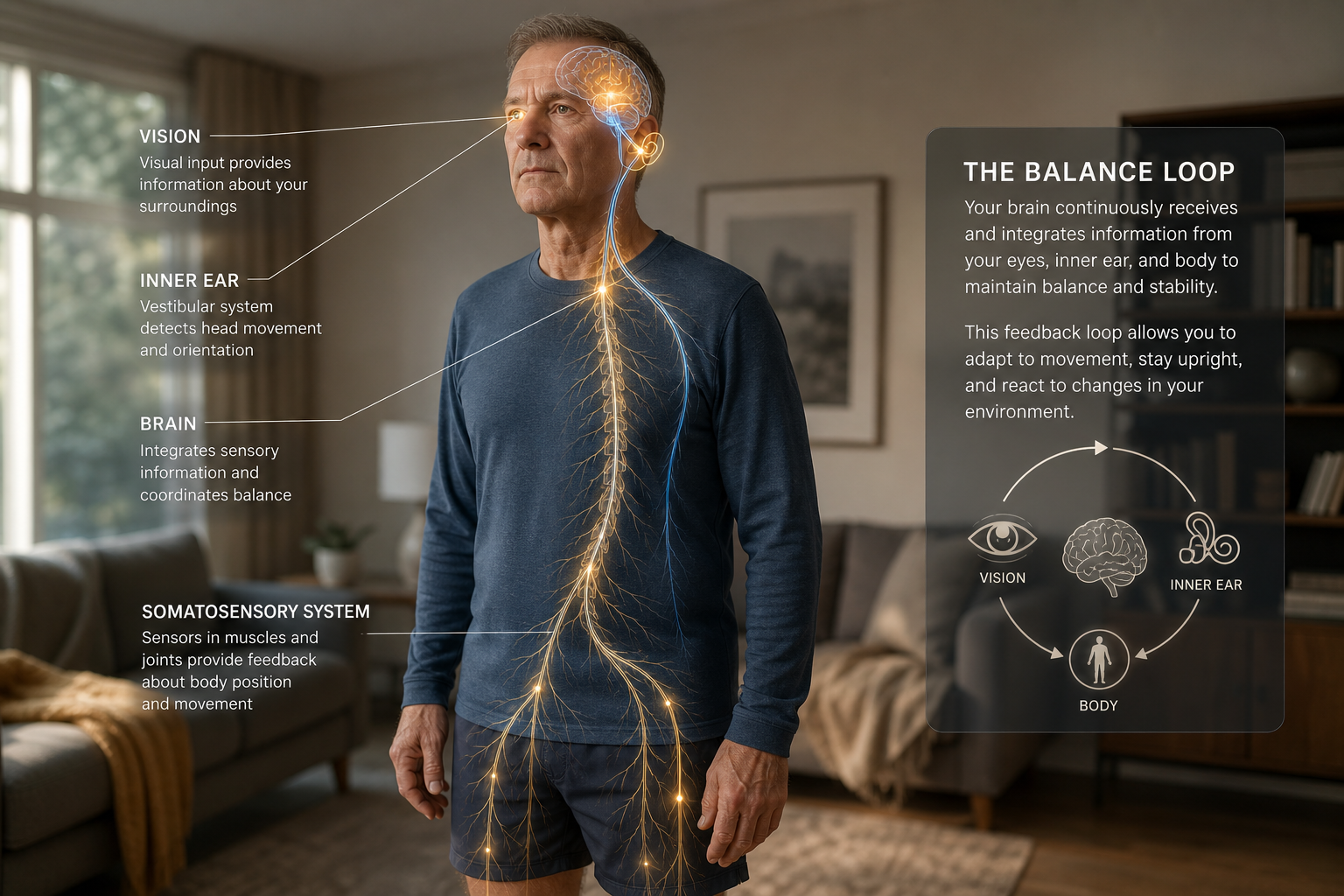
Your balance depends on three systems working together: your inner ear (vestibular system), your sense of body position (proprioception), and your vision. When all three are working well, they cross-check each other constantly. When one starts to fail, the others compensate. But as you age, multiple systems often decline at the same time, and vision problems can be the tipping point that breaks the whole system down.
Your eyes send your brain a continuous stream of information about where you are in space, where the floor is, how far away obstacles are, and whether you’re moving or standing still. Your brain processes all of this in milliseconds to make tiny postural adjustments. When the visual signal is blurry, distorted, or delayed, those adjustments become slower and less accurate.
Studies have consistently shown that older adults with visual impairment are twice as likely to fall as those with normal vision. That’s not a small margin. It’s a significant and preventable risk factor.
The Vision Changes That Matter Most for Fall Risk
Not all vision decline is equal when it comes to balance. Some changes are more directly tied to falls than others, and knowing which ones to watch for helps you take action before a fall happens.
Reduced Contrast Sensitivity
Visual acuity, meaning how sharp your vision is on an eye chart, is what most people think about. But contrast sensitivity is often a bigger problem for falls. This is your ability to distinguish between similar shades, like a light-colored step against a light-colored floor, or a curb against pale pavement. Age naturally reduces contrast sensitivity, and it can decline even when your distance vision seems fine.
Poor contrast sensitivity makes it harder to see edges, changes in surface height, and obstacles in low-contrast environments. This is why many older adults trip on stairs that look perfectly flat to them.
Depth Perception Decline
Depth perception relies heavily on both eyes working together. As people age, conditions like cataracts, macular degeneration, or even just different prescriptions in each eye can disrupt this. When your depth perception is off, you misjudge how far away a step is, how high a threshold is, or whether that shadow on the floor is a change in surface height or just a shadow.
Depth perception problems are particularly dangerous on stairs, uneven outdoor terrain, and in parking lots where lighting and surface contrast can be inconsistent.
Slower Dark Adaptation
Moving from a bright area to a darker one, like stepping from a sunny porch into a dim hallway, requires your eyes to adapt. This process takes longer as you age. For a 70-year-old, it can take minutes to fully adjust, compared to seconds for a younger person. That transition window is a high-risk moment for a fall.
Narrowed Visual Field
Conditions like glaucoma gradually reduce peripheral vision, often without the person noticing until significant damage has occurred. Your peripheral vision is crucial for detecting movement and obstacles at the edge of your path. Without it, you’re essentially navigating with blinders on.
The Specific Danger of Bifocals and Progressive Lenses
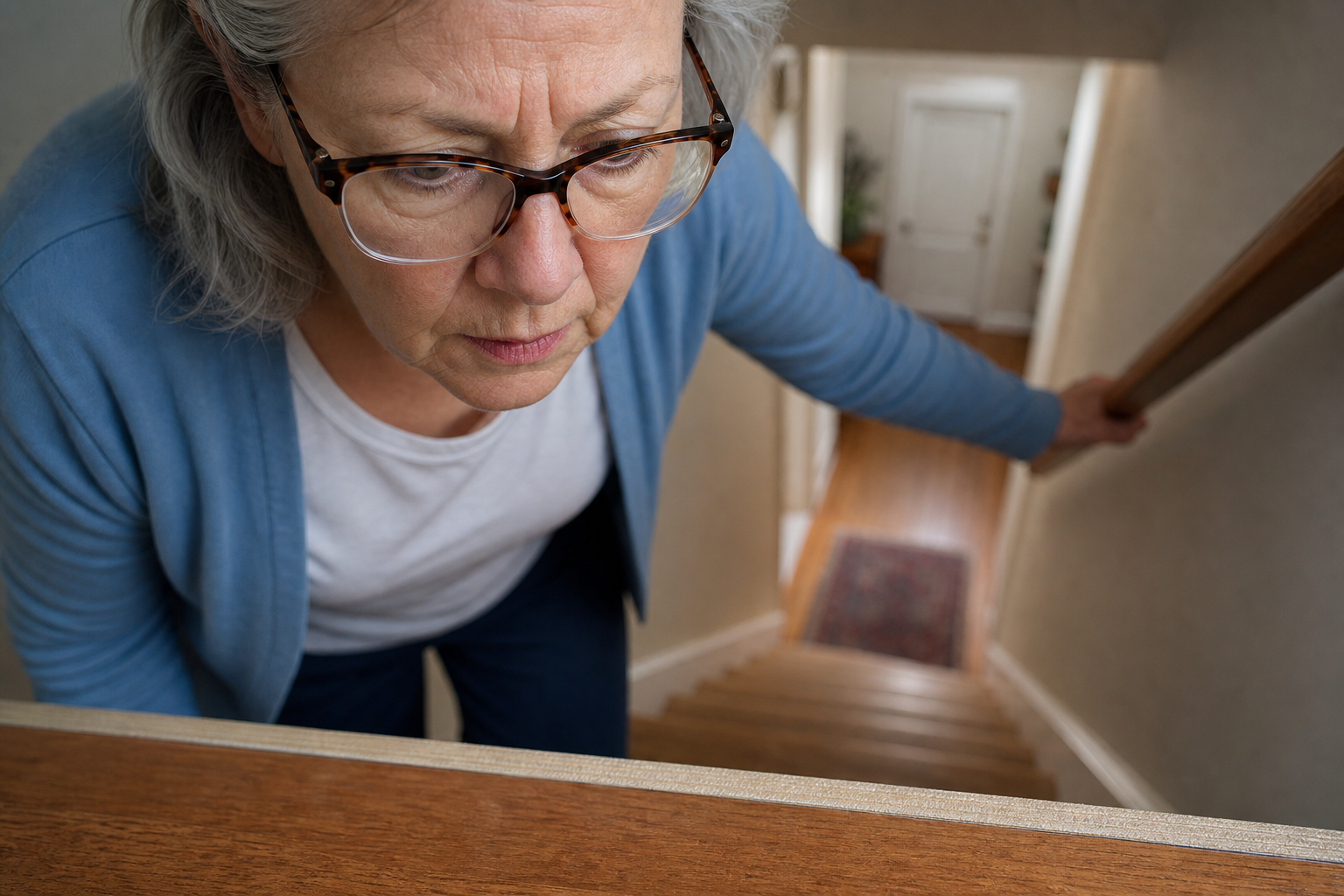
Here’s something that surprises a lot of people: wearing the wrong glasses for the task at hand can actually increase your fall risk. Bifocals and progressive lenses are designed for versatility, but they come with real trade-offs for balance and navigation.
The bottom portion of progressive lenses is optimized for near vision, like reading. When you look down at the ground while walking, you’re looking through that near-vision zone, which blurs your view of the floor and distorts depth perception. Research published in the British Medical Journal found that older adults who wore multifocal glasses had significantly higher fall rates outdoors compared to those wearing single-vision distance glasses for walking.
This doesn’t mean you need to stop wearing progressives. It means you should consider having a separate pair of single-vision distance glasses specifically for walking, exercise, and any activity where you need clear ground-level vision. Many optometrists don’t bring this up unless you ask.
If you’re working on balance training or exercises to support your stability, pairing proper eyewear with a structured program makes a real difference. Exercises designed for vestibular issues and coordination, like those covered in our guide to vertigo and balance exercises for seniors, become more effective when your visual system is giving your brain accurate information.
Lighting: The Cheapest and Most Overlooked Fix
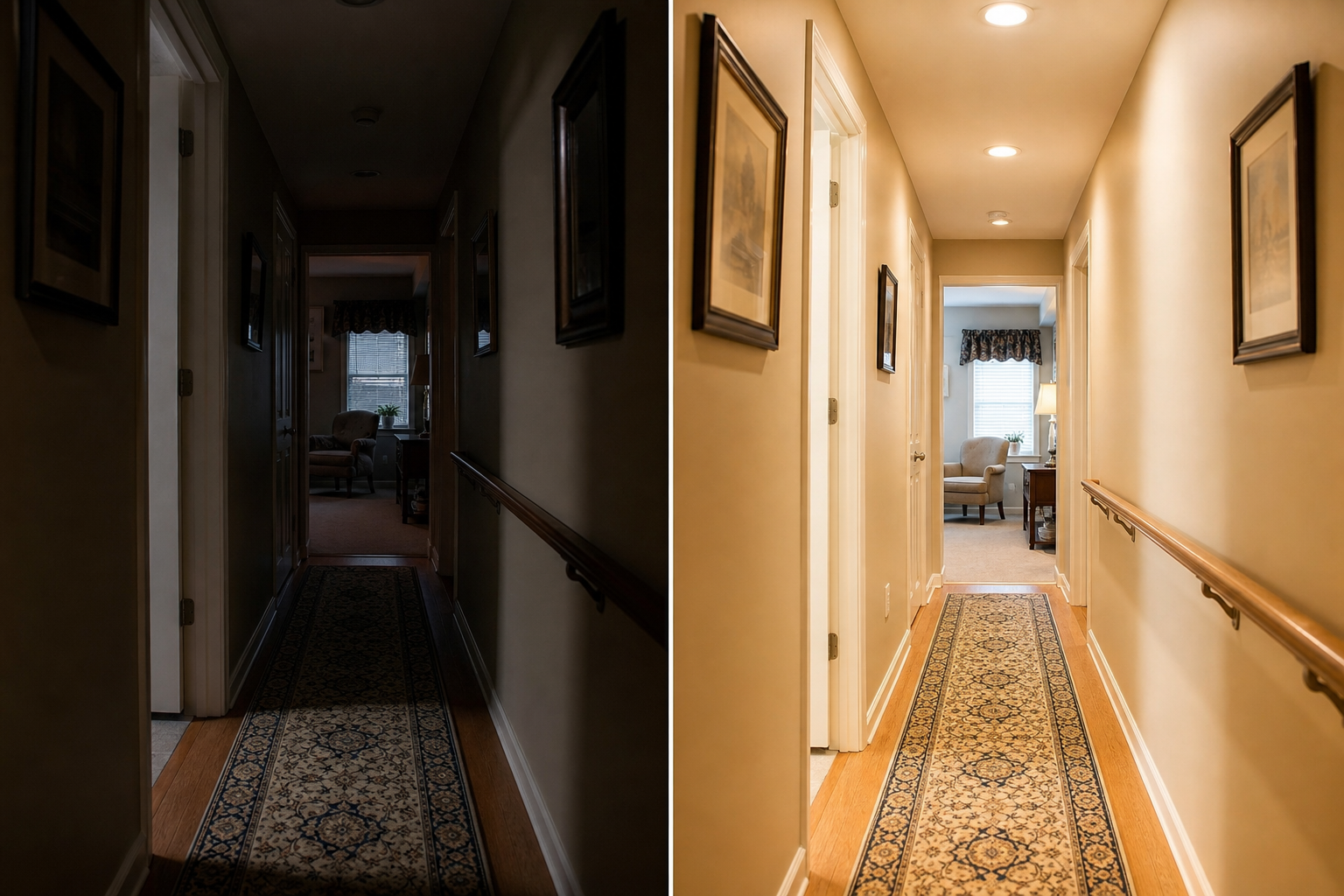
Improving the lighting in your home is one of the most cost-effective things you can do to reduce fall risk, and it’s often the last thing people think about. Most homes simply aren’t lit well enough for aging eyes.
Key Areas to Address
- Stairways: Install lighting at both the top and bottom of every staircase. Use contrasting tape or paint on step edges if the color contrast is low.
- Hallways and bathrooms: Plug-in LED night lights with motion sensors work well here. The GE Enbrighten LED Night Light with dusk-to-dawn sensing is a practical, widely available option.
- Transition zones: Any area where you move from bright to dim, like from a sunny room into a hallway, needs extra attention. A small lamp or motion-activated light in that zone helps your eyes adjust faster.
- Bedside: A motion-activated bedside light reduces the risk of falling during nighttime trips to the bathroom, one of the most common times falls happen.
The Right Kind of Light
Color temperature matters. Bulbs in the 3000K to 4000K range (warm white to neutral white) tend to be better for visibility without creating harsh glare. Very cool or very warm light can actually reduce contrast perception. Avoid bare bulbs that create glare directly in your visual field, since glare is especially problematic for older eyes with cataracts or other lens changes.
Aim for light levels of at least 50 to 100 foot-candles in task areas like kitchens and bathrooms. That’s significantly brighter than most older homes are set up for.
When to Get Your Eyes Checked (and What to Ask)
Adults over 60 should have a comprehensive eye exam at least once a year, not just a vision screening at a pharmacy kiosk. There’s a significant difference. A comprehensive exam checks for glaucoma, macular degeneration, cataracts, diabetic retinopathy, and changes in your prescription that may not be obvious to you day to day.
Many older adults are walking around with an outdated glasses prescription simply because they’ve adapted to the gradual change. Your brain is good at compensating, but that compensation taxes other parts of your balance system and makes you more vulnerable to falls in challenging environments.
At your next exam, specifically ask your optometrist or ophthalmologist about:
- Your contrast sensitivity, not just your acuity
- Whether your current lenses are appropriate for walking and outdoor activity
- Whether cataract surgery might be beneficial (studies show it significantly reduces fall rates)
- Whether your peripheral vision has changed
Don’t wait until you notice a problem. Many of the changes that increase fall risk are ones you won’t detect yourself until you’ve had a fall.
Nutrition and Vision Health
Your eyes depend on specific nutrients to maintain function as you age, and most older adults don’t get enough of them from diet alone. Lutein and zeaxanthin are carotenoids that concentrate in the macula and help protect against age-related macular degeneration. Foods rich in these include leafy greens like kale and spinach, eggs, and corn.
Vitamin D is another factor that doesn’t get enough attention in discussions about vision. Beyond its well-known role in bone and muscle function (covered in detail in our article on Vitamin D for senior bone and muscle health), research suggests adequate Vitamin D levels may help protect against cataracts and support retinal function.
Omega-3 fatty acids, particularly DHA, are highly concentrated in the retina and are essential for maintaining the structural integrity of photoreceptor cells. If you’re interested in how omega-3s support overall health in seniors, our article on omega-3 supplements for senior joint health is a solid starting point, and the benefits extend well beyond joints.
An anti-inflammatory diet more broadly can also support eye health by reducing oxidative stress in retinal tissue. The principles covered in our anti-inflammatory diet for active seniors apply here too.
Exercise Strategies That Support Vision-Related Balance
Strengthening your legs and core gives your body more options to recover from a stumble before it becomes a fall. Even if your vision isn’t perfect, better physical conditioning gives you a wider margin for error.
Balance training specifically teaches your nervous system to work with imperfect sensory input. Tai chi, single-leg standing exercises, and tandem walking are all well-supported by research. The key is to challenge your balance in a controlled, safe environment so that your body gets better at managing uncertainty.
If you’re dealing with a condition that already affects your nervous system or coordination, you’ll want to pair vision-related fall prevention with appropriate exercise modifications. For example, people managing peripheral neuropathy have reduced foot sensation, which compounds the effect of poor vision on balance. The guide to neuropathy-safe exercises for seniors addresses how to train effectively when you’re dealing with reduced sensory input from multiple sources.
Posture also plays an often-overlooked role. Forward head posture and slouching change the angle at which your eyes scan the environment ahead of you, making it harder to process visual information accurately while walking. Working on posture correction exercises isn’t just about comfort, it directly affects how well your visual system supports your balance.
Frequently Asked Questions
Can cataracts really increase my risk of falling?
Yes, significantly. Cataracts reduce visual acuity, contrast sensitivity, and depth perception all at once. Multiple studies have shown that cataract surgery reduces fall rates in older adults, often dramatically. If your doctor has mentioned that your cataracts are progressing, it’s worth having a direct conversation about the fall prevention benefits of surgery, not just the vision clarity benefits.
Are there glasses specifically designed to reduce fall risk?
There aren’t glasses marketed specifically as “fall prevention glasses,” but the general recommendation from vision researchers is to use single-vision distance glasses for walking rather than multifocal lenses. Some optometrists also fit patients with anti-glare coatings and high-contrast lenses that are particularly useful in low-light conditions. Ask specifically about these options at your next exam.
How much does lighting actually matter compared to other fall prevention strategies?
Lighting is consistently ranked among the most effective and cost-efficient home modifications for fall prevention. One study found that home hazard modifications, including improved lighting, reduced fall rates by around 19 percent overall, and by 36 percent in high-risk individuals. It’s not a replacement for exercise and vision care, but it’s a change you can make this week with immediate effect.
My vision seems fine to me. Do I still need an annual eye exam?
Absolutely. Many of the vision changes most associated with fall risk, including reduced contrast sensitivity, early glaucoma, and subtle shifts in depth perception, are changes you won’t notice in daily life until they’ve progressed considerably. An annual comprehensive exam catches these early. Your visual system adapts gradually, so your perception of “fine” may not reflect what’s actually happening in your eyes.
Putting It All Together
Vision and balance are more tightly connected than most people realize, and the good news is that most vision-related fall risks are addressable with practical steps that don’t require major lifestyle changes.
Start with an up-to-date comprehensive eye exam and an honest conversation with your optometrist about fall risk. Take a walk through your home and assess the lighting in stairways, hallways, and transition areas. Consider whether your current glasses are actually appropriate for your daily activities. And pair all of this with consistent balance and strength training to give your body more resilience when your visual system isn’t giving it perfect information.
Falls aren’t an inevitable part of aging. They’re often the result of several small, manageable risk factors stacking up over time. Addressing your vision is one of the most impactful things you can cross off that list.