Hearing loss affects roughly one-third of adults aged 65-74 and nearly half of those over 75. In exercise settings, hearing loss creates barriers that go beyond missing instructions. You can’t hear the group fitness instructor’s cues, the warning beep of a treadmill, the approaching cyclist on a shared path, or the timer signaling a set change. These communication gaps lead many hearing-impaired seniors to avoid group exercise, outdoor walking, and gym environments entirely, defaulting to isolated home workouts or skipping exercise altogether. With the right strategies, every exercise environment becomes accessible.
Challenges of Exercising with Hearing Loss
Group Fitness Classes
Instructors often face away from the class while demonstrating. Background music competes with verbal cues. Acoustics in large gym rooms create echoes that muddle speech. Other participants’ conversations add noise.
For someone with hearing loss, the result is a confusing experience where you’re always half a beat behind, guessing what to do next.
The music volume in typical fitness classes ranges from 80 to 90 decibels. That’s loud enough to mask speech entirely for someone with moderate hearing loss. Many instructors call out transitions (“now switch to left leg”) without making eye contact or facing the group.
You miss the cue and find yourself doing the wrong exercise while everyone else has moved on. The embarrassment compounds. After a few classes where you feel lost and out of sync, it’s easier to just stay home.
Lighting also matters. Dimmed studio lighting (common in cycling and dance classes) makes lip reading impossible. You can’t see the instructor’s mouth or facial expressions clearly enough to compensate for what you can’t hear.
Outdoor Exercise
Wind noise overwhelms hearing aids. Traffic sounds (car horns, engine noise, sirens) may be inaudible. Approaching cyclists, runners, and skateboarders from behind aren’t heard. Dogs off-leash may bark warnings you can’t detect.
The safety implications are significant.
Crosswalks with audio signals often use tones in the 2,000 to 4,000 Hz range, exactly where age-related hearing loss hits hardest. You might not hear the walk signal at all. Many people with hearing loss report feeling isolated during outdoor walks because they can’t participate in conversation with walking partners.
The wind noise through hearing aids creates a roaring sound that drowns out speech entirely above a light breeze.
Nature walks present their own challenges. You can’t hear rustling that warns of wildlife. Hikers approaching from behind startle you when they suddenly appear. The peaceful, social aspects of outdoor exercise become stressful guessing games about what’s happening around you.
Gym Environment
Machine beeps, timer signals, and equipment warnings are often high-pitched (the frequency range most affected by age-related hearing loss). Other gym members trying to get your attention (“excuse me” or “are you using this?”) may go unheard, creating awkward social situations that discourage gym attendance.
Trainers giving form corrections from across the weight room might as well be miming. You don’t realize they’re talking to you until they’re standing directly in front of you, and by then you’ve done several reps incorrectly.
The social protocol around sharing equipment and asking to work in becomes fraught. You accidentally ignore people, appear rude, and feel self-conscious about the whole interaction.
Gyms also tend to have hard surfaces (tile, concrete, rubber flooring) and high ceilings that bounce sound around unpredictably. Even with hearing aids, speech becomes garbled. You hear that someone’s talking, but the words themselves are unintelligible.
Communication Strategies for Exercise Settings
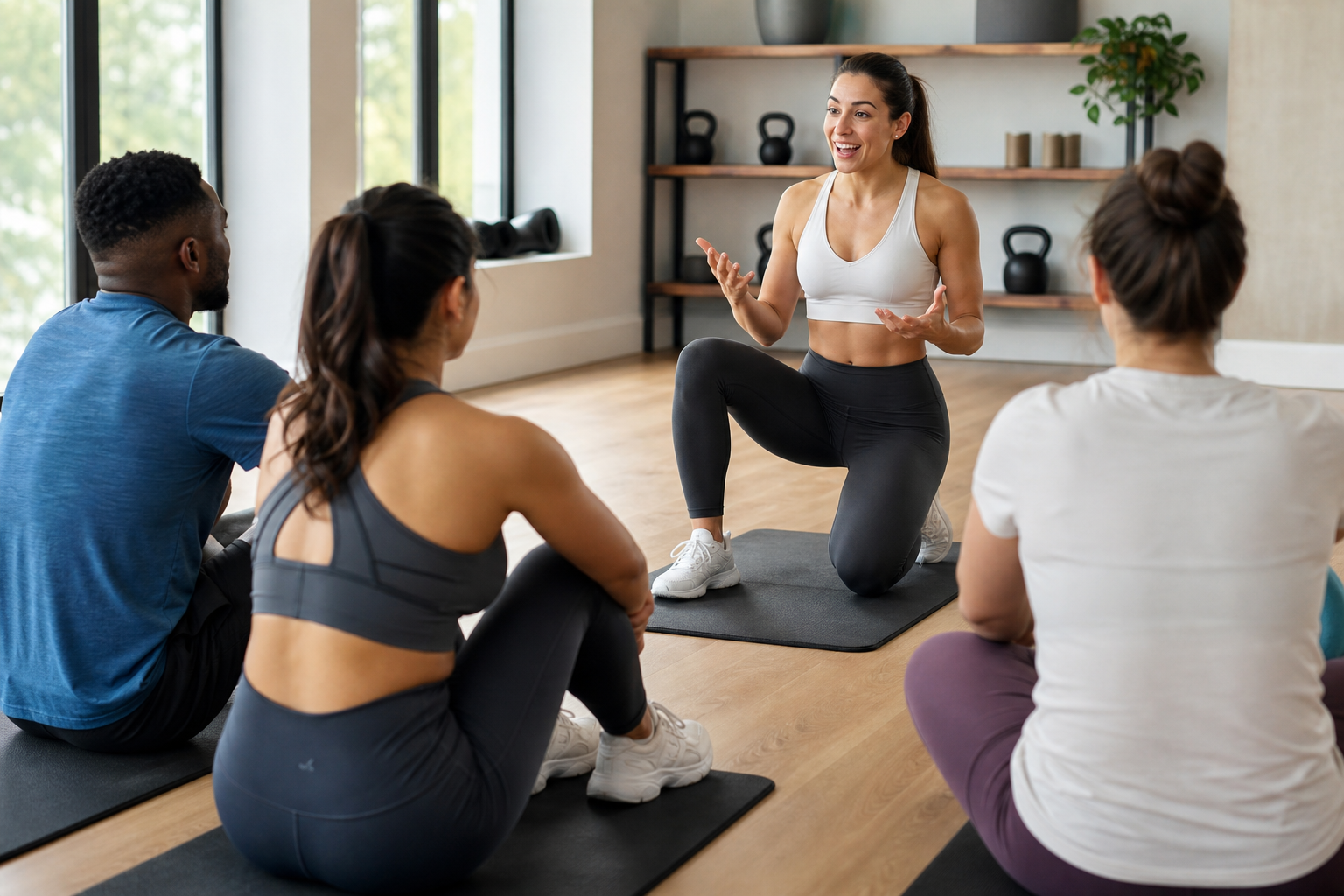
In Group Classes
Position yourself in the front row, facing the instructor directly. Proximity improves both hearing and the ability to read lips and body language. The front row also gives you the clearest view of demonstrations without other participants blocking your sightline.
Aim for center-front if possible. Corner positions mean the instructor is less likely to make direct eye contact with you.
Tell the instructor about your hearing loss before class starts. Most instructors will naturally face the class more, use larger demonstrations, and check in with you visually. This simple disclosure transforms the experience.
You’re not asking for special treatment. You’re giving the instructor information that helps them do their job better. Many instructors appreciate knowing because they want everyone to follow along successfully.
Be specific about what helps. Say “I read lips, so it helps when you face the class while talking” or “I won’t hear you call my name for corrections, so please tap my shoulder if you need to get my attention.” Clear requests get clear accommodations.
Ask for a written outline of the workout before class begins. Even a brief list of exercises in order lets you follow along without catching every verbal cue. Some instructors write the workout on a whiteboard. Others can text you a quick list.
Once you know the sequence (warm-up, squats, lunges, core work, cooldown), you can watch for visual transitions rather than waiting for verbal ones.
Watch other participants. If you miss a cue, glance at the person next to you (preferably someone who looks experienced) and mirror their movements. Position yourself near someone who seems to know the routine. Their body language provides constant backup information when your ears miss something.
Choose classes with visual structure: Yoga and tai chi follow predictable sequences. Cycling classes have rhythm cues you can feel. Dance classes with repeated choreography become easier to follow after the first round.
Avoid classes that rely heavily on rapid-fire verbal cues with constant new combinations (like some boot camp and HIIT formats).
Strength training classes where everyone works at their own station with minimal transitions work well. Once you know the exercise and rep count, you don’t need to hear anything else. The instructor walks around giving individual feedback, and you can see when others are finishing to know when to move to the next exercise.
Buddy up with another class regular. Having a workout partner who knows your hearing loss means someone can subtly signal you when there’s a change or when the instructor is looking at you. This informal support network makes group exercise far less stressful.
During Outdoor Exercise
Walk facing traffic (on the left side of the road) so you can see approaching vehicles rather than relying on hearing them. This reverses the usual pedestrian rule but prioritizes your safety. You need visual information since auditory information isn’t reliable.
Use a mirror. A small wrist mirror or clip-on mirror lets you see what’s behind you without turning around, compensating for the inability to hear approaching people and vehicles.

Wrist Mirror for Walking
Provides rear visibility without relying on hearing, essential for safe outdoor exercise
Cyclists use these routinely. They work just as well for walkers who need to know what’s coming up behind them. Check the mirror every 30 seconds or so, the way you’d check car mirrors while driving.
Walk with a partner who can alert you to auditory hazards (approaching bikes, crossing signals, emergency vehicles). Agree on simple hand signals for common situations: a tap on the shoulder means stop, a point to the right means bike coming from that side, a raised hand means wait. Your partner becomes your ears without having to shout or wave frantically.
Stay on designated walking paths separated from vehicle and bicycle traffic whenever possible. Parks with paved trails, rail-trails, and dedicated pedestrian paths reduce the number of hazards you need to monitor. The more controlled the environment, the less you need to rely on hearing.
Be extra vigilant at intersections. Don’t rely on hearing a car. Make eye contact with drivers before crossing. Look left, right, left again. Watch for turn signals and brake lights.
Treat every intersection as if you were deaf, because functionally, you are in that moment. Some people with hearing loss carry a small card that says “I have hearing loss” to show drivers if there’s confusion about right-of-way.
Walk during daylight hours when visibility is best. Dusk and darkness remove the visual cues you depend on. If you must walk in low light, choose routes you know extremely well and carry a flashlight so others can see you easily.
In the Gym
Use visual timers instead of audible ones. A phone or watch with a vibrating timer replaces the beep you can’t hear. Vibrating interval timers worn on the wrist provide silent interval alerts.
Set your phone to vibrate mode and use the timer or stopwatch app. You’ll feel the buzz against your body when your rest period ends.
Learn machine settings visually. Read the display screens rather than relying on audio cues. Most modern machines display all necessary information (speed, resistance, time) on screen. Familiarize yourself with a machine’s display before starting your workout.
Know where the stop button is. Some machines have emergency stop clips you can attach to your clothing, so the machine stops automatically if you step off suddenly. This safety feature matters more when you can’t hear warning beeps.
Wear your hearing aids. Modern hearing aids with noise-reduction features work reasonably well in gym environments. If your aids have a “noisy environment” program, activate it before entering the gym.
Some people take their aids out at the gym to avoid damage or discomfort, but this removes even the partial hearing you have. Unless sweat or machine noise makes your aids truly unusable, keeping them in improves safety and social interaction.
Create a visual routine card. Write out your workout (machine name, sets, reps, weight) on an index card or note on your phone. You’re not relying on remembering what comes next or hearing a trainer call out instructions. You have a written script to follow.
This also signals to other gym-goers that you’re following a plan and unlikely to respond to verbal questions.
Use equipment strategically. Machines with visual feedback (screens showing your reps, time, distance) work better than free weights where a trainer might shout corrections from across the room. Cable machines, resistance machines, and treadmills give you all the information you need without sound.
Hearing Aid Considerations During Exercise
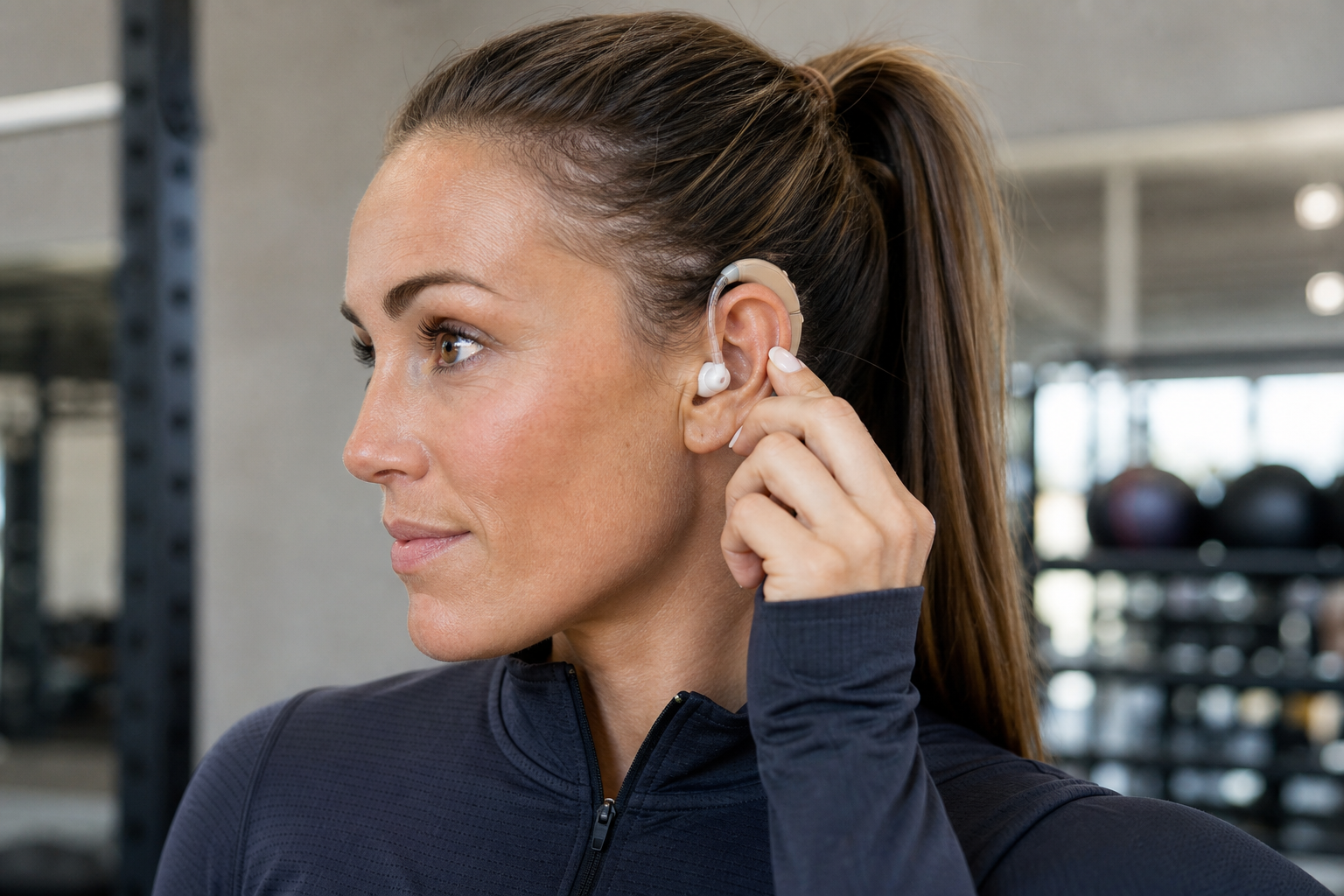
Sweat protection: Sweat can damage hearing aids. Use a hearing aid sweatband or moisture guard during vigorous exercise. Wipe aids dry after each session.
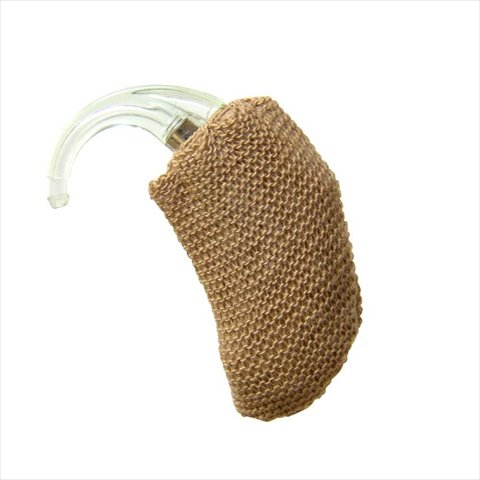
Hearing Aid Sweatband
Protects expensive hearing aids from sweat damage during workouts
Sweat contains salt and minerals that corrode electronics over time. If your hearing aids get wet with sweat, remove the batteries (or open the battery door on rechargeable models) and let the aids air dry completely. A hearing aid dehumidifier (an inexpensive container with desiccant) can be used overnight to remove moisture.
Avoid touching your aids during a workout with sweaty hands. The moisture transfers from your fingers directly into the device.
Secure fit: Aids that fall out during head movements or floor exercises need a retention clip or sport lock. Losing an aid mid-exercise is both disruptive and expensive. Behind-the-ear models can shift during burpees, downward-facing dog, or any movement where your head goes below your heart.
Sport clips attach to your clothing or glasses and tether the aid so it can’t fall to the floor. They’re inexpensive insurance against loss of an expensive device.
In-the-ear aids fit more securely during exercise but don’t work for everyone’s hearing loss. Discuss this with your audiologist if exercise is a regular part of your routine.
Wind noise: Outdoor walking with hearing aids can produce overwhelming wind noise. Aids with directional microphones and wind-noise reduction algorithms handle this better. Wearing a headband over your ears reduces wind interference.
A lightweight fleece headband or even a baseball cap changes how wind hits the microphone, significantly reducing that roaring static sound. Some people use a thin layer of medical tape over the microphone opening (check with your audiologist first) to diffuse wind without blocking sound entirely.
Turning down the aid volume slightly during outdoor exercise can also help. You lose some hearing range, but you eliminate the distracting wind noise that makes the aids unbearable.
Remove before swimming. Most hearing aids are not waterproof. Remove them before pool exercise and store them safely in a case. Waterproof hearing aids exist but are specialized and not universally available. Even “water-resistant” aids shouldn’t be submerged.
Get a small waterproof case to store your aids poolside. Don’t leave them in the locker room where they might be stolen or accidentally knocked to the floor.
Some people invest in a waterproof pouch worn around the neck to keep aids close during aqua classes, so they can put them back in immediately after exiting the pool.
Technology That Helps
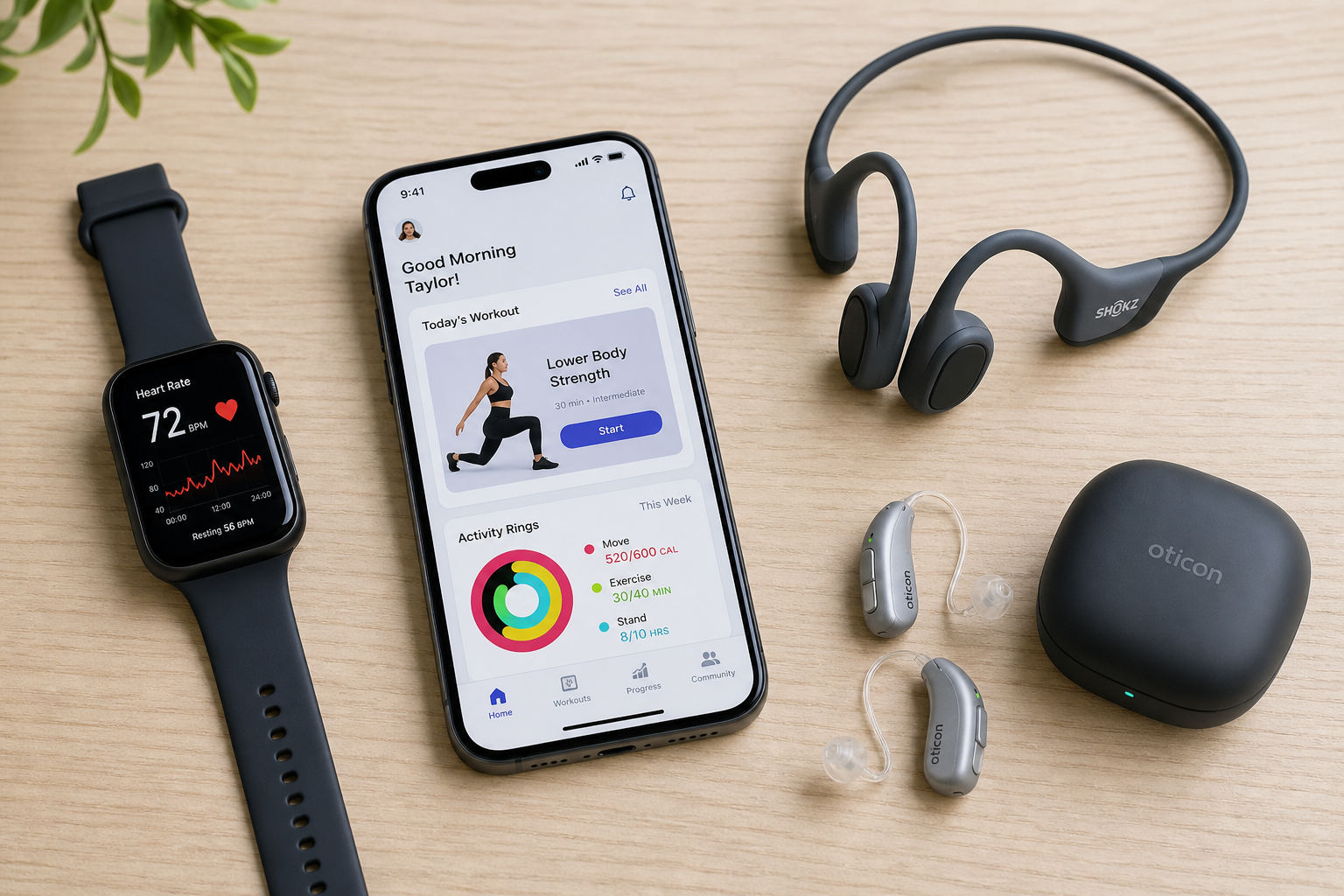
Fitness apps with visual cues: Many workout apps show exercise demonstrations in video form with on-screen timers. You’re not dependent on audio. Apps like Fitness Blender, Nike Training Club, and others offer free workouts where you can turn off the audio entirely and follow along visually.
Smart watches with haptic feedback: A smart watch can vibrate to signal interval changes, heart rate zones, and workout milestones. You feel the notification on your wrist rather than hearing a beep or voice cue. Pair your watch with a fitness app that supports haptic alerts.
Bone conduction headphones: These sit outside your ear and transmit sound through your cheekbones to your inner ear. They leave your ear canal open so you can wear hearing aids simultaneously.
Some people with hearing loss find bone conduction headphones help them hear audio cues from workout videos more clearly. Others find them ineffective depending on the type of hearing loss. Worth trying if standard headphones don’t work with your aids.
Closed captioning on fitness videos: Enable captions on YouTube, streaming fitness platforms, and DVDs. Many newer fitness programs include professional captions rather than auto-generated ones. If a video lacks captions, look for a different program. Captions are common enough now that you don’t need to settle for videos without them.
Exercises You Can Do Without Hearing
Many exercises require no auditory input at all:
Resistance band training: Follow a written or visual routine. No audio cues needed. Resistance bands are also quiet (unlike clanging weights), so you’re not creating noise that makes it harder to hear your surroundings. A printed chart showing band exercises in sequence gives you everything you need.
Walking (safe routes): Familiar paths with good visibility require minimal auditory input. Loop routes in parks where you can see the entire path ahead work well. Walking tracks at schools or community centers give you a controlled environment with few surprises.
Swimming: The pool environment is naturally low-communication. You swim in your lane independently. Water in everyone’s ears creates a level playing field. Swimmers use visual c