Cardiovascular exercise from a chair sounds like a contradiction, but it’s not. Your heart doesn’t know whether your feet are on the floor or off it. It responds to muscular demand: move your arms and legs quickly enough, and your heart rate climbs into the aerobic training zone regardless of your position.
For seniors over 70 who can’t safely stand for extended periods (due to balance concerns, joint pain, neuropathy, or severe deconditioning), chair cardio provides genuine cardiovascular conditioning that translates to better heart health, more energy, and improved endurance for daily activities.
The beauty of seated cardio is that it removes the variables that make standing exercise risky. You’re not worried about falling. You’re not loading arthritic knees or hips with body weight. You’re not managing balance while your heart rate rises. You’re simply moving your limbs against air resistance and gravity while seated securely.
That simplicity makes it possible to focus entirely on effort level and breathing, which is where the cardiovascular benefit comes from.
Before you begin any new exercise program, talk to your doctor. This is especially important if you have existing heart conditions, uncontrolled blood pressure, or recently experienced a cardiac event. Most physicians enthusiastically support chair cardio for older patients because the injury risk is minimal compared to standing programs, but individual medical history matters.
The 4-Week Beginner Chair Cardio Program
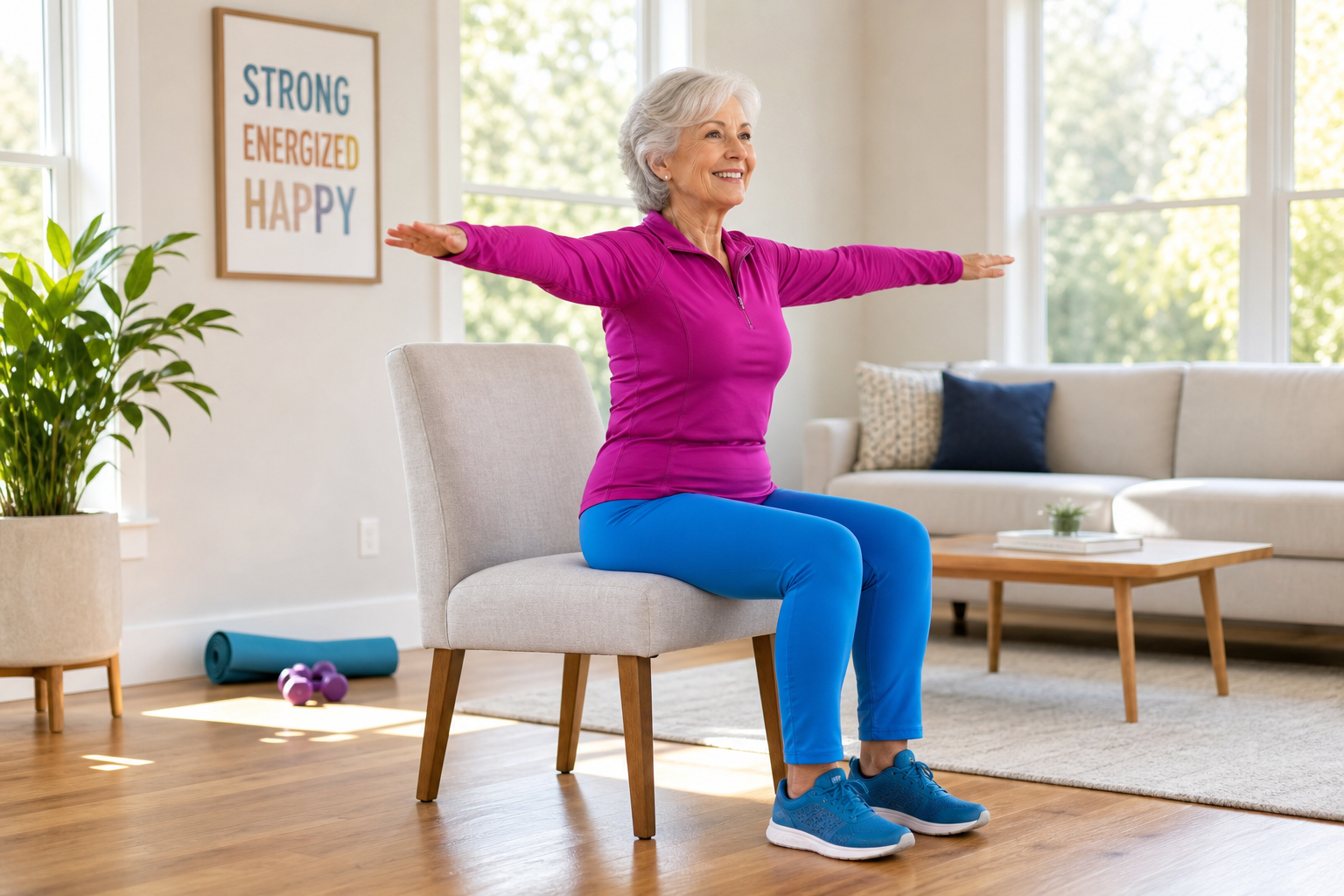
This program assumes you’re starting from very low baseline fitness. If you already walk regularly or do other exercise, you may progress faster. If you tire easily or have significant deconditioning, repeat weeks as needed.
There’s no shame in staying at Week 1 for two weeks if your body needs it.
Week 1: Learning the Movements (10 Minutes, 3 Days)
Focus on familiarizing yourself with the movements at a comfortable pace. Don’t push for intensity yet. Concentrate on form: sit upright, engage your core lightly, and move through the full range of motion without rushing.
- Seated marches: 2 minutes at an easy pace (lift knees alternately, pump arms naturally)
- Seated arm reaches: 2 minutes (reach forward, overhead, and to the sides alternately)
- Seated toe taps: 2 minutes (tap toes forward alternately)
- Seated shoulder rolls: 1 minute
- Gentle seated marches: 2 minutes (cool-down pace)
- Deep breathing: 1 minute
Choose a sturdy chair without wheels. A kitchen or dining chair works well. Sit toward the front edge so your feet rest flat on the floor with knees at about 90 degrees. Don’t lean back into the chair during the active portions. Keep your back straight and shoulders relaxed.

Sturdy Exercise Chair for Seniors
A stable, armless chair provides the best range of motion for chair cardio exercises
If lifting your knees feels difficult, reduce the height of the lift. Even a one-inch knee raise counts as a march. If overhead arm reaches bother your shoulders, stick to forward and side reaches.
Modify any movement that causes sharp pain (dull muscular fatigue is expected and fine, sharp joint pain is not).
Week 2: Building Duration (12 Minutes, 4 Days)
Increase the pace slightly. You should feel your breathing rate increase but still be able to speak in sentences.
- Seated marches with arm pumps: 3 minutes
- Seated punches: 2 minutes (alternate forward punches at moderate speed)
- Seated jumping jacks: 2 minutes (open legs while raising arms, close while lowering)
- Seated toe and heel taps: 2 minutes
- Gentle marches and stretching: 3 minutes
The seated jumping jack is less intense than it sounds. Spread your legs apart (knees still bent, feet flat) while raising your arms overhead, then bring legs back together while lowering arms. It’s a smooth, controlled movement, not a jerking motion.
If spreading your legs wide causes hip discomfort, use a narrower stance. The arm movement alone still provides cardiovascular stimulus.
By the end of this week, you should notice that 12 minutes feels manageable. Your breathing will be faster during the active portions, but you’ll recover quickly during the cool-down. That recovery speed is one of the first signs of improving fitness.
Week 3: Adding Intensity (15 Minutes, 4-5 Days)
Introduce intervals: 2 minutes at moderate pace, then 30 seconds at a faster pace, repeating throughout. The 30-second bursts should feel noticeably harder. Your breathing should quicken and you shouldn’t want to chat during them.
But 30 seconds ends quickly, and then you drop back to moderate pace to recover.
- Seated marches with intervals: 3 minutes
- Seated punches with intervals: 3 minutes
- Seated jumping jacks: 2 minutes
- Seated cross-body punches (right fist toward left knee, alternate): 2 minutes
- Seated arm circles at speed: 2 minutes
- Cool-down and stretching: 3 minutes
Cross-body punches add a rotational element. Twist gently from your torso as you reach your right fist toward your left knee, then alternate. Don’t force the twist if you have lower back issues. A small rotation is enough.
The movement engages your obliques and increases the work your cardiovascular system has to do.
Arm circles at speed mean making large, controlled circles with both arms moving forward, then reversing direction. Keep the motion smooth. If your shoulders tire before the time is up, switch to smaller circles or drop to shoulder-height raises instead.
Week 4: Full Routine (20 Minutes, 5 Days)
By this point, you’ve built the endurance and familiarity for a full chair cardio session. This routine includes distinct blocks that mix movement patterns to keep your heart rate elevated across the full 20 minutes.
- Warm-up: seated marches and arm circles (3 minutes)
- Cardio block 1: speed marches + arm pumps (3 minutes with intervals)
- Cardio block 2: punches + cross-body reaches (3 minutes with intervals)
- Cardio block 3: seated jumping jacks + flutter kicks (3 minutes with intervals)
- Cardio block 4: combined arm and leg movements to music (3 minutes)
- Cool-down: slow marches, shoulder rolls, deep breathing (3 minutes)
- Stretching: hamstrings, chest, neck, calves (2 minutes)
Flutter kicks are done by extending one leg forward, ankle flexed, then quickly alternating legs. Think of kicking a ball softly in front of you, one foot after the other. If hip flexor tightness makes this uncomfortable, stick with toe taps or marches instead.
The combined movement block is where you put it all together: march while punching, do jumping jacks with cross-body reaches, or any combination of the movements you’ve learned. Pick three or four combinations and rotate through them during the 3 minutes.
Stretching at the end is non-negotiable. Your muscles have been working, and a few gentle stretches prevent tightness. For hamstrings, extend one leg forward with heel on the floor and gently reach toward your toes. For chest, clasp hands behind your back and gently press your arms back. For neck, tilt your head to each side.
Hold each stretch for 20-30 seconds without bouncing.
Increasing the Challenge
Once the Week 4 routine feels comfortable (meaning you finish it without feeling wiped out for the rest of the day), add progressive challenges rather than just doing more minutes.
Hold Light Weights
1-2 pound hand weights during arm movements increase cardiovascular demand. Your heart has to work harder to pump blood to muscles lifting resistance.
Start with 1-pound weights and only during the arm-dominant movements like punches and arm circles. You can always drop the weights mid-session if your arms fatigue before your cardiovascular system does. The combination of cardio and resistance training offers compounding benefits for seniors, improving both heart health and muscle strength simultaneously.

Light Hand Weights for Seniors
Starting with 1-2 pound weights adds just enough resistance to elevate heart rate without straining joints
Add a Resistance Band
Loop a loop band around your thighs during marches and seated jacks for leg resistance. A light band is plenty. The added resistance forces your hip and thigh muscles to work harder, which increases oxygen demand and raises heart rate.
Place the band just above your knees and keep tension on it throughout the movement.
Increase Speed
Faster movements at the same resistance produce higher heart rates. Once form is solid, try completing more marches or punches in the same time window. Count how many marches you do in 30 seconds, then aim to add 2-3 more marches in the next session’s 30-second interval.
Small, incremental speed increases compound over weeks.
Use Music
Matching movements to music with 100-120 BPM naturally increases pace and makes the session feel shorter. Classic rock, oldies, or upbeat instrumental tracks work well. Music with a clear beat helps you maintain rhythm without having to think about it.
Spotify and YouTube have “chair exercise music” playlists already curated to the right tempo.
Follow Guided Videos
YouTube chair cardio videos provide variety, pacing, and external motivation. Search “chair cardio for seniors” and you’ll find hundreds of options. Some are 10 minutes, some are 30. Some use weights, some don’t.
Variety prevents boredom and introduces new movement patterns your body hasn’t adapted to yet, which keeps the training stimulus effective. If you prefer equipment-based alternatives, consider exploring pedal exercisers for low-impact cardio as a complementary option.
Tracking Your Progress
Monitor your resting heart rate weekly (first thing in the morning, before getting out of bed). As cardiovascular fitness improves, your resting heart rate decreases. A drop of 5-10 BPM over 4-8 weeks confirms your chair cardio is producing genuine cardiovascular adaptation.
Use two fingers on your wrist or neck, count beats for 60 seconds, and log the number. You don’t need a fitness tracker for this, though they make it easier.
Also note whether daily activities (walking to the bathroom, getting dressed, climbing a few stairs) feel less exhausting. Functional improvement is the most meaningful progress metric. If putting on your shoes used to leave you winded and it doesn’t anymore, that’s a win that matters more than any number on a heart rate monitor. Building this cardiovascular endurance also translates to functional strength for everyday tasks like carrying groceries.
Some people track session duration or interval speed. If that motivates you, do it. But don’t get so focused on metrics that you miss the bigger picture: are you moving more, feeling stronger, and managing daily life with less fatigue?
Chair cardio delivers exactly those results when practiced consistently.
What If You Miss Sessions?
Life happens. You’ll miss workouts. When you do, don’t compound the problem by quitting entirely. If you miss a week, drop back one week in the program and rebuild.