Your ankles do a lot of quiet, thankless work every time you take a step. They absorb impact, adjust to uneven surfaces, and help your body stay upright when your balance is challenged. But for many older adults, ankle flexibility gradually decreases without much fanfare, and the consequences show up in subtle ways: a shorter stride, a tendency to shuffle, or a stumble on a slightly uneven sidewalk. The good part is that ankle mobility is one of the most trainable qualities in the body, and you don’t need any equipment or a gym membership to work on it.
This article walks you through exactly why ankle range of motion matters, which exercises actually help, and how to build a simple routine that supports steadier walking and better balance.
Why Ankle Flexibility Matters More Than Most People Realize
When your ankles are stiff, your whole movement pattern compensates. Your knees bend less efficiently, your hips take on more load, and your gait tends to shorten. Over time, this creates a cascade of problems that go well beyond sore feet.
Restricted dorsiflexion (the ability to pull your toes up toward your shin) is particularly tied to fall risk. Research has consistently linked limited ankle dorsiflexion to increased instability during walking, especially when stepping over curbs, transitioning from carpet to hard floors, or navigating stairs. If your ankle can’t flex adequately, your body compensates by leaning forward or widening your stance, both of which reduce your margin for error.
Ankle stiffness also tends to worsen with inactivity. If you’ve had a period of reduced movement due to illness, surgery recovery, or just spending more time sitting, your ankles can tighten up faster than you’d expect. For anyone managing conditions like neuropathy that affect sensation in the feet, working on ankle mobility becomes even more important because proprioception (your body’s sense of where your foot is in space) depends partly on joint mobility. You can find more targeted guidance on that in this article on neuropathy-safe exercises for seniors.
Understanding Your Ankle’s Range of Motion
The ankle joint moves in four main directions. Plantar flexion points the foot downward (like pressing a gas pedal). Dorsiflexion pulls the toes upward. Inversion turns the sole inward, and eversion turns it outward. All four directions matter for daily movement, but dorsiflexion is the most critical for safe walking.
A healthy dorsiflexion range is roughly 20 degrees. If yours is significantly less, you’ll likely notice it when squatting, stepping up onto a curb, or walking down a slope. You can do a simple self-test: stand about 10 centimeters from a wall, place your foot flat on the floor, and try to touch your knee to the wall without lifting your heel. If you can’t get close, your dorsiflexion is worth working on consistently.
Ankle Circles: Simple, Effective, and Easy to Do Daily
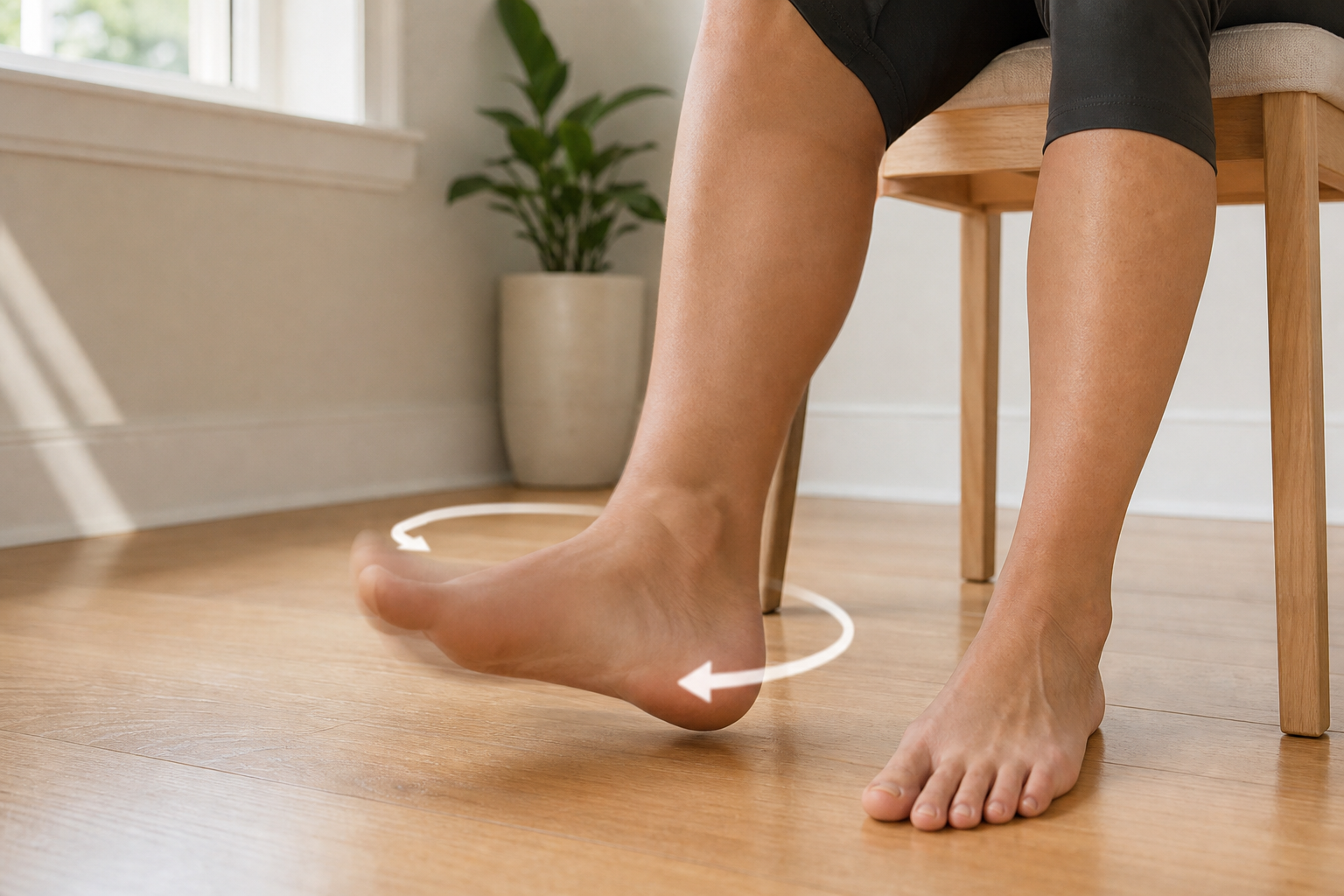
Ankle circles are a great starting point because they move the joint through its full available range without any strain. They also warm up the joint tissue before more targeted stretching, making everything that follows more comfortable and effective.
How to Do Ankle Circles
- Sit in a sturdy chair with your feet flat on the floor.
- Lift one foot a few inches off the ground.
- Slowly rotate your foot in a large circle, moving only at the ankle, not the whole leg.
- Complete 10 circles clockwise, then 10 counterclockwise.
- Switch feet and repeat.
Try to make the circles as large as possible. Many people default to small, hesitant movements. The larger the circle, the more of your ankle’s available range you’re actually using. If you feel grinding or clicking, don’t be alarmed as long as there’s no pain. Some joint noise is normal, especially in the morning or after a period of sitting.
You can do ankle circles while watching TV, sitting at your desk, or right after waking up. Doing them twice a day adds up quickly without requiring any extra dedicated workout time.
Dorsiflexion Stretches: The Key to Safer Walking
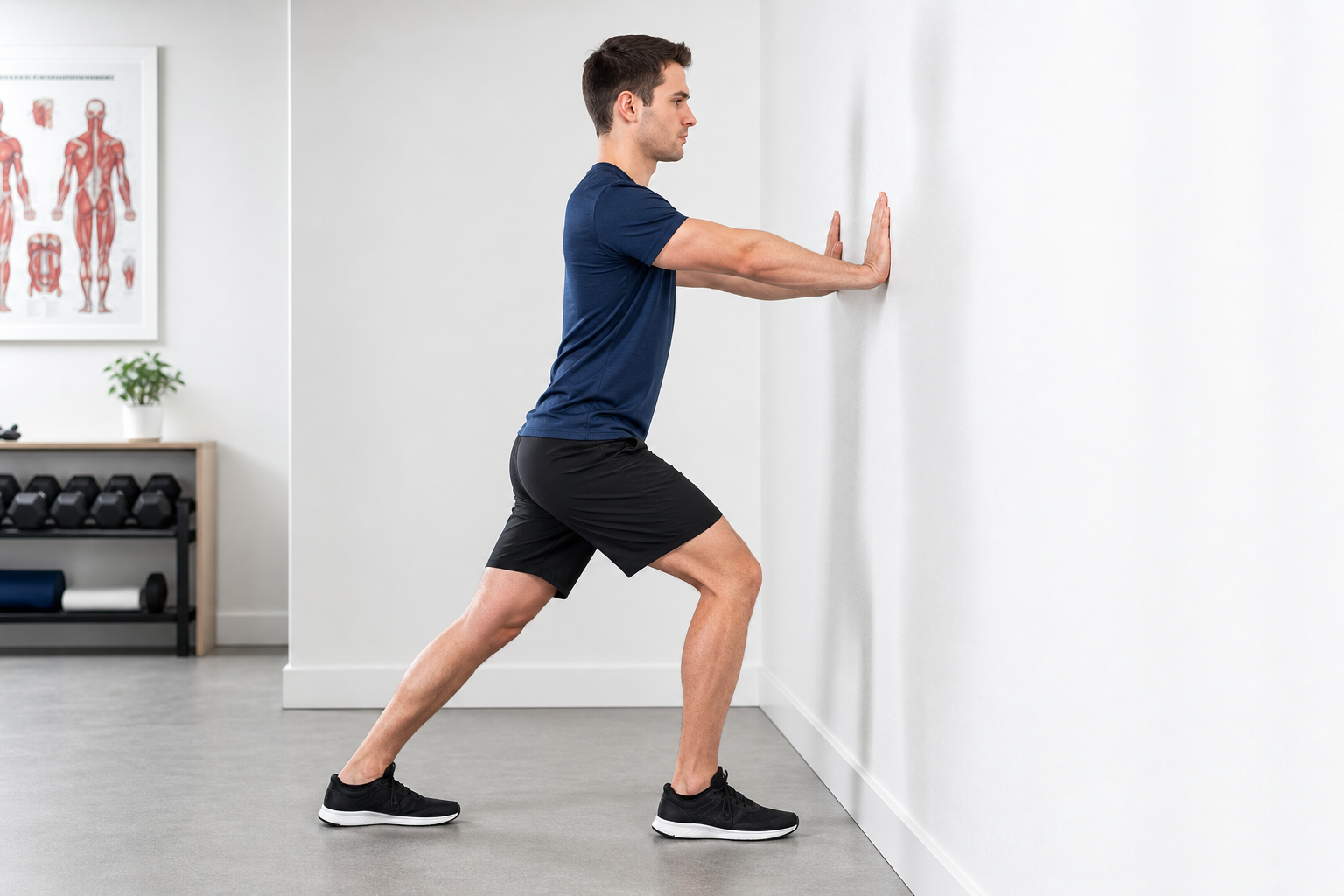
Because dorsiflexion is so central to fall prevention and walking mechanics, it deserves dedicated attention. These stretches specifically target the calf muscles and Achilles tendon, which are the structures most likely to limit dorsiflexion range.
Standing Wall Calf Stretch
Stand facing a wall with your hands resting on it for support. Step one foot back about two feet, keeping both feet pointing forward. Press your back heel firmly into the floor and gently lean toward the wall until you feel a stretch through the back of your lower leg. Hold for 30 seconds, then switch sides.
For a deeper stretch that targets the soleus muscle (deeper than the gastrocnemius), perform the same stretch but bend your back knee slightly. You’ll feel the stretch lower down, closer to the heel. Both versions are worth doing since both muscles affect dorsiflexion.
Seated Towel Stretch
Sit on the edge of a chair or on the floor with your legs straight. Loop a bath towel or resistance band around the ball of your foot. Gently pull the towel toward you, flexing your foot up toward your shin. Hold for 20 to 30 seconds per side. This is a good option if you have balance concerns or find standing stretches uncomfortable.
Kneeling Ankle Stretch (With Support)
Kneel on the floor on a yoga mat or folded blanket for cushioning. Bring one foot forward so it’s flat on the floor. Keeping your heel down, gently shift your knee forward over your toes until you feel the stretch in the front of the ankle and lower shin. Hold for 20 to 30 seconds. Use a chair beside you for support if needed. This stretch is particularly effective because it mimics the loaded dorsiflexion your ankle needs during the walking stride.
Video Guide: Ankle Mobility in Action
Seeing these movements demonstrated makes a real difference, especially when it comes to form details that are hard to describe in text. Watch the video below for a clear walkthrough of ankle mobility exercises you can follow along with at home.
Strengthening the Muscles Around the Ankle
Flexibility alone isn’t enough. Your ankle also needs muscular strength to control movement and respond quickly when your balance is disrupted. Strength and flexibility work together, and neglecting one undermines the other.
Heel Raises
Stand behind a sturdy chair with your hands resting lightly on the backrest. Rise up onto the balls of your feet as high as you comfortably can, pause for a moment at the top, then slowly lower back down. Do 2 to 3 sets of 12 to 15 repetitions. The slow lowering phase (called the eccentric portion) is where much of the benefit comes from, so don’t rush it.
Toe Raises
Standing in the same position, lift your toes and the front of your feet off the ground while keeping your heels down. This strengthens the tibialis anterior, the muscle running along your shin that controls dorsiflexion during the walking stride. Do 2 to 3 sets of 12 to 15 reps. If you’ve ever noticed yourself catching your toe on a threshold or a slight rise in the pavement, weak tibialis anterior muscles are often a contributing factor.
Resistance Band Ankle Exercises
A light resistance band adds useful loading once bodyweight movements feel easy. You can loop the band around your foot and work all four ankle directions from a seated position. A set of light to medium resistance bands is inexpensive and fits easily in a drawer. If you’re building out a basic home exercise setup, take a look at this guide to a budget-friendly home gym for seniors for practical equipment suggestions.
Balance Work That Builds on Your New Ankle Mobility
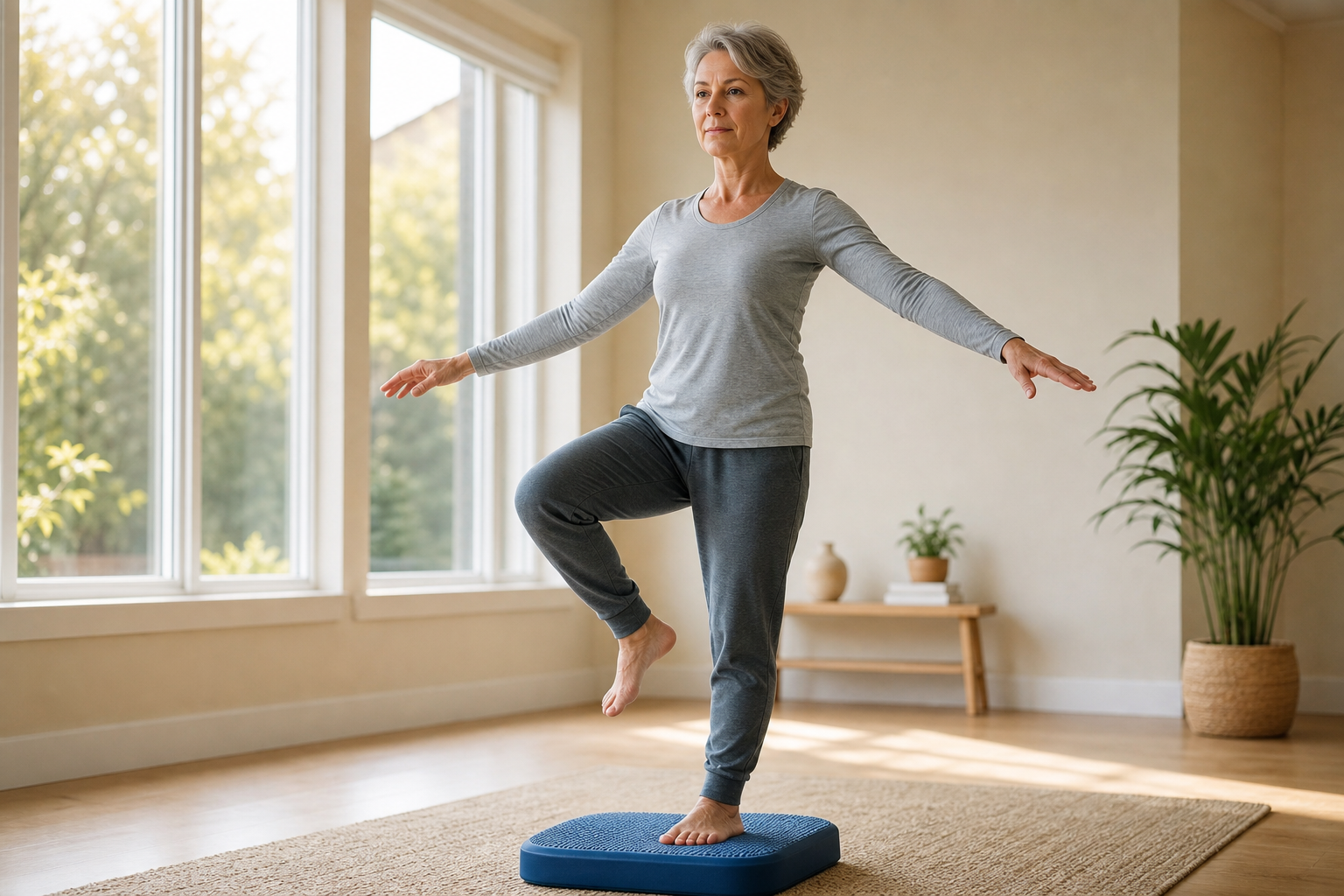
Once you’ve improved your ankle flexibility and started building some strength, balance exercises become more effective because your ankles can actually respond and adjust the way they’re supposed to. Think of it this way: improving ankle mobility creates the foundation, and balance training builds on top of it.
Single-leg standing is one of the simplest and most effective balance exercises available. Stand on one foot for 20 to 30 seconds while holding a chair for safety. As you improve, try reducing how much you rely on the chair. Your ankle will naturally make small adjustments to keep you upright, and those micro-corrections are exactly what you want to train.
If you’re working through specific balance challenges related to dizziness or inner ear issues, you’ll find more detailed guidance in this article on vertigo and balance exercises for seniors.
Posture also plays a meaningful role in balance. Tight ankles often accompany forward lean and stooped posture, which shifts your center of gravity and makes balance harder. Pairing ankle work with some posture-focused movement can make a noticeable difference. This article on posture correction exercises for seniors covers that in depth.
Supporting Joint Health From the Inside
Exercise does most of the heavy lifting when it comes to ankle mobility, but what you eat and supplement with can support the joint tissue itself. Connective tissue in the ankle, including the cartilage, tendons, and ligaments, responds to certain nutrients over time.
Vitamin D plays a direct role in muscle function and neuromuscular coordination, both of which affect your ability to maintain balance. Many older adults are deficient without knowing it. You can read more about why it matters in this guide on vitamin D for senior bone and muscle health.
Omega-3 fatty acids help reduce the low-grade inflammation that tends to accumulate in joints with age, and there’s meaningful evidence supporting their role in joint comfort. For more on how they fit into a senior’s supplement plan, see this article on omega-3 supplements for senior joint health.
Staying well-hydrated matters more than most people give it credit for. Cartilage is largely water, and even mild dehydration can make joints feel stiffer, particularly first thing in the morning.
Building a Simple Daily Ankle Routine
You don’t need a long session to see results. Consistency over weeks and months is what moves the needle on flexibility and joint health. Here’s a practical daily routine that takes about 10 minutes:
- Morning (5 minutes): Ankle circles, seated towel stretch, toe raises. Do these before you get moving for the day, ideally while still sitting on the bed or in a chair.
- Evening (5 minutes): Standing wall calf stretch (both versions), heel raises, single-leg balance (holding a chair).
Three to four weeks of this done consistently will produce noticeable improvements in how your ankles feel during walking. Six to eight weeks typically brings visible changes in your stride and confidence on varied terrain.
If you find it hard to stay consistent, attaching the routine to something you already do daily helps. Morning ankle circles while coffee brews, or an evening calf stretch while brushing your teeth, turns a new habit into something that happens automatically.
Frequently Asked Questions
How long does it take to improve ankle flexibility?
Most people notice some improvement within 3 to 4 weeks of daily stretching. Meaningful functional changes in your walking and balance typically show up around the 6 to 8 week mark. The timeline depends on how restricted your mobility is to begin with and how consistently you work on it. Doing these exercises five to seven days a week will produce faster results than two to three days.
Are ankle exercises safe if I have arthritis?
For most people with ankle or foot arthritis, gentle range of motion exercises are not only safe but beneficial. Movement helps lubricate the joint and can reduce stiffness over time. The key is to stay within a comfortable range and avoid pushing into pain. Start with seated exercises like ankle circles and the towel stretch, which require no weight-bearing load. If you have concerns about a specific arthritis diagnosis, clearing it with your doctor first is the sensible approach. For more general guidance, see this article on arthritis-friendly exercises for seniors.
Can stiff ankles really contribute to falls?
Yes, and the research on this is fairly clear. Limited dorsiflexion reduces your ability to adjust your center of gravity quickly when you step on an uneven surface or trip slightly. Your ankle is essentially your first line of defense against falling. When it can’t move through a full range, your whole postural correction system is compromised. Working on ankle mobility is one of the more concrete steps you can take toward fall prevention.
Should I do ankle exercises before or after walking?
Both have value, but for different reasons. Light ankle circles and a gentle towel stretch before walking can warm up the joint and reduce morning stiffness, making the first few minutes of your walk more comfortable. Doing calf and dorsiflexion stretches after walking is more effective for improving flexibility, since your muscles are warm and more pliable. If you only have time for one, post-walk stretching gives you more flexibility benefit. Pre-walk mobility work helps reduce discomfort during the activity itself.