Breathing exercises alone can calm your nervous system. Movement alone can reduce anxiety. Combining them creates something more powerful than either one separately: a focused practice that occupies your body and mind simultaneously, breaking the stress-worry-tension cycle that drives chronic anxiety, sleep problems, and elevated blood pressure in many seniors.
The practices below don’t require flexibility, strength, or equipment. They require attention and willingness to slow down.
Before starting any new movement or breathing practice, especially if you have cardiovascular conditions, respiratory issues, or balance concerns, talk to your doctor. These practices are gentle, but individual needs vary.
Why Combining Breath and Movement Works
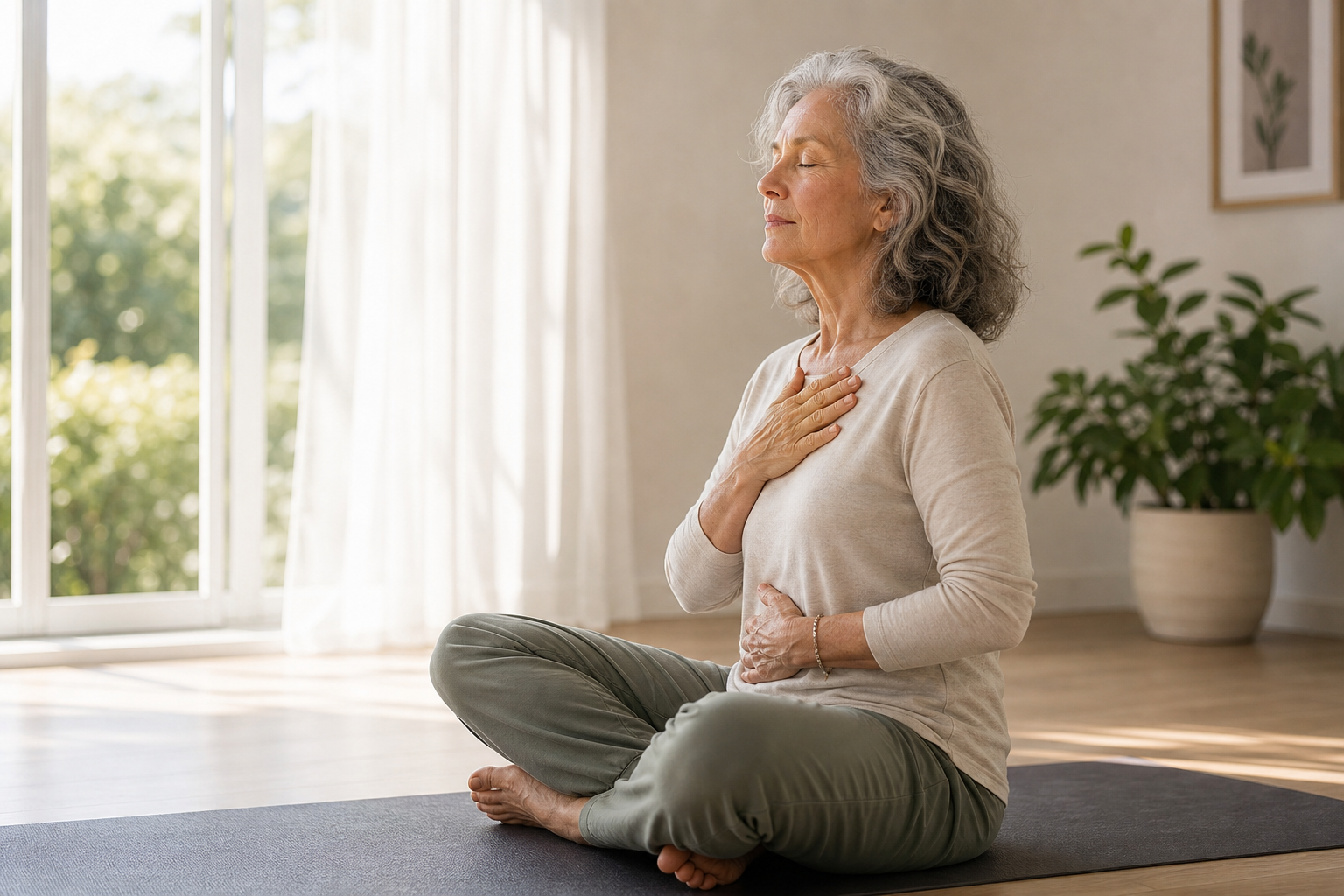
Dual-Channel Nervous System Reset
Slow, deliberate breathing activates the vagus nerve, which triggers the parasympathetic (“rest and digest”) nervous system. Slow, deliberate movement engages proprioceptors throughout your body, which provides grounding sensory input that interrupts the anxious thought loops of the sympathetic (“fight or flight”) system. Together, these two channels create a more complete nervous system shift than either one alone.
The proprioceptors in your muscles, tendons, and joints send constant feedback to your brain about where your body is in space. When you move slowly and deliberately, this feedback becomes clearer and more detailed. Your brain processes this information as safety data: slow, controlled movement signals that there’s no immediate threat, which helps quiet the alarm systems that fuel anxiety and stress.
Cognitive Occupation
Anxiety thrives on unoccupied attention. When your brain is coordinating breath timing, movement sequence, and body awareness simultaneously, there’s simply less bandwidth available for worry.
This is why tai chi, yoga, and qigong are consistently more effective for anxiety than simple treadmill walking: the cognitive demand of coordinating breath and movement fills the mental space that anxiety would otherwise occupy.
This isn’t distraction. It’s directed attention toward neutral sensory input. Distraction temporarily diverts your attention from worry. Breath-movement practices train your attention to rest on present-moment sensory experience, which builds a more lasting capacity to exit worry loops when they start.
The Exhale Advantage
Most breath-movement practices emphasize longer exhales than inhales, often in a 2:3 or 4:6 ratio. This isn’t arbitrary. Exhalation activates the vagus nerve more strongly than inhalation.
The vagus nerve acts as a brake on your heart rate and overall nervous system arousal. When you extend the exhale, you’re pressing that brake more firmly, creating a measurable shift toward calm within seconds.
You can test this right now: breathe in for 4 counts, out for 4 counts, for three cycles. Then breathe in for 4 counts, out for 6 counts, for three cycles. Most people feel a noticeable difference in the second set. That’s the vagus nerve responding to the extended exhale.
5 Breath-Movement Practices
1. Walking Breath Coordination
How: Walk at a slow, deliberate pace. Inhale through your nose for 4 steps. Exhale through pursed lips for 6 steps. Maintain this rhythm for 5-10 minutes.
Why it works: The extended exhale (longer than the inhale) directly stimulates the vagus nerve and activates the parasympathetic system. The step counting occupies your mind. The walking keeps your body engaged. This practice can be done anywhere, at any time, and looks like ordinary walking to anyone watching.
When to use it: During your daily walk. Before stressful events (doctor appointments, difficult conversations). When anxiety builds during the day. Before bed to transition from daytime stress to nighttime calm.
Modifications: If 4-in, 6-out feels rushed or strained, try 3-in, 5-out. If it feels too slow, try 5-in, 7-out. The ratio matters more than the specific count.
If pursed-lip breathing (exhaling as if blowing through a straw) feels unnatural, exhale through your nose instead. The extended exhale still works.
Common mistakes: Walking too fast. This practice requires a pace that feels slower than your normal walk. If you can’t comfortably maintain the breath count, you’re walking too quickly.
Another mistake is holding tension in your shoulders or jaw. Check in every minute and consciously relax those areas.
2. Breath-Linked Arm Raises
How: Stand or sit comfortably. On a slow inhale (4 counts), raise both arms from your sides to overhead. Pause at the top for 2 counts. On a slow exhale (6 counts), lower your arms back to your sides. Repeat 8-10 times.
Why it works: The upward arm movement opens your chest, which physically expands your lung capacity for a deeper inhale. The downward movement compresses slightly, encouraging a complete exhale. The coordinated timing prevents rushing and keeps the practice meditative rather than mechanical.
Modifications: If raising your arms overhead causes shoulder discomfort, stop at shoulder height. You still get the chest-opening benefit. If standing feels unstable, sit in a sturdy chair.
If lifting both arms simultaneously is tiring, try one arm at a time: inhale as the right arm rises, exhale as it lowers, then switch to the left.
What you should feel: A gentle stretch across your chest as your arms rise. A sense of your ribcage expanding. Possibly a slight fatigue in your shoulders after 8-10 repetitions.
What you shouldn’t feel is pain in your shoulders, breathlessness, or dizziness. If any of those appear, stop and try the seated modification or reduce your arm range.
3. Seated Cat-Cow with Breath
How: Sit on the edge of a chair, hands on your knees. On the inhale, arch your back, open your chest, and look slightly upward (cow). On the exhale, round your spine, tuck your chin, and push your upper back toward the ceiling (cat).
Move slowly; each transition takes the full length of the breath (4-5 seconds per inhale, 4-5 seconds per exhale). Repeat 10 times.
Why it works: The spinal flexion and extension directly massage the vagus nerve where it passes through the thoracic spine. The rhythmic movement is deeply soothing. Many people find this practice more calming than static breathing exercises because the movement prevents the restless discomfort that sitting still can create.
Positioning details: Sit far enough forward that your back isn’t touching the chair back. Your feet should be flat on the floor, hip-width apart. Hands rest gently on your knees; you’re not gripping or pushing.
The movement originates in your spine, not your head. Your head follows the spine rather than leading.
Modifications: If looking upward in the cow position bothers your neck, keep your gaze straight ahead. If rounding forward in the cat position compresses your abdomen uncomfortably, reduce how far you round.
The movement should feel like a gentle wave through your spine, not a forced stretch. If you have significant osteoporosis or a history of spinal compression fractures, check with your doctor before doing spinal flexion exercises like this one.
4. Standing Side Bends with Extended Exhale
How: Stand with feet hip-width apart. Inhale and raise your right arm overhead (4 counts). Exhale and lean to the left, reaching the right hand toward the ceiling and the left hand toward the floor (6 counts).
Inhale to return to center (4 counts). Exhale and lower the arm (4 counts). Repeat on the other side. Continue alternating for 6-8 repetitions per side.
Why it works: The lateral stretch opens the intercostal muscles between your ribs, physically expanding your breathing capacity. The extended exhale during the stretch activates the calming response while you’re in a physically opened position.
Form cues: Keep your hips stable; the lean comes from your ribcage, not from shifting your pelvis. Don’t collapse forward or backward; think of moving between two panes of glass.
Your raised arm reaches up and over, not down into the stretch. The hand that isn’t overhead can rest on your thigh or reach gently downward.
Modifications: If balance feels unsteady, stand with your back a few inches from a wall for support. If raising your arm overhead is uncomfortable, rest that hand on your hip instead and just do the side lean with breath.
If you have significant balance concerns, do this seated: sit upright in a chair and lean side to side without raising your arms.
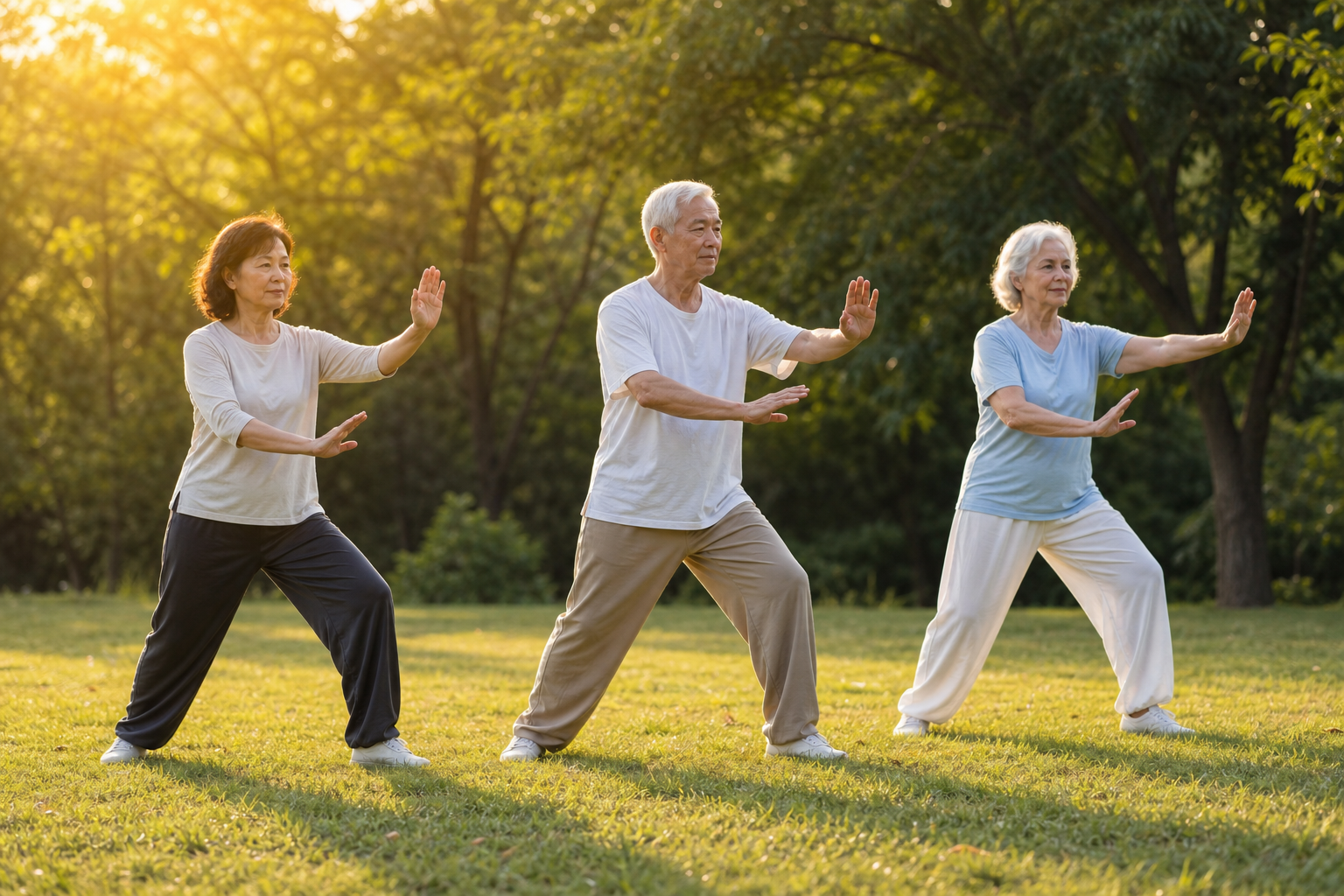
5. Tai Chi Cloud Hands with Breath
How: Stand with feet shoulder-width apart. As you inhale, float your right hand up to face level while your left hand floats down to waist level. Shift your weight to the right as your body turns gently right.
As you exhale, reverse: left hand rises, right hand lowers, weight shifts left, body turns left. Step sideways as you shift. Continue for 3-5 minutes.
Why it works: The flowing, circular arm movement combined with weight shifting and breath coordination creates a moving meditation that engages your entire body and attention. This is the foundational tai chi stress-relief pattern, distilled into a single, learnable movement. The slow weight shifts also provide balance training as a bonus.
Learning the pattern: Start with just the arms, no stepping. Stand in place and practice the hand circles with breath for a minute. Then add the weight shift: as your right hand rises, shift your weight onto your right leg. As your left hand rises, shift onto your left leg.
Once that feels natural (usually after 2-3 practice sessions), add the sideways step. Your foot steps in the direction of the weight shift just before the weight fully transfers.
Modifications: If balance is a concern, skip the stepping version and practice the arm circles with weight shifting only. You still get most of the calming benefit.
If standing for 3-5 minutes is tiring, alternate between standing for 1-2 minutes and sitting for 1-2 minutes. The seated version works the arms and breath without the weight shift.
What the movement should feel like: Smooth, continuous, with no pauses or jerky transitions. Your hands move in gentle arcs, not straight lines. Your torso rotates slightly with each shift. The pace is slow enough that you can take a full breath for each half-cycle (one inhale as one hand rises, one exhale as the other hand rises).
Building a Daily Practice
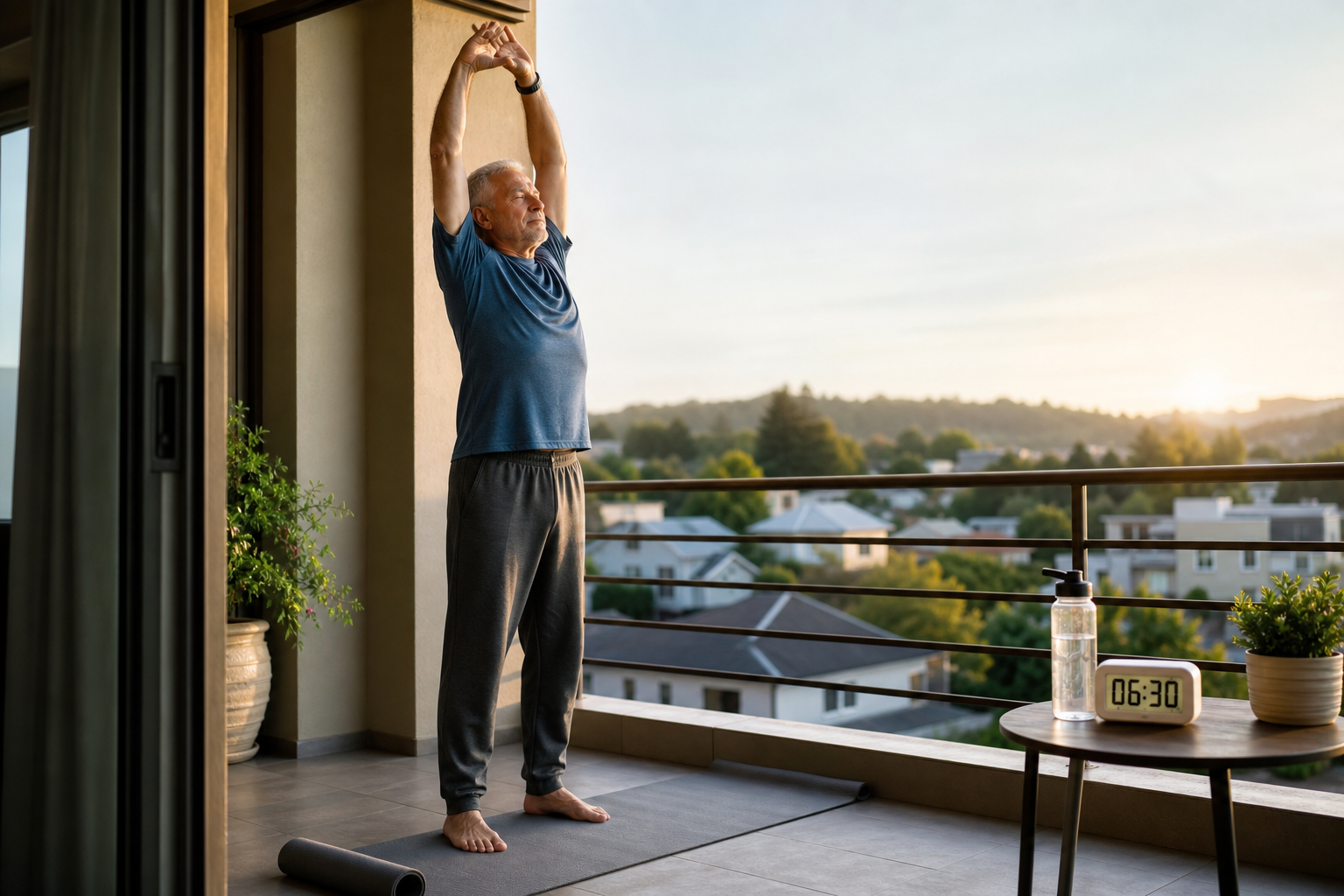
Morning (5 minutes): Standing breath-linked arm raises (2 minutes) + seated cat-cow with breath (3 minutes). Sets a calm foundation for the day.
Midday (3-5 minutes): Walking breath coordination during a short walk or around your home. Breaks the accumulated stress of the morning.
Evening (5 minutes): Cloud Hands (3 minutes) + standing side bends (2 minutes). Transitions from daytime activation to evening calm.
Total daily investment: 13-15 minutes across three brief sessions. The distributed approach (three short practices rather than one long one) provides stress management throughout the day rather than at a single point.
Adapting the Schedule to Your Life
If mornings are rushed, shift the morning practice to mid-morning after breakfast. If evenings are unpredictable, do the evening practice right after dinner rather than waiting until bedtime.
If you can only commit to two sessions instead of three, prioritize morning and evening. The morning practice sets your nervous system baseline, and the evening practice helps you transition into sleep.
You can also fold these practices into existing routines. Do seated cat-cow while your coffee brews. Do arm raises while watching TV. Use walking breath coordination anytime you walk from one room to another or from your car into a building.
The formal practice matters, but the informal integration throughout your day compounds the benefits.
Tracking Your Practice
A simple checkmark calendar works better than detailed logs. Mark each day you complete at least one breath-movement session. After two weeks, you’ll see a pattern.
Most people find they feel noticeably different on days they practice compared to days they skip. That felt difference is more motivating than any external tracking system.
Some people notice sleep improvements first. Others notice they’re less reactive to daily irritations. Some notice their resting heart rate drops. Physical changes (lower blood pressure, improved heart rate variability) typically take 4-8 weeks of consistent practice to become measurable, but subjective changes often appear within the first week.
Common Obstacles and Solutions
“I Feel Silly Doing This”
The movements look simple, almost childlike. That’s intentional. Complexity requires thinking, which activates your stress response. Simplicity allows your nervous system to settle.
If you feel self-conscious practicing around others, start alone until the movements feel natural. After a few weeks, the calming effect outweighs any self-consciousness.
“My Mind Still Wanders”
That’s normal and expected. The goal isn’t to eliminate all wandering thoughts. The goal is to notice when your mind wanders and gently return attention to breath and movement.
Each time you notice and return, you’re strengthening your ability to direct attention. That skill is what ultimately reduces anxiety.
“I Get Bored with the Same Movements”
Boredom often appears when you’re doing the movements mechanically rather than attentively. Try this: pick one sensation to focus on.
During arm raises, focus only on the feeling of air moving across your skin. During cat-cow, focus only on the sensation of your spine moving. During cloud hands, focus only on the weight shifting from foot to foot. Narrow, detailed attention eliminates boredom.
“I Don’t Have Time”
The full schedule above takes 13-15 minutes. If that feels impossible, start with one 3-minute session daily. Three minutes of walking breath coordination after lunch. That’s enough to produce measurable nervous system changes.
Once three minutes becomes automatic, add a second session. The perfect schedule you don’t do accomplishes nothing. An imperfect schedule you actually follow changes your physiology.
When to Involve a Professional
A physical therapist can help if you have significant balance issues or if any of these movements cause pain. An occupational therapist can modify practices for arthritis or other joint conditions.
A respiratory therapist can help if you have COPD or other breathing conditions and need breath pattern adjustments.
A meditation teacher or certified yoga therapist can deepen your practice if you want more structure or complexity. But the practices above are complete on their own. You don’t need professional guidance to benefit from them unless you have specific physical concerns that require modification.
Frequently Asked Questions
What if I can’t coordinate my breath and movement?
Start with the movement only for a few days