A clicking or popping hip during leg exercises, walking, or getting out of a chair raises an immediate question: is something breaking down in there, or is this harmless? The answer depends almost entirely on one factor: pain. A painless click is almost always a tendon sliding over bone. A painful click may indicate something inside the joint that needs attention.
Understanding the difference matters because treatment paths diverge completely. Painless clicking requires no medical intervention. It’s a mechanical quirk that responds well to simple strength and flexibility work you can do at home. Painful clicking, by contrast, may signal structural damage that benefits from imaging and professional evaluation.
Painless Clicking (Usually Harmless)

IT Band Snapping
The iliotibial band running along the outside of your hip slides over the bony prominence (greater trochanter) during leg movements. This produces a visible or audible snap on the outer hip, most noticeable during walking, climbing stairs, or leg circles. It’s the most common cause of hip clicking in seniors and is completely benign when painless.
The snap occurs because the IT band acts like a guitar string stretched over a ridge. When your hip moves through certain angles, the band shifts position abruptly rather than gliding smoothly. You might notice the snap is louder or more frequent on one side, particularly if you tend to stand with more weight on that leg.
Tightness in the IT band increases snapping frequency. Prolonged sitting shortens the band and reduces its ability to glide smoothly. This explains why IT band snapping often feels more pronounced after sitting for an extended period and then walking.
Some people can see the snap. If you’re thin enough or the trochanter is prominent, you’ll notice a visible flick on the outer hip as the band moves. This can look alarming but carries no more significance than the audible version.
Psoas Tendon Catching
The iliopsoas tendon at the front of the hip can catch on a bony ridge as it slides during hip flexion and extension. This produces a deep clicking sensation in the groin or front of the hip, often during leg raises, step-ups, or getting out of a chair. Painless psoas snapping is common and harmless.
The iliopsoas is your primary hip flexor, connecting your lower spine to the top of your thighbone. It crosses several bony landmarks on its path, creating multiple opportunities for catching. The most common catch point is the iliopectineal eminence, a small ridge on the front of the pelvis.
Psoas snapping tends to occur in a predictable range of motion. You’ll notice it happens at roughly the same point in the movement every time. This consistency distinguishes it from labral tears, which produce more variable catching patterns.
Dancers and cyclists report psoas snapping more frequently than other groups, likely because both activities involve repetitive hip flexion through the range where catching occurs. However, it’s equally common in older adults who spend significant time sitting, which keeps the psoas in a shortened position.
Gas Bubbles (Cavitation)
Just like cracking your knuckles, hip joints can produce a single pop when gas bubbles form and collapse in the synovial fluid during movement. This is a one-time pop (not repetitive) and is completely benign. It can’t be reproduced immediately because the gas needs time to re-dissolve.
The synovial fluid inside your hip joint contains dissolved gases. When you move the joint through certain positions, you create a temporary vacuum that allows these gases to form bubbles. The pop you hear is the bubbles collapsing as pressure normalizes.
This type of clicking has a refractory period. Once you’ve created the pop, you typically can’t reproduce it for at least 20 minutes. The gas needs time to dissolve back into the fluid. If you can click your hip repeatedly in rapid succession, you’re dealing with tendon snapping rather than cavitation.
Cavitation pops tend to feel satisfying rather than concerning. Many people intentionally create them because the joint feels looser afterward. This temporary increase in range of motion is real but brief, lasting only a few minutes.
Painful Clicking (Needs Evaluation)
Labral Tears
The labrum is a cartilage ring that deepens the hip socket and provides a seal for the joint fluid. Tears in the labrum can produce a clicking, catching, or locking sensation accompanied by a sharp pain deep in the groin or front of the hip. The clicking is position-specific: it occurs during certain movements (often hip flexion with internal rotation) and may be accompanied by a feeling of the hip “catching” before releasing.
Hip labral tears become more common with age as the cartilage loses water content and becomes less resilient. Minor tears can exist for years without symptoms. They become symptomatic when the torn edge catches on the ball of the hip joint during movement.
The pain pattern is distinctive. Unlike arthritis pain that builds gradually during activity, labral tear pain strikes suddenly when the hip moves into the problem position. The pain may ease immediately when you shift out of that position.
Certain activities consistently aggravate labral tears. Getting in and out of low cars, pivoting on the affected leg, and sitting cross-legged all force the hip into positions where torn labrum is more likely to catch. You might notice you’ve unconsciously started avoiding these movements.
Not all labral tears require surgery. Small tears in older adults often respond well to physical therapy focused on strengthening the hip stabilizers. The muscles can be trained to control the hip’s movement path and avoid positions that cause catching.
Loose Bodies
Small fragments of cartilage or bone can break off from the joint surfaces and float freely in the joint space. When these fragments get caught between the moving joint surfaces, they produce intermittent catching, clicking, and sharp pain. The location and severity of clicking changes because the loose body moves around.
Loose bodies are most common in people with a history of hip injury or surgery. A fall that jars the hip, even if it didn’t seem severe at the time, can chip off a small fragment of bone or cartilage. These fragments don’t heal or reattach. They remain free-floating in the joint.
The unpredictability distinguishes loose bodies from other causes of clicking. With tendon snapping or labral tears, you learn which movements trigger the problem. Loose bodies produce symptoms that vary day to day because the fragment shifts position inside the joint.
True locking, where the hip gets stuck and won’t move, points strongly to a loose body. The fragment becomes wedged between joint surfaces and physically blocks movement. You might need to shift your leg to a different position to dislodge it.
Osteoarthritis Crepitus
Advanced hip arthritis produces a continuous grinding or crunching sensation (crepitus) during movement rather than a single click or pop. It’s caused by rough cartilage surfaces rubbing against each other. This is different from the discrete pop of tendon snapping. Crepitus accompanied by progressive stiffness and deep aching pain points to arthritis.
Early arthritis may produce only occasional crepitus during weight-bearing movements. As cartilage wear progresses, the grinding becomes constant and audible to people standing near you. This continuous nature separates it from the intermittent snapping of tendons.
Morning stiffness that improves with movement is arthritis’s hallmark. The joint feels stiff and grinds more noticeably for the first 15-30 minutes of activity, then loosens up somewhat as synovial fluid circulates. Tendon snapping, by contrast, doesn’t vary based on time of day.
Weight-bearing activities make arthritis crepitus worse. Standing from a chair, climbing stairs, and walking all increase the grinding sensation because they load the joint surfaces together. Non-weight-bearing movements like lying leg lifts produce less noticeable grinding.
Exercises That Reduce Harmless Clicking
Strengthening for IT Band Snapping
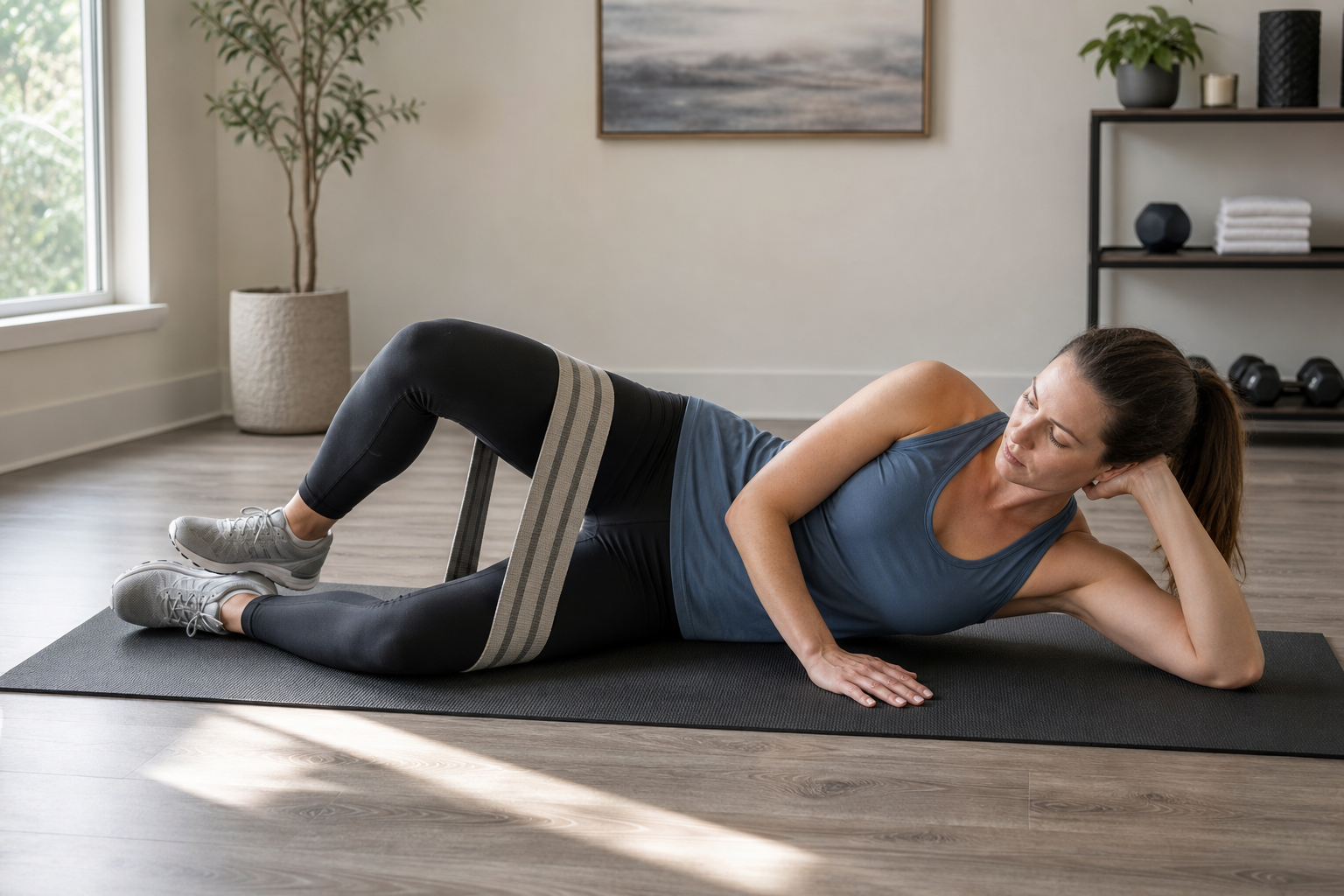
Clamshells: Lie on your side with knees bent at 90 degrees and feet together. Open your top knee against a resistance band while keeping feet together. 3 sets of 15 per side. Strengthens the gluteus medius and reduces IT band tension.

Mini Loop Resistance Bands
Perfect for targeted hip strengthening exercises like clamshells and lateral walks
Keep your pelvis stable. Don’t let your top hip roll backward as you open your knee. The movement should come entirely from hip rotation. Place your hand on your pelvis to monitor for unwanted rolling.
Start with a light band. The gluteus medius fatigues quickly if it’s been underworked. A band that allows you to complete all 15 reps with good form beats a heavier band that forces compensation after 8 reps.
Banded lateral walks: Place a loop band around your ankles. Take 10 steps sideways in each direction, keeping your toes pointing forward. 2 sets. Strengthens the hip stabilizers that control tendon tracking.
Maintain a slight knee bend throughout the movement. Locked knees shift the work away from the hip stabilizers and reduce the exercise’s effectiveness. Keep your steps controlled rather than quick.
Stretching for Psoas Snapping
Hip flexor stretch: Kneeling lunge, 30 seconds per side, twice daily. Reduces psoas tension that contributes to front-of-hip snapping.
Tuck your pelvis under slightly to increase the stretch in the front of your hip. The stretch should be felt deep in the groin, not in the lower back. If you feel it primarily in your back, you’re arching too much rather than stretching the hip flexor.
Use a folded towel under your back knee for comfort. Hard floors make this stretch unpleasant, which reduces your likelihood of doing it consistently.
Press your hips forward rather than leaning your torso backward. The hip flexor stretch comes from hip extension, not spinal extension.
Mobility Work for General Clicking
Foam rolling the outer thigh: 60-90 seconds per side with a soft roller. Loosens the IT band to reduce its tendency to snap over the trochanter.

Foam Rollers for IT Band
Look for medium-density options that provide relief without triggering muscle guarding
Use a softer roller if you’re new to foam rolling. A rock-hard roller on tight tissue triggers protective muscle guarding that defeats the purpose. You want the tissue to relax, not tense up against pressure. Our foam roller guide for seniors provides detailed techniques for safe and effective use.
Roll slowly. Taking 3-4 seconds to move from hip to knee and back allows the fascia time to respond. Quick rolling back and forth creates heat but little mechanical change in tissue length.
Avoid rolling directly on the trochanter (the bony bump on the outer hip). Roll above and below it. Direct pressure on bone is painful and unproductive.
Controlled hip circles: Stand on one leg and move your other leg in large circles, 10 in each direction. Trains smooth tracking patterns.
Use a counter or wall for light balance support if needed. The goal is to move the hip, not test your balance. Grabbing for support mid-circle defeats the control objective.
Make the circles as large as your pain-free range allows. Small circles don’t challenge the hip to improve its tracking through problematic ranges.
When to See a Doctor
See an orthopedic specialist if clicking is accompanied by pain that limits your activities, you feel catching or locking (the hip briefly gets stuck), clicking has progressively worsened over weeks, you notice reduced range of motion alongside the clicking, or the clicking started after a specific injury or fall.
Note the specific movements that trigger symptoms. Your doctor will ask which activities hurt and which positions cause catching. Video yourself performing the problem movement if possible. Seeing the exact motion helps the physician understand what’s happening mechanically.
Document pain patterns. Is it sharp or aching? Does it occur during the movement or after? How long does it last? This information helps differentiate between tendon issues, labral tears, and arthritis.
Bring a list of what you’ve already tried. If you’ve done strengthening exercises for six weeks with no improvement in painful clicking, that suggests the problem may require imaging to identify structural damage.
An X-ray evaluates bone structure and arthritis severity. It’s quick, inexpensive, and shows whether you have bone spurs, joint space narrowing, or loose bone fragments. However, X-rays don’t show soft tissues well.
An MRI (sometimes with contrast injection, called an MR arthrogram) is the gold standard for identifying labral tears and loose bodies. The contrast injection improves visualization of the labrum by outlining its edges. Standard MRIs can miss small labral tears that become obvious with contrast.
Physical therapy is often the first treatment step even when imaging shows a labral tear or mild arthritis. Three months of targeted hip strengthening resolves symptoms in roughly half of patients with labral tears, avoiding surgery. If you’ve had a hip replacement, working with a physical therapist is essential for proper recovery.
Common Mistakes That Make Clicking Worse
Stretching without strengthening: Many people focus exclusively on stretching tight hip flexors or IT bands without addressing the weak stabilizers that allowed those structures to become tight. Stretching provides temporary relief but the clicking returns because the underlying strength imbalance persists.
Avoiding all clicking movements: If your hip clicks painlessly during squats, you don’t need to stop squatting. The click itself causes no damage. Avoiding the movement weakens the muscles that control the hip, potentially making the clicking louder when you do eventually use that range of motion.
Aggressive foam rolling: Bearing down hard on a foam roller doesn’t release tissue faster. It triggers protective guarding that makes muscles tighten up. Use moderate pressure and slow movement for better results.
Ignoring one-sided weakness: Clicking that occurs only on one hip often stems from strength imbalances between sides. Testing both hips with single-leg exercises reveals these differences. Address the weaker side with extra sets as part of your progressive resistance training routine.
Frequently Asked Questions
Should I avoid exercises that make my hip click?
If the clicking is painless, there’s no reason to avoid the exercise. Painless clicking is mechanical and doesn’t cause damage. If clicking is accompanied by pain, stop the specific movement that triggers it and focus on strengthening the surrounding muscles with pain-free alternatives.
Consider modifying the exercise first before abandoning it entirely. Squats might click at full depth but feel fine if you stop at 90 degrees. Leg circles might click in one direction but not the other. Finding the pain-free variation keeps the muscles working while you address the underlying cause.
Will the clicking get worse over time?
Painless tendon snapping may become more noticeable with age as the tissues lose some of their glide, but it doesn’t typically progress to a painful condition. Arthritis-related crepitus may worsen gradually as cartilage wears, but strengthening the hip muscles slows this progression significantly.
Maintaining hip mobility and strength provides the best protection against clicking becoming problematic. Sedentary habits allow muscles to weaken and tissues to shorten, increasing