Swimming is one of the best exercises for adults over 60. It’s low-impact, works every major muscle group, improves cardiovascular fitness, and the water itself provides natural resistance and joint support. But stepping into a pool for the first time (or the first time in decades) can feel intimidating. You might worry about your speed, your technique, or simply how you look in a swimsuit.
None of that matters. The pool doesn’t judge, and every single person in that lap lane started somewhere. Here’s how to begin.
Overcoming the Intimidation Factor
The biggest barrier isn’t physical. It’s the anxiety of being a beginner in a public pool surrounded by experienced swimmers. A few strategies help:
- Visit during off-peak hours. Early mornings (6-8 AM) and mid-afternoons (1-3 PM) are typically the quietest times. Avoid the after-work rush.
- Look for senior swim programs. Many community pools, YMCAs, and recreation centers offer dedicated senior swim times or beginner water exercise classes. You’ll be surrounded by people at your level.
- Start in the shallow end. You don’t need to swim laps from day one. Walking in waist-deep water provides excellent exercise and lets you get comfortable in the pool environment.
- Bring a friend. If someone you know is also interested in starting, go together. Having a familiar face reduces the self-consciousness that stops many beginners from even trying.
- Remember that most lap swimmers are focused on their own workout. They’re not watching you or judging your form. They’re counting laps and managing their breathing.
One mental shift that helps: reframe the pool as your space. You have just as much right to use the facility as anyone else, regardless of speed or ability. Your presence is normal and expected.
Choosing the Right Stroke
Water Walking (Easiest Start)
Walk forward, backward, and sideways in waist-to-chest-deep water. The water resistance makes every step a workout. Swing your arms naturally for added upper body engagement. This is a legitimate exercise method, not just a warm-up, and many seniors do water walking exclusively for months before attempting actual swimming strokes.
Increase difficulty by lifting your knees higher, widening your arm swings, or adding directional changes. Walking backward particularly challenges your balance and engages your glutes and hamstrings differently than forward movement. If you have balance concerns, stay near the pool wall until you feel stable. For those comparing different fitness options, water walking offers significant advantages similar to seated exercises for seniors in terms of joint protection while providing greater resistance.
Breaststroke (Best for Beginners)
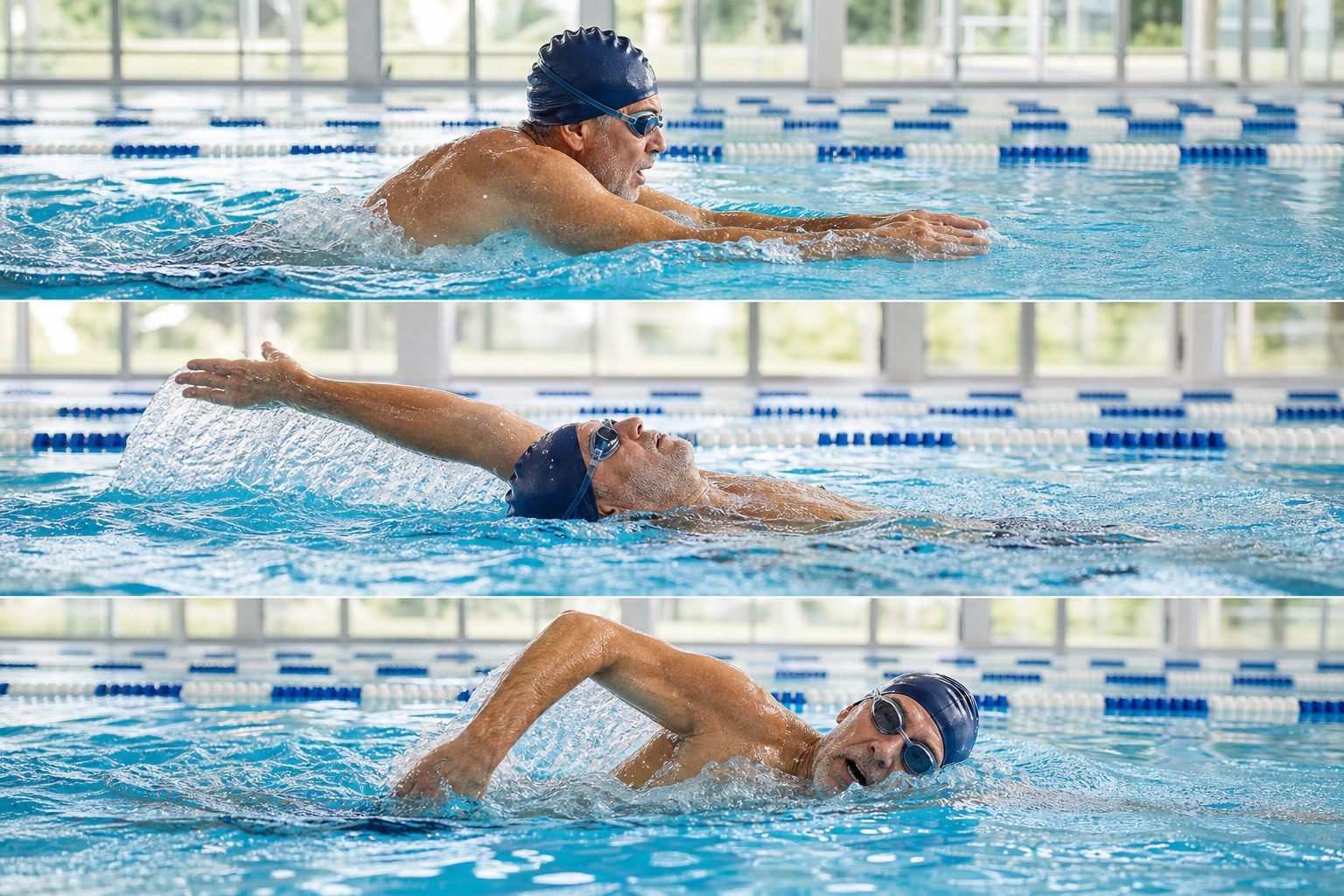
Breaststroke keeps your head above water (you can breathe normally), uses a symmetrical motion that’s easy on the shoulders, and moves at a pace that lets you stay relaxed. The frog kick is gentle on the knees for most people, though those with significant knee arthritis should modify the kick width to avoid discomfort.
The stroke breaks down into clear phases: pull your arms in a circular motion, glide briefly with arms extended, then perform the frog kick while your arms recover forward. The rhythm is pull-breathe-kick-glide. Many beginners rush the glide phase, which kills efficiency and increases effort. Let yourself glide for a full second between strokes.
If the standard frog kick bothers your knees, try a narrower wedge kick or even a flutter kick instead. The stroke police won’t show up. What matters is forward movement and comfort.
Backstroke (Best for Back Pain)
Swimming on your back eliminates the neck strain of front strokes and allows your spine to decompress in a neutral position. The alternating arm motion provides a good shoulder workout. The downside: you can’t see where you’re going, so use lane markers on the ceiling for guidance, and be aware of the wall as you approach the end of the pool.
Count your strokes per length so you know roughly when you’re nearing the wall. Most pools have backstroke flags suspended across the pool five yards from each end. When you see the flags in your peripheral vision, you know the wall is close.
Keep your hips high by engaging your core and looking straight up (not toward your feet, which drops your hips). Your ears should be in the water. The arm motion is a continuous windmill pattern, with one arm always in motion. If you have limited shoulder mobility, reduce your arm extension and work within a comfortable range rather than forcing a full rotation.
Freestyle (For Those Ready to Progress)
Freestyle (front crawl) is the fastest and most efficient stroke, but it requires bilateral breathing and good coordination. Don’t attempt freestyle until you’re comfortable exhaling underwater and rotating your head to the side for quick breaths. Many beginners tense up during freestyle because they’re holding their breath.
Start with one-sided breathing every three or five strokes. As you improve, work toward bilateral breathing (alternating sides every three strokes) to balance your stroke and avoid neck strain. If bilateral breathing feels impossible, stick with breathing on your comfortable side. Getting oxygen is more important than textbook form.
Essential Gear
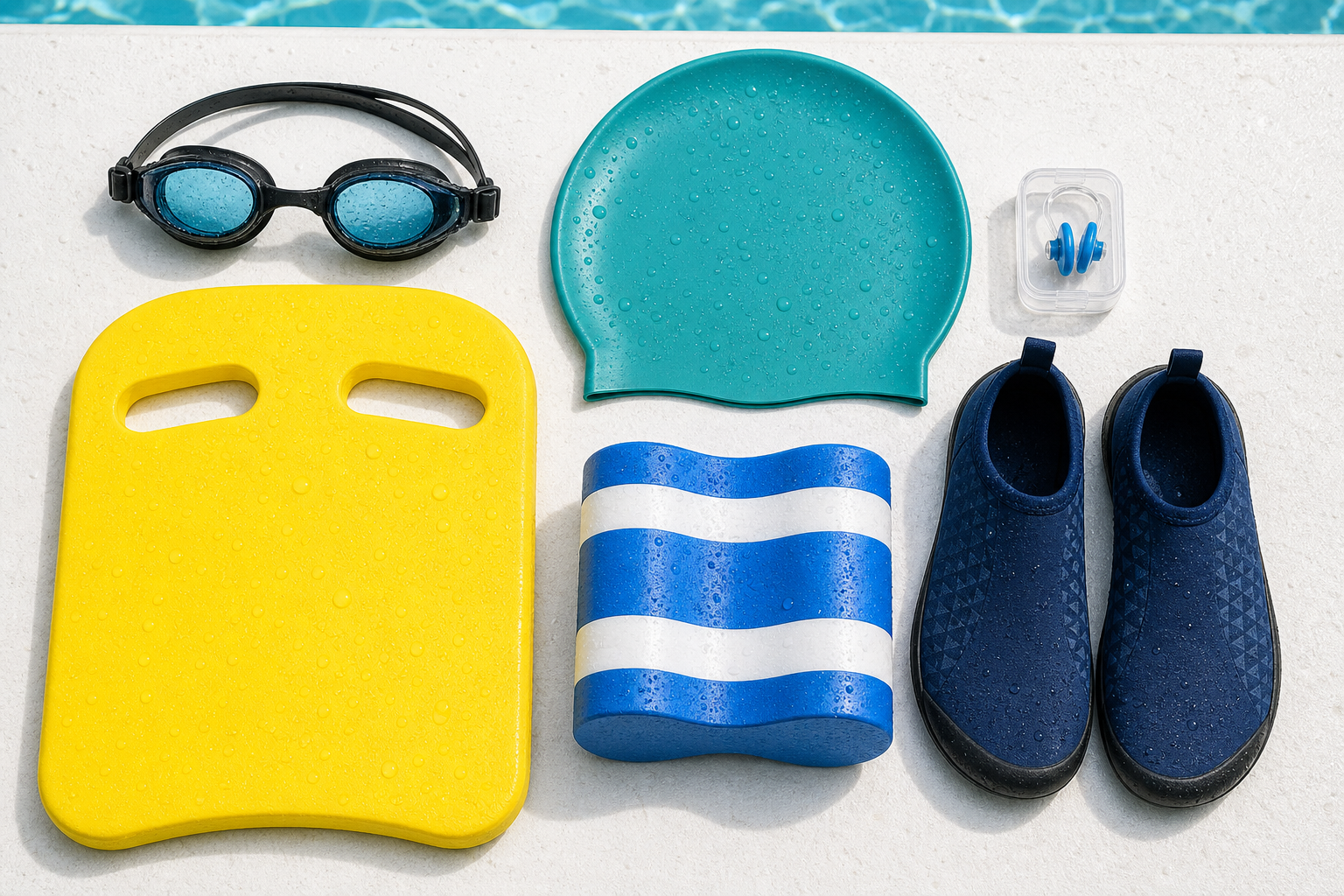
- Goggles: Anti-fog swim goggles are essential even if you keep your head above water. Splashing and pool chemicals irritate eyes. Look for goggles with adjustable nose bridges and wide eye cups for comfort.
- Kickboard: A kickboard lets you hold onto a floating platform while kicking, which isolates your legs and removes the coordination challenge of arm strokes. It’s also a confidence boost for anyone nervous about keeping their head above water.
- Pull buoy: This figure-8 foam float goes between your thighs and keeps your lower body afloat so you can focus entirely on arm strokes. Great for upper body workouts and for swimmers whose kick is weak.
- Water shoes: Non-slip water shoes protect your feet on the pool deck and in locker rooms where wet surfaces create slip hazards.
- Swim cap (optional): Caps keep hair out of your face and reduce drag if you’re doing actual lap swimming. They also keep chlorine exposure to your hair minimal. Silicone caps are more comfortable than latex for most people.
- Towel and toiletries: Bring shampoo, body wash, and a good moisturizer. Chlorine dries out skin, especially for older adults. Apply lotion immediately after showering while your skin is still slightly damp to lock in moisture.

Anti-Fog Swim Goggles
Wide eye cups and adjustable nose bridges make these comfortable for extended wear

Adult Kickboard
Essential for building leg strength and confidence without worrying about arm coordination
Don’t buy expensive tech suits or fancy fins. Basic gear is all you need. Resist the urge to over-equip before you’ve even started.
A 6-Week Progressive Swim Program
This program assumes three sessions per week. If you can only manage two, extend each phase by an extra week. If you miss a session, don’t try to make it up by doubling the next one. Just continue where you left off.
Before starting any exercise program, talk to your doctor, especially if you have heart conditions, joint problems, or have been sedentary for an extended period.
Weeks 1-2: Water Walking and Comfort
Three sessions per week, 10-15 minutes each. Walk in waist-deep water, forward and backward. Add arm movements (pushing water forward, pulling it back). Practice putting your face in the water and exhaling through your nose if you’re comfortable doing so.
Focus on getting used to the pool environment. Notice how the water supports your joints. Experiment with different depths. Walk along the shallow end wall if you need something to hold onto. There’s no performance target here except showing up and moving.
If 10 minutes feels like too much, stop at 5 and call it a win. If 15 minutes feels easy, don’t jump to 30. Stick to the plan. Gradual progression prevents burnout and overuse injuries.
Weeks 3-4: Kickboard Laps and Stroke Introduction
Three sessions, 15-20 minutes. Start each session with 5 minutes of water walking. Add kickboard laps (hold the board, kick gently down the pool). Introduce breaststroke arms in the shallow end, standing and practicing the pull pattern.
Kickboard work teaches you the leg motion without the complexity of breathing and arm coordination. Hold the board at arm’s length, keep your face in or above the water (your choice), and kick steadily. Flutter kick (alternating up-and-down leg motion) or frog kick both work here.
When practicing breaststroke arms while standing, focus on the pull pattern: hands start together in front, sweep outward and backward in a circular motion, then recover forward under your chin. Do this 10 times per session. Muscle memory builds through repetition.
Weeks 5-6: Full Laps
Three sessions, 20-30 minutes. Combine arm strokes and kicks for full breaststroke or backstroke laps. Swim one length, rest at the wall for 30-60 seconds, repeat. Aim for 8-10 lengths by the end of week 6. Don’t worry about speed. Smooth, relaxed movement is the goal.
One length means swimming from one end of the pool to the other (not there and back, which is two lengths). Most pools are 25 yards or 25 meters. If your pool is 50 meters, count a half-length as one length for this program.
Rest as long as you need between lengths. Gasping for air means you’re going too hard. You should be able to hold a conversation (if there were someone next to you) throughout the session. If you can’t, slow down or take longer rests.
By the end of week 6, you might not feel like an expert swimmer, but you’ll have established a routine and built base fitness. That’s the foundation everything else builds on.
Breathing Technique
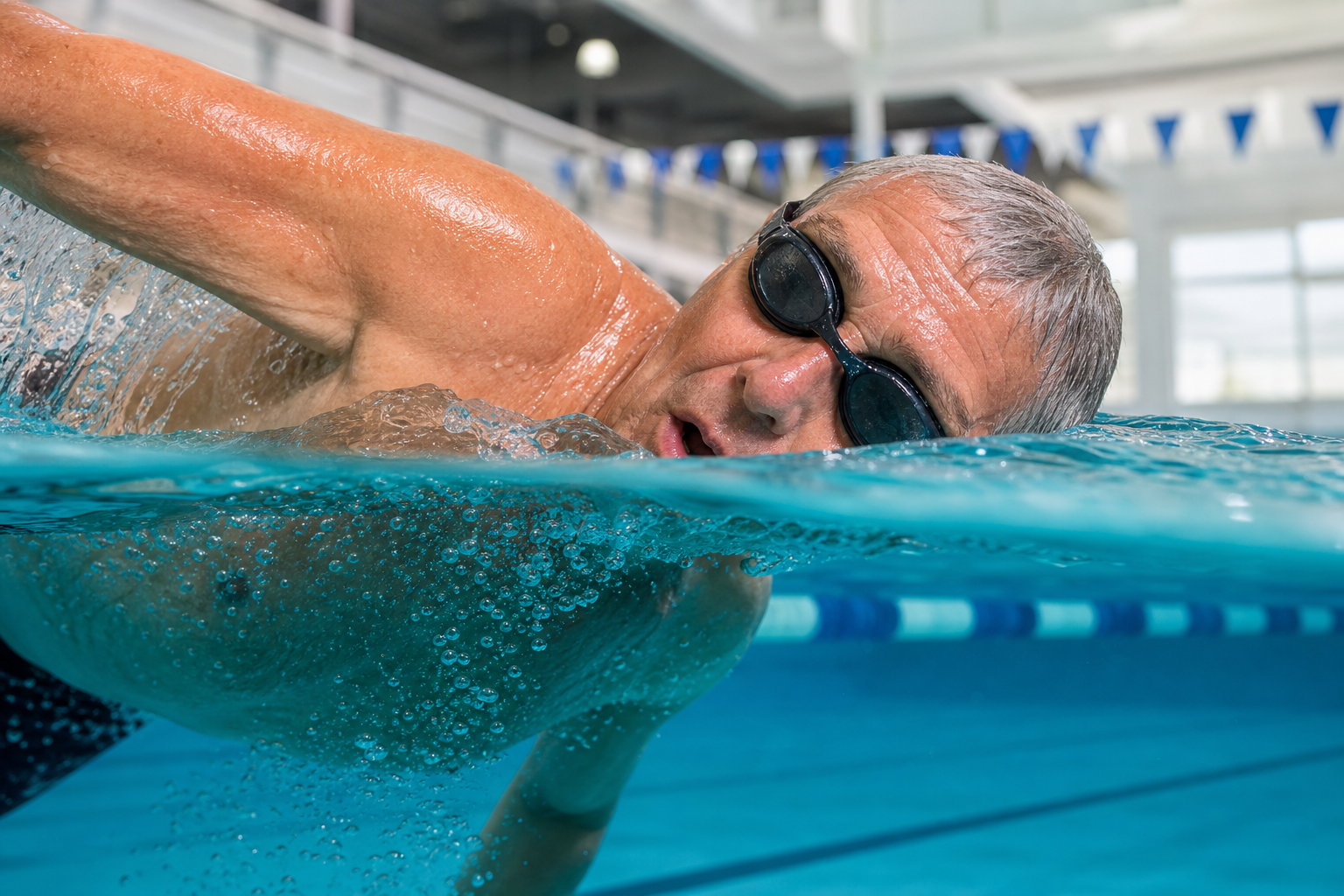
Poor breathing is the number one reason beginners quit swimming. The key principles are simple: exhale fully while your face is in (or near) the water, and inhale quickly when your face clears the surface. Holding your breath creates tension, raises your heart rate, and makes everything feel harder. Practice exhaling through your nose while standing in shallow water before attempting it during strokes.
The exhale phase should be slow and controlled. Empty your lungs completely. The inhale is fast and happens in the brief moment your mouth clears the water. New swimmers often try to inhale and exhale through the mouth during the same brief window, which doesn’t work. Exhale happens underwater. Inhale happens above.
If rhythmic breathing feels impossible, stop mid-length, stand up, breathe normally for 10 seconds, then continue. There’s no rule that says you have to swim the full length without stopping