A small apartment doesn’t disqualify you from a complete home gym. The right equipment fits in a closet, under a bed, or behind a door, sets up in 30 seconds, and covers every exercise category you need: cardiovascular conditioning, strength training, balance work, and flexibility. The trick is choosing compact, multi-purpose items that provide maximum versatility per square inch of storage space.
Before starting any new exercise program, talk to your doctor, especially if you have existing health conditions, balance concerns, or haven’t been active recently. The equipment recommendations here can support fitness at various levels, but your medical provider can help you determine appropriate starting points and any modifications you might need.
The Essential 5: Complete Fitness in a Shoebox
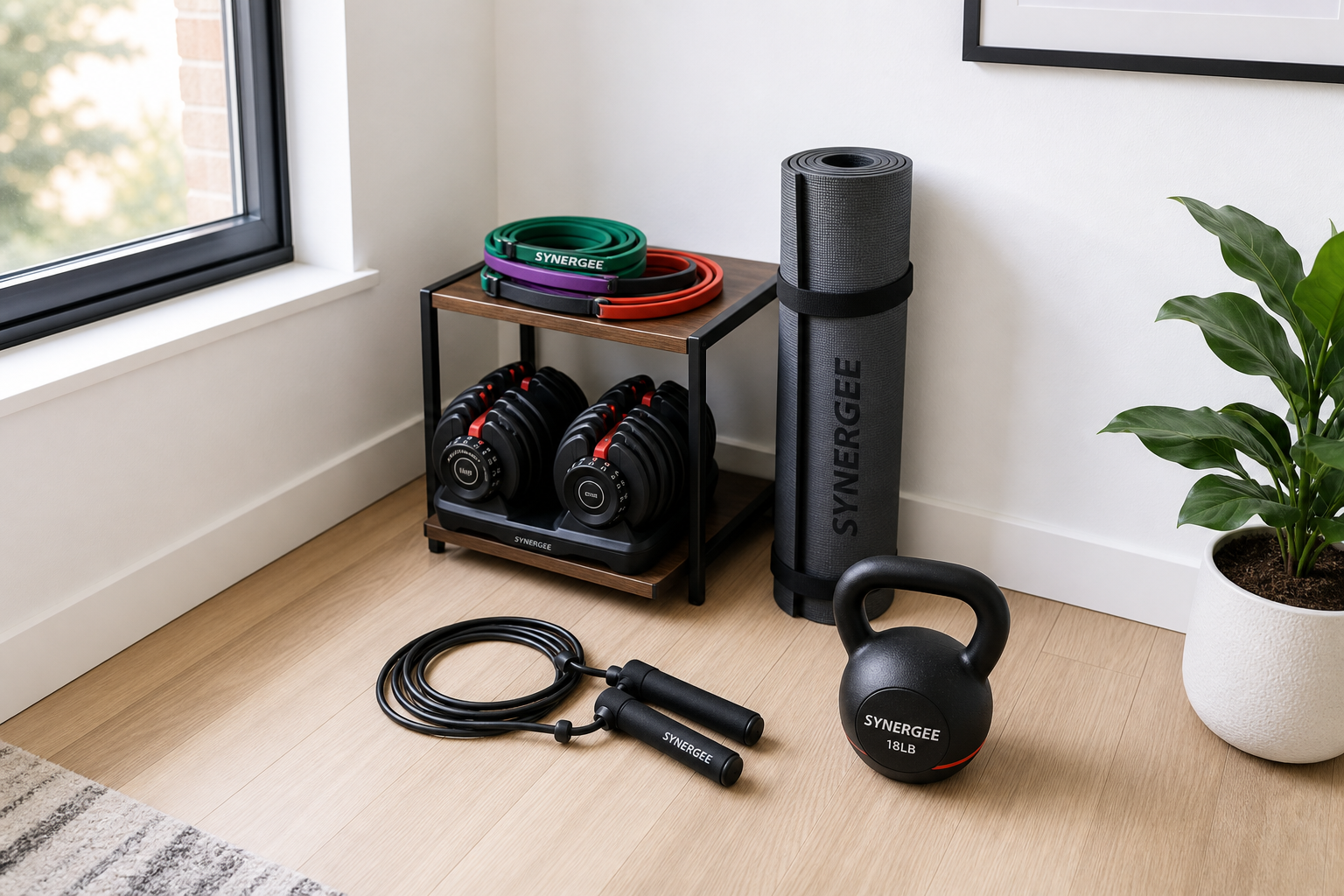
These five items provide a full-spectrum workout program while occupying less storage space than a stack of board games. Each piece earns its place by doing multiple jobs well.
1. Resistance Band Set
A set of tube resistance bands with handles and a door anchor replaces an entire wall of gym machines. Rows, presses, curls, squats, lateral walks, and core exercises are all possible with a single set. Multiple resistance levels (light, medium, heavy) cover beginner through advanced training. The entire set rolls into a bag the size of a water bottle and stores in a drawer.

Resistance Band Set with Door Anchor
The single most versatile piece of equipment for small spaces, replacing thousands of dollars worth of gym machines
The door anchor is what makes bands genuinely versatile. Loop it over the top of a closed door for high pulling exercises (lat pulldowns, tricep extensions). Anchor it at mid-height for rows and presses. Loop it at the bottom for low rows and bicep curls. You’re getting the movement patterns of cable machines that cost thousands and occupy entire rooms.
Start with the lightest band in your set. Even if you consider yourself strong, band resistance feels different from free weights because tension increases as you stretch the band. A light band at full extension may provide more challenge than you expect. Many older adults find that a medium band is plenty for lower body exercises like squats and a light band works well for shoulder and arm movements.
Look for sets with padded handles rather than bare plastic. You’ll hold these for 30-40 minutes during a full workout, and comfort matters. Check that the door anchor has a thick foam or rubber bumper so it won’t scratch door frames. The best sets include ankle straps so you can do hip extensions, leg curls, and hip abductions without needing to hold the band. When selecting equipment, consider what best fits your specific fitness needs and space constraints.
2. Pedal Exerciser
A pedal exerciser provides cardiovascular conditioning from any chair. At 10-15 pounds and roughly 18×12 inches, it slides under a couch, into a closet, or beside a chair when not in use. Use it during TV time for effortless cardio accumulation. The quiet magnetic models are apartment-friendly (no noise complaints from downstairs neighbors).
The advantage here is exercise that doesn’t feel like exercise. Put the pedaler in front of your favorite chair, turn on a show, and pedal for 20 minutes. You’ve just done cardio without the mental load of “working out.” Research suggests that this kind of accumulated activity throughout the day may be just as beneficial as structured exercise sessions, and it’s far easier to maintain consistently.
Magnetic resistance models are worth the slight premium over friction-based units. Magnetic resistance is silent, smooth, and requires no maintenance. Friction models develop squeaks over time and need periodic tension adjustments. In an apartment where noise carries, the magnetic option is the better choice.
Most pedal exercisers include resistance adjustment knobs. Start with zero or minimal resistance and focus on smooth, consistent pedaling for 10-15 minutes. Add resistance gradually over weeks. The goal is sustainable cardiovascular conditioning, not leg exhaustion. If you can’t hold a conversation while pedaling, you’re working too hard.
Place a yoga mat or rubber mat under the pedaler if you’re using it on carpet. This prevents the unit from sliding backward during use. On hard floors, the rubber feet usually provide enough grip.
3. Foam Balance Pad
A foam balance pad (approximately 15x18x2 inches) provides an unstable surface for balance training. Stand on it for single-leg exercises, sit on it during chair exercises for core activation, or use it as a knee cushion for floor exercises. Stores flat under a bed or behind a bookshelf.
Balance training prevents falls, and falls are the leading cause of injury-related hospitalization for older adults. The foam pad creates a controlled instability that forces your feet, ankles, and core to make constant micro-adjustments. This trains the neuromuscular systems that keep you upright when you step on uneven ground, reach for something on a high shelf, or turn quickly. Balance work should be a core component of any well-rounded fitness routine for seniors.
Start balance work conservatively. Stand on the pad with both feet, holding a sturdy chair or counter for support. Just standing there for 30 seconds while maintaining upright posture is legitimate balance training. Progress to touching the chair with one finger, then one hand hovering nearby, then no hands. Single-leg standing on the foam pad is advanced work. Don’t rush toward it.
The foam pad also serves as seating during floor exercises. Sit on it for seated stretches and you’ll activate core muscles that would otherwise stay passive on a hard floor. Use it as knee padding during quadruped exercises (bird dogs, quadruped hip extensions) if your knees are sensitive to pressure.
Look for pads that are at least 2 inches thick. Thinner pads don’t provide enough instability to challenge your balance system. Denser foam is better than soft, pillowy foam. You want a pad that compresses slightly under your weight but doesn’t collapse.
4. Adjustable Ankle Weights
A pair of adjustable ankle weights (1-5 pounds per ankle) adds progressive resistance to leg extensions, hip exercises, and walking. At roughly 10×4 inches each, they hang on a doorknob or fit in a small basket. They’re the smallest, most space-efficient way to add lower body resistance.
Ankle weights turn bodyweight leg exercises into strength-building movements. Leg extensions, standing hip abductions, hip flexions, and hamstring curls all become more effective with 2-3 pounds added to each ankle. This is especially valuable for seniors because lower body strength directly correlates with mobility, independence, and reduced fall risk.
Adjustable weights are worth the investment over fixed-weight options. Start with 1 pound per ankle and add weight in 1-pound increments as exercises become easier. Most older adults find that 3-5 pounds per ankle is plenty for challenging leg work. Heavier weights tend to strain the knees and hip flexors without adding proportional benefit.
Don’t wear ankle weights during regular walking as a daily habit. The altered gait mechanics can stress knees and hips over time. Use them during dedicated exercise sessions for specific leg-strengthening movements, then remove them. The exception is short-distance walking (10-15 minutes) as an intentional weighted walk workout, not all-day wear.
The best ankle weights have individual weight pouches that slide into pockets around the ankle strap. This distributes weight evenly rather than creating a single heavy lump. Look for soft, padded contact surfaces to prevent chafing during exercises.
5. Yoga Strap
An 8-foot yoga strap enables assisted stretching for the hamstrings, shoulders, chest, and back. It coils to the size of a fist and stores anywhere. The strap extends your reach in seated forward folds, shoulder stretches, and calf stretches that would otherwise be inaccessible for tight seniors.
Flexibility declines with age, but much of that decline comes from underuse rather than inevitable aging. The yoga strap compensates for reduced range of motion so you can perform effective stretches even if you can’t touch your toes or clasp your hands behind your back. Loop the strap around your foot during a seated hamstring stretch and you can gradually walk your hands down the strap as flexibility improves over weeks and months.
Cotton straps with D-ring buckles are more versatile than straps with pre-sewn loops. The D-ring lets you create custom loop sizes for different stretches. An 8-foot length works for most users. Taller individuals (over 6 feet) may prefer a 10-foot strap for some stretches.
Use the strap for shoulder mobility work by holding it with both hands and moving it from front to back over your head. Start with hands wide on the strap and gradually walk them closer together as shoulder mobility improves. This movement maintains or restores the range of motion needed for reaching overhead, fastening a bra, or retrieving items from high shelves.
Straps also assist in calf and ankle stretches. Loop the strap around the ball of your foot while lying on your back, then pull your toes toward your shin. This stretches the calf and Achilles tendon without requiring you to bend forward.
The Nice-to-Have 3
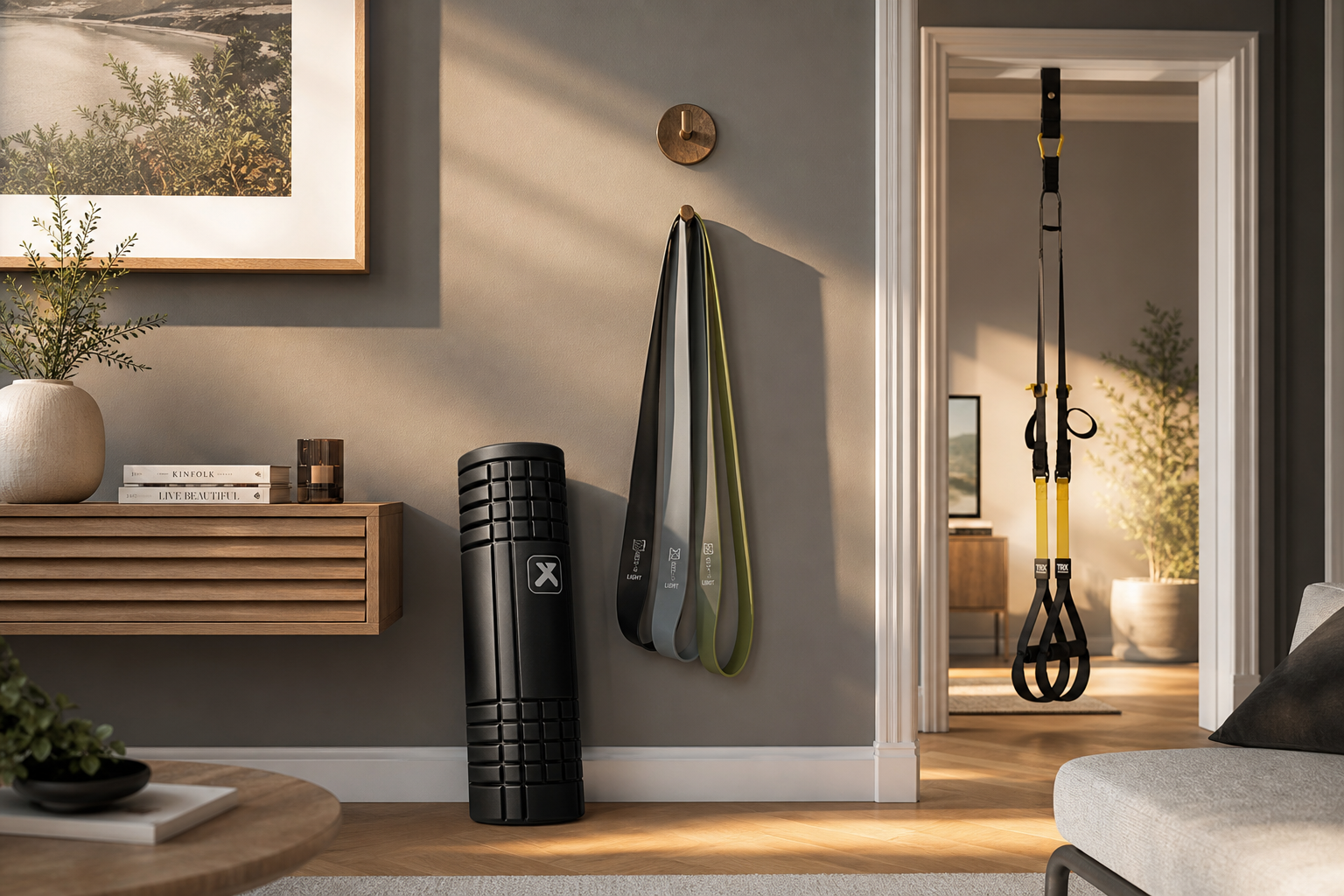
Once you’ve built a routine with the Essential 5, these additions provide exercise variety and address specific training gaps. They’re valuable but not critical for a complete program.
6. Mini Loop Bands
A set of mini loop bands (4-5 resistance levels) adds targeted hip strengthening (clamshells, lateral walks, hip abduction) that tube bands don’t easily provide. The entire set fits in a sandwich bag. They’re the second most space-efficient piece of exercise equipment after the yoga strap.
Hip strength prevents falls and supports knee health. Weak hip abductors (the muscles on the outside of your hips) allow the knee to collapse inward during walking and stair climbing, which accelerates knee arthritis and increases fall risk. Mini loops target these muscles with exercises that are difficult to replicate with tube bands or dumbbells.
Clamshells are the signature mini loop exercise. Lie on your side with knees bent and a loop band around your thighs just above the knees. Keep your feet together and lift the top knee away from the bottom knee. This directly works the hip abductors and external rotators. Start with 10-12 reps per side and progress to 15-20 reps before moving to a heavier band.
Lateral walks with a mini loop around your ankles or lower thighs build hip strength in a functional movement pattern. Step sideways while maintaining slight knee bend and upright posture. The band resists each step, forcing the hip muscles to work. Do 10 steps in one direction, then 10 steps back.
Mini loops come in resistance levels usually marked by color. Start with the lightest band. Even fit individuals often find that the light or medium band provides plenty of challenge for hip exercises. The hip muscles are smaller than the legs and fatigue quickly.
7. Light Dumbbells
A pair of 3-5 pound dumbbells adds variety to upper body exercises and enables farmer’s carries. They’re the bulkiest item on this list but fit behind a door, under a bed, or in a small corner. If space is truly limited, filled water bottles (16 oz = 1 pound, 32 oz = 2 pounds) substitute for dumbbells at zero storage cost.
Dumbbells provide a different resistance profile than bands. Band tension increases as you stretch them, while dumbbell weight remains constant throughout the movement. This makes dumbbells better for some exercises like shoulder presses and lateral raises where maintaining tension at the top of the movement matters.
Farmer’s carries are one of the most functional strength exercises available. Hold a dumbbell in each hand and walk 30-60 feet. This trains grip strength, core stability, shoulder stability, and upright posture under load. It directly translates to carrying groceries, luggage, and laundry. Start with 3-pound dumbbells and focus on maintaining upright posture and level shoulders throughout the walk.
Neoprene-coated dumbbells are quieter than bare metal or rubber-coated options if