You drag yourself out of bed, lace up your shoes, and start your morning workout. Ten minutes in, your stomach lurches. Nausea during morning exercise is common in adults over 60, and it’s almost always caused by one of five fixable issues. Most people just need to adjust their pre-workout routine, not abandon morning exercise entirely.
Once you identify which factor is triggering your nausea, the fix is usually simple. You don’t need special supplements or expensive equipment. You need to understand what’s happening in your body after a night’s sleep and how exercise interacts with those changes.
1. Low Blood Sugar from Overnight Fasting

By morning, you’ve gone 8-10 hours without eating. Your blood sugar is at its daily low. Exercise demands glucose from your muscles and brain, and when there isn’t enough available, your body responds with nausea, shakiness, lightheadedness, and difficulty concentrating. This is especially problematic if you take diabetes medication that further lowers blood sugar.
Your liver stores some glucose as glycogen and releases it overnight to keep blood sugar stable while you sleep. But those stores run low by morning. When you start exercising on depleted reserves, your body has to work harder to maintain blood sugar levels. The stress hormones released during this scramble (cortisol and adrenaline) can trigger nausea as a warning signal.
Older adults are more vulnerable to exercise-induced low blood sugar because muscle mass naturally decreases with age, reducing your body’s glucose storage capacity. If you’ve lost 10-15 pounds of muscle over the past decade, you have less glycogen available for morning workouts than you did when you were younger.
The Fix
Eat a small snack 20-30 minutes before your morning workout. Choose something that combines a fast-acting carbohydrate with a small amount of protein to sustain energy: half a banana with a tablespoon of peanut butter, a piece of toast with a thin spread of almond butter, or a small handful of crackers with cheese. Keep portions small to avoid the opposite problem (exercising on a full stomach).
The carbohydrate gives you immediate fuel. The protein slows digestion slightly, preventing a blood sugar spike followed by a crash mid-workout. If you’re taking diabetes medication, check your blood sugar before exercise. A reading below 100 mg/dL means you definitely need that pre-workout snack.
2. Dehydration from Overnight Fluid Loss

You lose 1-2 pounds of water overnight through breathing and mild sweating. Most people wake up mildly dehydrated, and the thirst mechanism weakens with age, so you may not feel thirsty even when your fluid levels are low. Dehydration reduces blood volume, which triggers nausea during the physical stress of exercise.
When blood volume drops, your heart has to work harder to pump what’s left through your system. During exercise, your muscles need more blood flow, and your digestive system gets less. That reduced blood flow to the stomach and intestines is a direct nausea trigger. Your body is essentially saying “stop moving so I can redistribute this limited blood supply.”
Older adults produce less concentrated urine, meaning your kidneys can’t hold onto water as efficiently as they once did. You may urinate once or twice during the night, compounding the fluid loss from breathing. By morning, you may be down 3-4 pounds of water, not just 1-2.
The Fix
Drink 8-12 ounces of water as soon as you wake up, at least 20 minutes before exercising. Keep a water bottle on your nightstand as a visual reminder. If plain water first thing isn’t appealing, adding a splash of lemon or a low-sugar electrolyte packet can help.
Don’t chug the entire 12 ounces at once. Sip it over 10-15 minutes while you’re getting dressed and preparing for your workout. Drinking too fast can cause stomach sloshing during exercise, which adds to nausea rather than solving it.
Room temperature or slightly warm water is easier on the stomach first thing in the morning than ice-cold water. Some people find that cold water on an empty stomach triggers mild cramping.
3. Blood Pressure Medication Timing
If you take blood pressure medication first thing in the morning and then exercise within an hour, the combined blood-pressure-lowering effects of the medication and exercise can cause excessive drops. Low blood pressure (hypotension) produces nausea, dizziness, and that “woozy” feeling that makes you want to stop moving and sit down.
Exercise naturally lowers blood pressure by dilating blood vessels. Your medication is doing the same thing. When both effects hit simultaneously, your blood pressure can drop below the level needed to adequately supply your brain and digestive system. The nausea is your body’s alarm system.
Diuretics (water pills) compound this problem by reducing blood volume, which makes the blood-pressure-lowering effects of exercise more pronounced. Beta-blockers can prevent your heart rate from increasing as much as it normally would during exercise, limiting your body’s ability to compensate for low pressure.
The Fix
Talk to your doctor about the best timing for your medication relative to exercise. Some people do better taking medication after their workout. Others benefit from splitting the dose (taking half before and half after). Never adjust medication timing without medical guidance, but raising the question with your doctor often leads to a simple solution.
If your doctor approves delaying medication until after exercise, take it within 30 minutes of finishing. Don’t skip it or push it too late in the day, as that can interfere with nighttime blood pressure control.
Another option: check your blood pressure before and after exercise for a week to see how much it drops. If you’re starting at 110/70 and dropping to 90/60 during exercise, that’s likely causing your nausea. Your doctor needs that data to adjust your medication appropriately.
4. Vestibular Sensitivity from Position Changes
Your vestibular system (inner ear balance apparatus) is more sensitive in the morning because you’ve been lying flat for hours. Rapid position changes during exercise (going from standing to bending to standing, looking up then down, turning your head quickly) can trigger motion-sickness-like nausea in people with even mild vestibular dysfunction.
The fluid in your inner ear canals helps you sense position and movement. After lying horizontal for 7-8 hours, that fluid takes time to recalibrate to upright movement. Your brain expects certain signals from your inner ear when you move, and in the morning, those signals can be slightly off. The mismatch between what your eyes see, what your muscles feel, and what your inner ear reports creates the sensation of nausea.
Age-related changes in the vestibular system make this worse. The hair cells in your inner ear that detect movement become less responsive over time. By age 60, most people have lost 20-40% of vestibular function compared to their 20s. Your system compensates well during normal daily activity, but the rapid movements of exercise can overwhelm that compensation in the morning.
The Fix
Transition between positions slowly during morning workouts. When going from lying to standing, pause in a seated position for 10-15 seconds. Avoid exercises that require rapid head movements (like looking up and down repeatedly) early in your session. Start your workout with 5 minutes of gentle walking or seated movements before introducing position changes.
Structure your workout to gradually increase position complexity. Begin with standing exercises where your head stays level. Move to exercises with gentle forward bending (keeping your head aligned with your spine, not dropping it down). Save exercises that require looking up, lying down, or rapid directional changes for the last third of your workout when your vestibular system has fully adjusted to being upright and active.
If you have diagnosed vestibular issues (benign paroxysmal positional vertigo, for example), morning exercise requires extra caution. Work with a physical therapist to identify which movements trigger your symptoms and develop a morning routine that avoids them.
5. Acid Reflux Triggered by Core Exercises
Exercises that increase abdominal pressure (crunches, planks, bending forward) can push stomach acid upward, especially in the morning when the stomach may contain residual acid from overnight. Gastroesophageal reflux disease (GERD) is common after 60 and worsens with exercise-induced pressure changes.
Your lower esophageal sphincter (the valve between your stomach and esophagus) weakens with age, making it easier for acid to escape upward. When you compress your abdomen during exercise, you’re mechanically pushing stomach contents against that weakened valve. If you ate late the night before or have a naturally high acid production rate, there’s more material to push up.
The nausea from reflux feels different than nausea from low blood sugar or dehydration. It often comes with a sour taste in your mouth, a burning sensation in your chest or throat, or a feeling of something stuck in your esophagus. You may also feel like you need to burp or clear your throat repeatedly.
The Fix
Avoid exercises that compress the abdomen early in your workout. Save core work for the middle or end of the session when your stomach has had time to settle. If you take reflux medication, take it 30-60 minutes before exercise. Avoid citrus juice, coffee, or acidic foods before morning workouts if reflux is a problem. Sleeping with your head slightly elevated (using a wedge pillow) reduces overnight acid buildup.
Rearrange your workout sequence so exercises are organized by position, not muscle group. Do all your standing exercises first (arm raises, leg lifts, squats), then seated exercises (seated rows, bicep curls), and save floor exercises (core work, stretches) for last. By the time you’re lying down or bending forward, your stomach has had 20-30 minutes to process that pre-workout snack.
If you’re a stomach sleeper, consider switching to side or back sleeping. Stomach sleeping increases abdominal pressure overnight and can worsen morning acid reflux. It takes a few weeks to adjust to a new sleep position, but the reduction in morning reflux symptoms is often worth it.
Pre-Workout Mini-Meal Timing Guide
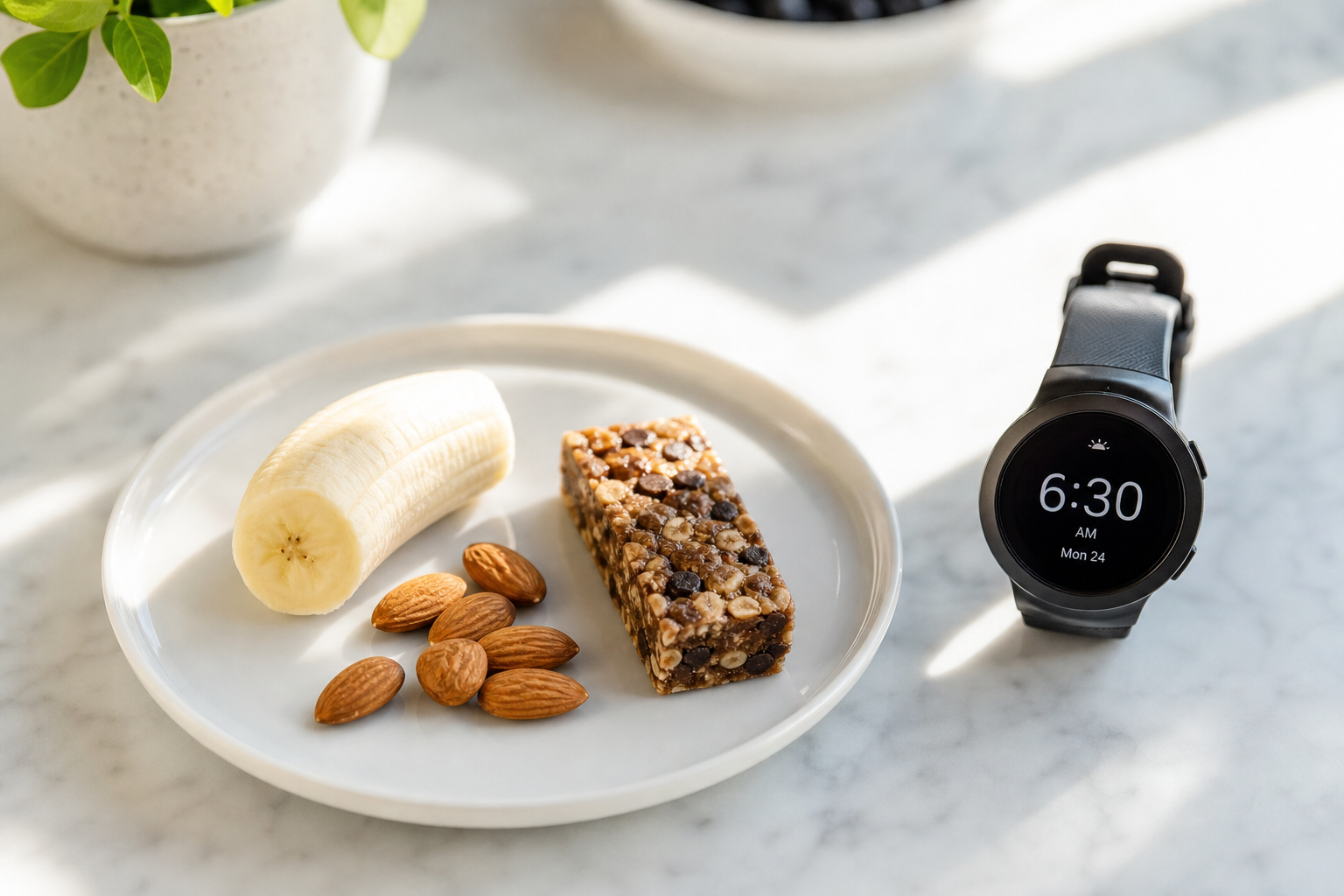
The ideal pre-workout eating window depends on what you’re eating and how intense your workout will be. Your digestive system slows down with age, so food sits in your stomach longer than it did when you were younger. Older adults generally need more time between eating and exercising to avoid stomach discomfort.
- 60 minutes before exercise: A small balanced meal (1 egg on toast, oatmeal with nuts, yogurt with fruit). Best if your workout will be intense or includes resistance training.
- 30 minutes before: A small snack (half a banana, a few crackers, a handful of dry cereal). Best for moderate walking or light exercise.
- 15 minutes before: Just a few sips of a sports drink or a couple of glucose tablets. Emergency minimum if you have no other option.
Stomach-settling food choices: Bananas, plain toast, crackers, applesauce, and oatmeal are gentle on the stomach. Avoid high-fat foods (slow to digest), high-fiber foods (can cause bloating during exercise), and dairy (can trigger nausea for some people during activity).
Fat slows digestion significantly. A tablespoon of peanut butter is fine, but a couple of eggs fried in butter will sit in your stomach for 2-3 hours. High-fiber foods like bran cereal or raw vegetables can cause gas and bloating when your body is trying to exercise. Save those for post-workout.
Individual tolerance varies. Some people can eat a full breakfast 30 minutes before a workout with no issues. Others need a full hour even after a small snack. Experiment to find your personal window, starting conservative (longer wait times) and gradually shortening if you’re not experiencing nausea.
What to Do When Nausea Hits Mid-Workout
If you start feeling nauseous during exercise, stop immediately and sit down. Don’t try to push through. Sip water slowly (don’t gulp). If you’re outdoors, find shade. Focus on slow, deep breathing through your nose.
The nausea will usually pass within 5-10 minutes once you stop moving. If it doesn’t, or if it’s accompanied by chest pain, severe dizziness, or cold sweats, those are signs to seek medical attention. Call someone or ask for help rather than trying to drive yourself.
Once the nausea subsides, you can resume exercise at a lower intensity if you feel up to it. Many people find that cutting their workout intensity in half allows them to finish without retriggering symptoms. A 30-minute brisk walk might need to become a 30-minute gentle stroll.
Track when nausea occurs during your workout. If it’s always around the 10-minute mark, that’s often a blood sugar or hydration issue. If it happens when you transition from standing to floor exercises, that points to vestibular sensitivity or reflux. If it starts during core work specifically, reflux is the likely culprit. This pattern recognition helps you apply the right fix.
Frequently Asked Questions
Should I switch to afternoon workouts if morning nausea persists?
Try the fixes above for at least 2 weeks before changing your schedule. Most morning exercise nausea resolves with proper hydration and a small pre-workout snack. If nausea persists despite these adjustments, afternoon exercise eliminates most of the contributing factors (blood sugar has stabilized, you’re hydrated, medication has reached steady state).
Afternoon workouts have their own challenges (fatigue from the day’s activities, schedule conflicts, higher outdoor temperatures in summer), but they completely sidestep the overnight fasting and dehydration issues. You’ve also been upright for hours,