Sciatica doesn’t discriminate, but it does seem to hit harder as we get older. The sharp, radiating pain that travels from your lower back down through your buttock and into your leg can turn simple tasks like getting out of a chair or walking to the mailbox into an ordeal. If you’re a senior dealing with this, you’re far from alone, and there are gentle, evidence-informed exercises that can genuinely help.
This article walks you through the most effective low-impact options, including nerve glides and targeted stretches, that many older adults find helpful for managing sciatic pain at home. We’ll also be clear about the warning signs that mean it’s time to stop exercising and call your doctor instead.
Understanding What’s Actually Happening With Sciatica
The sciatic nerve is the longest nerve in your body, running from your lower spine all the way down to your feet. When something compresses or irritates it, such as a herniated disc, bone spur, or tight piriformis muscle, you get that familiar burning, shooting, or tingling pain down one leg.
In seniors, spinal stenosis (a narrowing of the spinal canal) is one of the most common culprits. This is different from a classic disc herniation, and it actually changes which positions feel better or worse. People with stenosis often find that leaning slightly forward relieves symptoms, while standing upright or walking long distances makes things worse. Knowing your likely cause matters for choosing the right exercises.
For a broader look at how movement can address ongoing nerve-related discomfort, our guide on managing sciatica through exercise covers the full picture in more depth.
When to Stop and See a Doctor First
Before you try any of the exercises below, please read this section carefully.
Seek prompt medical attention if you experience any of the following:
- Weakness or heaviness in one or both legs that is new or getting worse
- Loss of bladder or bowel control (this is a medical emergency, call immediately)
- Numbness in the groin or inner thigh area
- Pain that is rapidly worsening over days, not improving with rest
- Sciatica following a fall or injury
These symptoms can signal something more serious than typical nerve compression, including cauda equina syndrome, which requires urgent care. Exercise is appropriate for garden-variety sciatica flares, not for neurological emergencies. When in doubt, check with your physician or a physical therapist before starting.
If you’re managing other conditions alongside sciatic pain, our article on neuropathy-safe exercises for seniors offers compatible movement strategies worth reviewing.
Gentle Nerve Glide Exercises
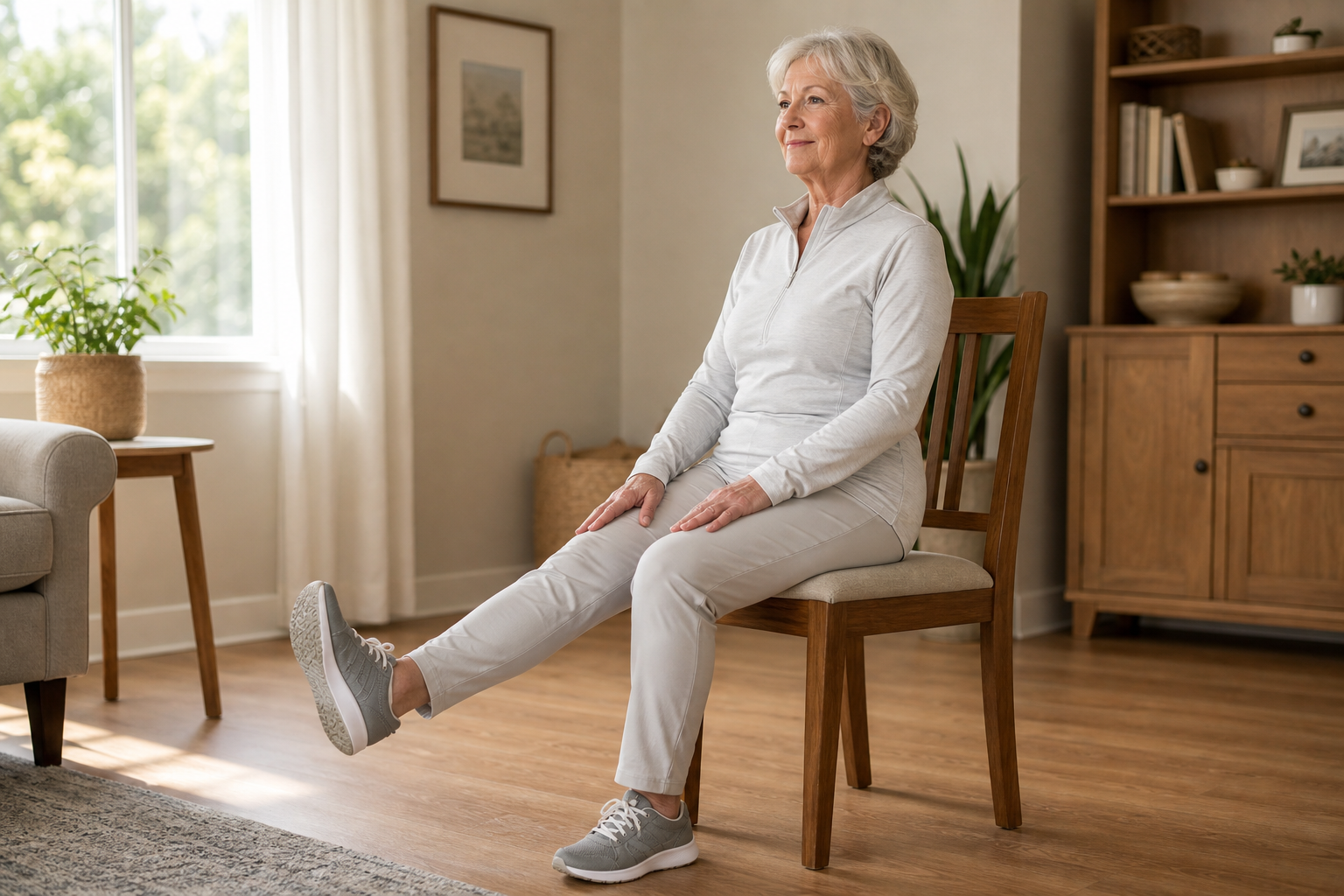
Nerve glides (sometimes called nerve flossing) are designed to gently mobilize the sciatic nerve along its path. Think of it like flossing a piece of dental floss through tight spaces. Done slowly and carefully, these movements can reduce the nerve’s sensitivity over time.
Watch this video for a clear visual demonstration of several sciatic nerve glide techniques suitable for older adults:
Seated Sciatic Nerve Glide
- Sit upright in a firm chair with both feet flat on the floor.
- Slowly straighten one knee until your leg is extended in front of you.
- At the same time, gently flex your foot (toes toward your shin).
- Hold for just 2 to 3 seconds, then slowly lower the leg and point your toes.
- Repeat 10 times on each side, once or twice daily.
Keep the movement slow and controlled. You may feel a mild stretch or tension down the back of your leg, but you should not feel sharp pain. If sharp pain occurs, stop and rest.
Supine Knee-to-Chest Nerve Glide
- Lie on your back on a firm surface with knees bent, feet flat.
- Bring one knee toward your chest and hold it gently with both hands.
- Slowly straighten that leg upward as far as is comfortable, then flex the foot.
- Bend the knee back to starting position. That’s one rep.
- Perform 8 to 10 repetitions per side.
This version is often easier on the lower back than the seated variation and is a good starting point if you’ve had a recent flare.
Stretches That Target the Root of the Problem
Stretching the piriformis muscle and hip rotators is one of the most consistently helpful approaches for sciatica relief. These muscles sit right next to the sciatic nerve, and when they’re tight, they can press directly on it.
Supine Piriformis Stretch (Figure-4 Stretch)
- Lie on your back with knees bent, feet flat on the floor.
- Cross your right ankle over your left knee, creating a figure-4 shape.
- Gently press the right knee away from your body while keeping your hips flat.
- For a deeper stretch, lift the left foot slightly off the floor and clasp your hands behind the left thigh.
- Hold 20 to 30 seconds. Repeat 2 to 3 times per side.
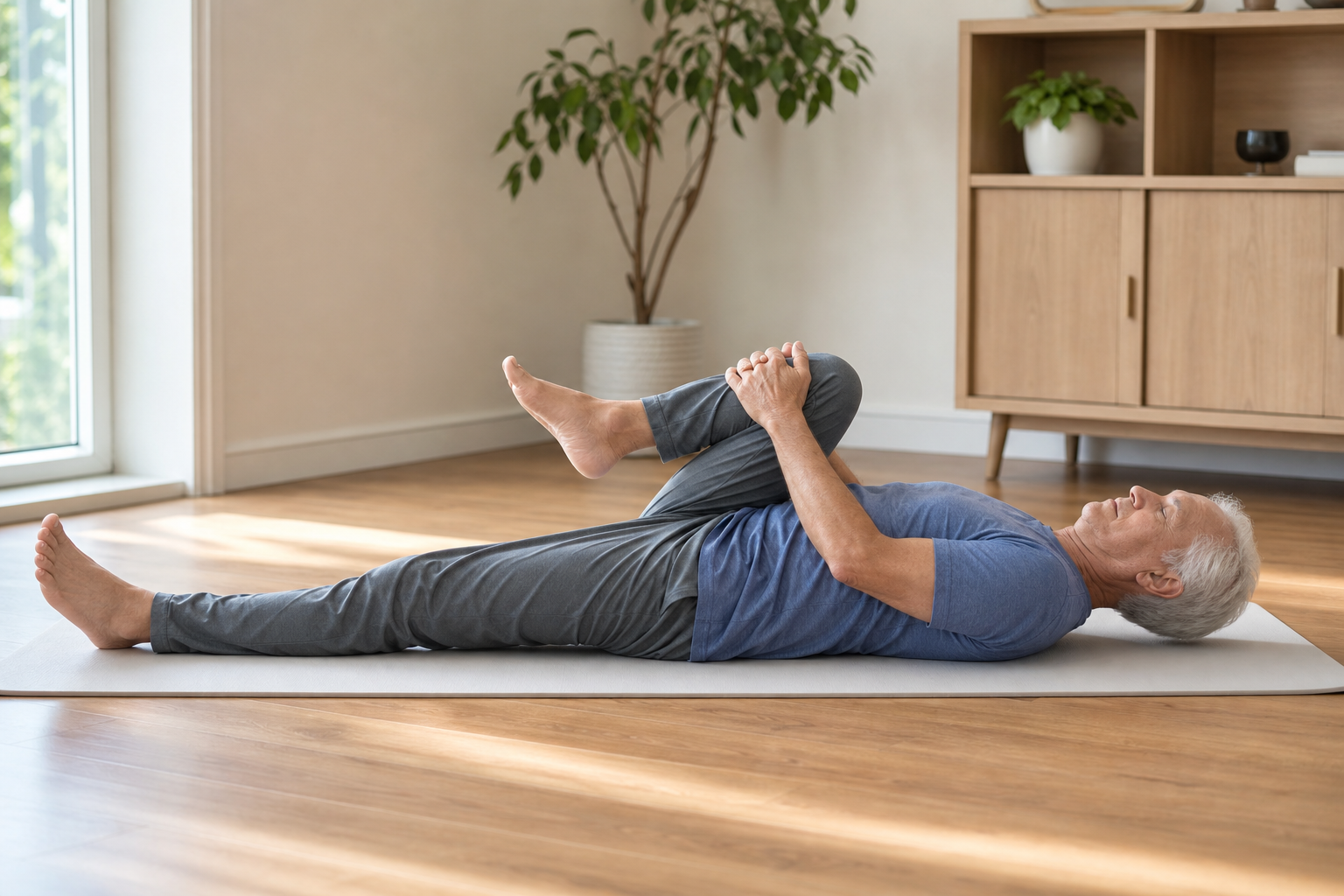
Knee-to-Opposite-Shoulder Stretch
- Lie on your back with both legs extended.
- Bend one knee and grasp it gently with both hands.
- Pull that knee slowly toward the opposite shoulder until you feel a stretch in the buttock.
- Hold for 20 to 30 seconds, then return to start.
- Repeat 3 times on each side.
If getting down on the floor is a challenge, a thick exercise mat with good cushioning makes floor work much more manageable and safer.

Extra Thick Exercise Mat for Seniors
A cushioned, non-slip mat makes floor stretches more comfortable and reduces the risk of slipping when getting up and down.
Posture, Support, and Daily Habits That Make a Difference

Exercises help, but what you do between sessions matters just as much. Prolonged sitting is one of the biggest aggravators of sciatic pain, especially sitting in a soft couch or chair that lets your pelvis tilt backward.
Using a good lumbar support cushion in your car seat or favorite chair can take meaningful pressure off the lower spine and reduce nerve irritation throughout the day.

Lumbar Support Cushion
A well-designed lumbar cushion supports the natural curve of your lower back and is one of the simplest ways to reduce daily sciatica irritation.
Improving your overall posture is also worth investing time in. Rounded shoulders and forward head posture shift your center of gravity in ways that add load to the lumbar spine. Our article on posture correction exercises for seniors has a practical program you can do alongside your sciatica work.
Additionally, if chronic inflammation is contributing to your pain (which it often does), your diet deserves a second look. An anti-inflammatory diet for active seniors can support nerve and tissue healing from the inside out.
For additional mobility support during walks or gentle activity, compression shorts designed for back support can provide gentle stabilization without restricting movement.

Compression Shorts with Back Support
These provide light compression around the hips and lower back, which some seniors find reduces sciatic flare-ups during daily activity.
Building a Sustainable Routine
Consistency beats intensity every time with sciatica. A 10-minute daily routine done gently and regularly will outperform an aggressive 45-minute stretch session done twice a week. Start with just two or three of the exercises above and build from there.
Mornings tend to be when sciatic symptoms are most noticeable, partly due to sleeping positions and reduced circulation overnight. Doing a few gentle stretches before you get fully up and moving can ease that initial stiffness significantly. Our piece on morning vs. evening exercise for seniors explores how to time your movement for the best results.
If sciatic pain is connected to a broader pattern of nerve issues, our guide on chronic pain management through movement covers complementary strategies that work well alongside what’s outlined here.
Frequently Asked Questions
How long does it typically take for sciatica exercises to start helping?
Most people notice some improvement within 2 to 4 weeks of consistent daily stretching and nerve glides. Acute flares can sometimes calm down faster, within a few days. If you’re not seeing any change after 4 to 6 weeks of gentle exercise, it’s worth revisiting your doctor or seeing a physical therapist for a more targeted plan.
Is walking good or bad for sciatica in older adults?
Walking is generally helpful, but it depends on your specific cause. If stenosis is the issue, long upright walks may increase discomfort, and walking while slightly bent forward or using a walker can help. For piriformis-related sciatica, moderate walking on flat ground often provides relief by loosening up the hip area. Start with short distances and pay attention to how your symptoms respond.
Can I do these exercises during a sciatica flare, or should I wait until the pain settles?
During a severe flare, rest for the first day or two is reasonable. After that, very gentle movement is usually more beneficial than complete bed rest, which can actually prolong recovery. Start with the mildest versions of the nerve glides and piriformis stretches, move slowly, and stop if sharp pain increases. Mild discomfort during stretching is normal. Sharp or worsening pain is a signal to back off.
This article contains affiliate links. We may earn a small commission at no extra cost to you.