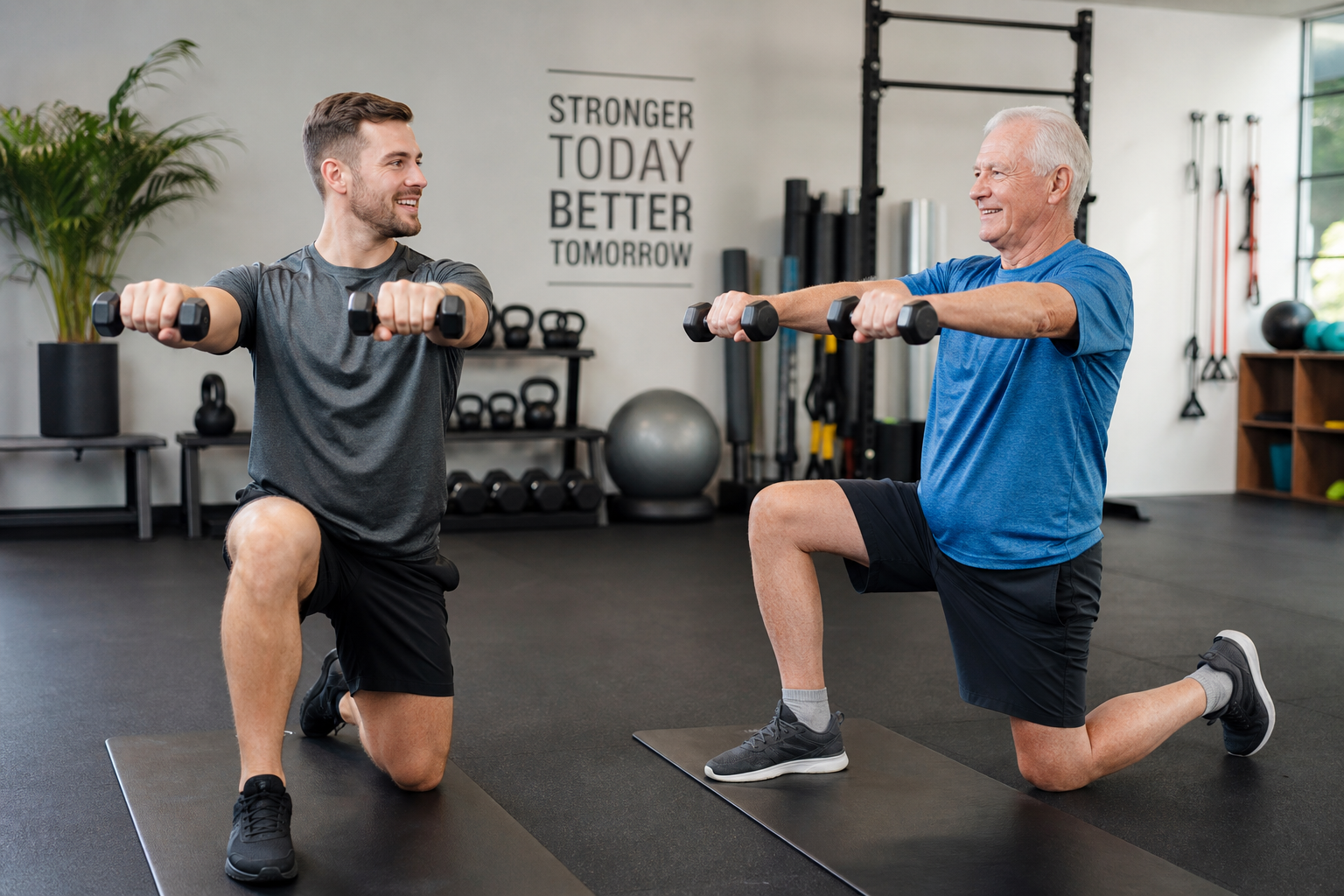
If there’s one type of exercise that delivers the most return per minute invested for adults over 65, it’s resistance training. Walking gets the most attention, yoga gets the most cultural buzz, but resistance training addresses the core issue behind most age-related functional decline: loss of muscle strength. Every difficulty you associate with aging (getting out of chairs, climbing stairs, carrying things, maintaining balance, recovering from illness) has a muscular weakness component that resistance training directly reverses.
The evidence is clear and consistent: lifting weights, working with resistance bands, or doing bodyweight exercises builds strength at any age. You don’t need a gym membership or complex equipment. You need progressive resistance applied consistently to your major muscle groups, and the benefits compound over months and years in ways that fundamentally change your daily experience.
12 Evidence-Backed Benefits

1. Reverses Muscle Loss
Sarcopenia (age-related muscle loss) accelerates after 60, with adults losing 3-8% of muscle mass per decade. Resistance training is the only intervention proven to build new muscle tissue in seniors. Studies show 1-3 pounds of new muscle and 25-50% strength increases within 12-16 weeks of consistent training, even in adults over 80.
This isn’t about vanity. Muscle mass determines whether you can carry your own groceries, get out of a bathtub safely, or walk across a parking lot without fatigue. The difference between 100 pounds of muscle and 85 pounds of muscle is the difference between independence and assistance in daily life.
The muscle loss happens silently. You might notice that opening jars is harder, that you’re more tired after walking, or that you need to use both hands where one used to work. These are symptoms of sarcopenia, and they respond quickly to resistance training. The muscle-building process works the same at 70 as it does at 30 (it just starts from a different baseline and progresses at a different rate).
2. Reduces Fall Risk
Stronger leg muscles improve your ability to recover from a stumble by taking a faster, more forceful corrective step. The LIFE study found that resistance training combined with balance work reduced serious fall injuries by 28% in adults over 70. Stronger muscles also support the joints and improve proprioception, both of which contribute to stability.
Falls aren’t inevitable with age. They’re mostly the result of insufficient leg strength to catch yourself. Your body knows how to prevent a fall (step quickly to reestablish your center of gravity over your base of support), but that protective response requires a baseline level of strength in your quads, glutes, and hip muscles. When those muscles are weak, the automatic correction doesn’t happen fast enough or powerfully enough.
Resistance training makes you harder to knock off balance in the first place. Stronger core muscles stabilize your torso. Stronger ankles give you better control on uneven surfaces. Stronger hips give you better lateral stability. The cumulative effect is that the small perturbations that cause falls in untrained seniors don’t even register as problems when your muscles are trained.
3. Builds Bone Density
Muscle contractions pull on bone at the attachment points, stimulating osteoblast activity (bone-building cells). Resistance training produces 1-3% improvements in bone density at the hip and spine over 12-18 months. For seniors with osteoporosis, this represents a reversal of the annual 1-2% bone loss that occurs without intervention.
Your bones respond to mechanical stress by becoming denser. Walking provides some stress, but not enough to reverse osteoporosis. Resistance training, especially exercises that load the spine and hips (squats, deadlifts, overhead presses), creates the kind of mechanical stress that tells your bones they need to be stronger.
The bone-building effect is site-specific. Exercises that load your spine increase spine density. Exercises that load your hips increase hip density. This is why a complete resistance training program that works all major muscle groups produces better bone density improvements than a program focused on just upper body or just lower body. For more detailed information on building bone strength, check out our complete guide to maintaining bone density after 65.
Bone density improvements take time (slower than muscle strength improvements), but they’re measurable on DEXA scans after 12-18 months of consistent training. For someone with osteopenia or osteoporosis, this can mean the difference between continuing to lose bone and actually gaining it back.
4. Improves Blood Sugar Control
Muscle is the largest glucose sink in your body. More muscle means more capacity to absorb blood sugar from the bloodstream. A single resistance training session improves insulin sensitivity for 24-48 hours. Regular training reduces HbA1c (the long-term blood sugar marker) by 0.3-0.5% in people with type 2 diabetes, an effect comparable to adding a second diabetes medication.
This happens because muscle contractions deplete the glycogen (stored glucose) in your muscle cells, which creates room for new glucose to be absorbed from the bloodstream. The effect is immediate (blood sugar drops during and after your workout) and long-term (more muscle means more storage capacity for glucose even on rest days).
Type 2 diabetes is fundamentally a disease of insufficient glucose disposal. Your body produces insulin, but your cells don’t respond well enough, so glucose accumulates in the blood. Resistance training attacks this problem at two points: it increases the number and sensitivity of glucose transporters in muscle cells, and it increases the total amount of muscle tissue available to absorb glucose.
For seniors taking diabetes medications, the blood sugar improvements from resistance training can be dramatic enough to require medication adjustments. Work with your doctor to monitor your glucose levels closely when you start a training program, because your medication needs may decrease. Learn more about managing diabetes through exercise.
5. Reduces Chronic Pain
Strengthening the muscles surrounding arthritic joints reduces the load on the joint surfaces and decreases pain. Research shows 30-40% pain reduction in knee osteoarthritis with consistent quad and hip strengthening. Back pain, shoulder pain, and hip pain all respond similarly to targeted resistance training.
Arthritis pain isn’t just about cartilage damage. It’s about the forces going through a damaged joint. When the muscles around a joint are weak, the bones grind together more forcefully. When those muscles are strong, they absorb some of the force and stabilize the joint so it tracks properly through its range of motion.
This is counterintuitive because the natural response to joint pain is to move less and avoid loading that joint. But less movement leads to weaker muscles, which leads to more joint stress, which leads to more pain. Resistance training breaks this cycle by making the muscles strong enough to protect the joint.
The key is starting at the right intensity. Too much weight too soon inflames the joint. Too little resistance doesn’t build enough strength to help. A physical therapist or trainer experienced with older adults can help you find the right starting point and progression rate for your specific joints and pain levels. Our guide to arthritis-friendly exercises provides additional safe movement options.
6. Boosts Metabolism
Muscle tissue burns more calories at rest than fat tissue. Adding 2-3 pounds of muscle increases your resting metabolic rate by approximately 50-70 calories per day. That may sound small, but over a year, it’s equivalent to 5-7 pounds of body fat difference. Resistance training also produces an “afterburn” effect (excess post-exercise oxygen consumption) that elevates calorie burning for 24-48 hours after each session.
The metabolic boost matters more as you age because your baseline metabolic rate declines with each decade. Much of that decline is due to muscle loss, not age itself. Replace the lost muscle, and you reverse much of the metabolic slowdown.
Practically, this means you can eat slightly more without gaining weight, or you can lose weight more easily if that’s a goal. The metabolic effect isn’t dramatic enough to rely on as your only weight management strategy, but it makes everything else (dietary changes, activity increases) work better. For those interested in weight management, our article on safe weight loss for seniors explains how to maintain muscle while losing fat.
The afterburn effect is real but often overhyped. You’re burning an extra 50-100 calories in the day after a hard resistance training session, not 500. But those extra 50-100 calories add up across multiple weekly sessions, and they’re calories you’re burning while sitting on the couch or sleeping.
7. Improves Heart Health
Resistance training reduces resting blood pressure by 2-4 mmHg (systolic) and improves cholesterol ratios. It also reduces resting heart rate and increases the heart’s stroke volume, making it a more efficient pump. The American Heart Association recommends resistance training at least twice per week as part of a complete cardiovascular health program.
For years, resistance training was considered secondary to aerobic exercise for heart health. That view has changed. We now know that resistance training produces distinct cardiovascular benefits that aerobic exercise alone doesn’t provide. The two types of exercise complement each other.
Blood pressure improvements happen because resistance training makes your blood vessels more elastic and responsive. The rhythmic muscle contractions during training act like a pump, improving blood flow through the entire vascular system. Your heart doesn’t have to work as hard to circulate blood, so resting blood pressure drops.
The cholesterol improvements (higher HDL, lower triglycerides) happen through multiple mechanisms. Resistance training increases the number and activity of lipoprotein lipase enzymes that clear fat from the bloodstream. It also increases insulin sensitivity, which affects how your liver processes cholesterol.
8. Enhances Mental Health
Lifting weights reduces depression symptoms as effectively as aerobic exercise in multiple studies. The sense of accomplishment from progressive strength gains builds self-efficacy, and the visible evidence of physical capability combats the helplessness that sometimes accompanies aging.
Depression in older adults often includes a physical helplessness component. You feel like your body is failing, like you can’t do the things you used to do, like decline is inevitable. Resistance training provides concrete evidence that this narrative is wrong. You can get stronger. Your body can improve. Decline is not inevitable.
The mental health benefits compound over time. Early in your training, you’re getting the acute mood boost from endorphins and the satisfaction of completing workouts. After a few months, you’re getting the deeper self-efficacy boost from tangible strength improvements. After six months or more, you’re getting the identity shift from being “someone who lifts weights” rather than “someone who is declining.”
Anxiety also responds to resistance training. The physical exertion burns off stress hormones. The focus required during exercises interrupts rumination. The regular schedule provides structure. The progressive improvement provides a sense of control in a domain (physical capability) where many seniors feel they’ve lost control.
9. Improves Cognitive Function
Resistance training increases blood flow to the brain, stimulates the release of brain-derived neurotrophic factor (BDNF), and improves executive function (planning, attention, multitasking). A study from the University of British Columbia found that twice-weekly resistance training for 12 months significantly improved cognitive function in women over 70.
BDNF is essentially fertilizer for brain cells. It promotes the growth of new neurons and the connections between them. Higher BDNF levels correlate with better memory, faster learning, and slower cognitive decline. Resistance training is one of the most reliable ways to increase BDNF.
The executive function improvements are particularly relevant for seniors. Executive function controls your ability to plan, make decisions, switch between tasks, and inhibit inappropriate responses. It’s the set of mental skills that keeps you independent. Resistance training appears to preserve and even improve these skills in ways that purely aerobic exercise doesn’t match.
The mechanism isn’t fully understood, but it likely involves multiple pathways: increased blood flow delivering more oxygen and nutrients to the brain, hormonal changes that support neuroplasticity, reduced inflammation, and the cognitive challenge of learning and performing new movement patterns.
10. Preserves Independence
The ability to live independently correlates more strongly with muscle strength than with any other physical measure. Getting out of bed, dressing yourself, preparing meals, carrying groceries, cleaning the house, and managing stairs all require muscular strength. Resistance training directly builds the strength reserve that keeps you in your own home rather than a care facility.
Independence has a threshold. Below a certain level of leg strength, you can’t get out of a chair without using your hands. Below a certain level of upper body strength, you can’t lift a gallon of milk. Below a certain level of core strength, you can’t dress yourself without assistance. These thresholds are predictable and measurable.
Resistance training keeps you well above those thresholds. It builds a buffer between your current capability and the minimum required for independent living. That buffer is what determines whether a flu bout or a minor surgery sends you to a rehab facility or just means a few slow days at home.
The strength reserve also gives you options. With good strength, you can choose to travel, take up new hobbies, help with grandchildren, or move to a new home. Without it, those options disappear one by one. The loss of options is often more distressing than the loss of any particular capability.
11. Speeds Recovery from Illness
Stronger muscles provide a larger reserve that illness, surgery, and hospitalization can draw down without reaching a critical threshold. A senior who enters the hospital with good muscle mass recovers faster and is discharged sooner than one who enters with sarcopenia. Resistance training is essentially building a fitness savings account for future health emergencies.
Hospitalization and illness cause rapid muscle loss. Bed rest alone causes 1-2% muscle loss per day. A week in the hospital can cost you 10-15% of your muscle mass. If you entered the hospital with a small reserve, that loss pushes you below the independence threshold. If you entered with a large reserve, you come out weaker but still functional.
Surgery recovery follows the same pattern. The stress of surgery, the inflammatory response, and the enforced rest all eat into your muscle reserve. Patients with better pre-surgery strength have fewer complications, shorter hospital stays, and faster returns to normal function. For specific post-surgical guidance, see our resources on post-hip replacement exercises and post-knee replacement exercises.
Resistance training before a planned surgery (when possible) improves outcomes. Even a few weeks of training can build enough reserve to make a measurable difference. For unplanned medical events, your current strength is whatever you’ve built and maintained through regular training.
12. Improves Sleep Quality
Resistance training increases the amount of deep (slow-wave) sleep, which is the most restorative sleep stage. This effect is independent of and additive to the sleep benefits of aerobic exercise. Seniors who combine resistance training with walking report the best overall sleep quality.
Deep sleep is where your body does most of its repair and recovery work. Growth hormone is released, muscle tissue is rebuilt, and the immune system is strengthened. Older adults naturally spend less time in deep sleep than younger people, but resistance training partially reverses this decline.
The sleep improvements appear gradually over weeks of consistent training. You’re not going to notice better sleep after one workout. But after a month of regular training, most people notice they’re falling asleep faster, waking up less during the night, and feeling more rested in the morning.
Timing matters slightly. Training too close to bedtime can interfere with sleep (the stimulatory effects take time to wear off). Morning or early afternoon training works best for most people, but late afternoon is fine too if you allow at least four hours between finishing your workout and going to bed.
Getting Started