Falls are the leading cause of injury among older adults, and what makes them so dangerous is that most people don’t see them coming. You might feel perfectly fine walking through your kitchen, but your balance system could already be showing signs of decline without giving you any obvious warning. The good news is you can get a real sense of where you stand, literally, with a few simple tests right at home.
These aren’t medical diagnostic tools, and they won’t replace a professional evaluation. But they give you useful, honest information about your stability so you can decide whether it’s time to take action. This guide walks you through how to do them safely, what your results mean, and when it makes sense to call in a physical therapist.
Before You Start: Set Up a Safe Testing Environment
Running a balance test without proper setup is a bit like testing your car’s brakes at highway speed. The whole point is to find your limits, which means you need to be ready for a wobble or a stumble before it happens.
Here’s what you need before you begin:
- A sturdy surface nearby. A kitchen counter, a heavy chair back, or a wall all work well. Make sure it won’t slide or tip if you grab it quickly.
- Clear floor space. Move rugs, cords, and any furniture that could catch your foot if you shift suddenly.
- Bare feet or well-fitting shoes. Avoid socks on smooth floors and never do these tests in sandals or slippers.
- A timer. Your phone’s stopwatch works perfectly.
- A second person nearby if possible. Especially for your first attempt, having someone close by adds a real layer of safety.
Don’t attempt these tests when you’re tired, right after a large meal, or if you’ve taken any new medications that day. Those variables can skew your results and increase your risk.
Test 1: The Single-Leg Stand
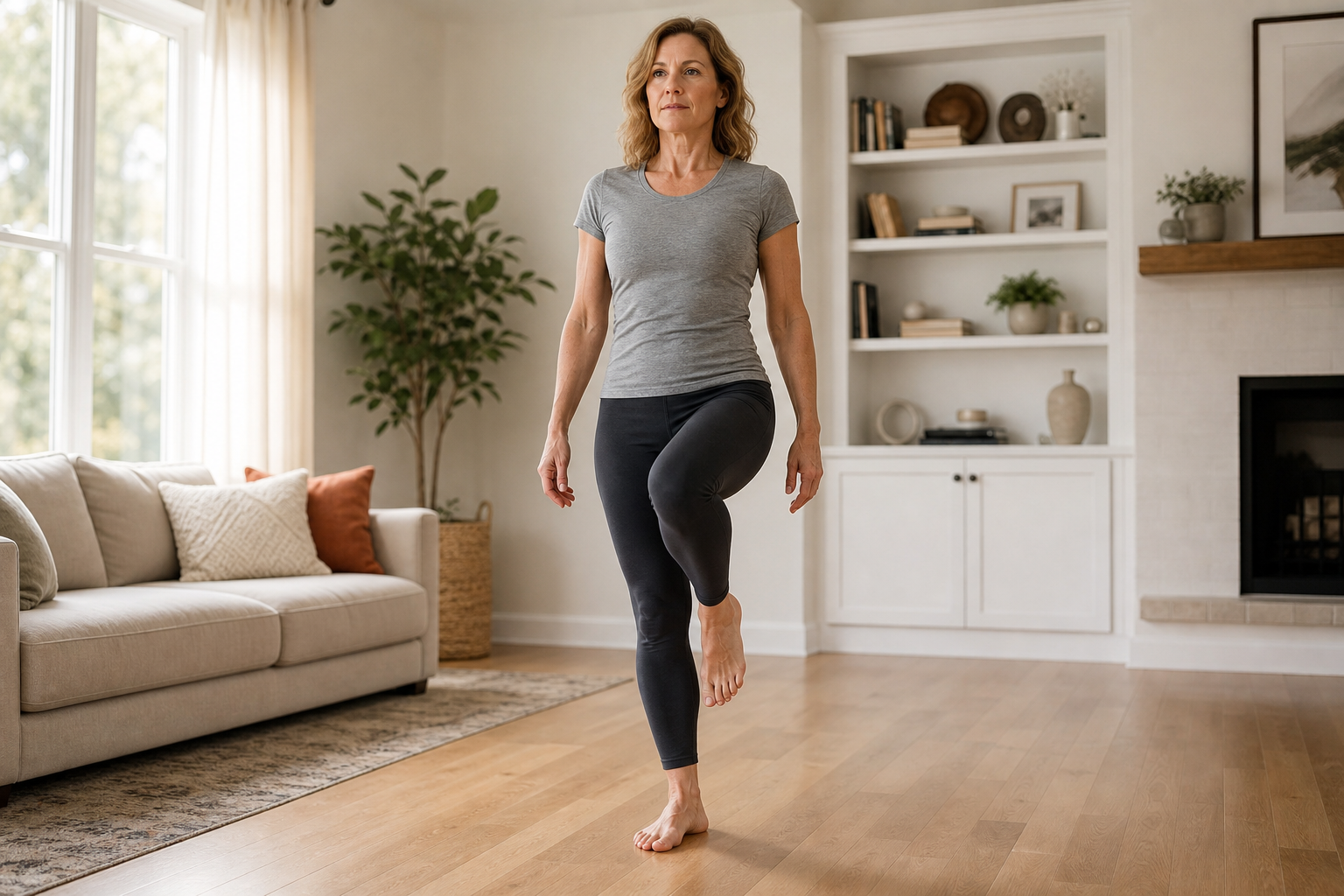
This is one of the most widely used clinical balance screens in physical therapy, and it translates directly to everyday activities like climbing stairs, stepping over a threshold, or getting dressed while standing.
How to Do It Safely
- Stand near your counter or chair back with your hands hovering just above the surface, not gripping it yet.
- Shift your weight onto one foot and lift the other foot a few inches off the ground. Bend the lifted knee slightly, but don’t let it touch your standing leg.
- Start your timer and hold as still as possible. Stop the timer the moment you need to touch down, grab the support, or your arms start windmilling significantly.
- Rest for 30 seconds, then repeat on the other side.
- Do this three times on each side and take your best time.
What Your Results Mean
Research published in journals like the Journal of Geriatric Physical Therapy gives us reasonable benchmarks to work from:
- Under 60 years old: Holding for 30 seconds with eyes open is considered solid.
- 60 to 69 years old: Around 22 to 28 seconds is a reasonable target.
- 70 to 79 years old: 14 to 20 seconds is considered good.
- 80 and older: Even 5 to 10 seconds is meaningful and functional.
If you’re holding significantly less than those ranges, or if there’s a big difference between your right and left side (more than 4 to 5 seconds), that’s worth paying attention to.
The Eyes-Closed Variation
Once you’ve done the basic test, try it again with your eyes closed, but only if you have someone standing right beside you. Closing your eyes removes visual feedback and forces your vestibular and proprioceptive systems to do more of the work. Most healthy adults can hold for about 10 seconds with eyes closed. Struggling significantly under that is a sign your balance relies heavily on vision, which is common in conditions like vertigo or inner ear dysfunction.
Test 2: The Tandem Stance
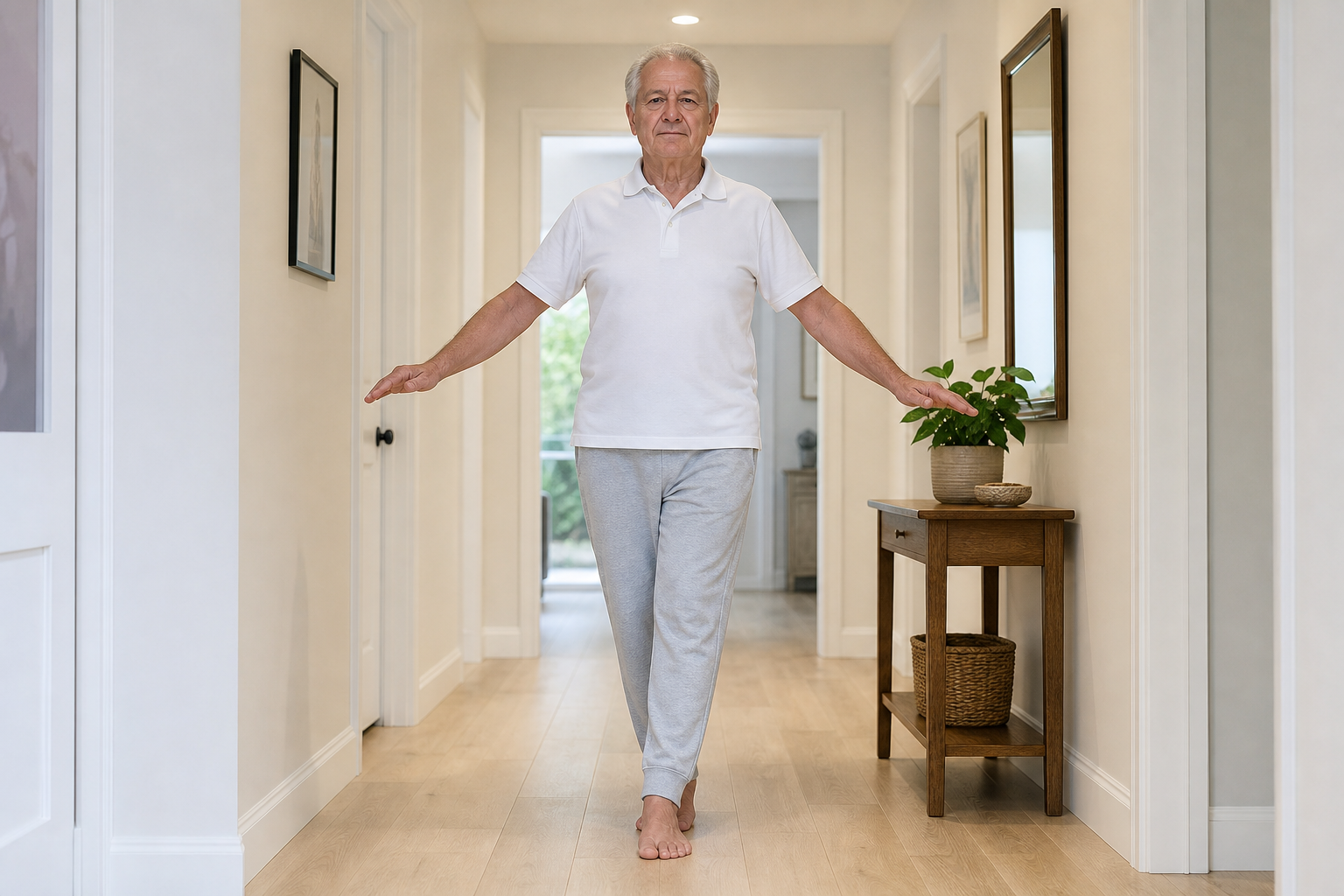
The tandem stance involves standing with one foot directly in front of the other, heel to toe, like you’re on a tightrope. It tests a different dimension of balance than the single-leg stand, specifically your medial and lateral stability, which is your ability to resist side-to-side sway.
How to Do It
- Stand near your support surface with both feet together to start.
- Step one foot directly in front of the other so the heel of your front foot is touching the toes of your back foot.
- Place your arms at your sides or cross them lightly over your chest (don’t fold them in tightly).
- Start your timer and hold the position.
- Stop when you need to step out, grab support, or your feet separate noticeably.
- Try both foot positions (right foot forward and left foot forward).
Reading Your Tandem Stance Score
The Berg Balance Scale, a tool physical therapists use regularly, considers holding the full tandem stance for 10 seconds a passing score for most older adults. Holding for 30 seconds or more with eyes open is excellent. If you can’t hold it for more than 3 to 5 seconds, or if one foot-forward position is dramatically harder than the other, take note.
You can also attempt a modified version called the semi-tandem stance, where the heel of the front foot is placed alongside the middle of the back foot rather than directly in front. This is a good starting point if the full tandem feels unsafe.
Test 3: The Timed Up and Go (TUG)
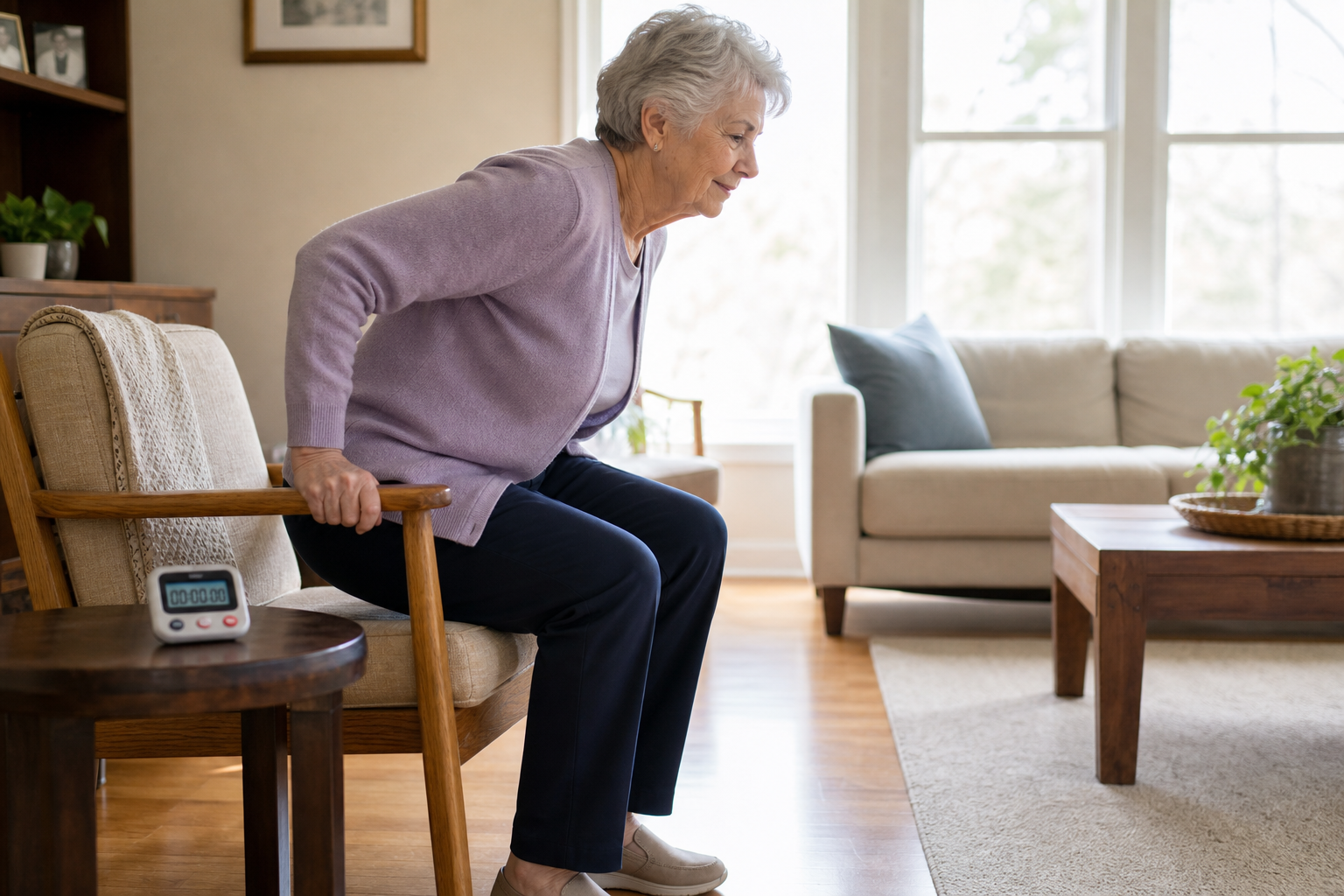
The TUG test is widely used by geriatric specialists and physical therapists because it captures something the static tests miss: your ability to transition between positions and walk safely. It’s quick and it tells you a lot.
How to Do It
- Sit in a firm chair with armrests, your back against the backrest.
- Place a piece of tape or a small object on the floor exactly 10 feet (about 3 meters) in front of the chair.
- When you’re ready, start the timer, stand up, walk to the marker, turn around, walk back, and sit down again.
- Use your normal walking speed. You’re not racing, but you’re not shuffling either.
- Use your usual walking aid if you normally use one.
Scoring the TUG
- Under 10 seconds: Generally considered low fall risk.
- 10 to 20 seconds: Moderate fall risk, especially in unfamiliar environments.
- Over 20 seconds: Associated with higher fall risk and may indicate reduced mobility and independence.
If you’re taking more than 12 seconds and you’re under 75, or more than 15 seconds and you’re over 75, that’s a meaningful signal worth discussing with a professional. If you have peripheral neuropathy, conditions affecting sensation in your feet can significantly impact this test, and dedicated neuropathy-safe exercises may help address the underlying balance challenges.
Factors That Affect Your Balance Test Results
Your scores don’t exist in a vacuum. Several common factors can drag your balance numbers down without it meaning anything catastrophic, but they’re all worth knowing about.
Medications
This is one of the most underappreciated contributors to balance problems in older adults. Blood pressure medications, sleep aids, antihistamines, and certain antidepressants can all affect stability. If you’re on multiple medications, understanding how they interact with your physical performance is important. Our guide on medication and exercise timing for seniors covers this in more detail.
Muscle Weakness
Balance isn’t just a neurological function. Your legs, core, and ankle muscles all play a direct role. Weakness in the hip abductors and the ankle stabilizers is especially common and directly tied to poor single-leg stance times. Strength training, even light progressive work, can produce noticeable balance improvements within 8 to 12 weeks.
Vitamin D and Bone Health
Low vitamin D is one of the most common and fixable contributors to fall risk in older adults. It affects both muscle function and neuromuscular coordination, not just bone density. If you haven’t had your levels checked recently, it’s worth asking your doctor. Our article on vitamin D for senior bone and muscle health breaks down how much you actually need and how to get it.
Vision Changes
Your eyes are a major part of your balance system. Outdated glasses prescriptions, cataracts, and even dry eyes can compromise your ability to read your environment and compensate for sway. If your eyes-closed test score dropped dramatically compared to your eyes-open score, vision may be playing a bigger role in your stability than you realize.
When to Stop Testing and See a Physical Therapist
Home screening tools are genuinely useful, but they have a ceiling. There are specific situations where you should skip the DIY approach and go straight to a professional evaluation.
See a physical therapist if:
- You’ve had a fall in the past 12 months, even a minor one.
- You feel unsteady on a daily basis, even if you haven’t fallen.
- Your single-leg stand time is under 5 seconds.
- Your TUG time is over 20 seconds.
- There’s a noticeable difference between your right and left side on any test.
- You have a diagnosed condition like Parkinson’s disease, which benefits from specialized balance programs. Our Parkinson’s disease exercise program is a good complement to clinical care.
- You’ve recently had hip or knee surgery and haven’t had a formal balance assessment since rehab.
A physical therapist can administer the full Berg Balance Scale, assess your gait pattern, identify muscle imbalances, and build you a specific program. Most people need only a few sessions to get a clear picture and a plan they can carry out on their own.
Building Better Balance After Your Assessment
Once you know where you stand, the next step is actually doing something about it. Balance improves with consistent, targeted practice, and the research on this is genuinely encouraging. Even adults in their 80s show measurable improvement with regular training.
A few practical starting points:
- Practice the single-leg stand near your counter every morning while you wait for your coffee. Even 30-second attempts each side build meaningful stability over time.
- Add tandem walking (heel-to-toe walking along a straight line on the floor) to your daily routine.
- Work on hip and ankle strength with exercises like side-lying hip abductions and standing calf raises.
- Consider tai chi or a structured balance class. The evidence for tai chi specifically is strong and consistent across multiple studies.
Posture also plays a bigger role in balance than most people expect. Forward head posture and rounded shoulders shift your center of gravity forward and force your stabilizing muscles to work harder. Addressing those patterns through posture correction exercises can produce real balance benefits.
Frequently Asked Questions
How often should I retest my balance at home?
Once a month is a reasonable frequency if you’re actively working on balance. Testing more often than that doesn’t give your nervous system enough time to adapt and show meaningful change. Keep a simple log of your times so you can actually track progress over weeks and months.
Is it normal to be much better on one side than the other?
A small difference between sides is normal. Most people have a dominant leg that performs slightly better. But if the gap is more than 4 to 5 seconds on the single-leg stand, or if one side feels dramatically less stable, that asymmetry is worth investigating. It can point to hip weakness, an old ankle injury, or neurological differences that a professional should evaluate.
Can I improve my balance if I’ve had a hip or knee replacement?
Yes, and this is actually one of the areas where targeted training makes the biggest difference. Post-surgical balance deficits are common because the surgery changes proprioceptive feedback from the joint. Specific rehab exercises address this directly. The guidance in our article on post-hip replacement exercise includes balance work appropriate for that recovery stage.
Do balance problems always mean a fall risk?
Not automatically, but they do raise the probability, especially combined with other factors like medication use, home hazards, or reduced strength. Balance problems exist on a spectrum. Catching them early and addressing them proactively is far more effective than waiting until a fall occurs. Think of these tests as a regular check, like getting your blood pressure measured, rather than a crisis response.