A compact home gym puts a full range of exercises within arm’s reach without consuming your living space. For seniors who want more than resistance bands but don’t have room for a multi-station gym system, the latest compact options pack serious workout capability into footprints smaller than a dining chair. These devices fold, collapse, or tuck into corners, and they provide the progressive resistance that bands alone can’t always deliver for intermediate and advanced exercisers.
The right compact gym lets you train every major muscle group, adjust resistance as you get stronger, and work out without a drive to the gym or a monthly membership fee. For many older adults, a home setup removes barriers: no commute, no equipment-sharing wait times, no feeling self-conscious in a crowded facility. You exercise on your schedule, in your clothes, with the thermostat set to your preference.
Before diving into options, talk to your doctor if you have existing health conditions, recent surgeries, or concerns about starting or changing your exercise routine. This is especially important if you have cardiovascular issues, joint problems, or balance impairments. Your physician can help you understand which movements are appropriate and which might need modification or supervision.
What to Look for in a Compact Home Gym
Footprint and Storage
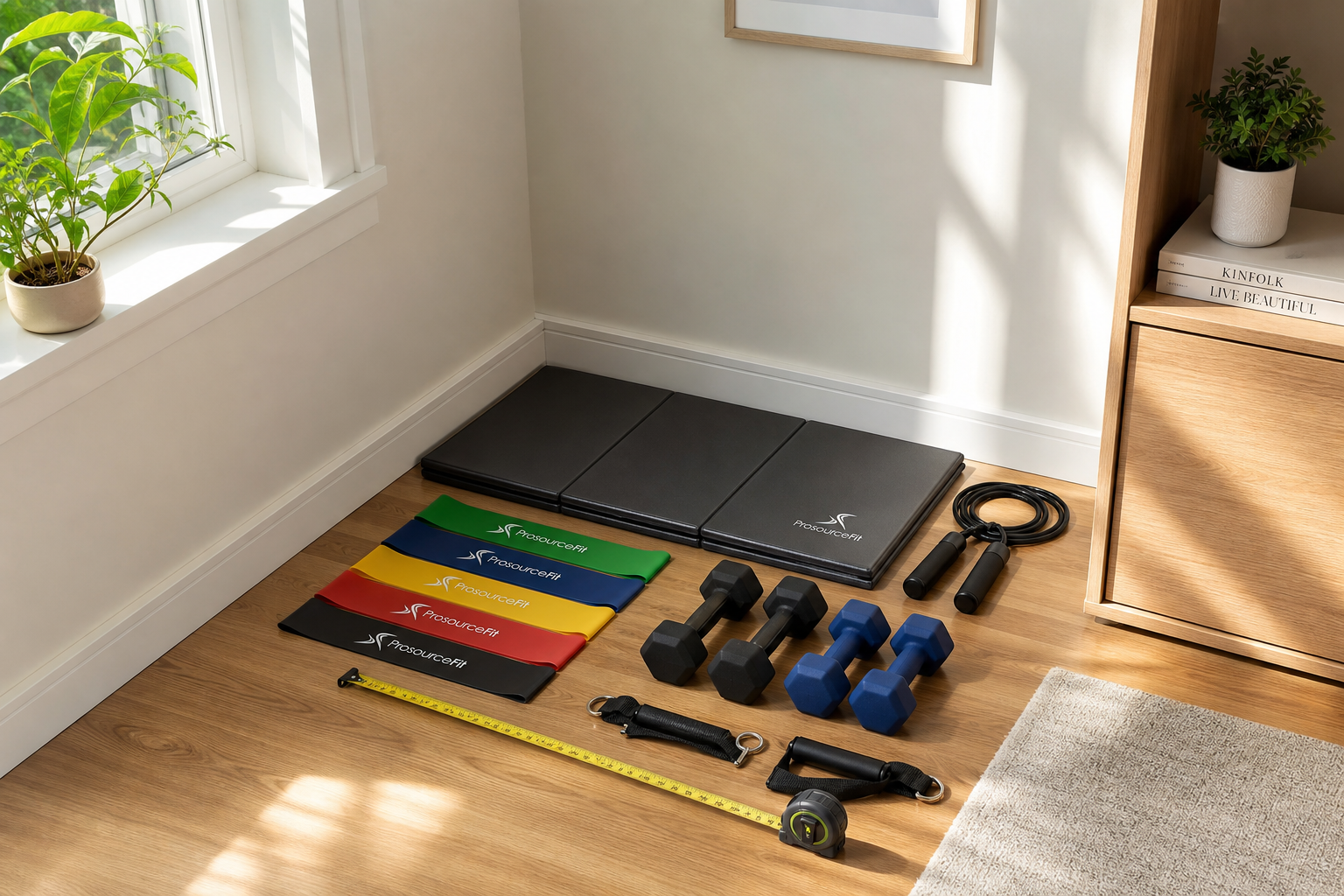
The gym must fit your space both during use and during storage. Measure the area where you’ll exercise and where you’ll store the equipment. Many compact gyms fold to half their exercise footprint. The best options occupy 4×3 feet during use and fold to 2×3 feet or less for storage against a wall or in a closet.
Consider ceiling height too. Some gyms require overhead clearance for pulldown movements or standing exercises. If you have low ceilings or plan to work out in a basement, verify that the machine accommodates your space when fully extended.
Storage weight matters. A gym that folds but weighs 150 pounds isn’t practical if you need to move it daily and can’t comfortably shift that load. Look for wheels on heavier units or choose lighter systems (under 50 pounds) if you’ll be folding and storing frequently.
Resistance Range
Seniors need a resistance range from very light (5-10 pounds for rehabilitation and warm-up) through moderate (20-50 pounds for maintenance) and potentially heavy (50-100+ pounds for progressive overloading). A gym with too narrow a range is either too easy or too hard and can’t grow with your strength.
Progressive overload is how you build muscle and bone density at any age. Your muscles adapt to a load after several weeks, and you need to increase resistance slightly to continue improving. A gym that tops out at 30 pounds might work for the first month but leaves nowhere to go after that.
Adjustability matters as much as the top resistance level. Fine increments (2.5 to 5 pounds per step) let you increase load gradually without big jumps that strain joints or discourage you. A system that jumps from 20 to 40 pounds in one step is frustrating when you need 25 or 30 pounds to match your current strength.
Seated Exercise Capability
Many compact gyms are designed for standing use. For seniors with balance concerns, a gym that includes a seat or accommodates a chair for seated exercises is essential. Check whether the exercises you need (rows, chest press, leg extensions) can be performed seated.
Balance issues are common as we age, and there’s no shame in modifying exercises to work safely. A stable seated position lets you focus on the muscle you’re training rather than on staying upright. You still get the strength benefits without the fall risk.
Some gyms include an integrated bench or seat. Others are compatible with a sturdy dining chair or workout bench you already own. Make sure the seat height works with the resistance mechanism. If the cables or bands are too high or too low relative to where you sit, you’ll struggle with proper form.
Ease of Adjustment
Switching between exercises should be quick and intuitive. If changing resistance or adjusting the seat takes five minutes and requires tools, you’ll spend more time fiddling with the equipment than exercising. Look for pin-adjustable weight stacks, simple lever adjustments, or clip systems that snap into place without frustration.
Clear labeling helps. Some gyms mark resistance levels clearly on the frame or use color-coded pins. Others require you to count rod positions or remember arbitrary settings. The easier the system is to read and adjust, the more likely you are to use it consistently.
Stability and Build Quality
Compact doesn’t mean flimsy. The gym should feel solid when you’re using it, without wobbling, creaking, or shifting during an exercise. Check weight capacity ratings. Most quality gyms support 250 to 400 pounds, which accounts for your body weight plus the resistance load during exercises like leg presses or squats.
Steel frames generally outlast plastic or thin aluminum. Welds should be smooth and complete. Cable-based systems need durable cables (aircraft-grade steel is standard) and pulleys that glide without catching or grinding.
Top Compact Home Gyms for Seniors
Bowflex PR1000
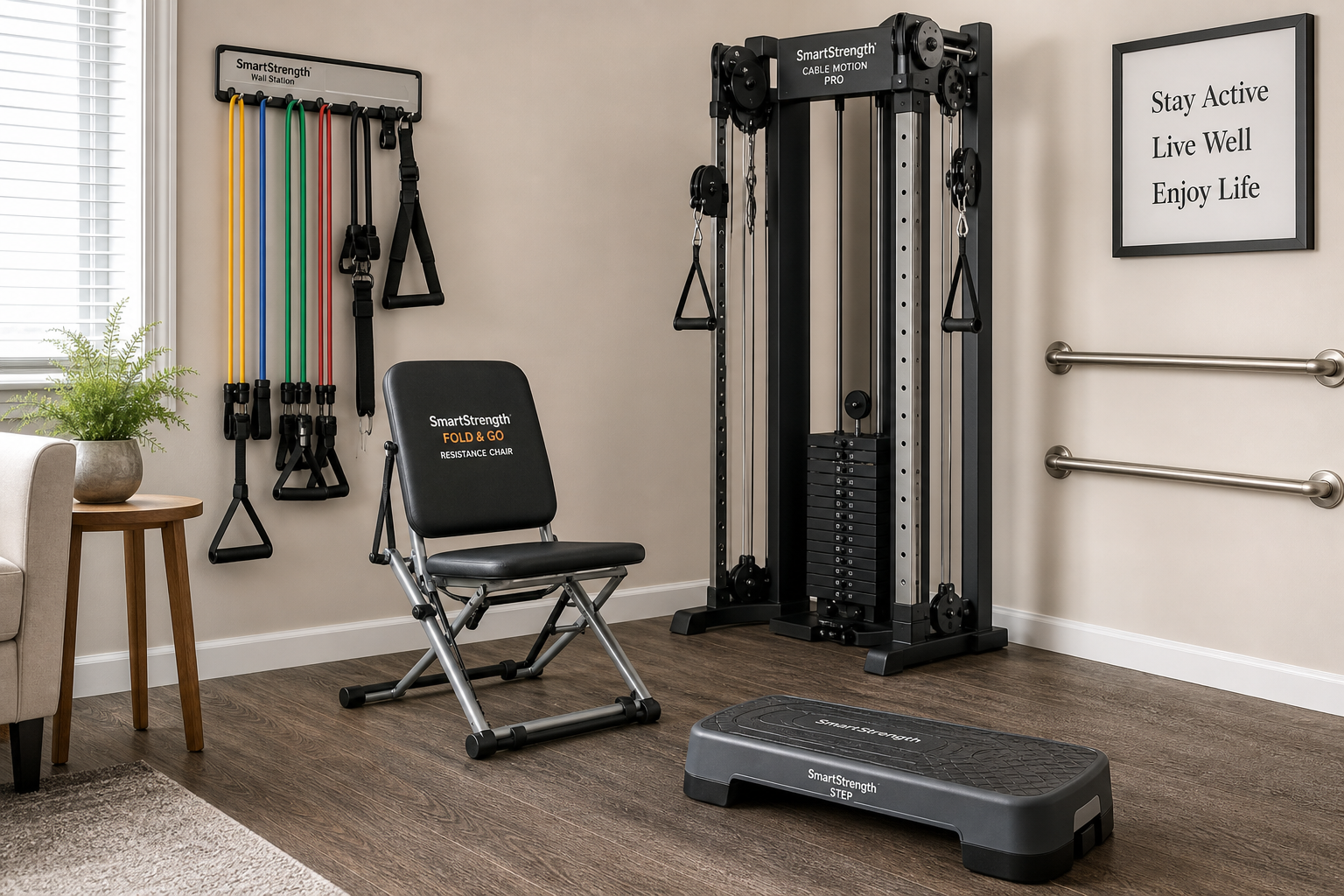
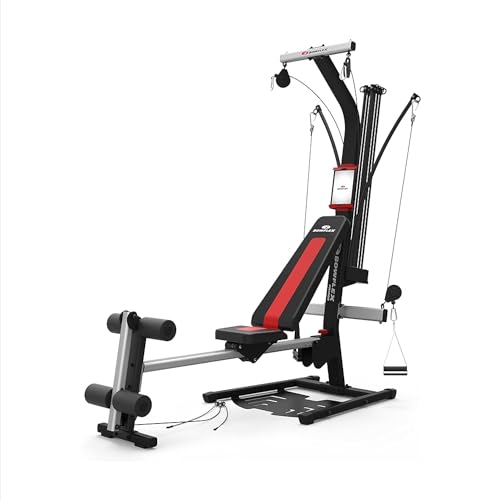
The Bowflex PR1000 uses power rod resistance (5-210 pounds) and includes a built-in rowing station, bench press, lat pulldown, and leg press capabilities. The folding design reduces the footprint by half for storage. Over 30 exercises are possible. The bench seat accommodates seated exercises, and the resistance starts light enough for rehabilitation-level work.
Bowflex PR1000
Complete guided machine with power rod resistance that grows with your strength, featuring built-in seat for safe senior workouts
The power rod system feels different from free weights or pin-loaded machines. Resistance increases slightly as you extend through the movement, which some people find more natural than the constant resistance of a weight stack. Others prefer the consistency of traditional weights. If possible, try a Bowflex at a store before buying to see whether the feel works for you.
Setup takes about two hours with basic tools. The machine ships in several boxes and requires assembly, but the instructions are clear and most people can manage it alone or with one helper. Once assembled, it’s stable and durable. The rods are lifetime-warranted against breakage.
The rowing motion is a bonus for cardio and back training. It’s not a full-featured rowing machine, but it adds variety and gets your heart rate up between strength sets. The vertical bench press position may feel awkward at first if you’re used to lying flat, but it works the same chest muscles and keeps the footprint smaller than a full bench setup.
Total Gym APEX G5
The Total Gym APEX G5 uses your body weight on an inclined glide board for resistance. Adjusting the incline changes the resistance level (8 levels from very light to challenging). Over 75 exercises target every muscle group. The lying or seated position on the glide board is comfortable for seniors with balance concerns. Folds vertically for upright storage.
The glide board approach has advantages for joint health. Your body moves smoothly along the track without the impact or joint shear of some standing exercises. The motion is fluid and controlled, which reduces injury risk. For seniors with arthritis or joint replacements, this can make the difference between exercising comfortably and avoiding exercise altogether.
Resistance is lighter than a Bowflex at comparable settings, which makes the Total Gym better suited for beginners or those focused on toning and endurance rather than heavy lifting. Advanced lifters who want to move serious weight will outgrow the upper levels fairly quickly. But for maintenance training and functional strength, it covers the bases.
The learning curve is moderate. The included workout cards and online videos show proper form for each exercise, but expect to spend a few sessions figuring out hand and foot placement. Once you learn the setup, transitions between exercises are fast.
Storage is genuinely compact. The unit stands upright against a wall and takes up about as much space as a folded ironing board. Unfolding and setting it up takes under a minute with no tools or pins to fumble with.
Resistance Band Door Gym System
For the smallest spaces, a door anchor resistance band system with multiple bands (providing 5-150 pounds of combined resistance), handles, ankle straps, and a door anchor provides a complete gym that stores in a bag the size of a shoe box. Anchor the bands at different door heights (high for pulldowns, mid for rows, low for curls) and you have the equivalent of a cable machine without the footprint.
Band systems are portable. You can pack them in a suitcase and maintain your routine when traveling. They’re silent, which matters if you live in an apartment with thin walls or work out early in the morning while others sleep.
The door anchor must be installed correctly to be safe. Thread it over the top of a sturdy door, close the door toward you (so the anchor is on the hinge side), and tug hard to verify it’s secure before starting your first exercise. Don’t use hollow-core doors, which can’t handle the stress. Solid wood or metal doors work best.
Resistance feels different from weights or machines. Bands provide variable resistance: lightest at the start of a movement, hardest at full extension. This challenges your muscles in a unique way and builds strength through the entire range of motion. Some people love the feel, others prefer the constant resistance of iron.
Quality varies widely in band systems. Look for reinforced latex or fabric bands with carabiner clips rather than cheap plastic hooks. Cheap bands snap, and a snapped band under tension can sting or injure you. Budget a bit more for a reputable brand.
Adjustable Dumbbell Set
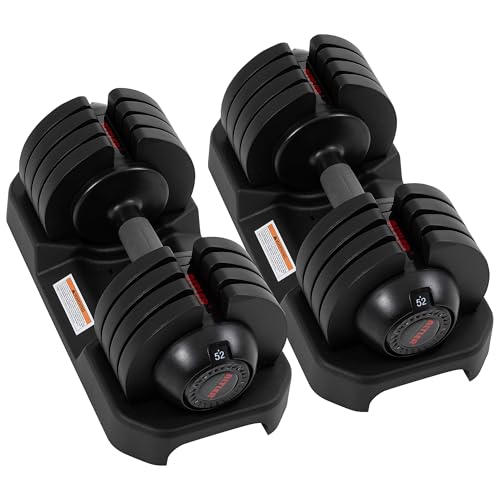
A pair of adjustable dumbbells (5-52 pounds per dumbbell) replaces 15 pairs of fixed dumbbells in a footprint the size of two shoeboxes. They allow every traditional dumbbell exercise (presses, rows, curls, squats, carries) with progressive resistance. The dial-adjustment mechanism changes weight in 5-pound increments in 2 seconds.
Adjustable Dumbbells
Space-saving solution that replaces dozens of fixed weights, perfect for seniors who want free-weight training without clutter
Dumbbells force each side of your body to work independently, which corrects strength imbalances. If your right arm is stronger than your left (common after strokes, injuries, or just from being right-handed), dumbbells reveal that gap and let you address it. Machines and bands often allow the stronger side to compensate.
The compact design is clever. A dial on each end of the dumbbell selects which weight plates lift with the handle. Unselected plates stay in the tray. The mechanism is durable if you set the dumbbells down gently, but dropping them from height can damage the selection system. Treat them with reasonable care and they’ll last decades.
Adjustable dumbbells require a sturdy chair or bench for some exercises. You’ll do chest presses, shoulder presses, and step-ups more effectively with a stable seat or platform. A basic flat workout bench pairs perfectly with adjustable dumbbells for a full home gym setup.
Free weights demand more attention to form than machines. There’s no guide rod or track, so you control the path of the weight through space. This builds stabilizer muscles and improves coordination, but it also means you can injure yourself if you lift with poor technique or attempt too much weight too soon. Start conservatively and consider a session or two with a personal trainer to learn proper movement patterns.
Choosing Between Options
Tightest budget, smallest space: Resistance band door system. Stores in a drawer. Provides complete training for a reasonable investment. Great as a starter gym or travel companion.
Moderate budget, some space: Adjustable dumbbells plus a sturdy chair. Covers all exercises with progressive loading. Best for people comfortable with free weights and willing to learn proper form.
Larger budget, dedicated space: Bowflex or Total Gym. The guided movement paths reduce form errors and the built-in seats accommodate seated exercise safely. Best for people who want the simplicity of a machine and have a corner or spare room to dedicate to fitness.
If you’re torn between options, consider your fitness history. If you’ve never lifted weights, a guided machine (Bowflex or Total Gym) reduces the intimidation factor and teaches movement patterns safely. If you’ve lifted before and just need equipment at home, dumbbells or bands offer more exercise variety and take up less space.
Setting Up Your Compact Gym Space
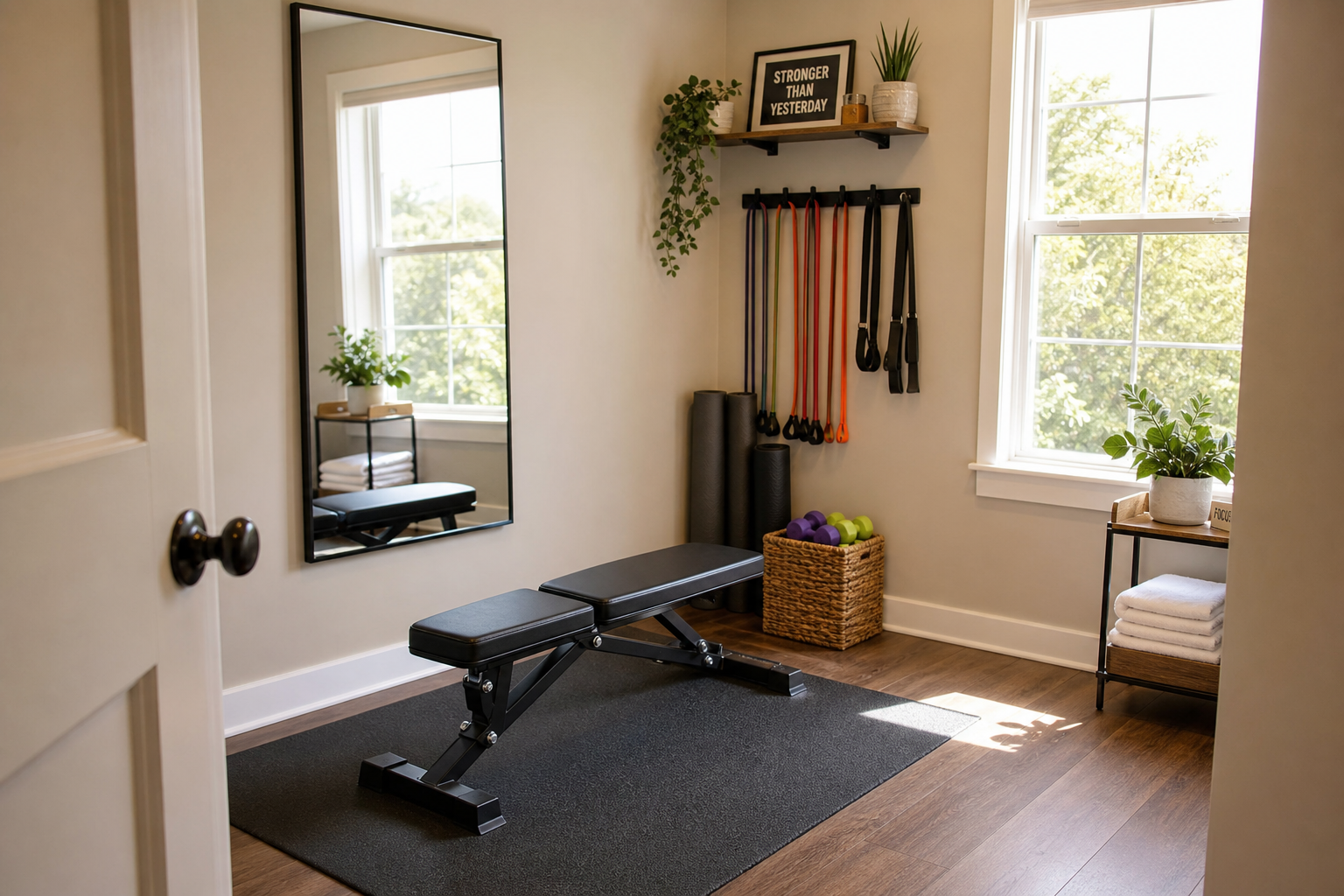
Dedicate a specific area to exercise if possible. It doesn’t need to be a full room. A corner of the bedroom, a section of the basement, or even a spot in the living room works as long as the space is clear during workout time. Having a set location helps build a routine. You’re more likely to exercise when the equipment is ready to go and not buried in a closet.
Flooring matters. A gym mat or interlocking foam tiles protect your floor from scratches and dampen noise. They also provide cushioning if you do floor exercises (planks, stretches, core work) as part of your routine. Consider checking out budget-friendly home exercise equipment options that include quality mats.
Good lighting helps you see clearly and maintain proper form. Natural light is ideal, but a bright overhead bulb or a standing lamp works fine. Avoid dim spaces where you might misjudge your position or miss a foot placement on the Total Gym glide board.
Ventilation keeps you comfortable. A small fan circulates air and prevents overheating during cardio-intensive circuits. Seniors are more sensitive to heat, and good airflow makes the workout more pleasant. Remember to follow hot weather workout safety tips when exercising indoors during summer.
Building a Routine with Your Compact Gym
Start with two to three sessions per week, allowing at least one rest day between sessions. Your muscles need recovery time to repair and grow stronger. Exercising the same muscles on consecutive days increases injury risk and slows progress.
A balanced routine includes exercises for all major muscle groups: chest, back, shoulders, arms, legs, and core. Aim for one or two exercises per group. For example, on a Bowflex you might do chest press, lat pulldown, shoulder press, bicep curls, leg press, and abdominal crunches in one session.
Reps and sets depend on your goals. For general strength and health, 8 to 12 reps per exercise for two to three sets works well for most seniors. Rest 60 to 90 seconds between sets. If 12 reps feels easy, increase the resistance next time.