Bone loss is one of those things that happens quietly. You don’t feel it, you don’t see it, and then one day a routine X-ray or a DEXA scan tells a very different story than you expected. For adults over 60, maintaining bone density isn’t just about avoiding osteoporosis on paper. It’s about staying on your feet, staying independent, and not spending your later years sidelined by a fracture that could have been prevented.
Calcium is at the center of that conversation, but it’s not as simple as “take a supplement and call it done.” There’s a food-first approach that works better for most people, specific situations where supplements make sense, and an exercise component that no pill can replace. This guide walks through all of it.
How Much Calcium Do Seniors Actually Need?
The National Institutes of Health recommends 1,200 mg of calcium per day for women over 50 and men over 70. Men between 51 and 70 need about 1,000 mg daily. These numbers are higher than what most younger adults need because calcium absorption declines with age and bone turnover accelerates, especially after menopause.
Here’s the important nuance: those numbers represent total daily intake from all sources combined, not just supplements. Most people who eat reasonably well are already getting 600 to 800 mg from food. That gap is what you’re trying to fill, not a reason to take a 1,200 mg supplement on top of a calcium-rich diet.
Getting significantly more than 2,500 mg per day from all sources combined can cause problems, including kidney stones and, according to some research, potential cardiovascular concerns. More calcium is not automatically better. Hitting your target consistently is the goal.
Food-First: The Best Dietary Sources of Calcium
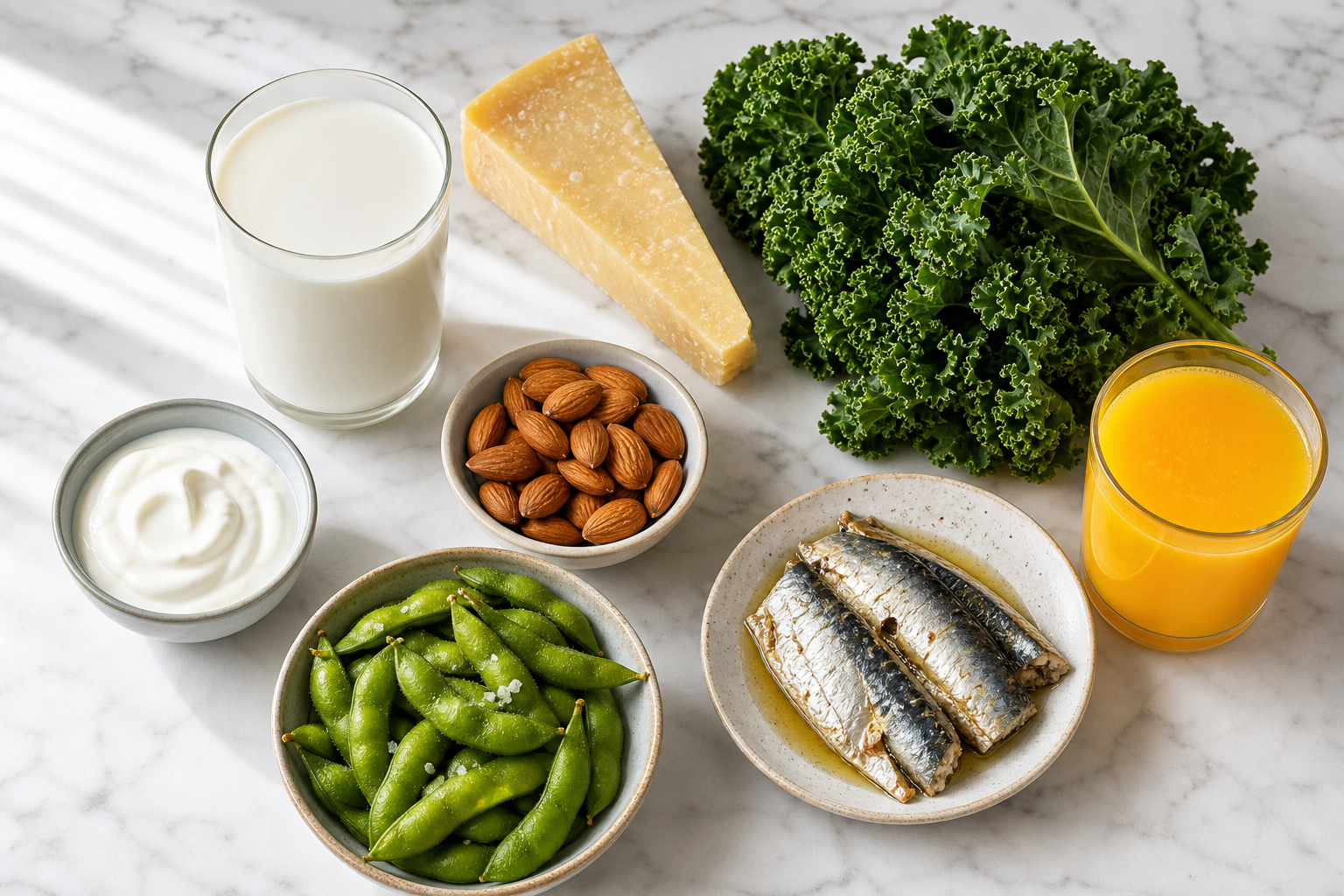
Food sources of calcium come packaged with other nutrients your body needs, and the calcium from whole foods tends to be absorbed more gradually and efficiently than what comes from supplements. Building your intake around food first is the smarter strategy.
Dairy Sources
- Plain yogurt (1 cup): roughly 300 to 400 mg of calcium
- Milk (1 cup): about 300 mg
- Hard cheeses like cheddar (1.5 oz): around 300 mg
- Cottage cheese (1 cup): approximately 200 mg
Dairy is the most concentrated and accessible source for most people. If you tolerate it well, a cup of yogurt and a glass of milk in a day puts you halfway to your goal before you’ve thought about anything else.
Non-Dairy Sources
If dairy isn’t on your menu due to lactose intolerance, preference, or a plant-based diet, there are solid alternatives. Our article on calcium sources beyond dairy for seniors covers these in depth, but the highlights include:
- Fortified plant milks (almond, soy, oat): typically 300 to 450 mg per cup
- Canned sardines or salmon with bones: 325 to 350 mg per 3 oz serving
- Tofu made with calcium sulfate: 200 to 400 mg per half cup
- Cooked collard greens or bok choy: 150 to 270 mg per cup
- White beans (canned): about 130 mg per half cup
- Almonds (1 oz): around 75 mg
Spinach and kale often get credit as calcium superstars, but spinach contains oxalates that significantly block calcium absorption. Bok choy, broccoli, and collard greens are actually better choices for absorbable calcium among the leafy greens.
The Vitamin D Connection You Can’t Ignore

Calcium and vitamin D are a package deal. Without adequate vitamin D, your body can absorb as little as 10 to 15 percent of the calcium you consume. With good vitamin D status, that absorption rate climbs to 30 to 40 percent. You can eat all the dairy and leafy greens you want, but if your vitamin D is low, much of that calcium is going to waste.
Adults over 70 need 800 IU of vitamin D daily, and many researchers in bone health advocate for levels closer to 1,000 to 2,000 IU. Deficiency is extremely common in older adults, especially those who live in northern climates or spend most of their time indoors.
We’ve covered this in detail in our guide on vitamin D for senior bone and muscle health, but the short version is: ask your doctor to test your 25-hydroxyvitamin D levels. A simple blood test takes the guesswork out of whether you actually need to supplement.
When Supplements Make Sense (and Which Form to Choose)
Supplements are not a shortcut around a poor diet, but they do fill a real gap for many seniors. If you’re consistently falling short of your daily calcium target through food alone, or if absorption issues make it hard to keep up, a well-chosen supplement is worth considering.
Calcium Carbonate vs. Calcium Citrate
These are the two main forms you’ll find on store shelves, and they’re not interchangeable for everyone.
Calcium carbonate contains more elemental calcium per tablet (about 40%), making it the more economical and compact option. The catch is that it requires stomach acid for proper absorption, so it needs to be taken with food. If you take proton pump inhibitors (like omeprazole) or have naturally lower stomach acid, common in older adults, this form doesn’t work as well.
Calcium citrate contains less elemental calcium per tablet (about 21%) but absorbs well even without food and doesn’t depend on stomach acid levels. It’s the better choice for anyone taking acid-reducing medications, anyone over 70 with reduced stomach acid, and anyone who experiences digestive upset with carbonate.

Calcium Supplement with Vitamin D3
A well-formulated calcium supplement that includes vitamin D3 is the most practical way to address both nutrients at once, especially for seniors who prefer fewer pills.
Whichever form you choose, don’t take more than 500 mg of elemental calcium at one time. Your body can only absorb a limited amount in a single dose, so spreading your intake throughout the day is more effective than taking a large amount all at once.
What to Look for on the Label
When evaluating a calcium supplement, check for third-party testing verification such as USP, NSF, or ConsumerLab. This confirms the supplement actually contains what it says it does. Look for vitamin D3 (cholecalciferol) added to the formula, as this is the more effective form of vitamin D compared to D2. Magnesium is also a valuable addition since it works alongside calcium in bone metabolism.

Calcium Citrate with Magnesium and Vitamin D
Calcium citrate combined with magnesium and D3 is a good all-in-one option for older adults with reduced stomach acid or those on acid-blocking medications.
Weight-Bearing Exercise: The Half of the Equation People Skip

No amount of calcium or supplementation replaces the mechanical stimulus that exercise provides for bone formation. Bone is living tissue that responds to stress. When you put load on your skeleton through weight-bearing and resistance activity, your body responds by building more bone. Without that stimulus, calcium has less of a reason to stay in your skeleton.
This is one reason why swimming, while excellent for cardiovascular health, doesn’t do much for bone density. The water supports your body weight and removes most of the mechanical stress your bones need.
The Best Exercises for Bone Health
Resistance training is the most effective tool for improving bone density in older adults. Exercises like squats, deadlifts, rows, and chest presses put direct load on the major bones of your body. You don’t need to lift heavy weights to get results, but you do need progressive challenge over time. Our 12-week progressive resistance training program lays out a practical framework if you’re not sure where to start.
Walking and hiking are useful weight-bearing activities, especially on varied terrain that requires balance and adaptation. They’re not as potent as resistance training for bone building, but they’re valuable and sustainable.
Impact activities like dancing, stair climbing, and gentle jogging (if your joints allow) create bone-loading forces through ground reaction. These activities are particularly beneficial for hip bone density.
For those with existing osteoporosis or low bone mass, some high-impact activities may not be appropriate. The osteoporosis exercise plan for bone strength on this site walks through safe, effective options for that specific situation.
Balance Training Matters Too
Building bone density only does so much if a fall leads to the fracture in the first place. Balance and stability work is an important companion to bone-building exercise. Tai chi, single-leg stands, and heel-to-toe walking are all accessible starting points. If balance is a specific concern for you, check out our guide on vertigo and balance exercises for seniors for a targeted approach.
Lifestyle Factors That Steal Calcium
It’s not just about what you’re putting in. Some common habits actively work against your bone health by pulling calcium out of your body or blocking its absorption.
- Excess sodium: High salt intake increases the amount of calcium your kidneys excrete. Reducing processed food intake is one of the most underrated steps for bone health.
- Too much caffeine: Coffee and tea aren’t the enemy, but drinking more than three to four cups of caffeinated beverages per day can modestly increase calcium excretion. Adding a splash of milk to your coffee is a simple way to offset this.
- Smoking: Smoking reduces calcium absorption, lowers estrogen in women, and accelerates bone loss. If you smoke, quitting is the single most impactful thing you can do for your bones beyond diet and exercise.
- Sedentary behavior: Long periods of inactivity, particularly bed rest, cause measurable bone loss within weeks. Staying active isn’t optional for bone maintenance.
- Alcohol: Heavy drinking interferes with calcium metabolism and bone formation. Moderate consumption, meaning one drink per day for women and up to two for men, is generally considered safe for bone health.
Certain medications also affect calcium and bone metabolism, including corticosteroids, some anticonvulsants, and proton pump inhibitors. If you take any of these regularly, it’s worth talking with your doctor about monitoring bone density and whether additional nutritional support is appropriate. Our overview of medication and exercise timing for seniors covers related considerations for staying active while managing medications.
Frequently Asked Questions
Is it better to take calcium in the morning or at night?
Timing matters less than consistency and dose size. The most important rule is to split your supplement intake into doses of no more than 500 mg at a time, spaced throughout the day. If you’re taking calcium carbonate, take it with meals to maximize absorption. Calcium citrate can be taken with or without food, so it’s easier to fit into any schedule.
Can you get too much calcium from food alone?
It’s uncommon but possible if you’re consuming very large amounts of dairy combined with fortified foods and supplements. The tolerable upper limit is 2,500 mg per day for adults under 50 and 2,000 mg for those over 50. Staying well below that threshold by focusing on food-based sources and using supplements only to fill gaps is the safest approach.
Do plant-based eaters have a harder time getting enough calcium?
They can, but it’s very manageable with planning. Fortified plant milks, calcium-set tofu, white beans, and low-oxalate greens like bok choy and collard greens provide meaningful calcium. The key is to actually check labels on fortified foods since calcium content varies widely between brands, and to cook or steam high-oxalate vegetables like spinach rather than relying on them as a primary calcium source.
Do collagen supplements support bone health too?
Collagen is the primary structural protein in bone matrix, so it’s not just a skin and joint supplement. Some research suggests that hydrolyzed collagen may support bone density when combined with adequate calcium and vitamin D. Our detailed look at collagen supplements for joint and skin health covers the evidence and what to look for in a quality product.
Putting It All Together
Strong bones at 65, 70, and beyond are not inevitable, but they’re also not beyond reach for most people. The approach that works is layered: build your calcium intake around whole foods first, supplement to fill what food doesn’t cover, make sure your vitamin D status is adequate, and load your bones regularly through resistance training and weight-bearing activity.
None of these steps is complicated on its own. The challenge is consistency. Your bones respond to what you do daily over months and years, not what you do perfectly for a week. Small, sustainable habits compound into meaningful protection over time.
If you want to round out your nutrition for active aging, our guide on anti-inflammatory eating for active seniors pairs well with everything covered here, since chronic inflammation is another factor that can undermine bone health over the long run.

Vitamin D3 Supplement 2000 IU
A standalone vitamin D3 supplement is useful if your calcium supplement doesn’t include enough D3 or if your blood levels are low and you need a higher dose.
This article contains affiliate links. We may earn a small commission at no extra cost to you.