If your legs feel noticeably weaker than they did a year ago, you’re not imagining it. Muscle loss after 70 is real, it’s measurable, and it affects millions of older adults. But here’s what most people don’t hear enough: weakness is not a one-way street. With the right exercises done consistently, you can rebuild leg strength, stand up more easily, and walk with more confidence, even if you feel like you’ve lost a lot of ground.
Before we get into the routine, one important note. If your leg weakness came on suddenly, appeared after a fall, or is paired with numbness or changes in bladder control, please see your doctor before starting any exercise program. Those symptoms can signal something that needs medical attention first. This guide is for the gradual, creeping kind of weakness that builds up over months.
Why Legs Get Weaker After 70

The main culprit is a process called sarcopenia, the age-related loss of muscle mass. After 70, the body loses muscle faster and rebuilds it more slowly. Inactivity speeds this up dramatically. If you’ve been sitting more due to pain, fatigue, or just habit, those leg muscles are getting the signal that they aren’t needed.
Other factors contribute too. Low vitamin D levels are closely linked to muscle weakness in older adults. Inadequate protein intake means the body doesn’t have enough building blocks to maintain or grow muscle tissue. Medications, circulation problems, and joint pain can also play a role.
The encouraging part is that muscles respond to training at any age. Studies consistently show that adults in their 70s and 80s can make meaningful strength gains with regular resistance exercise. You don’t need a gym membership or heavy weights to see results.
A Safe Progressive Routine for Leg Strength
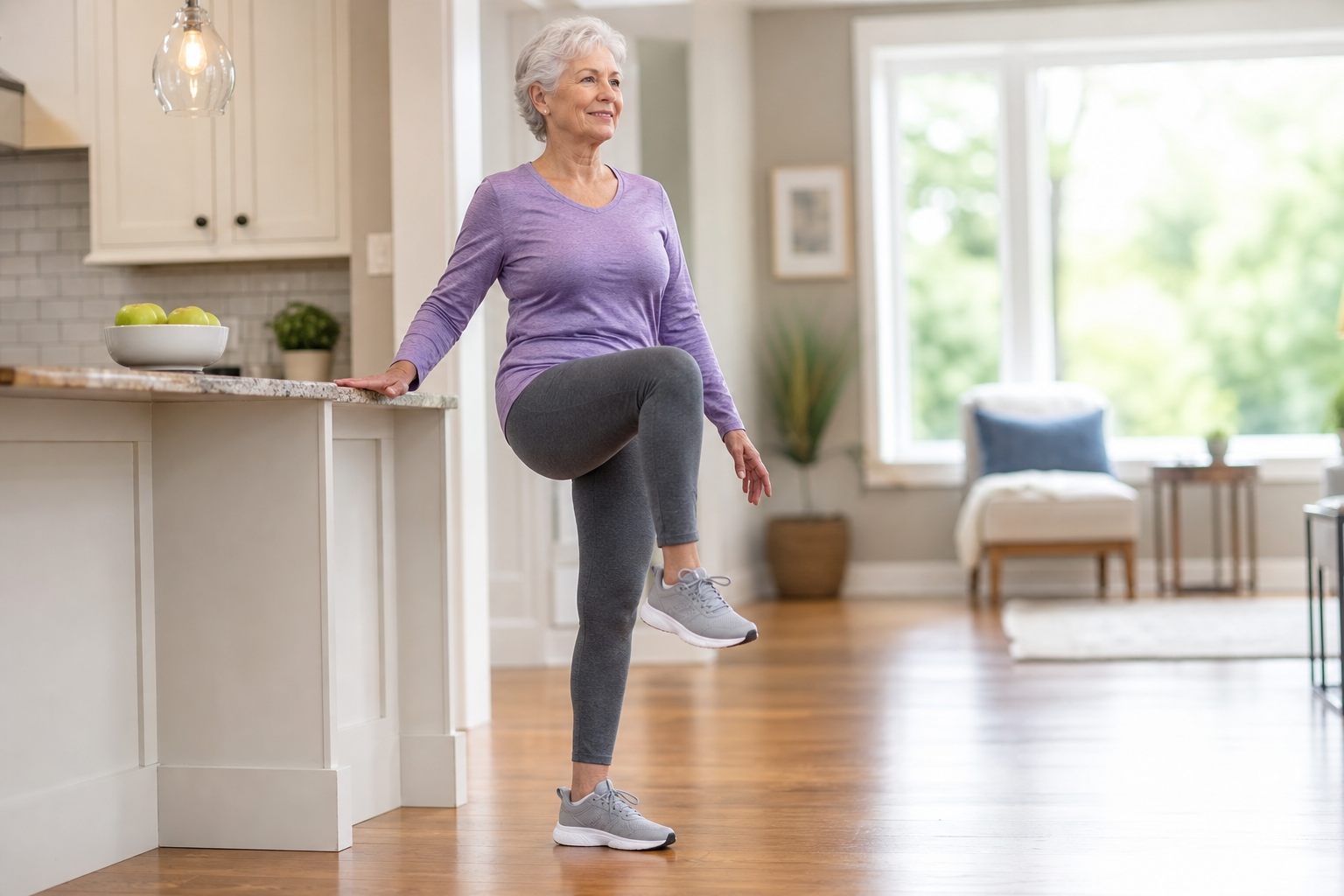
Start with the chair-based exercises below. The goal in the first two weeks is simply to build the habit and let your joints and muscles adapt. Don’t rush to add resistance.
Week 1 and 2: Foundation Moves
- Seated marching: Sit tall in a firm chair and lift one knee at a time, like marching in slow motion. Do 10 repetitions per leg, twice a day.
- Chair sit-to-stand: Slowly stand up from a chair using your legs, not your arms. Lower back down with control. Start with 5 repetitions and work up to 10.
- Heel raises (standing): Hold the back of a chair for support, rise up on your toes, hold two seconds, lower slowly. Do 10 repetitions.
- Knee extensions: Sitting in a chair, straighten one leg out, hold for two seconds, lower slowly. 10 reps per leg.
These moves target the quadriceps, hamstrings, and calves, which are exactly the muscles you need for standing and walking. If you’re also working on balance alongside strength, our article on vertigo and balance exercises pairs well with this routine.
Week 3 and 4: Add Light Resistance
Once the foundation moves feel manageable, it’s time to challenge your muscles a bit more. Adjustable ankle weights are ideal here because you can start very light, with just half a pound, and increase gradually.

Adjustable Ankle Weights
Adjustable ankle weights let you start as light as half a pound and progress at your own pace, which is exactly what you need when rebuilding leg strength after a long break.
Add the ankle weights to your knee extensions and seated marching. Keep the repetitions the same and focus on slow, controlled movement rather than speed. If you’re following a longer progressive resistance program, this routine slots in as the early phase.
Week 5 and Beyond: Standing and Walking Drills
- Step-ups: Use the bottom step of a staircase. Step up with one foot, bring the other foot up, then step back down. Hold a railing and go slowly. 5 to 8 reps per side.
- Mini squats: Stand with feet shoulder-width apart, hold the back of a chair, and bend your knees just a few inches. Hold two seconds, return to standing. Build to 15 repetitions.
- Short walks with purpose: Walk to the end of your driveway, around the block, or just down the hallway and back. Aim for 10 minutes daily and add two minutes each week.
A good pair of resistance bands can also be useful at this stage for seated leg presses and clamshell exercises that target the hip muscles supporting your knees.

Resistance Bands Set for Seniors
A light-to-medium resistance band set gives you multiple strength levels to progress through without needing any bulky equipment.
Supporting Your Progress with Nutrition

Exercise alone won’t do the full job if your muscles aren’t getting what they need to rebuild. Protein is the big one. Most older adults need more protein than they think, roughly 1.2 grams per kilogram of body weight per day. Our protein powder guide for seniors over 70 can help you fill any gaps.
After your workouts, a small meal or snack combining protein and carbohydrates helps muscle recovery. For ideas, check out these post-workout recovery meals for seniors. And if your vitamin D levels haven’t been checked recently, talk to your doctor. Low vitamin D is one of the most common and easily corrected causes of muscle weakness in this age group.
Frequently Asked Questions
How long will it take to notice improvement in my leg strength?
Most people notice some improvement within three to four weeks of consistent training, though the early gains are largely neurological, meaning your brain gets better at activating the muscles you already have. Visible muscle growth and more significant strength gains typically show up around eight to twelve weeks. Consistency matters more than intensity, especially at the start.
Is it safe to exercise if my legs hurt when I walk?
It depends on the type of pain. Mild muscle fatigue and some achiness after exercise is normal and expected. Sharp pain, joint pain that gets worse during exercise, or pain that’s new and unexplained should be evaluated by a doctor or physical therapist. Many older adults with arthritis or arthritis-related stiffness find that gentle strengthening actually reduces their pain over time, but the starting point matters. When in doubt, a single session with a physical therapist can give you a personalized green light.
This article contains affiliate links. We may earn a small commission at no extra cost to you.