A cane is not a sign of defeat. It’s a balance tool that extends your safe walking range, reduces joint pain by offloading up to 25% of your body weight, and provides the confidence to keep going places rather than staying home. The right cane fits your body, matches your needs, and doesn’t feel like a burden. The wrong one ends up unused because it’s the wrong height, the wrong type, or uncomfortable to hold.
Choosing a cane isn’t complicated, but it does require matching the design to your actual needs rather than grabbing whatever’s on sale at the pharmacy. This guide breaks down cane types, the features that matter for daily use, and how to use a cane correctly so it helps rather than creates new problems.
Types of Canes
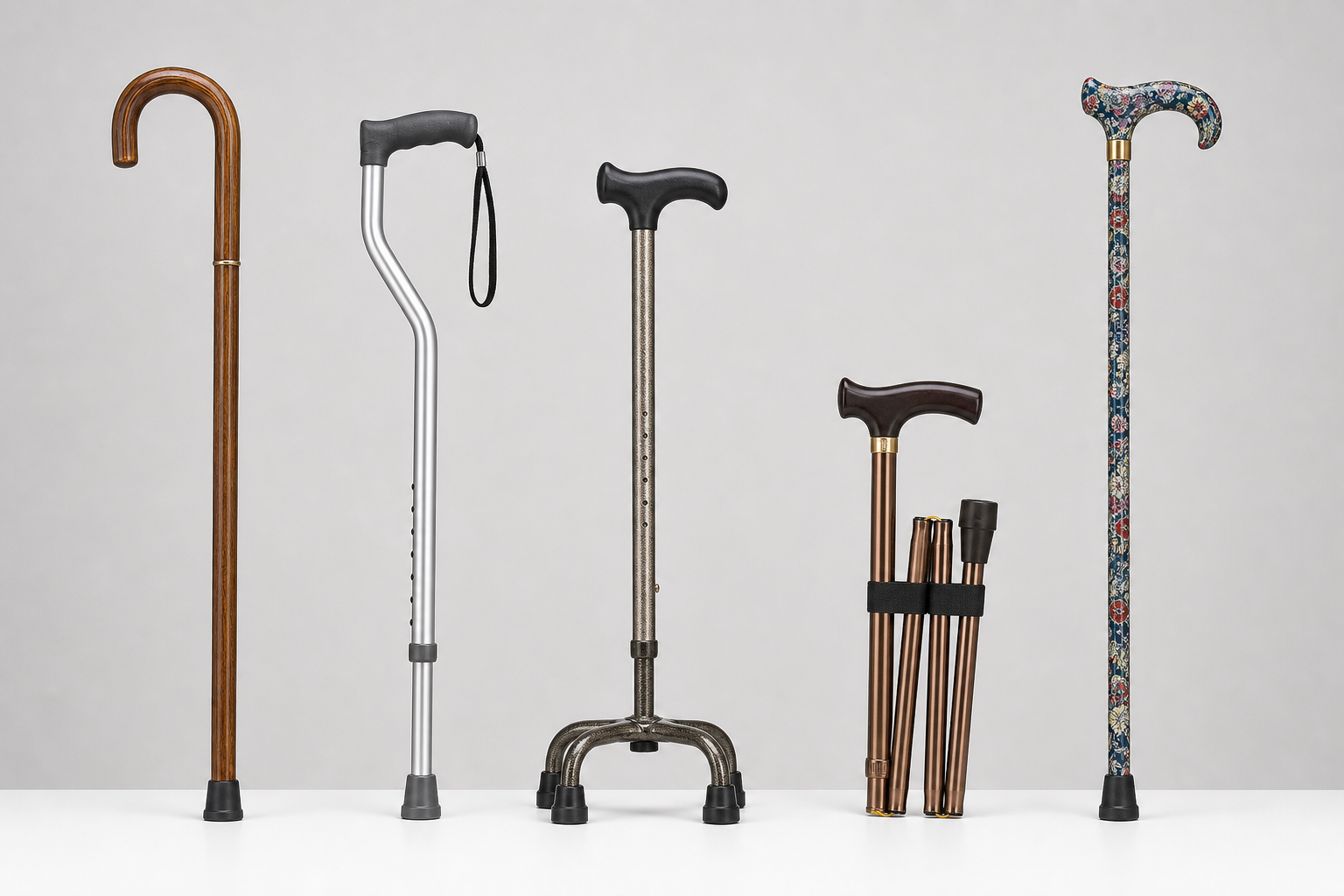
Standard Single-Point Canes
The classic walking cane with one tip. Lightweight (about 1 pound), simple, and appropriate for people who need mild balance support or pain offloading for one leg. The standard cane provides support in the forward-backward plane but minimal lateral (side-to-side) support.
Single-point canes work well on most surfaces. They’re narrow enough to navigate tight spaces like grocery store aisles, restaurant seating areas, and crowded sidewalks. The single tip doesn’t catch on carpet edges or door thresholds the way multi-point bases sometimes do.
The drawback is limited stability. If you have significant balance issues or need to lean heavily on the cane, a single point won’t provide enough support. You’re essentially balancing on one small contact patch with the ground.
Best for: Mild unsteadiness, hip or knee pain on one side, post-surgical recovery with partial weight-bearing, people who primarily need confidence support rather than heavy weight offloading.
Quad Canes (Four-Point Base)
Quad canes have four small feet at the base, providing a wider support platform. They stand upright on their own (convenient for setting down without leaning), offer more lateral stability than single-point canes, and can support more body weight. The trade-off is more weight (2-3 pounds) and a wider footprint that can catch on obstacles.
The self-standing feature matters more than you’d think. You can set a quad cane down next to your chair or bed without worrying about it falling. The four-point base also allows you to lean more heavily during rest breaks while standing.
However, quad canes require flat, even surfaces to function properly. All four feet must make contact with the ground for the cane to be stable. On uneven outdoor terrain, stairs with deep treads, or thick carpeting, one or more feet may lift off, reducing stability. The wider base also takes up more space and can bump into your ankle on the swing-through.
Best for: Moderate balance impairment, stroke recovery, people who need to lean more heavily on their cane, indoor use on flat surfaces.
Tripod Canes (Three-Point Base)
A middle ground between single-point and quad canes. Three feet provide more stability than one but less than four, with a smaller footprint than a quad cane. Lighter than quad canes and less likely to catch on carpet or door thresholds.
Tripod canes also self-stand, though they’re slightly less stable when free-standing than quad canes. The triangular base distributes weight efficiently while maintaining a relatively compact footprint. Many people find them easier to maneuver than quad canes without sacrificing much stability.
Like quad canes, tripods work best on flat surfaces. The three-point contact requires reasonably level ground to maintain stability.
Best for: People who need more stability than a standard cane but find quad canes too bulky, those who want a self-standing cane without the wide footprint of a quad.
Offset Handle Canes
The handle is offset (angled) from the shaft, positioning your weight directly over the cane tip rather than behind it. This distributes weight more efficiently and reduces wrist strain. Most modern medical-grade canes use an offset handle design. The flat-top handle also allows you to lean on the cane while standing in line or resting.
Traditional straight canes position your hand behind the shaft, creating a slight backward angle that’s biomechanically inefficient. The offset design places your hand directly over the shaft, transferring weight straight down through the cane to the ground. This reduces the strain on your wrist and elbow.
Offset handles come in both single-point and multi-point base configurations. If you’re buying a new cane, choose an offset handle unless you have a specific reason to prefer a traditional straight design.
Folding Canes
Canes that fold into 3-4 sections for storage in a purse, backpack, or car door. They’re convenient for intermittent use (you don’t always need the cane but want it available). Folding mechanisms slightly reduce the cane’s rigidity and weight capacity compared to solid-shaft models.
Folding canes work well for people who need a cane occasionally but not constantly. If you walk fine at home but want support for longer outings, a folding cane travels easily. They’re also useful for people who use a wheelchair or scooter for long distances but need a cane for short transfers and indoor walking.
The joints where the sections connect are potential weak points. Check the locking mechanisms regularly to make sure they’re secure. Most folding canes support 250 pounds or less, which is adequate for most users but lower than some solid-shaft canes.
Best for: Intermittent use, traveling, people who need a backup cane in the car, those with limited storage space at home.

Adjustable Folding Cane
Perfect for travel and intermittent use with secure locking mechanism
Key Features for Seniors
Height Adjustment
Your cane must be the correct height. When standing upright with your arm relaxed at your side, the cane handle should be at wrist level (the crease where your hand meets your wrist). Your elbow should bend about 15-20 degrees when gripping the handle. Too short and you lean forward. Too tall and your shoulder rides up. Most adjustable canes have push-button height settings in 1-inch increments.
Measure while wearing the shoes you’ll typically use with the cane. A half-inch difference in heel height changes the proper cane height. If you wear sneakers most days but dress shoes for church or appointments, set the cane height for your everyday shoes.
Fixed-height canes (usually wooden) work fine if they happen to match your height perfectly, but adjustable canes are more forgiving. If you share a household with someone else who might occasionally need your cane, adjustability matters even more.
A too-short cane forces you to lean to the side, shifting your weight away from the cane and defeating its purpose. A too-tall cane pushes your shoulder up with every step, creating neck and upper back tension. Get the height right before worrying about any other feature.
Handle Comfort
You’ll grip this handle for thousands of steps. Ergonomic contoured handles distribute pressure across your palm and reduce finger fatigue. Gel-padded handles cushion arthritic joints. Avoid thin, round handles that require a tight grip. If you have significant hand arthritis, a Fischer-style ergonomic handle (shaped to match the natural contour of your palm) significantly reduces hand pain during extended use.
Handle shape affects how much of your hand makes contact with the cane. Round handles concentrate pressure on a small area, requiring a tighter grip to maintain control. Ergonomic handles spread the load across your entire palm, reducing the grip strength needed.
Foam padding helps, but it compresses over time and needs replacement. Gel padding lasts longer and provides better cushioning for arthritic joints. Some handles have grooves or finger contours that guide your grip into the most efficient position.
If you have carpal tunnel syndrome or weak grip strength, a platform handle (also called a palm grip) distributes weight across the entire palm and wrist, eliminating the need to curl your fingers around a handle. Platform handles look unusual but can be life-changing for people with severe hand arthritis or neurological conditions affecting grip.
Tip Quality
Standard rubber tips wear down after 3-6 months and lose their grip. Replace tips regularly (carry a spare). Wider tips (3/4 inch or more) provide better stability than narrow tips. Pivoting tips (that angle with the ground surface) maintain full contact even when the cane isn’t perfectly vertical. For winter use, retractable ice tips with metal spikes provide traction on ice and snow.
Check your cane tip monthly. Hold the cane at eye level and look at the bottom. If you see the metal shaft poking through anywhere, or if the rubber is worn smooth, replace the tip immediately. Worn tips slip on smooth floors, especially tile and linoleum.
Cane tips aren’t universal. Measure the diameter of your cane shaft before buying replacement tips. Most standard canes use 5/8-inch or 3/4-inch tips, but check your specific cane. Quad and tripod canes often need matching replacement foot sets rather than individual tips.
Pivoting tips have a flexible joint that allows the rubber to angle with the ground. If you naturally walk with your cane at a slight angle (most people do), a pivoting tip maintains full ground contact while a fixed tip rocks onto one edge. The difference is subtle but noticeable on long walks.
Weight Capacity
Standard aluminum canes support 250-300 pounds. Carbon fiber canes are lighter but may have lower weight limits. Check the manufacturer’s rating and choose a cane that supports at least 50 pounds above your body weight for a safety margin.
Weight capacity isn’t just about static load. Impact forces when walking can be 1.5 to 2 times your body weight, especially if you have an uneven gait or lean heavily on the cane during steps. The safety margin accounts for this.
Bariatric canes are available for weight capacities up to 500 pounds. They use reinforced shafts and heavier-duty tips. If you need a bariatric cane, don’t try to make do with a standard model. The standard cane may hold up for a while, but it’s not designed for the sustained load and will eventually fail.
Wrist Strap
A simple wrist strap lets you release the cane briefly without dropping it. This matters when you need to open a door, pay at a register, or pick something up. The strap loops around your wrist, leaving the cane dangling when not in use.
Adjust the strap snugly enough that it won’t slide off but loose enough that it doesn’t restrict circulation. Some people dislike wrist straps because they feel tethered, but they’re worth trying. If the cane falls and you instinctively grab for it, you risk a fall. The strap prevents that situation.

Quad Cane with Offset Handle
Best choice for moderate balance issues with self-standing stability
How to Use a Cane Correctly