The elliptical is marketed as the joint-friendly alternative to treadmill walking. Your feet never leave the pedals, there’s no impact, and the smooth motion should feel gentle on knees and hips. Yet many seniors step off the elliptical with aching knees, sore hips, or a stiff back, wondering why the “low-impact” machine feels harder on their joints than a simple walk.
The machine isn’t broken. Your setup, technique, or specific machine type is mismatched with your body.
Before making any changes to your current exercise routine or trying these adjustments, talk to your doctor, especially if you have existing joint conditions, arthritis, or balance concerns. These fixes address common setup and technique issues, but individual ability varies significantly.
Fix 1: The Stride Length Is Wrong
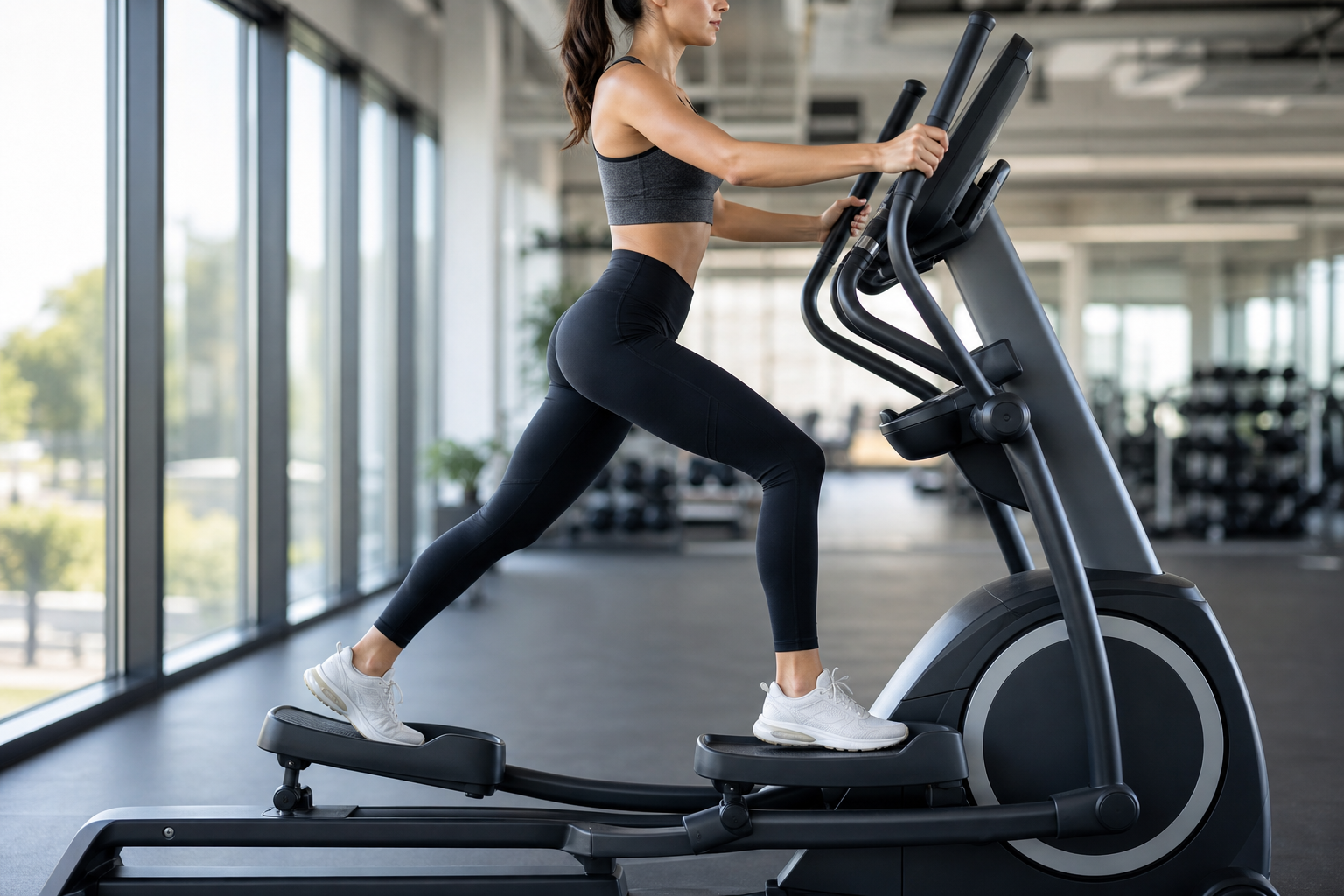
Ellipticals have fixed or adjustable stride lengths ranging from 14-22 inches. A stride that’s too long for your leg length forces your hips into excessive extension and your knees into an unnatural arc. A stride that’s too short cramps your movement and increases knee compression at the bottom of the pedal stroke.
The mismatch shows up as specific pain patterns. If you feel pulling or strain in the front of your hip at the top of each pedal stroke, your stride is too long. If your knees feel jammed or compressed when the pedals are at their lowest point, your stride is too short. The pain typically appears 5-10 minutes into your session as repetitive strain accumulates.
Solution: Your stride length should roughly match your natural walking stride (typically 18-20 inches for average-height adults, shorter for shorter seniors). If your elliptical has adjustable stride, reduce it by 2-inch increments until the motion feels natural. Test each new setting for at least 3-4 minutes before adjusting again. If the stride is fixed and doesn’t match your body, this machine may not be right for you.
A proper stride length feels smooth through the entire pedal rotation. You shouldn’t feel like you’re reaching at the top or getting cramped at the bottom. Your hips should stay level without rocking side to side, and your knees shouldn’t extend past your toes at any point in the motion.
Fix 2: You’re Leaning on the Handles
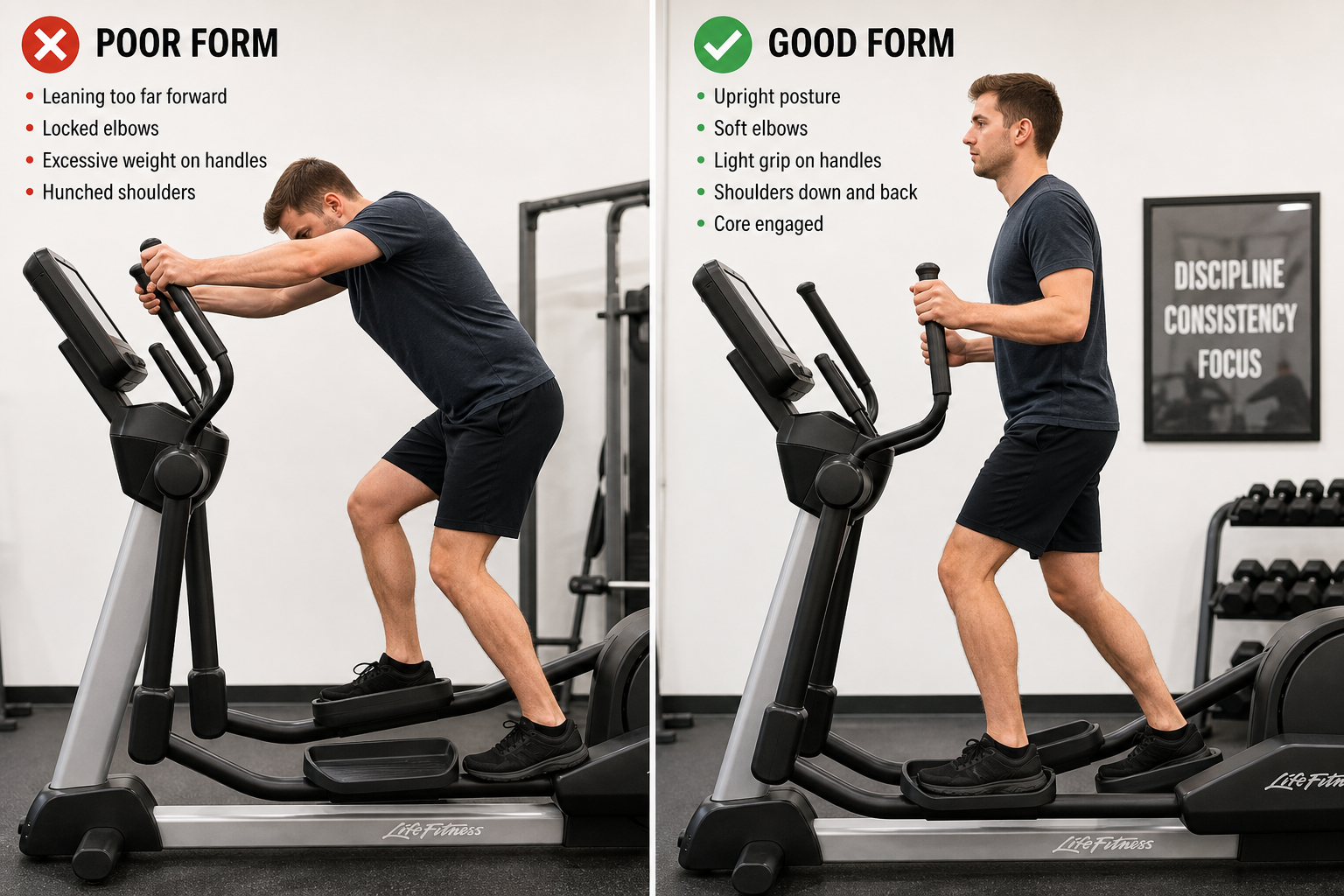
Gripping the moving handles and leaning forward shifts your weight off your legs and onto your arms, which changes the elliptical from a lower-body exercise into an upper-body strain exercise. The forward lean also compresses the lumbar spine, which produces the back pain many seniors report after elliptical sessions.
This posture error is common because the moving handles seem like they’re there to hold for stability. But the more you lean, the more weight transfers forward, and your shoulders, wrists, and lower back carry load they weren’t designed for during cardiovascular exercise. You end up with sore forearms and an aching back while your legs barely work.
Solution: Stand upright on the pedals. Use the stationary handles (not the moving ones) for light balance support only. If you need the moving handles for balance, hold them with a relaxed grip and keep your torso vertical. Your legs should drive the motion, not your arms.
Check your form in a mirror if possible. Your shoulders should be stacked over your hips, not pitched forward. You should be able to briefly let go of the handles without losing balance. If you can’t, slow down and reduce resistance until your core strength catches up. It’s fine to touch the handles lightly for reassurance, but they shouldn’t bear significant weight.
If balance is a genuine concern, consider starting with a recumbent bike or seated stepper instead. These provide back support and remove the balance challenge entirely while still offering low-impact cardiovascular conditioning. For more details on choosing between these options, check out our exercise bike vs elliptical comparison guide.
Fix 3: The Resistance Is Too High
High resistance makes the elliptical feel like climbing stairs in sand. The added force on each pedal stroke loads the knees and hips beyond what the “low-impact” marketing suggests is possible. For seniors with arthritis, excessive resistance negates the joint-friendly advantage of the machine.
Many people assume more resistance means a better workout. That’s true for muscle building, but cardiovascular conditioning comes from sustained moderate effort, not fighting heavy loads for a few minutes. When resistance is too high, your stride often gets shorter and choppier because you can’t complete the full range of motion smoothly. This choppy motion actually increases joint stress rather than reducing it.
Solution: Start at the lowest resistance setting and increase by one level every 2 weeks only if your joints tolerate the current setting without increased pain. The cardiovascular benefit comes from sustained movement at moderate effort, not from fighting heavy resistance. A light resistance for 20 minutes provides better heart conditioning for most seniors than a heavy resistance for 8 painful minutes.
You should be able to maintain a conversation in short sentences during your elliptical session. If you’re too breathless to speak, either the resistance is too high or you’re moving too fast. Dial it back. Effective cardiovascular exercise feels like moderate effort sustained over time, not brief bursts of maximum strain.
Fix 4: Your Feet Are Rolling Inward
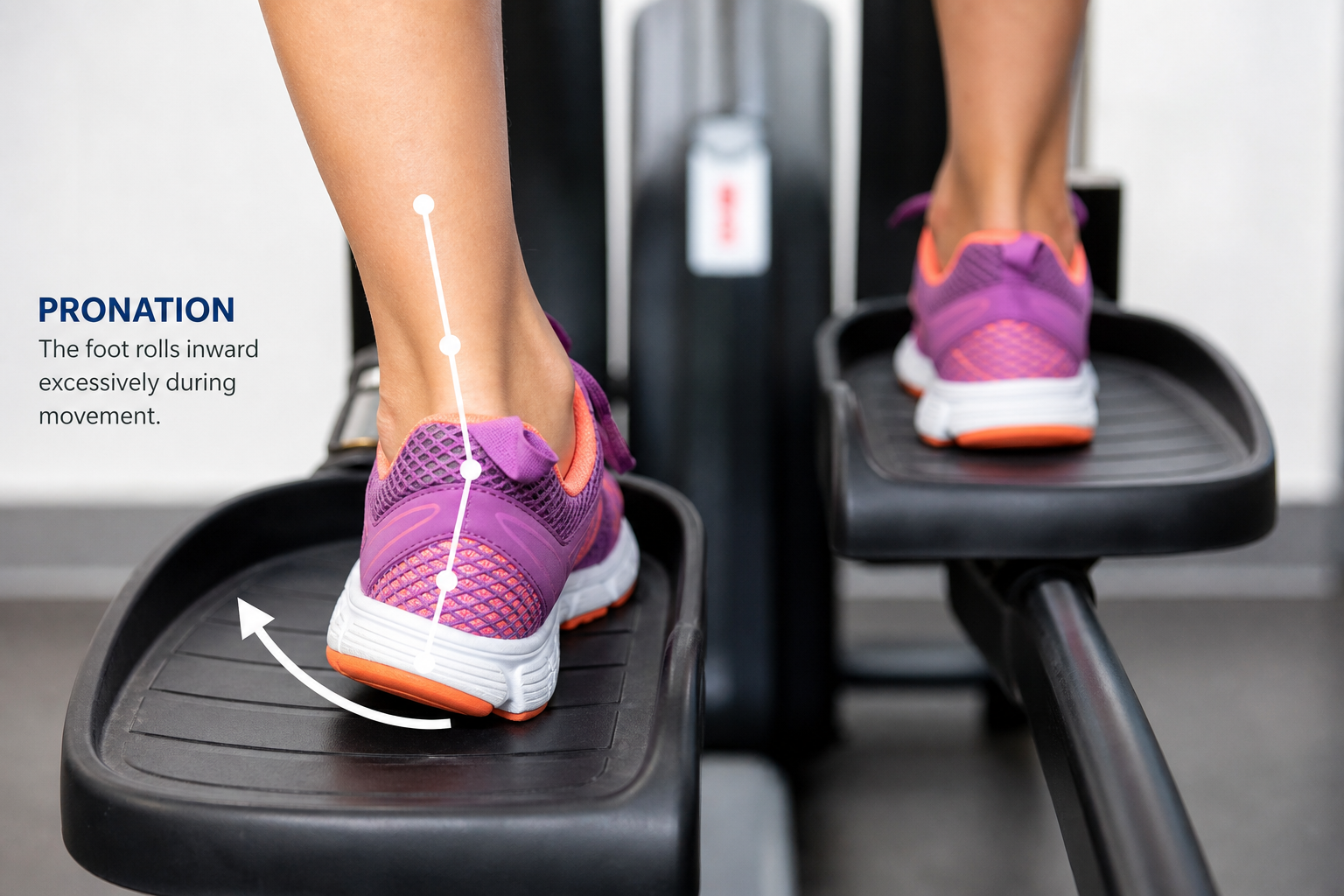
The flat, fixed pedals of most ellipticals don’t accommodate the natural rolling motion of the foot during walking. If your feet pronate (roll inward), the fixed pedal forces your knees to track inward with each stroke, increasing stress on the inner knee compartment. This produces medial knee pain that gets worse with longer sessions.
You can test for this issue off the machine. Look at your everyday walking shoes. If the inner edge of the sole is significantly more worn than the outer edge, you pronate. That inward roll is fine when walking because your foot lifts off the ground and resets. On an elliptical, your foot stays planted, so the pronation force transmits directly up through your knee joint with every pedal stroke.
Solution: Wear supportive athletic shoes with arch support (not flat sandals or socks). If you use custom orthotics in your walking shoes, wear them during elliptical use too. The shoe’s arch support prevents the foot pronation that the pedal can’t accommodate.
Don’t use the elliptical barefoot or in minimalist shoes, even if you prefer those for walking. The fixed pedal position requires structured support. Replace worn-out athletic shoes. If the midsole feels compressed or the shoe rocks on a flat surface, it’s no longer providing adequate support.

Stability Athletic Shoes for Seniors
Proper arch support prevents foot pronation and reduces knee stress during elliptical workouts
Some ellipticals have pedals with slight articulation or cushioning. If yours has adjustable pedal angles, experiment with a slight outward tilt, which can reduce pronation strain. But shoe support is the primary fix here.
Fix 5: You’re Going Backward Too Much
Reverse pedaling (backward motion) targets the hamstrings and glutes differently than forward pedaling. However, the backward motion places the knee in a position of increased patellar compression, which aggravates kneecap arthritis. If your knees hurt specifically during reverse pedaling, this is likely the cause.
The reverse motion changes the knee tracking angle and loads the patella (kneecap) differently. For seniors with patellofemoral pain syndrome or arthritis behind the kneecap, this position can produce sharp, focused pain right at the front of the knee. The pain often feels worse going down stairs after a reverse-heavy elliptical session.
Solution: Limit or eliminate reverse pedaling. If your knees tolerate it, use it for only 1-2 minutes per session as variety, not as a primary direction.
Forward pedaling should make up at least 80-90% of your elliptical time. Some people can’t reverse at all without pain, and that’s fine. The cardiovascular and lower-body conditioning benefits of forward pedaling are sufficient. You don’t lose anything meaningful by skipping reverse entirely if it bothers your joints.
If you do reverse briefly, keep resistance very low and pay attention to how your knees feel during and after. If you notice lingering soreness or stiffness several hours later, cut reverse out completely for a few weeks and then try again. For those recovering from knee surgery, our post-knee replacement exercise guide offers additional movement modifications.
Fix 6: Your Warm-Up Is Too Short
Cold, stiff joints don’t glide smoothly through the elliptical’s motion arc. The forced range of motion on unprepared joints produces stiffness and pain that a proper warm-up would prevent.
Synovial fluid, the natural lubricant inside your joints, thickens when you’re inactive. It needs movement and warmth to thin out and circulate properly. Jumping straight into moderate-intensity elliptical work on cold joints is like running an engine without letting the oil warm up. The parts move, but the friction is higher than it needs to be.
Solution: Start with 3-5 minutes at the slowest possible speed and zero resistance. Gradually increase speed over the next 2-3 minutes before adding any resistance. This 5-8 minute ramp-up allows your synovial fluid to warm, your joints to lubricate, and your muscles to activate before loading begins.
During the warm-up, focus on smooth, controlled motion. Don’t worry about getting your heart rate up yet. You’re preparing your joints, not conditioning your cardiovascular system. Some seniors find it helpful to do 5 minutes of gentle walking or marching in place before even getting on the elliptical, especially first thing in the morning when joints are stiffest.
If you have arthritis, a longer warm-up (8-10 minutes) often feels better. Listen to your body. The warm-up is complete when the motion feels fluid and your joints feel mobile, not when a timer goes off. Our 15-minute morning stretching routine can be an excellent pre-elliptical warm-up for stiff joints.
Fix 7: This Elliptical Type Doesn’t Suit Your Body
There are three main elliptical designs: rear-drive (flywheel behind you), front-drive (flywheel in front), and center-drive (flywheel beneath you). Each produces a slightly different motion arc. Rear-drive models tend to produce a more linear, walking-like motion. Front-drive models produce a slightly more circular motion. Center-drive models have the shortest stride and most upright posture. If one type bothers your joints, another type may feel significantly different.
The differences matter more than most people realize. Rear-drive ellipticals typically produce a flatter, more horizontal pedal path that mimics natural walking. This feels intuitive for most seniors. Front-drive models often have a slightly more elliptical (oval-shaped) path with more vertical lift at each pedal stroke. Some people love this, others find it aggravates knee or hip issues. Center-drive models keep you very upright and compact, which can be easier on the lower back but may feel cramped for taller individuals.
Solution: If possible, try different elliptical types at a gym or store before committing to a home purchase. Many seniors who struggle with a front-drive elliptical find a rear-drive or center-drive model much more comfortable.

Elliptical Machines for Seniors
Test different drive types to find the motion arc that best suits your body mechanics
When testing, spend at least 10 minutes on each type. The first 2-3 minutes feel awkward on any new machine. You need time to adapt and see how your joints respond. Pay attention to which machine feels most natural, not which one has the fanciest console or the most programs.
If you already own an elliptical that doesn’t suit your body and the other fixes in this article don’t help, it may be worth selling it and trying a different type. The wrong machine will never feel right no matter how much you adjust your technique.
When to Stop and Reassess
Some joint discomfort during the first few sessions on an elliptical is normal as your body adapts to the new movement pattern. But sharp pain, pain that worsens as you continue, or pain that lingers for hours after your session isn’t normal. These are signals to stop and reassess.
If you’ve tried all seven fixes and the elliptical still bothers your joints, it may not be the right exercise modality for you. That’s okay. Low-impact doesn’t mean universally appropriate. Some seniors do better with recumbent bikes, seated steppers, swimming, or even treadmill walking at a slow pace.
Consider working with a physical therapist if you’re unsure whether your form is correct or if persistent pain makes you hesitant to continue. A single session can identify specific body mechanics issues that written instructions can’t catch. For those with specific joint concerns, our guides on post-hip replacement exercise and arthritis-friendly exercises offer additional low-impact alternatives.
Frequently Asked Questions
Is the elliptical better or worse than walking for bad joints?
The elliptical eliminates impact (your feet never leave the pedals), which makes it gentler than walking on hard surfaces. However, the fixed motion arc forces your joints through a specific path that may not match your body’s natural movement. Walking allows your body to self-select its stride, speed, and joint angles naturally.
For some seniors, walking is more comfortable; for others, the elliptical is better. Try both and use whichever your joints prefer. The answer often depends on the specific joint issue. Seniors with knee arthritis often prefer the elliptical because it eliminates the impact spike that occurs when your heel strikes the ground during walking. Seniors with hip issues sometimes prefer walking because the elliptical’s fixed stride can force the hip through ranges of motion that feel uncomfortable.
How long should a senior use the elliptical?
Start with 10 minutes at low resistance and build by 2-3 minutes per week. Most seniors build to 20-30 minutes comfortably within 6-8 weeks. If joint pain limits your session length, split into two shorter sessions (10 minutes morning and evening) for the same total benefit.
Don’t rush the progression. Adding 2-3 minutes per week seems slow, but it gives your joints time to adapt without overload. If a new duration causes increased pain or stiffness the next day, drop back to the previous duration for another week before trying again. Some seniors plateau at 15-20 minutes and never get comfortable beyond that. That’s fine. Twenty minutes of consistent elliptical work several times per week provides meaningful cardiovascular benefit.
Should I use the arm handles or just the legs?
For cardiovascular conditioning, legs only (holding the stationary handles for balance) provides adequate stimulus. Adding the moving arm handles increases total-body energy expenditure by 15-20% and engages the upper body, but it also increases the complexity and can promote the forward-leaning posture that causes back pain. Start legs-only and add arm handles once your form is solid and your joints are comfortable.
If you do use the moving handles, push and pull deliberately rather than just letting your arms get dragged along by the momentum. The handles should be an active choice to engage your upper body, not a crutch for balance. Keep your grip light. White knuckles and tense forearms mean you’re gripping too hard.
Can the elliptical make knee pain worse?
Yes, if the setup or technique is wrong. The most common causes are stride length mismatch, excessive resistance,