You finished your strength session two days ago, and your arms still ache every time you lift a coffee cup. Is that normal at 62, or is your body telling you something went wrong? The honest answer sits somewhere in the middle, and it depends on more factors than most people realize.
What Counts as Normal Soreness After 60

Delayed onset muscle soreness, or DOMS, typically shows up 12 to 24 hours after a workout and peaks somewhere between 24 and 72 hours later. For most people over 60, mild to moderate soreness that fades within two to three days falls squarely in the “expected” category.
What does mild to moderate actually feel like? You should be able to walk, dress yourself, and go about your day with some stiffness or tenderness, but without sharp pain or a noticeable loss of strength. If you can still climb stairs and reach overhead, even if it’s uncomfortable, that’s soreness doing what soreness does.
Where this differs from what a 30 year old experiences is duration and recovery speed. Older adults often take one to two days longer to feel fully recovered, partly due to changes in protein synthesis and connective tissue elasticity that come with age. A 25 year old might bounce back in 48 hours; a 65 year old doing the same workout might need 72 to 96 hours.
Why the Answer Changes From Person to Person
There isn’t one soreness timeline that applies to everyone over 60. Several factors shift the range significantly, and understanding them helps you figure out whether your own experience is typical.
Training Experience
Someone who has been lifting weights consistently for years will feel far less soreness than someone who just started. This is called the “repeated bout effect,” and it’s real. Your muscles adapt to a given exercise after just one or two exposures, so soreness drops off quickly once your body recognizes the movement pattern.
If you’re new to strength work, expect more soreness for the first three to six weeks, especially after trying a new exercise. This is one reason a gradual approach matters so much when you’re building a routine. Our guide on how many sets and reps seniors should do covers how to structure volume so you’re building strength without overwhelming your recovery capacity.
Exercise Selection
Eccentric movements, the lowering phase of a squat or the controlled descent of a bicep curl, cause more microscopic muscle damage than concentric (lifting) movements. That damage is part of what triggers soreness. Exercises with a long, controlled eccentric phase, like slow lunges or wall push-ups, tend to produce more next-day soreness than machine-based or seated movements.
New exercises also cause more soreness than familiar ones, even if the muscle group is the same. Switching from seated leg presses to free-standing squats, for example, can leave you sorer than usual even though you’ve trained legs plenty of times before.
Effort and Load
Pushing closer to muscle fatigue, or adding more weight than you’re used to, increases soreness. This is normal and even a sign that you’re providing enough stimulus for strength gains. But there’s a line between productive effort and overreaching, and it’s worth reading through how to increase your weights safely after 60 before you jump to heavier loads. The same logic applies to choosing your starting weights in the first place, which our article on how heavy dumbbells should be for seniors walks through in detail.
Recovery Habits
Sleep, hydration, and protein intake all influence how quickly soreness resolves. Poor sleep in particular slows muscle repair and can make you feel sorer for longer, even after an identical workout. Dehydration also plays a bigger role than most people expect, sometimes worsening cramping and stiffness that gets mistaken for typical soreness. Our piece on hydration and muscle cramps in seniors explains the connection if you’ve noticed cramping alongside your soreness.
Underlying Health Status
Conditions like hypothyroidism, statin use, and certain autoimmune disorders can all amplify muscle soreness or slow recovery. If you’re on a statin and notice soreness that feels disproportionate to your workout, or that shows up in muscles you didn’t even train, mention it to your doctor. This isn’t something to self-diagnose, but it’s a real variable that changes what “normal” looks like for you specifically.
Practical Ranges to Watch For
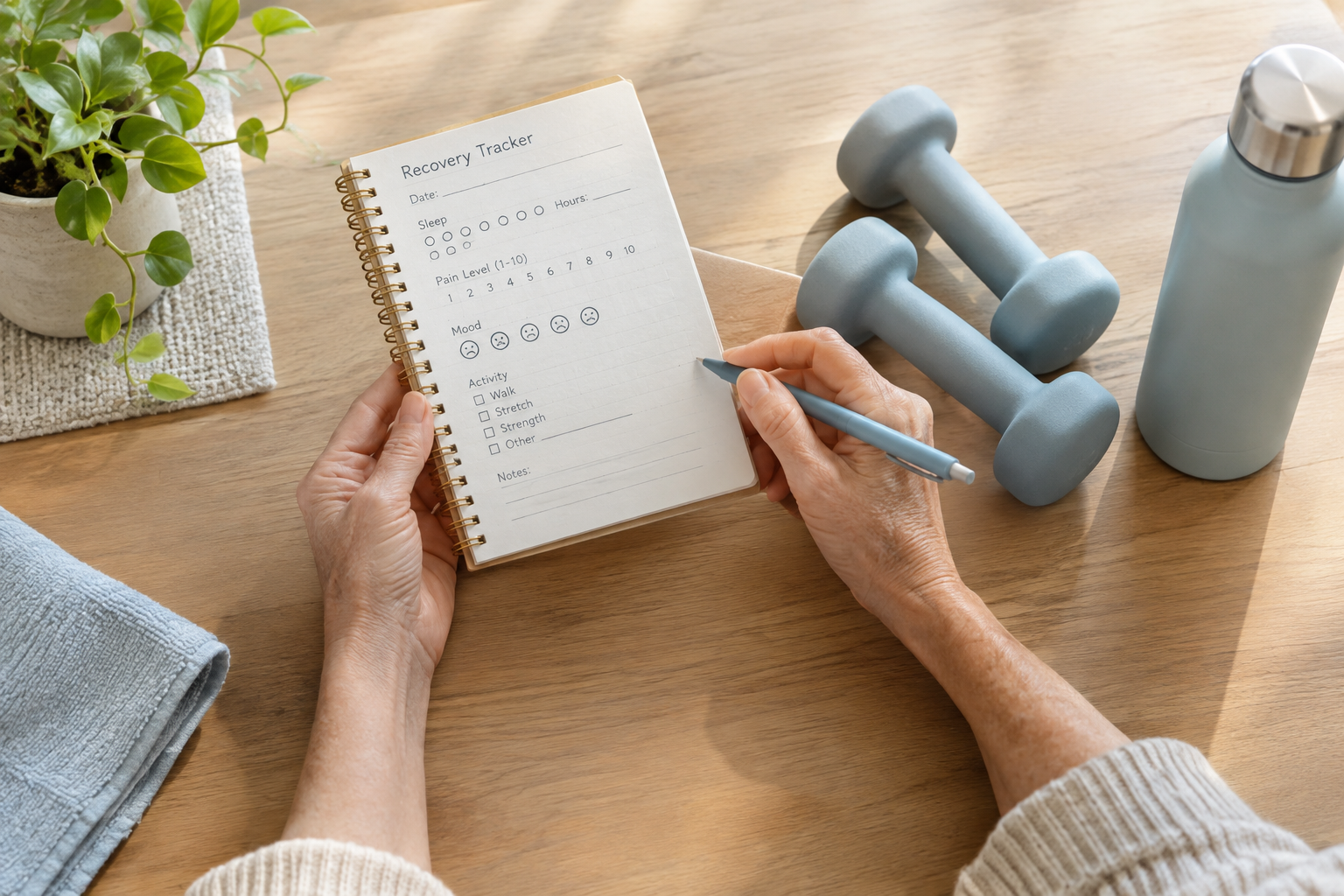
Here’s a rough framework based on how experienced you are and what you did:
- Experienced lifter, familiar routine: Little to no soreness, or mild tightness resolving within 24 hours.
- Experienced lifter, new exercise or heavier load: Moderate soreness lasting one to two days.
- New to strength training: Noticeable soreness lasting two to four days, especially in the first six weeks.
- Returning after a long break: Soreness similar to a beginner, even if you used to lift heavy years ago.
If your soreness regularly stretches past four or five days, or it’s getting worse rather than better with each session, that’s a signal to dial back volume or intensity rather than push through. Stretching afterward can help take the edge off, and if you’re deciding how to balance the two, our comparison of stretching versus strength training is a useful starting point.
When It’s Not Just Soreness

Muscle soreness is diffuse, symmetrical in most cases, and improves day by day. Pain that shows up on only one side, feels sharp or stabbing, or is localized to a joint rather than the belly of a muscle is a different story. That kind of pain points toward a strain, sprain, or joint irritation, not typical training soreness.
Swelling, bruising, or a joint that feels unstable after a workout also falls outside normal DOMS territory. So does soreness paired with weakness that doesn’t improve, or pain that gets sharply worse with movement rather than gradually easing as you warm up.
Get medical attention right away if you experience chest pain, unusual shortness of breath, fainting or near-fainting, or sudden severe pain during or after exercise. These are not signs of muscle soreness and should never be brushed off as a normal part of training.
An acute injury, like a sharp pop, sudden swelling, or the inability to bear weight, also needs prompt evaluation rather than a wait-and-see approach. If you experience a fall or sudden loss of balance during a workout, it’s worth reading how to get up from the floor safely after a fall so you know the right steps to take afterward.
Frequently Asked Questions
How long should muscle soreness last after strength training when you’re over 60?
For most people, one to three days is typical, with new exercises or heavier loads sometimes extending that to four days. Soreness lasting longer than five days, or soreness that isn’t improving daily, is worth addressing by adjusting your training rather than ignoring it.
Is it bad if you don’t feel sore at all after a workout?
Not necessarily. As your body adapts to a routine, soreness naturally decreases even though you’re still building and maintaining strength. Soreness is not a reliable measure of whether a workout “worked,” so don’t chase it as a goal.
Should you keep exercising the same muscles while they’re still sore?
Light activity, like walking or gentle mobility work, is usually fine and can even help. But training the same muscle group hard again before soreness resolves increases injury risk and can slow your progress rather than speed it up. Give major muscle groups at least 48 hours between hard sessions.