A dog doesn’t care about your motivation level. It needs to go outside, and it needs to go now. This unconditional daily exercise demand makes dog ownership one of the most effective exercise interventions for seniors.
Research from the University of East Anglia found that dog owners walk an average of 22 minutes more per day than non-dog-owners, and they’re 20% more likely to meet the recommended 150 minutes of weekly exercise. The dog provides the accountability, the schedule, and the purpose that many seniors struggle to generate on their own.
The beauty of this arrangement is its inevitability. Rain or shine, tired or energized, motivated or not, the dog still needs to go out. This removes the internal negotiation that derails other exercise routines.
You’re not deciding whether to exercise today, you’re just doing what the dog requires. The fitness benefits accumulate as a byproduct of responsible pet ownership.
Turning Dog Walks into Structured Exercise
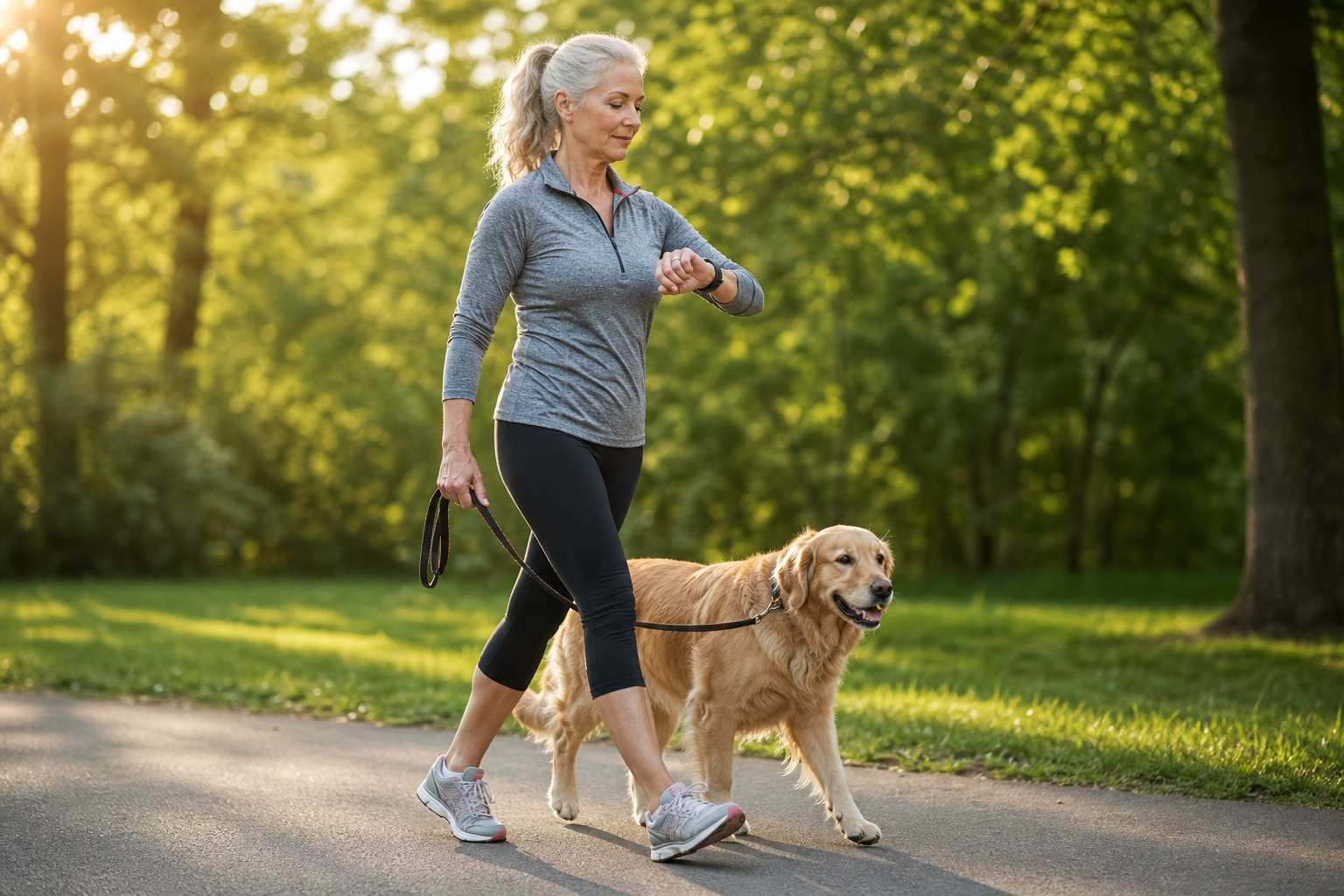
The Base Walk (Daily Minimum)
Most dogs need 20-30 minutes of walking per day. For seniors, this base walk already provides the cardiovascular minimum if done at a moderate pace. To make it an exercise session rather than just an amble, walk at a pace that elevates your breathing slightly (you can talk but not sing).
Swing your arms naturally. Maintain upright posture with shoulders back and head up.
Pay attention to your stride length. Short, shuffling steps reduce cardiovascular benefit and can indicate balance concerns. Aim for a natural stride that feels comfortable but purposeful.
Your foot should roll from heel to toe with each step. If you find yourself taking smaller steps to maintain balance, mention it to your doctor or physical therapist.
The time of day matters less than consistency. Morning walks work well because they establish exercise early, before other commitments interfere. Evening walks help decompress from the day.
Pick the time that fits your energy patterns and stick to it. The dog will quickly internalize the schedule and begin prompting you when walk time approaches.
The Interval Walk (3-4 Times Per Week)
Add intervals during one daily walk: walk at your normal pace for 3 minutes, then pick up the pace to brisk for 1 minute. Your dog will happily match the speed changes. Repeat the 3:1 pattern throughout the walk.
Interval walking improves cardiovascular fitness 20-30% more than steady-pace walking at the same total duration.
Start conservatively. If a full minute at brisk pace feels too challenging, begin with 30 seconds and gradually increase the duration over several weeks. The brisk interval should feel demanding but sustainable.
You should still be able to speak in short sentences, even if you wouldn’t want to hold a long conversation.
Interval walking also trains your body to recover between efforts, which translates to better resilience in daily activities. Climbing stairs, carrying groceries, or keeping pace with grandchildren all involve bursts of elevated effort followed by recovery periods.
The pattern you practice on interval walks prepares you for these real-world demands.
If you have arthritis or joint concerns, keep the intensity moderate. The goal is elevated heart rate, not impact stress. Focus on faster leg turnover rather than longer strides, which puts less force through your knees and hips.
The Exploration Walk (Once Per Week)
Take a new route: a different neighborhood, a park you don’t usually visit, a nature trail. New terrain (hills, grass, gravel, uneven sidewalks) challenges your balance and engages different muscle groups than your familiar route.
The novelty also stimulates your brain with new environments, new sights, and new smells for both you and the dog.
Uneven surfaces force your feet and ankles to adapt constantly, strengthening the small stabilizer muscles that prevent falls. Walking on grass requires more effort than concrete because the surface absorbs some of your push-off force.
Gravel paths demand careful foot placement. These variations build functional strength that smooth sidewalks never will.
Scout new routes in advance if possible. Walk them once without the dog to check for hazards: broken pavement, steep curbs, difficult crossings, or areas where loose dogs are common. Once you’ve confirmed the route is manageable, bring the dog along.
The preparation removes surprises that could compromise safety.
Natural settings provide additional benefits. Trees, water, and greenery reduce stress markers more than urban environments. The combination of exercise and nature exposure (researchers call it “green exercise”) improves mood and cognitive function beyond what either provides alone.
The Long Walk (Once Per Week)
Extend one weekly walk to 40-60 minutes at an easy-to-moderate pace. This endurance walk builds the aerobic base that supports all your other fitness activities. Your dog will love the extended outing, and the longer duration provides more cumulative cardiovascular benefit.
Build up gradually. If your current walks are 20 minutes, don’t immediately jump to 60. Add 5-10 minutes per week until you reach your target duration.
The progression might take two months, and that’s fine. You’re building capacity, not racing a deadline.
The long walk trains your body to sustain effort over time. This endurance translates directly to daily activities that require extended standing or moving: shopping trips, museum visits, outdoor events, travel. The fitness you build during long walks expands the range of activities you can enjoy without fatigue or discomfort.
Bring water for both you and the dog on longer walks. A collapsible bowl makes it easy to offer the dog a drink. Watch for signs of fatigue in both yourself and your pet: excessive panting, lagging pace, or reluctance to continue.
Hot weather requires extra caution. Early morning or evening walks avoid peak heat.
Adding Strength and Balance to Dog Walks
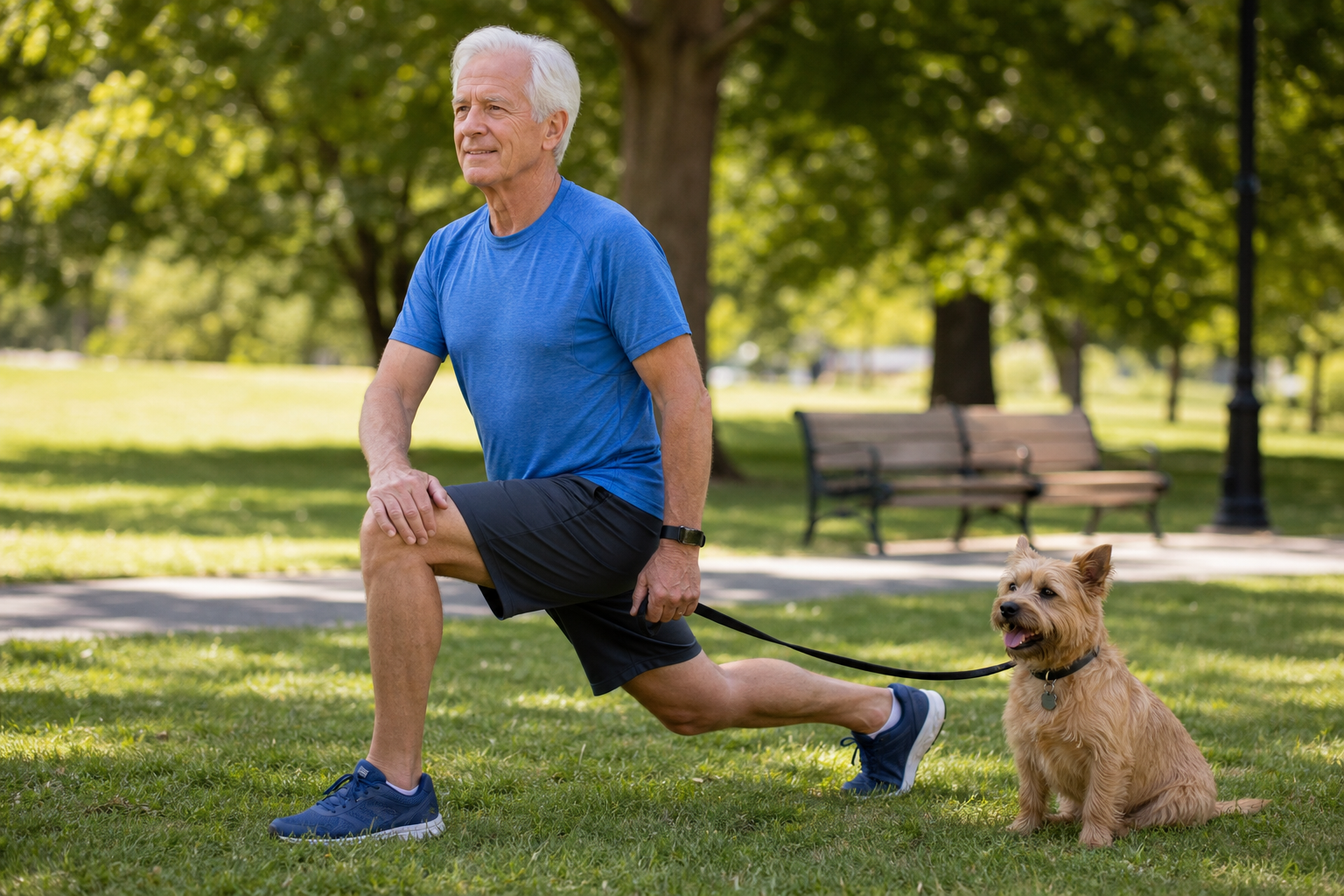
Every dog walk includes natural opportunities for functional fitness:
Bench Exercises
Stop at a park bench for 10 incline push-ups (hands on the bench seat), 10 step-ups onto the bench (if sturdy enough), and 10 seated-to-standing squats. The dog gets a sniff break; you get a strength set.
Incline push-ups build upper body and core strength without the shoulder stress of floor push-ups. Step-ups train the one-leg strength pattern you use every time you climb stairs or step up into a vehicle. Seated-to-standing squats replicate the movement you perform dozens of times daily getting out of chairs.
If full bench height feels too challenging for step-ups, use a park curb instead (typically 4-6 inches). The movement pattern is identical, just scaled to your current ability. As you get stronger, progress to the bench.
For squats, focus on controlled movement rather than speed. Lower yourself slowly to the seated position, pause briefly, then stand. Quality repetitions build more strength than rushed ones.
Tree or Pole Balance Holds
At a stop (while the dog investigates something), stand on one foot near a tree or signpost for 20-30 seconds. Switch legs. This turns every dog-stop into a balance training opportunity.
Keep the support close enough to grab if needed, but try to maintain balance without touching it. This builds the confidence and ability to recover balance before a wobble becomes a fall.
Progress the difficulty by moving your standing foot position. Heel-to-toe is harder than feet apart. Standing on grass or gravel is harder than pavement. Eyes closed is harder than eyes open.
These variations keep the exercise challenging as your balance improves.
Hill Repeats
If your route includes a hill, walk up it at a brisk pace and down at a moderate pace. Repeat 2-3 times. Hill walking builds leg strength and cardiovascular capacity faster than flat walking.
The uphill effort strengthens your quads, glutes, and calves while elevating your heart rate. The downhill return trains eccentric muscle control (lengthening under load), which is crucial for descending stairs safely.
Start with gentle grades. A slight incline that feels easy provides training stimulus without overwhelming your legs or lungs. As you adapt, seek out steeper hills or add more repeats.
Don’t rush the downhill sections. Controlled descent is better training and safer than letting gravity pull you down too fast.
Calf Raises at Curbs
While waiting at a crosswalk, do 10-15 calf raises on the curb edge. Use the signpost for balance. Strong calves support ankle stability and provide the push-off power for each walking step.
The stretch at the bottom of each rep (heel dropping below the curb level) maintains ankle flexibility, which tends to decrease with age.
These exercise additions require no equipment, no gym, and no separate workout time. They piggyback on the walk you’re already doing, turning dog stops and route features into fitness opportunities.
The dog doesn’t mind the pauses (it gets extra sniff time), and you accumulate strength and balance work that would otherwise require a dedicated session.
Dog Walking Safety for Seniors
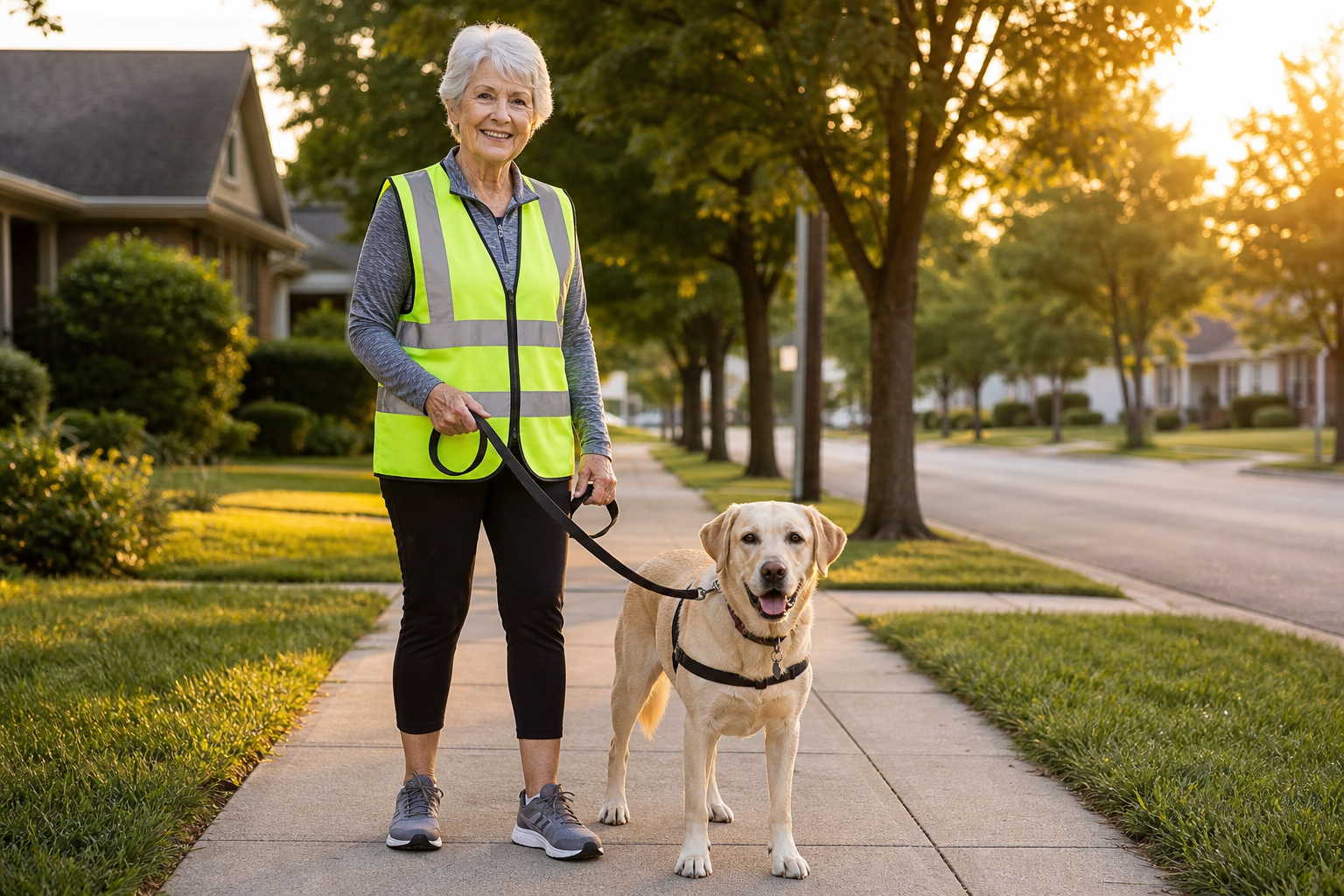
Leash Management
An unexpected lunge from your dog is a major fall risk. Use a fixed-length leash (4-6 feet) rather than a retractable leash, which gives the dog a 15-foot running start before the brake engages.
Walk the dog on your non-dominant side so your dominant hand is free to catch yourself or grab a railing.

Hands-Free Dog Leash
Distributes pulling force to your hips rather than your wrist and frees both hands for balance
A hands-free waist leash distributes the pulling force to your hips rather than your wrist and frees both hands for arm swinging and balance recovery. Hands-free leashes work best for dogs that don’t pull constantly.
If your dog still lunges frequently, the waist attachment could pull you forward or sideways. In that case, stick with a hand-held leash until training improves the dog’s walking behavior. Some leashes include a waist option and a hand-held option on the same piece of equipment, letting you switch based on conditions.
Loop the leash around your wrist, never tie it to your hand. If the dog bolts, you need to be able to release the leash instantly rather than being dragged along. A wrapped loop prevents the leash from being pulled out of your grip during normal walking but releases under extreme force.
Consider a second, backup leash during training phases. A short traffic leash (1-2 feet) attached to the collar gives you a grab handle close to the dog if the primary leash fails or if you need immediate control in a tight situation.
This redundancy is especially useful with large or reactive dogs.
Dog Size and Training
If your dog is large and untrained, it’s a walking hazard. Invest in obedience training (or reinforce existing training) with specific focus on loose-leash walking.
A dog that walks calmly beside you rather than pulling, lunging, or darting is the difference between an enjoyable exercise session and a dangerous one.
If your dog is too strong for you to control safely, consider a front-clip harness that redirects the dog’s pulling force to the side rather than forward.
Front-clip harnesses change the physics of pulling. When a dog wearing a back-clip harness pulls forward, it’s using the strongest muscle groups in its body (chest and shoulders) in their mechanically strongest position. A front clip turns that forward pull into a sideways rotation, which the dog can’t sustain effectively.
The dog quickly learns that pulling doesn’t create forward progress, so pulling decreases.
Consistent training matters more than equipment. Even the best harness won’t fix an untrained dog. Work with a professional trainer if needed, especially if your dog has reactivity issues (barking, lunging at other dogs or people).
Many trainers offer senior-specific classes that account for the handler’s physical limitations while teaching the dog appropriate behavior.
Smaller dogs present different challenges. They’re easier to control physically but often haven’t received the same training investment as large dogs because their pulling doesn’t seem threatening.
A 15-pound dog that lunges can still pull you off balance if you’re not expecting it. The same training standards apply regardless of size.
Route Selection
Choose routes with even surfaces, adequate lighting, and low traffic. Avoid routes where off-leash dogs are common (your dog’s reaction to an approaching off-leash dog can pull you off-balance).
Carry your phone, a water bottle (for you and the dog), and waste bags.
Sidewalk quality varies dramatically. Older neighborhoods often have heaved, cracked, or uneven pavement from tree roots. While uneven surfaces provide balance training in controlled doses, a severely broken sidewalk is a trip hazard that outweighs the training benefit.
Walk through your route slowly the first time, noting problem areas you’ll need to navigate carefully or avoid.
Lighting matters for early morning or evening walks. Poor visibility increases fall risk and makes you less visible to vehicles. A small flashlight or headlamp helps you spot pavement irregularities.
Reflective gear (vest, arm bands, or clip-on lights) makes you visible to drivers. Some leashes include reflective stitching or built-in LED lights.
Traffic levels affect both safety and exercise quality. High-traffic routes require constant vigilance for vehicles, which diverts attention from your walking form and posture. Quieter routes let you focus on the exercise itself.
Residential side streets often provide the best balance: smooth pavement, low traffic, and more interesting scenery than main roads.
Plan bathroom access for longer walks. Public restrooms in parks are ideal. Coffee shops or fast-food restaurants work in urban areas. Knowing where facilities are located removes the anxiety of being caught too far from a bathroom, which is a common concern that keeps seniors from extending their walking range.
Weather Considerations
Extreme temperatures require adaptations. Heat exhausts both you and the dog faster. Pavement temperature matters: if it’s too hot for your bare hand held on the surface for seven seconds, it will burn your dog’s paws.
Early morning or evening walks avoid peak heat. Bring more water. Watch for signs of heat stress: excessive panting, drooling, slowed pace, or reluctance to continue.
Cold weather demands layers. You’ll warm up as you walk, so dress slightly cooler than feels comfortable standing still. A light jacket you can tie around your waist once warmed up works better than a heavy coat you’re stuck with.
Dog breeds vary in cold tolerance. Short-haired dogs and small dogs may need a coat in temperatures below 40 degrees. Icy conditions are fall hazards. Use traction cleats that slip over your shoes, and walk very cautiously.
If conditions are genuinely dangerous, skip the outdoor walk and do indoor exercises instead.
Rain doesn’t have to stop walks, but visibility decreases and surfaces get slippery. A waterproof jacket, good