Stair climbing is one of the best functional exercises for seniors, building the leg strength, cardiovascular endurance, and balance you need for everyday independence. But real stairs present real fall risks, and many people don’t have consistent access to a suitable staircase. A stair stepper machine brings the benefits of stair training into your home with adjustable resistance, handrail support, and a controlled environment where you can build confidence safely.
Before starting any new exercise program, talk to your doctor, especially if you have existing joint problems, balance concerns, or cardiovascular conditions. A stepper is a moderately intense form of exercise that can affect these conditions, and your physician can help you determine appropriate intensity and duration for your situation.
Types of Stair Steppers
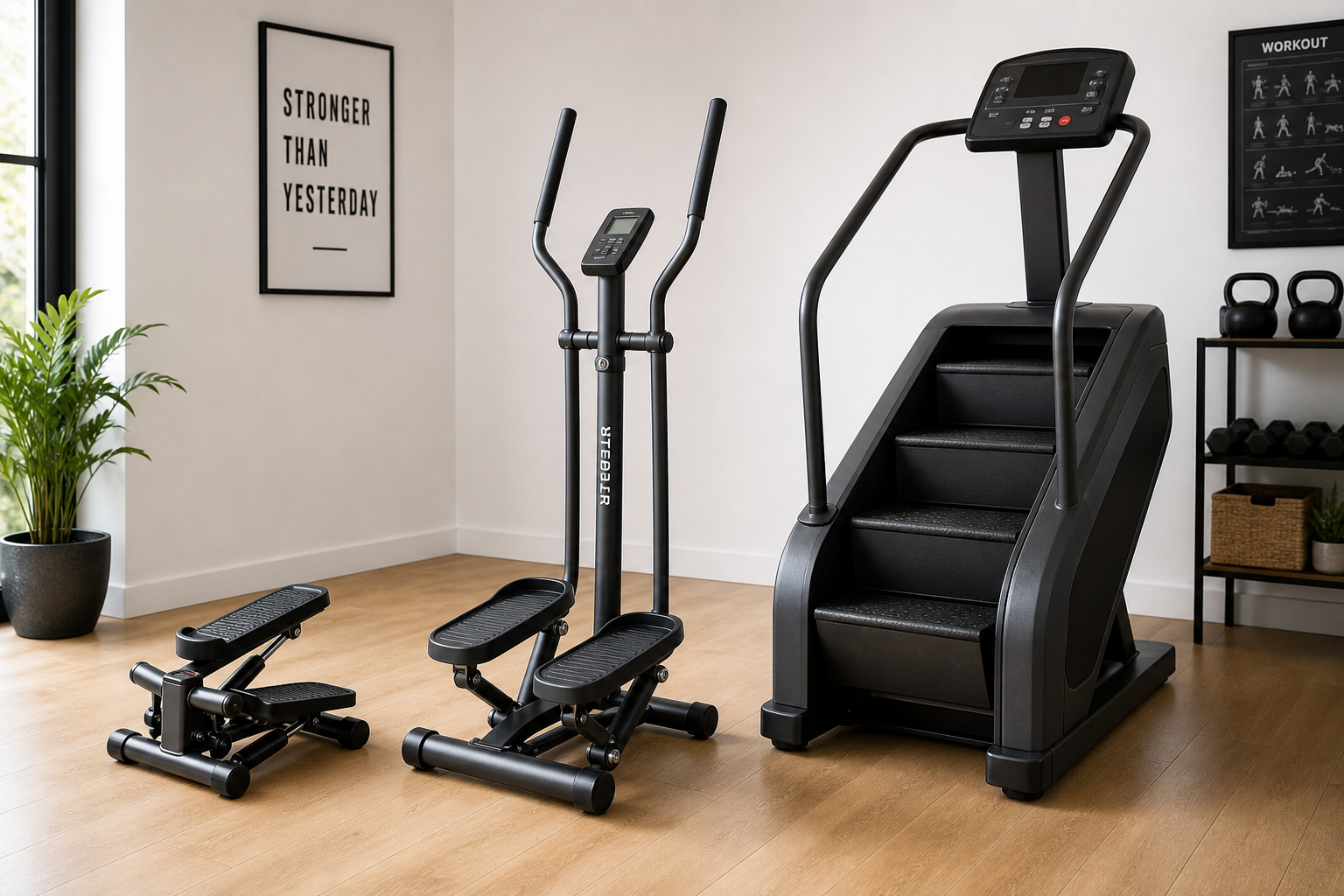
Mini Steppers
Compact, portable units with two foot pedals that move up and down against hydraulic resistance. They sit on the floor and take up about 2 square feet of space. Most don’t have handlebars, so you’ll need to position yours near a counter or wall for balance support. They’re the most affordable option and work well for light to moderate cardio.
Limitations: Short step height (about 6-8 inches), limited resistance range, and no built-in stability support. The small platform can feel cramped for larger feet or for anyone wearing shoes over a men’s size 11 or women’s size 12. The lack of handlebars is the biggest safety consideration. You must have something solid to hold onto. A wobbly chair or lightweight side table won’t cut it.
Full-Size Stair Climbers
These are the machines you see in gyms: large units with built-in handrails, adjustable step height, and electronic consoles displaying speed, time, and calories. They provide the most realistic stair-climbing experience and the widest range of resistance levels. The sturdy handlebars offer excellent balance support, and you can adjust your hand position throughout the workout without breaking stride.
Limitations: Expensive, large footprint (4-5 feet long, 2-3 feet wide), and heavy (100+ pounds). Best for dedicated home gyms with permanent floor space. Moving one to another room isn’t practical once it’s assembled. They also require a dedicated electrical outlet for the console and resistance system.
Side Steppers
Also called lateral steppers, these machines move your feet in a lateral (side-to-side) motion rather than up and down. This targets the hip abductors and gluteus medius more than standard steppers, making them particularly useful for fall prevention. The lateral motion is also gentler on the knees than vertical stepping, since it reduces the compression force on the joint with each step.
Limitations: Doesn’t replicate actual stair climbing as closely as vertical steppers. If your specific goal is to build confidence with real stairs in your home or apartment building, a vertical stepper is the better choice. Lateral steppers shine for general lower body strength and hip stability.
Key Features for Seniors
Step Height
Adjustable step height is important because your comfortable range may be different from a younger user’s. A step height of 4-8 inches is appropriate for most seniors. Very high step heights (10+ inches) require hip flexibility and leg strength that many older adults don’t have when starting out. Some steppers fix the height at one level, while others let you dial it down or up depending on your current ability and goals.
Starting with a lower step height reduces fall risk and lets you focus on form and balance before increasing the challenge. It’s better to do 15 minutes at 5-inch steps with good control than to struggle through 5 minutes at 10-inch steps with compromised stability.
Hydraulic Resistance
Hydraulic steppers use fluid-filled cylinders that provide smooth, consistent resistance. They’re quieter than mechanical-spring steppers and offer a more natural feel. Look for steppers with adjustable hydraulic resistance so you can start light and progress as you get stronger.
The adjustment mechanism varies by model. Some use a simple knob or dial that changes resistance level between 1 and 8 or 1 and 12. Others use interchangeable cylinders (less convenient but sometimes smoother). Avoid steppers with no resistance adjustment at all, since a fixed level might be too hard or too easy for your current strength.
Handlebar Stability
This is the most critical safety feature. If the stepper doesn’t have built-in handlebars, you must use it next to a counter, wall, or piece of furniture you can hold for balance. Some mini steppers offer optional resistance band attachments for upper body work, but these don’t substitute for a solid balance support. Resistance bands pull on your arms and upper body, which can actually destabilize you on the stepper rather than providing a safety anchor.
Built-in handlebars should feel rock-solid when you put weight on them. Test this by applying downward pressure before stepping. If the bars flex, wobble, or feel hollow and lightweight, the unit isn’t suitable for anyone with significant balance concerns.
Pedal Surface and Width
Non-slip pedal surfaces are essential. Look for textured rubber or ridged plastic that grips the sole of your shoe. Smooth plastic pedals can become slippery, especially if you’re wearing socks or if the pedal gets dusty.
Pedal width matters too. Wider pedals (14 inches or more) give you room to adjust your foot position during the workout. Narrow pedals (10-12 inches) can feel cramped and make it harder to center your weight properly.
Console Readability
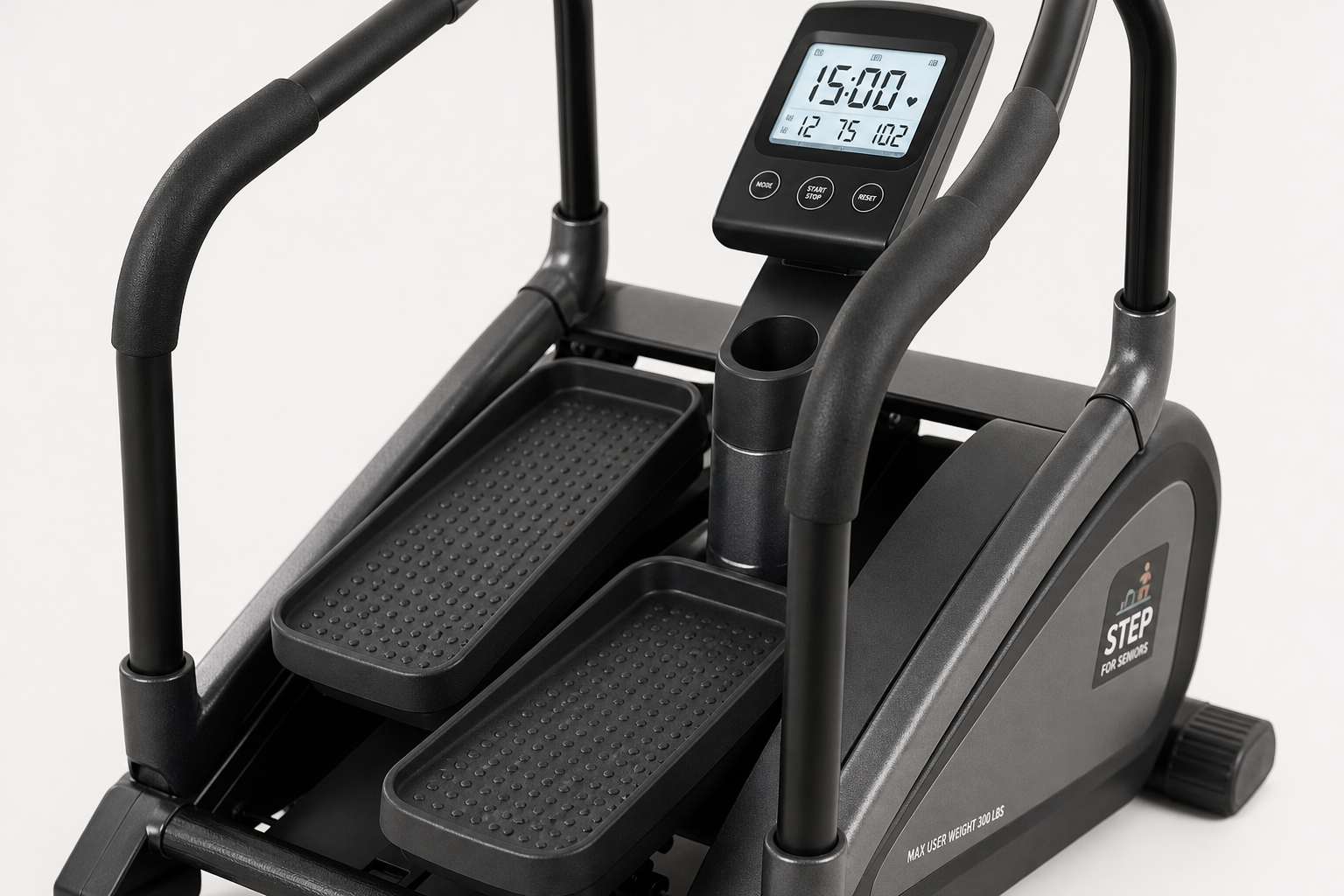
If the stepper includes a display console, make sure you can actually read it. Many budget models use tiny LCD screens with low-contrast gray-on-gray numbers. Larger displays with backlit screens are easier to read without stopping your workout to lean in and squint. Basic metrics like elapsed time, step count, and estimated calories are helpful for tracking progress. Heart rate monitoring is less common on mini steppers but appears on most full-size models.
Top Stair Steppers for Seniors
Sunny Health & Fitness Mini Stepper

Sunny Health & Fitness Mini Stepper
Budget-friendly option with adjustable hydraulic resistance, ideal for seniors with limited space who can position it near a counter for balance support
The Sunny Health mini stepper is the most popular budget option. It includes adjustable hydraulic resistance, a basic LCD console (steps, time, calories), and optional resistance band attachments for arm work. The compact size stores under a desk or in a closet. Weight capacity is 220-250 pounds depending on the model.
The hydraulic cylinders provide smooth resistance without jerky motion or noise. Resistance adjusts via a knob under each pedal. Start on the lowest setting and increase gradually as your legs adapt. The LCD is small but readable if you have decent close-up vision. No backlight, so you’ll need good ambient lighting.
Best for: Budget-conscious seniors with limited space who will use it near a counter for balance support.
Not ideal for: Anyone over 240 pounds, people who need built-in handrails, or those wanting a stepper that doubles as a standalone balance support.
Xiser Commercial Mini Stairmaster

Xiser Commercial Mini Stairmaster
Premium mini stepper with commercial-grade construction, 400-pound weight capacity, and whisper-quiet operation, built to last for years
The Xiser is a premium mini stepper built with commercial-grade components. It’s whisper-quiet, has a smooth stepping motion, and supports up to 400 pounds. The hydraulic cylinder provides a more natural stair-climbing feel than cheaper alternatives. It’s significantly more expensive than the Sunny but built to last for years.
The frame is welded steel, not bolted plastic. The pedals are wider and have deeper tread patterns. The stepping action feels closer to actual stairs because the hydraulic system responds proportionally to your effort rather than providing fixed resistance. It’s the mini stepper that physical therapists and trainers recommend most often.
Best for: Heavier seniors, those wanting a long-lasting investment, or anyone who found cheaper steppers to feel cheap or wobbly.
Not ideal for: Budget shoppers or anyone who needs a handlebar system (the Xiser has no built-in bars).
EFITMENT Twist Fitness Stepper
The EFITMENT twist stepper combines vertical stepping with a slight lateral twist, engaging the obliques and hip muscles alongside the standard quad and calf work. The LCD displays steps, time, and calories. It’s a good middle-ground between pure vertical and pure lateral steppers.
The twist motion is subtle, not a dramatic rotation. You won’t feel like you’re doing a dance move. It adds maybe 10-15 degrees of rotational movement with each step, enough to activate the core without throwing you off balance. Resistance adjusts the same way as standard mini steppers.
Best for: Seniors who want to combine stair training with core and hip work in a single compact machine.
Not ideal for: Anyone with lower back issues that worsen with twisting motions. The rotation is mild, but if you have lumbar arthritis or disc problems, check with your doctor or physical therapist first.
How to Choose the Right Stepper for Your Needs
Start by evaluating your balance honestly. If you need two hands on a rail to climb real stairs safely, you need either a full-size stepper with built-in handlebars or a mini stepper positioned next to a very solid piece of furniture. A kitchen counter bolted to cabinets works. A dresser that might slide on carpet does not.
Consider your space realistically. Measure the floor area where you plan to use and store the stepper. Mini steppers fit almost anywhere, but you’ll need an extra 2-3 feet of clearance around the unit for safe stepping and balance holds. Full-size climbers need dedicated floor space you won’t reclaim for other uses.
Think about progression. If you’re currently very deconditioned but motivated to improve significantly, a stepper with a wide resistance range gives you room to grow. If you’re looking for light maintenance activity to supplement walking and other exercises, a basic model works fine.
Weight capacity isn’t just about safety. Steppers rated closer to your actual weight tend to feel less stable and may wear out faster. If you weigh 200 pounds, a stepper rated for 220 is technically safe but a 300-pound capacity model will feel more solid and last longer.
Setting Up Your Stepper Safely
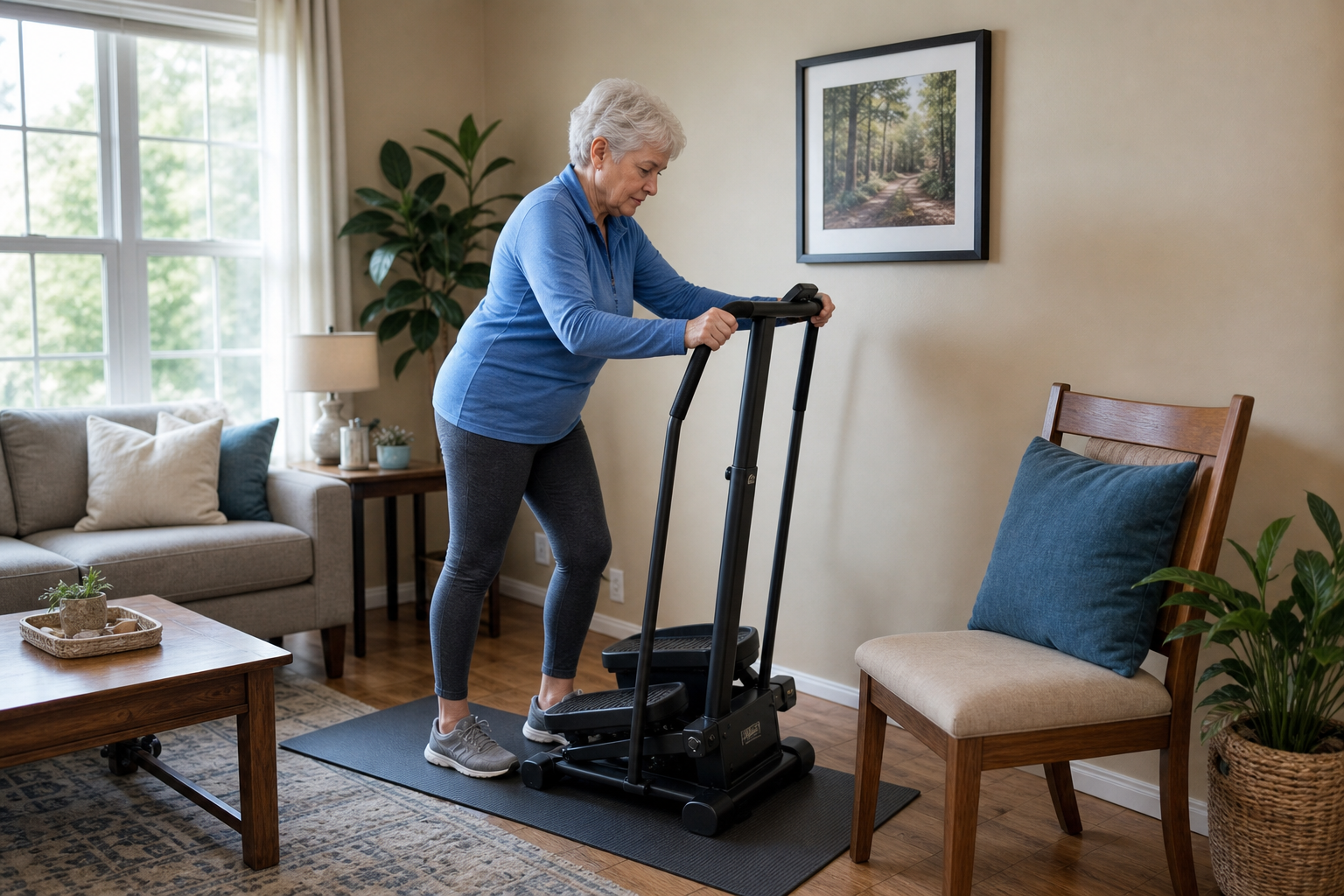
Place the stepper on a firm, level surface. Carpet is fine as long as it’s low-pile and the stepper doesn’t rock or tilt. High-pile carpet or uneven flooring can create instability. Some people place a large piece of plywood or a rubber mat under the stepper to create a stable platform.
Position your balance support before you step on. If using a counter or furniture, make sure it’s within easy reach the entire time you’re stepping. You should be able to touch it without leaning or stretching.
Clear the area around the stepper. Remove anything you could trip over if you need to step off quickly. This includes pets, floor lamps, coffee tables, and loose rugs.
Have a plan for getting on and off. Most people find it easiest to step on one foot at a time while holding their balance support, rather than trying to hop onto both pedals at once. Step off the same way: one foot to the floor, then the other, while maintaining your handhold.
Who Benefits Most from Stair Steppers
Seniors building stair confidence: If you avoid stairs because they feel risky, training on a stepper at home builds the specific strength and movement pattern you need to use real stairs safely. The controlled environment lets you practice the motion without the consequence of a fall down a flight.
People who can’t walk outdoors: Weather, terrain, or safety concerns that prevent outdoor walking. A stepper provides comparable cardiovascular benefits in a small indoor space. It’s particularly useful during winter months when icy sidewalks make outdoor exercise dangerous.
Post-knee surgery rehab: After clearance from your surgeon, controlled stepping rebuilds quad and calf strength with adjustable resistance. The ability to start at very low resistance and increase gradually makes steppers useful for progressive rehab protocols. Many physical therapists incorporate stepping exercises once patients have sufficient range of motion and stability. Check our post-knee replacement exercise guide for more information.
Apartment dwellers with stair anxiety: If you live on an upper floor and worry about your ability to evacuate in an emergency, regular stepper training builds the endurance and leg strength to handle multiple flights if needed.
Seniors with osteoporosis: Weight-bearing exercise helps maintain bone density. Stepping qualifies as weight-bearing because you’re supporting your body weight against resistance. It’s generally gentler on the joints than high-impact activities like running. Learn more about maintaining bone density after 65.
Common Mistakes to Avoid
Leaning too far forward: This shifts your weight over your toes and reduces stability. Keep your torso upright or just slightly forward. Your shoulders should stay over your hips.
Locking your knees: Keep a soft bend in your knees throughout the stepping motion. Locking them on each step sends impact force directly into the joint.
Gripping the handrail too hard: If you’re white-knuckling your balance support, the resistance is too high or your balance isn’t ready for sustained stepping yet. You should use the rail for stability, not to hold yourself up.
Starting too aggressively: New stepper users often go too hard on day one and end up with sore muscles or worse, a fall from fatigue. Start with 5 minutes at the easiest resistance. Soreness is normal. Sharp pain is not.
Stepping too fast: Speed doesn’t equal better results. A controlled, steady pace is more effective and safer than trying to rack up step counts quickly. Aim for a rhythm you can maintain for the full duration of your workout.
Skipping warm-up: Step onto the stepper and begin at an easy pace for the first 2-3 minutes before increasing resistance. This gives your muscles, tendons, and cardiovascular system time to adjust.
Maintenance and Longevity
Hydraulic steppers need minimal maintenance but a few habits extend their life significantly. Wipe down the pedals after each use to prevent dust and debris from building up. Check the hydraulic cylinders every few months for signs of leaking fluid. If you see wet spots or oily residue around the cylinder shafts, the seals are failing and the unit needs repair or replacement.
Tighten bolts and screws periodically. The stepping motion can gradually loosen connections. A quick check every month takes 5 minutes and prevents wobbles or stability issues.