Massage guns have become one of the most popular recovery tools in fitness, but the models marketed to athletes are typically too powerful for seniors. The aggressive percussion of a high-end massage gun can bruise thin skin, aggravate arthritic joints, and rattle your teeth if used on the wrong body area. Seniors need gentler options with lower amplitude (the depth the head travels), lower speed settings, and lighter weight that doesn’t fatigue your arm during use.
The right massage gun can relieve muscle tension, reduce post-exercise soreness, and improve circulation without the discomfort or safety risks of overly aggressive models. This guide covers what makes a massage gun appropriate for older adults, which models deliver effective relief without jarring intensity, and how to use percussion therapy safely if you’re dealing with thinner skin, joint issues, or medications that affect bruising.
What Makes a Massage Gun Senior-Friendly
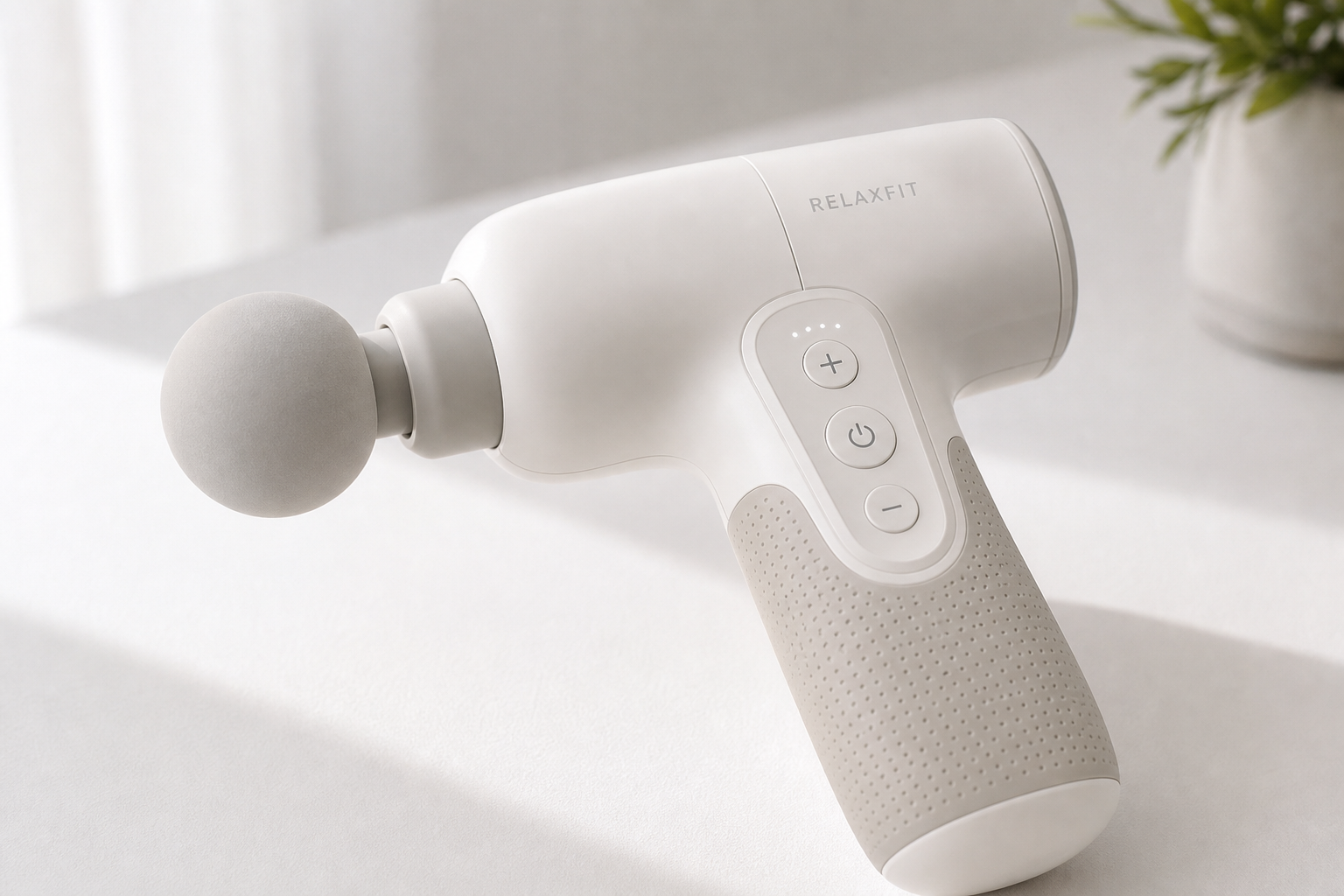
Low Starting Speed
The lowest speed setting is the most important specification. Many massage guns start at 1,800-2,000 percussions per minute, which is too aggressive for sensitive muscles and thin skin. Look for guns that start at 1,200-1,500 PPM. This gentler starting speed provides effective muscle relief without the jarring intensity of faster settings.
Most seniors find they never need to move past the first or second speed setting. The muscle-relaxing benefits happen at lower intensities when you give the gun enough time to work on each area. Higher speeds are designed for deep-tissue athletes with significant muscle mass, not the typical older adult body composition.
If a gun’s lowest setting feels uncomfortable on your forearm (an easy test area), it’s too powerful for safe regular use. You should be able to hold the gun against your skin for 30 seconds without wincing or pulling away.
Low Amplitude
Amplitude is how deep the head punches into the tissue. Standard massage guns have 12-16mm amplitude. For seniors, 8-12mm is sufficient. Deep percussion on a thin frame with less muscle mass can be uncomfortable and counterproductive. You want enough depth to reach the muscle belly but not so much that it compresses against bone.
High-amplitude guns marketed to powerlifters and CrossFit athletes assume a thick layer of muscle tissue between the percussion head and the skeleton. Many seniors, particularly those who’ve experienced age-related muscle loss, don’t have that protective cushion. The result is a bruising, unpleasant sensation rather than the relaxing muscle release the gun is supposed to provide.
Lower amplitude also reduces the risk of triggering a protective muscle spasm. When percussion is too aggressive, muscles tense up defensively instead of releasing. The gentler 8-10mm range encourages relaxation rather than resistance.
Light Weight
Holding a 2.5-pound massage gun at arm’s length for 10 minutes is exhausting for someone with shoulder issues or grip weakness. Look for models under 2 pounds. Some ultralight models weigh as little as 1.2 pounds, making them practical for self-use on the back, shoulders, and legs without arm fatigue.
Weight matters more than most marketing suggests. A gun that feels fine in the store during a 30-second test becomes a burden during actual use. If you’re targeting your upper back between the shoulder blades, you’re holding that weight at an awkward angle while trying to reach behind yourself. An extra half-pound makes a real difference.
Grip diameter also affects usability. Larger hands can manage thicker handles, but if you have smaller hands or any arthritis in your fingers, a slim grip design prevents hand cramping during extended sessions.
Quiet Operation
Loud percussion guns are startling and can raise your stress level during what should be a relaxation tool. Brushless motors (found in most quality guns) operate at 40-50 decibels, roughly the volume of a quiet conversation. Cheaper guns with standard motors can exceed 60-70 decibels.
Noise level affects whether you’ll actually use the device consistently. A loud gun is annoying to use while watching TV, disruptive if you share living space, and harder to use for the recommended duration because the sound itself becomes fatiguing. The quietest models let you use them in the morning without waking a partner or while listening to music without cranking the volume.
Top Massage Guns for Seniors
Theragun Mini

The Theragun Mini weighs just 1.43 pounds and fits in one hand like a large flashlight. It has three speed settings starting at a gentle 1,750 PPM, with a compact design that makes reaching your back and shoulders easier than full-size guns. The QX35 motor is quiet, and the single ball attachment is versatile enough for most body areas. Battery lasts about 150 minutes.
The triangular grip lets you hold it from multiple angles, which helps when reaching awkward spots. The build quality is solid enough that it won’t rattle or vibrate in your hand beyond the intended percussion. Some cheaper guns transmit motor vibration into the handle, which numbs your fingers after a few minutes.
The main downside is the single attachment. The ball head works for most applications, but you can’t swap to a flat head for broader muscle coverage or a softer foam head if your skin is particularly sensitive. The quality reflects the brand reputation, but the reliability and warranty support justify the investment for many users.
Best for: Seniors who want a brand-name option that’s light, quiet, and easy to handle.
RENPHO R4 Mini Massage Gun

RENPHO R4 Mini
Most affordable option with the gentlest starting speed at 1,200 PPM
The RENPHO R4 is a budget-friendly mini gun that weighs under 1.5 pounds and includes 5 speed settings starting at a very gentle 1,200 PPM. Four interchangeable heads (ball, flat, fork, bullet) cover different body areas. The pricing is much more accessible than the Theragun Mini with similar functionality.
The 1,200 PPM starting speed is the lowest in this category, making it the safest choice for very thin skin or significant bruising sensitivity. The five-speed range gives you room to increase intensity as your muscles adapt, though most users stay on speeds 1-3.
The included carrying case is more useful than it sounds. It keeps the attachments organized and protects the gun during travel or storage. Battery life is shorter than premium models at around 90 minutes, but that’s still enough for weeks of typical use between charges.
Build quality isn’t quite at Theragun levels. The plastic housing feels lighter, and the motor has a slightly higher-pitched sound. But for the price point, those are acceptable tradeoffs for most users.
Best for: Budget-conscious seniors who want gentle percussion with multiple attachment options.
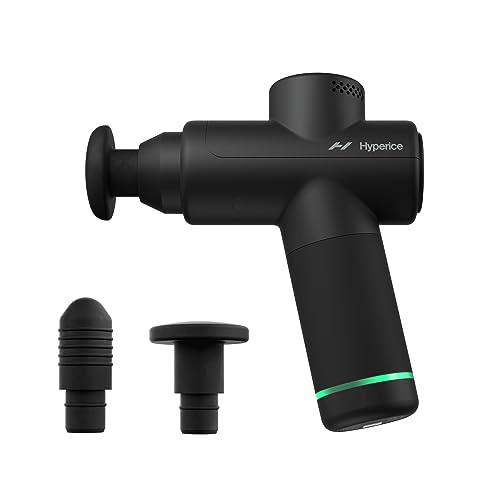
Hypervolt Go 2
Hypervolt Go 2
Quietest operation with ergonomic grip angle for reduced wrist strain
The Hypervolt Go 2 weighs 1.5 pounds with a comfortable grip angle and three speed settings. The Quiet Glide technology makes it one of the quietest massage guns available. The flat head attachment is particularly good for larger muscle areas (quads, glutes, upper back). Battery provides up to 2.5 hours of use.
The ergonomic grip angle positions your wrist in a more natural position than straight-handled guns. This matters if you have any wrist arthritis or carpal tunnel issues. The handle sits at roughly 15 degrees, which reduces wrist strain during extended sessions.
The two included heads (standard ball and flat) cover the essential use cases. The flat head is larger than most competitors, which works well for broad muscle sweeps across the quads or upper back. The pressure distributes over more surface area, making it feel gentler even at the same percussion depth.
The LED indicator shows battery level in real time, so you’re not guessing whether it needs charging. The magnetic attachment system makes swapping heads easier than screw-on designs, which can be difficult if you have reduced hand strength or dexterity issues.
Best for: Seniors who prioritize quiet operation and ergonomic grip design.
How to Use a Massage Gun Safely After 60
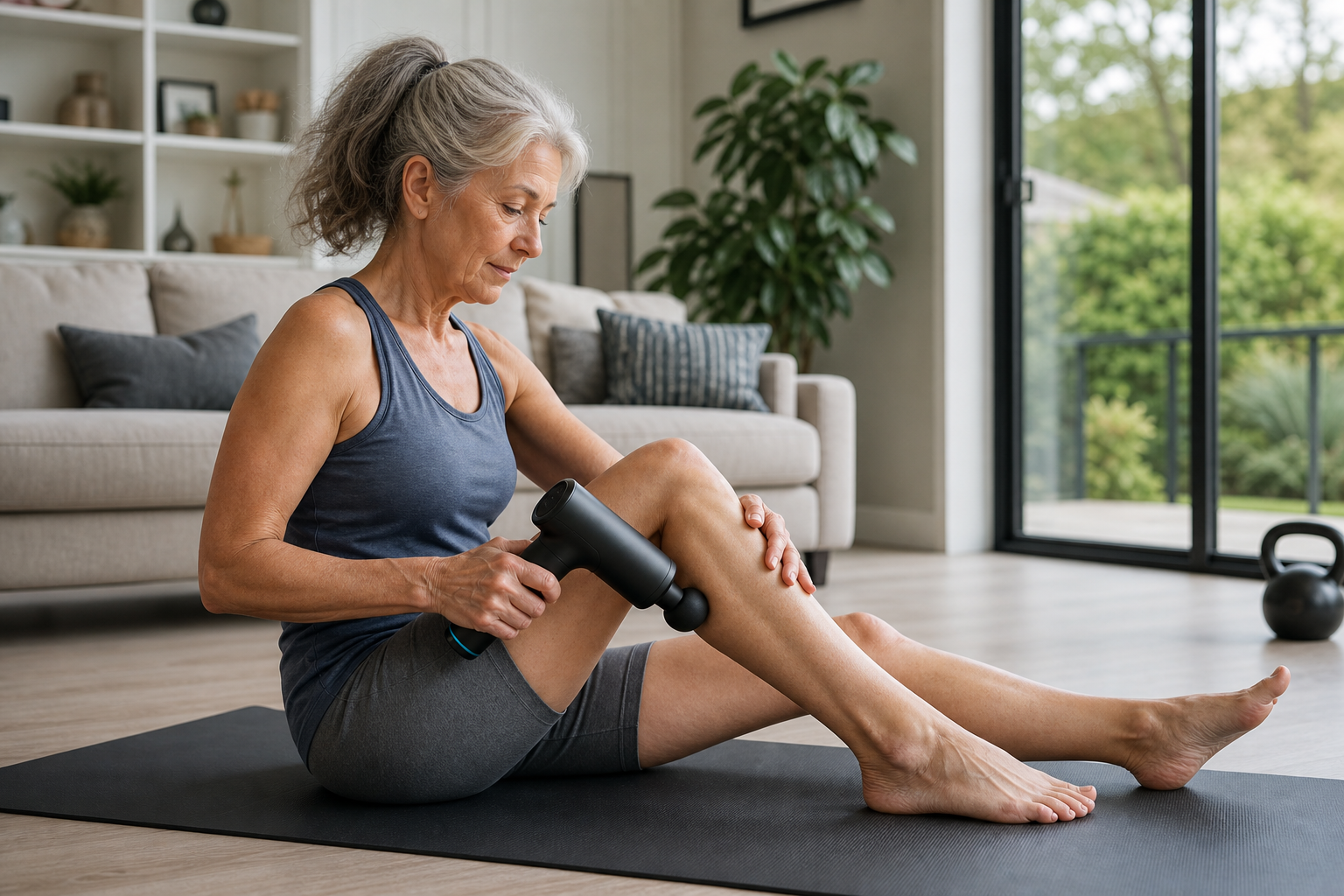
- Start on the lowest speed setting. Increase only if the lowest setting doesn’t provide enough relief after 2-3 sessions. Most seniors find the lowest setting sufficient.
- Never use on bony areas. Avoid the spine, kneecap, shin bone, elbow, ankle bones, and any area where bone is close to the skin surface. The percussion should target muscle tissue only.
- Limit to 30-60 seconds per muscle group. Move the gun slowly across the muscle belly. Don’t hold it in one spot for more than 10-15 seconds.
- Avoid varicose veins. Percussion on varicose veins can damage the weakened vessel walls. Work around visible veins, not on them.
- Don’t use on bruised or inflamed areas. If a joint is hot, red, or actively swollen from an arthritis flare, the percussion will worsen inflammation.
- Skip the massage gun if you’re on blood thinners or bruise very easily. The percussion can cause subcutaneous bruising even at low settings. A soft foam roller is a gentler alternative that provides similar muscle relief.
Talk to your doctor before starting percussion therapy if you have:
- Osteoporosis or significant bone density loss
- Neuropathy or reduced sensation in your limbs
- A pacemaker or other implanted electronic device
- Recent surgery or injury to the area you want to treat
- Chronic pain conditions like fibromyalgia where light touch can trigger flare-ups
Let the gun do the work. You don’t need to press hard into the muscle. The percussion creates the pressure. Just guide the gun along the muscle and let the motor handle the rest. Pushing harder doesn’t increase effectiveness and can cause bruising.
Float the gun across the muscle rather than dragging it. The head should bounce lightly against your skin, not scrape across it. If you’re leaving red marks or feeling discomfort that lingers after you stop, you’re either using too much pressure or the speed is too high.
Use the gun before stretching, not after. Percussion warms up the muscle tissue and increases blood flow, which makes stretching more effective and comfortable. Using it after stretching doesn’t add much benefit.
Best Body Areas for Seniors to Target
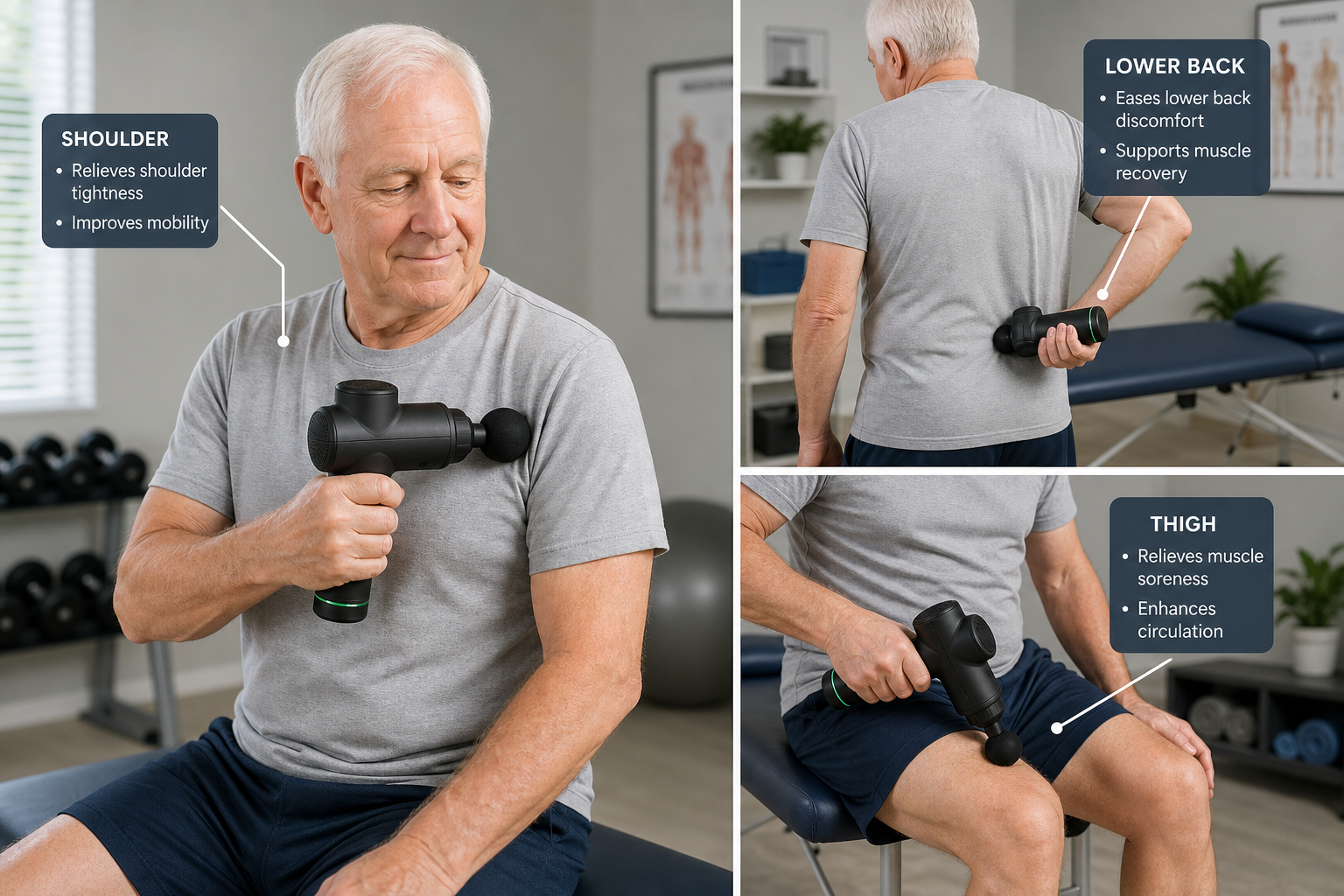
- Upper back (between shoulder blades): Relieves posture-related tension. Use the flat or ball head.
- Quadriceps: Loosens tight quads that pull on the kneecap. Use the flat head along the front of the thigh.
- Calves: Reduces post-walking tightness and may help prevent night cramps. Use the ball head.
- Glutes: Releases the piriformis and gluteus medius that contribute to hip and lower back pain. Use the ball head.
- Forearms: Relieves tension from gripping during resistance training. Use the flat head gently.
Additional areas that respond well to gentle percussion:
Feet (plantar surface): The ball head on the lowest setting can relieve plantar fascia tightness. Work from the heel toward the ball of the foot. Skip this if you have significant neuropathy and can’t feel the pressure clearly.
IT band (outer thigh): Start above the knee and work up toward the hip. The IT band is tough connective tissue that can handle slightly more pressure than softer muscle areas, but still start gentle. This area helps with knee tracking issues and hip stability.
Pectorals (chest muscles): Tight chest muscles pull your shoulders forward and contribute to rounded posture. Use the ball head on the meaty part of the pec, well away from the sternum and armpit. Women should stay above and to the side of breast tissue.
Hip flexors: These get tight from sitting and contribute to lower back pain. Lie on your back with knees bent, use the ball head on the front of your hip (not directly on the hip bone itself). This area is sensitive, so keep the intensity low.
Common Mistakes to Avoid
Using the gun on inflamed joints. Percussion doesn’t reduce inflammation. It can make it worse. If a joint is actively inflamed from arthritis, injury, or overuse, rest it and use ice or prescribed anti-inflammatories. The massage gun is for muscle tension, not joint problems.
Treating the gun like a spot treatment for pain. If you have a specific painful spot, using the gun only on that exact location often doesn’t help. Pain is frequently referred from trigger points located elsewhere. Knee pain might stem from tight quads or calves. Lower back pain often involves tight glutes or hip flexors. Work the whole muscle group, not just the point that hurts.
Holding it in one spot too long. Ten to fifteen seconds in one area is enough. Longer doesn’t increase benefit and can cause tissue irritation or bruising. Keep the gun moving in slow, deliberate passes.
Using it as a substitute for movement. Massage guns provide temporary relief from muscle tightness, but they don’t address the underlying cause. If tight hip flexors stem from sitting all day, you need to sit less and move more. The gun manages symptoms between correction efforts.
Expecting instant results on chronic tightness. Muscles that have been tight for months or years won’t release in one session. Consistent use over several weeks, combined with stretching and strengthening exercises, creates lasting change. The gun is one tool in a larger approach.
When NOT to Use a Massage Gun
Some situations call for different approaches:
Acute injury (first 48-72 hours). Fresh muscle strains, sprains, or impact injuries need rest, ice, compression, and elevation. Percussion during the acute inflammatory phase can increase swelling and delay healing.
Unexplained pain that’s getting worse. If you have pain that’s progressively worsening, accompanied by numbness, weakness, or other concerning symptoms, see a doctor before attempting self-treatment with a massage gun.