Walking poles transform a regular walk into a full-body workout while reducing stress on your knees, hips, and lower back by up to 25%. They improve stability on uneven terrain, increase calorie burn by 20-30% compared to walking without poles, and provide two additional points of contact with the ground that dramatically reduce fall risk. For seniors, the benefits are substantial enough that many physical therapists consider poles the single most impactful walking accessory you can buy.
Beyond the physical benefits, poles give you confidence. That matters when you’re walking on a path that dips or tilts, when the sidewalk has a crack you didn’t see coming, or when you’re recovering balance and strength after an injury or illness. The psychological boost of feeling steady on your feet keeps more seniors walking regularly, which compounds every other health benefit.
Trekking Poles vs. Nordic Walking Poles
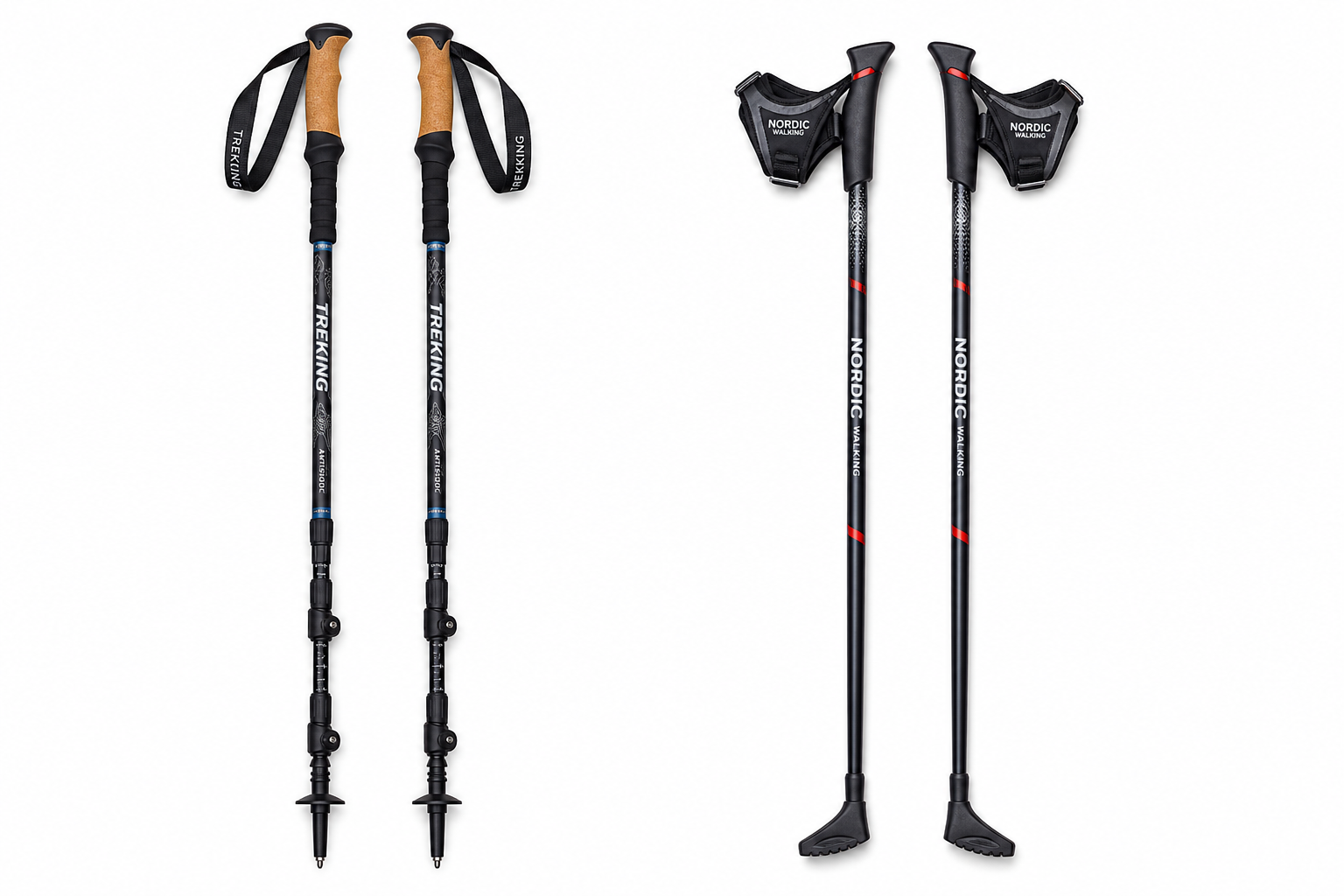
Trekking Poles
Designed for hiking and uneven terrain, trekking poles feature adjustable length, shock-absorbing springs, and ergonomic grips with wrist straps. They’re planted vertically or slightly behind you and used primarily for stability and downhill braking. Most trekking poles are adjustable from about 24-55 inches, accommodating a wide range of heights.
The adjustability is key if you’re walking varied terrain. You’ll want poles shorter when heading uphill (it keeps your posture upright and prevents shoulder strain) and longer when going downhill (it gives you better braking leverage and keeps weight off your knees). If you walk primarily on flat neighborhood streets, the adjustment feature is less critical, but it’s useful if multiple people in your household share the poles.
Best for: Trail walking, hiking, uneven neighborhood sidewalks, anyone who primarily needs stability support.
Nordic Walking Poles
Designed for fitness walking on flat or gently rolling surfaces, Nordic poles have angled rubber tips and specific wrist straps that allow a natural “plant and push” technique. You plant the pole behind you and push off, engaging your arms, shoulders, and core with every stride. This technique is what produces the 20-30% calorie burn increase.
Nordic walking was developed in Finland as summer training for cross-country skiers. The motion mimics the ski stride, driving power through your upper body with each step. Done correctly, it turns walking into a cardiovascular workout that rivals jogging, but without the joint impact. You’ll feel it in your triceps, lats, and core after your first few sessions.
The downside is that Nordic poles are less versatile. They’re built for smooth surfaces and don’t adjust well to trails or steep inclines. If you want one set of poles that works everywhere, trekking poles are the better choice.
Best for: Fitness-focused walkers on paved paths, people who want a full-body workout, cardiovascular improvement goals.
Key Features for Seniors
Grip Style
Cork grips absorb moisture and conform to your hand shape over time. Foam grips are softer and cushion arthritic joints. Rubber grips are durable but can cause blisters during long walks. For seniors, cork or foam is the best choice. Avoid grips that are too thin (less than 1 inch diameter), as they require more squeezing force.
Cork develops a custom fit after repeated use. The material compresses slightly under your grip pattern, creating a personalized handle. If you have sweaty palms, cork stays dry and doesn’t slip. Foam is immediately soft but can wear down faster, especially if you walk in wet conditions frequently. Either is vastly better than hard plastic, which amplifies vibration and gets slippery when damp.
Check the grip length too. Some poles have extended grips (6-8 inches of gripping surface instead of the standard 4-5 inches), which are helpful if you choke up on the pole for uphill sections without stopping to adjust the length.
Wrist Strap Design
A good wrist strap takes pressure off your grip, which is essential for seniors with hand arthritis or weak grip strength. Padded, adjustable straps that support the heel of your hand allow you to push on the pole without clenching. Quick-release straps let you detach instantly if the pole gets caught, preventing wrist injury.
The strap should fit snugly enough that the pole doesn’t swing loose when you lift it, but not so tight that it cuts off circulation or chafes. On Nordic poles, the strap does most of the work. You’re supposed to release your grip after each push and let the strap carry the pole forward for the next plant. On trekking poles, the strap is more of a safety backup that keeps the pole attached if you lose your grip on uneven ground.
Some high-end poles use a glove-style strap that wraps around your hand like a fingerless mitten. These distribute pressure more evenly but take longer to put on and remove. If you need to quickly free your hands to answer your phone, open a gate, or grab a railing, simple loop straps with a quick-release buckle are more practical.
Shock Absorption
Internal spring mechanisms in some trekking poles absorb impact when the pole contacts the ground. This reduces vibration transmitted to your wrists, elbows, and shoulders. Seniors with upper extremity arthritis particularly benefit from shock-absorbing poles. Budget poles without shock absorption transmit more jarring impact with each plant.
The springs add a small amount of weight (usually 1-2 ounces per pole) and a bit of complexity, which means one more component that could eventually need maintenance. Most shock systems can be locked out if you don’t want the spring action, which is useful when you’re walking on soft surfaces like sand or grass where the poles naturally sink slightly and the spring would make them feel mushy.
If you don’t have joint pain in your arms or shoulders, shock absorption is a nice-to-have rather than essential. If you do have arthritis, tendonitis, or old injuries in your upper body, it’s worth paying extra for poles with good shock systems.
Tip Options
Rubber tips are essential for paved surfaces (they grip asphalt and concrete without scratching). Carbide tips are necessary for trail walking (they dig into dirt and rock for grip). Most quality poles include interchangeable tips so you can switch based on your walking surface. Always check that your tips are secure before each walk.
Carbide tips are extremely hard metal points. They bite into soil, gravel, and rock, giving you solid purchase on trails. They’re terrible on pavement because they slip on smooth surfaces and the metal-on-concrete impact sends vibration straight up the pole. Rubber tips are the opposite: excellent traction on asphalt, sidewalk, and tile, but they slide on dirt and can get clogged with mud.
Some poles come with angled rubber tips (also called asphalt paws or fitness tips) specifically designed for Nordic walking. The angle matches the pole’s planting angle and has a larger surface area for better grip during the push-off phase.
Tip baskets (circular discs that attach above the tip) prevent the pole from sinking into snow, sand, or soft mud. If you walk on beaches or snowy paths, baskets are essential. On firm ground, they’re unnecessary and catch on roots or rocks.
Check your tips every few weeks. Rubber tips wear down, especially if you drag your poles instead of planting them cleanly. Carbide tips can snap off if you strike a rock at a bad angle. Replacement tips are inexpensive, but you need to replace them before they’re completely gone or you’ll damage the pole shaft.
Top Walking Poles for Seniors

LEKI Micro Vario Carbon
Premium carbon fiber poles with Speed Lock adjustment system that’s easier for arthritic hands
LEKI Micro Vario Carbon
The LEKI Micro Vario is a premium adjustable trekking pole with LEKI’s patented Speed Lock adjustment system, which is easier to operate than twist-lock mechanisms. The carbon fiber shaft is ultralight (about 8 ounces per pole) and the foam grip with padded strap is comfortable for long walks. Internal shock absorption is included.
Carbon fiber makes a noticeable difference on longer walks. The weight savings compared to aluminum (usually 3-5 ounces per pole) reduces arm fatigue. Carbon also dampens vibration better than metal, which your joints will appreciate. The tradeoff is durability. Carbon can crack if you strike a rock hard or if you lean heavily on a planted pole that’s wedged at an angle. Aluminum dents but rarely breaks.
The Speed Lock system uses a lever clamp instead of a twist collar. You flip the lever open, adjust the pole to the length you want, and flip it closed. It’s faster and requires less hand strength than twisting a collar tight. For seniors with arthritis, this is a meaningful advantage.
LEKI poles are expensive but worth it if you walk regularly (3+ times per week) and want poles that will last years. If you’re trying poles for the first time and aren’t sure you’ll stick with them, start with a less expensive option.
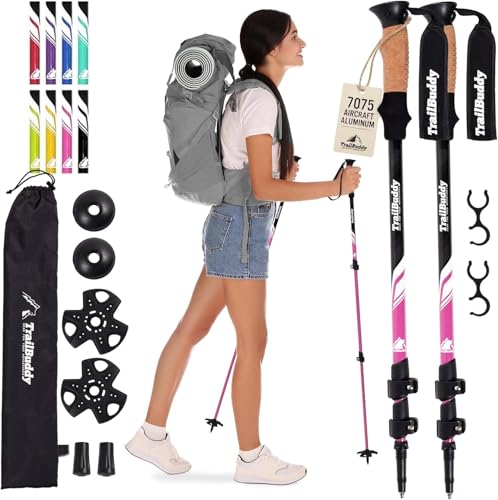
TrailBuddy Trekking Poles
Budget-friendly aluminum poles with flip-lock adjustment and complete accessory kit, perfect for beginners
TrailBuddy Trekking Poles
The TrailBuddy poles offer excellent value with aluminum shafts, cork grips, flip-lock adjustment (easier than twist-lock for arthritic hands), and multiple tip options (rubber, carbide, snow baskets). They’re heavier than carbon poles but significantly less expensive. A great starting point for seniors trying poles for the first time.
TrailBuddy includes a full accessory kit: rubber tips for pavement, carbide tips for trails, mud baskets, snow baskets, and a carrying case. You get everything you need to walk in any conditions without buying additional parts. The poles come in multiple colors, which is helpful if you’re walking with a group and want to distinguish yours at a glance.
The aluminum construction adds weight (about 11-12 ounces per pole), but it’s also more forgiving if you’re rough on your gear. Aluminum poles can take a beating. They’ll dent if you drop them on concrete or whack them against a tree, but they won’t snap. For seniors who are still building confidence with poles and might plant them awkwardly or lean too hard, the durability is reassuring.
TrailBuddy is competitively priced, making them an accessible entry point. If you try them for a month and decide poles aren’t for you, you’re not out much money. If you love them and use them until they wear out, you can upgrade to carbon fiber poles later with a clear idea of what features matter most to you.
York Nordic Walking Poles
The York Nordic poles are designed specifically for Nordic walking technique. They come in fixed lengths (sized by height) and include angled rubber tips optimized for pavement. The ergonomic strap design supports the specific push-and-release motion of Nordic walking. York also offers a beginner instructional guide with each purchase.
Fixed-length poles are lighter and simpler than adjustable ones because there are no locking mechanisms or telescoping sections. Once you know your correct pole length, fixed poles are a better choice for Nordic walking because there’s no risk of the pole collapsing mid-stride if a lock fails.
York’s straps use a half-glove design that cups the heel of your hand and wraps partway around your palm. This distributes push force more evenly and allows you to fully release your grip between strides, which is how Nordic technique is supposed to work. Standard loop straps don’t support the hand as well during the power phase.
The instructional guide is genuinely helpful if you’ve never done Nordic walking. It covers the four-count rhythm (plant, push, release, swing), common mistakes (planting too far forward, gripping too tight, not rotating your torso), and beginner drills. You can find similar information online, but having a printed guide that you can prop up while you practice is convenient.
York poles are a middle-ground option: more expensive than budget trekking poles, less expensive than premium carbon fiber. If you know you want to do Nordic walking specifically and you’ve measured yourself for the correct length, they’re the right tool for the job.
Best for: Seniors focused on fitness walking who want proper Nordic technique.
Proper Pole Height
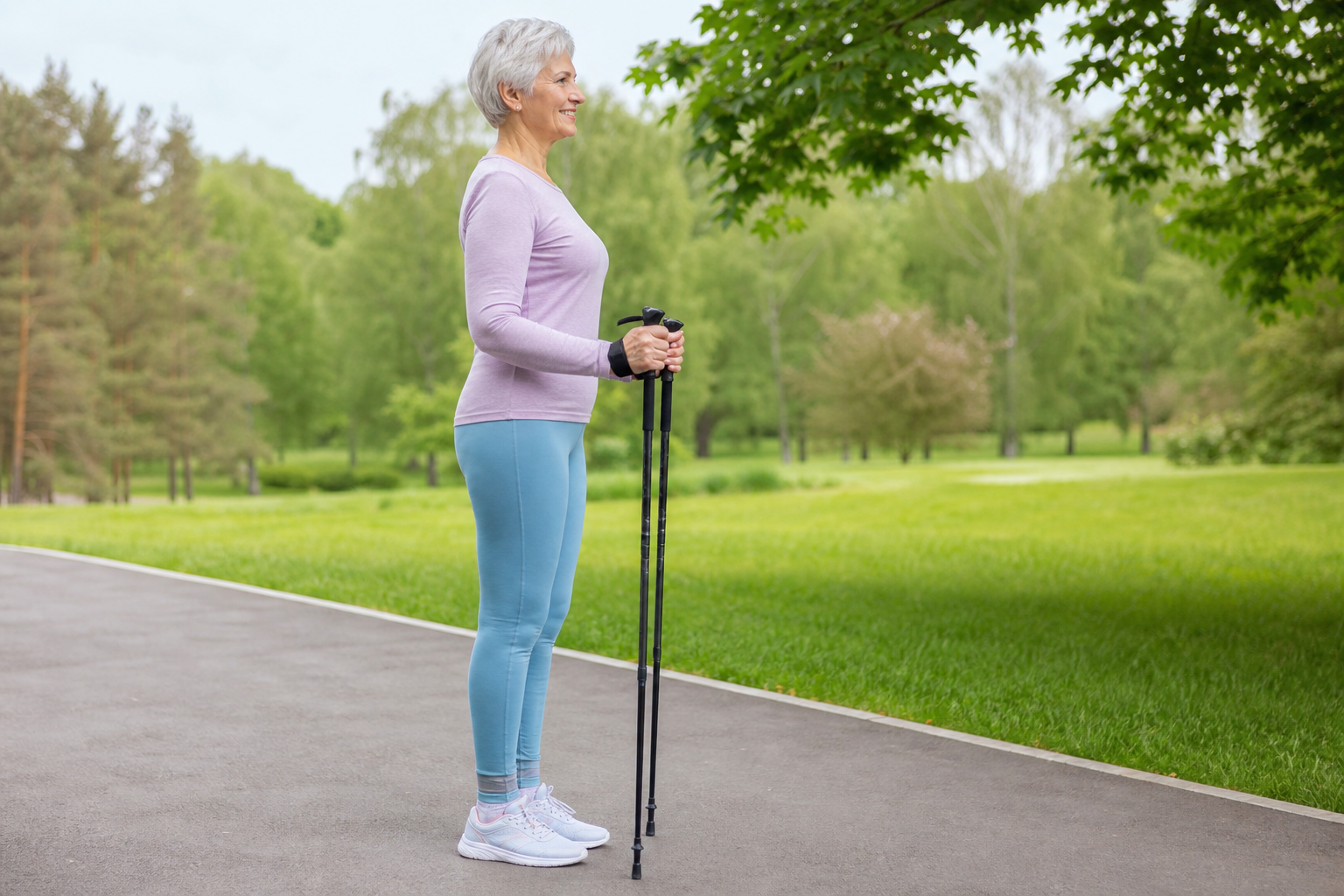
Stand upright and hold the pole vertically with the tip on the ground. Your elbow should bend at approximately 90 degrees (a right angle). If the pole is too short, you’ll lean forward. Too tall, and your shoulders will ride up, causing tension. Most adjustable poles cover a range of 24-55 inches, accommodating heights from about 5’0″ to 6’4″.
The 90-degree rule is a starting point, not a rigid law. Some people prefer poles slightly shorter (85-degree elbow bend) for a more upright posture and less arm swing. Others like poles slightly longer (95-degree bend) for more reach and a smoother stride. Experiment within a 1-2 inch range once you’ve established the baseline.
For Nordic walking specifically, the formula is your height in centimeters multiplied by 0.68. A 5’6″ person (168 cm) would use poles about 114 cm (45 inches) long. For trekking use, the 90-degree elbow rule works better because you’ll be adjusting length based on terrain anyway.
When you’re adjusting telescoping poles, make sure the adjustment marks are visible and the pole sections overlap by at least 4 inches. If you extend a pole to its maximum length with minimal overlap, it’s weaker and more likely to collapse under load. Most poles have a “max” line etched into the shaft. Don’t extend past it.
How Poles Reduce Knee Load

Research published in the Journal of Biomechanics found that using walking poles reduces the compressive force on the knee joint by 12-25% per step. Over a 30-minute walk (roughly 3,000-4,000 steps), that’s thousands of pounds of cumulative stress removed from your knees. For seniors with knee arthritis, this reduction can mean the difference between a comfortable walk and one that leaves you limping.
The load reduction comes from redistributing body weight across four points of contact instead of two. Each time you plant a pole, a portion of your weight transfers through your arms and shoulders instead of driving straight down through your hips and knees. The effect is most pronounced on downhill sections, where knee stress is highest.
Downhill walking without poles forces your quadriceps to act as brakes, contracting eccentrically to control your descent. This eccentric loading is particularly hard on the patellar tendon and the cartilage behind your kneecap. Poles let you brake with your arms, reducing the eccentric demand on your quads by roughly 20%.
The cardiovascular benefit is real too. Studies show that Nordic walking increases heart rate by 10-15 beats per minute compared to regular walking at the same speed. You’re moving more muscle mass with each stride (your lats, triceps, and core are all working), so your heart has to pump more blood. This makes a moderate walk into a meaningful cardiovascular session without