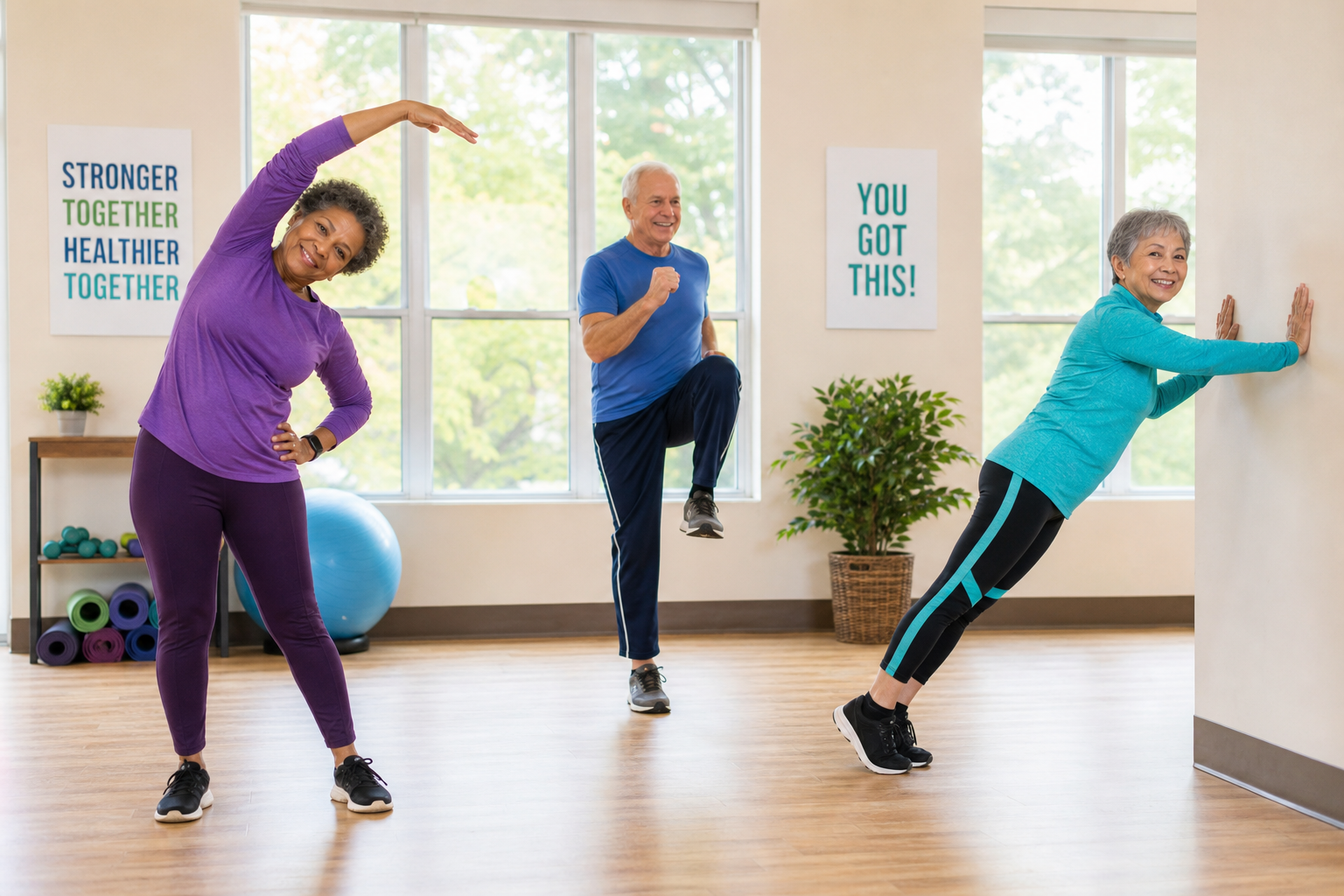
Core training’t require a mat, a plank, or getting down on all fours. If floor exercises are impractical because of knee pain, balance concerns, difficulty getting up, or simply because your floor is cold and hard, you can build a strong, functional core entirely from standing and seated positions.
These exercises target the same muscles (transverse abdominis, obliques, rectus abdominis, erector spinae) without ever leaving your feet or your chair.
Before starting any new exercise program, talk to your doctor, especially if you have a history of back problems, balance issues, or cardiovascular conditions. The exercises below are generally safe and low-impact, but individual ability varies.
Why Core Strength Matters After 60
Your core muscles stabilize your spine during every movement you make: walking, reaching, carrying, turning, bending, and even just standing upright.
Weak core muscles lead to back pain (the spine compensates for what the muscles can’t support), poor balance (your core is the central link in your balance chain), difficulty with daily tasks (getting dressed, lifting, household chores), and increased fall risk (a weak core can’t make fast corrective adjustments when you stumble).
The core isn’t just your abs. It’s a cylinder of muscles wrapping from your ribcage to your pelvis. The transverse abdominis acts like a natural weight belt, compressing and stabilizing. The obliques control rotation and side-bending. The rectus abdominis (the “six-pack” muscle) flexes the spine forward. The erector spinae run along your back and keep you upright. The multifidus muscles stabilize individual vertebrae.
All of these work together as a system.
When this system weakens, other structures pick up the slack. Your hip flexors tighten trying to stabilize what your core can’t. Your lower back muscles overwork and fatigue. The result is stiffness, discomfort, and compensatory movement patterns that increase injury risk. Building strength in this area can complement targeted lower back exercises for a comprehensive approach to spinal health.
Strong core muscles also improve breathing mechanics. The diaphragm is part of the core system. Better core control means better breath support, which helps with endurance during walks, household tasks, and recreational activities.
Standing Core Exercises
Pallof Press
Anchor a resistance band at chest height. Stand sideways to the anchor, holding the band handle with both hands at your chest. Press the handle straight out in front of you.
The band will try to rotate your torso toward the anchor. Your core resists. Hold for 3 seconds, return to chest. 3 sets of 10 per side.
This is one of the most effective anti-rotation core exercises available at any level.

Resistance Band Set with Door Anchor
Essential for Pallof presses and seated rotations, provides adjustable resistance without heavy weights
Start with light resistance. The point isn’t to press heavy weight away from your body. The challenge comes from resisting the rotational pull. Your feet should stay shoulder-width apart. Keep your shoulders down and back. Don’t lean or shift your hips.
The only thing moving is your arms extending and returning.
If 3 seconds feels too easy, extend the hold to 5 seconds. If it’s too challenging, step closer to the anchor point to reduce band tension.
Standing Trunk Rotation
Hold a light dumbbell or water bottle at chest level with both hands. Stand with feet shoulder-width apart. Rotate your upper body to the left, then to the right, keeping your hips facing forward.
Move slowly and with control. This isn’t a fast twist. 3 sets of 10 per side.
This works the obliques and rotational core muscles you use every time you turn, reach, or twist during daily activities.
Start with 2-3 pounds or even an empty water bottle. You can progress to 5-8 pounds over time, but the weight isn’t what makes this effective. Control is. Each rotation should take about 2 seconds. Pause briefly at each end point.
Keep your knees soft (slightly bent). Don’t lock them. Your head and chest rotate together as one unit. Don’t lead with your head or crane your neck.
Standing Marches (High Knees)
Stand near a counter for balance. Lift one knee toward your chest, then lower and lift the other. Alternate for 30-60 seconds at a brisk pace.
Your core contracts to stabilize your pelvis with every knee lift. Add a brief pause at the top of each lift (hold for 2 seconds) to increase the core challenge.
You don’t need to lift your knee all the way to your chest. Hip height is fine. The goal is controlled movement and core engagement, not maximum range of motion.
If balance is a concern, rest one hand lightly on the counter throughout. If your hip flexors fatigue before your core does, you’re lifting too high. Lower the knee height and focus on the stabilization component instead.
Standing Side Bends
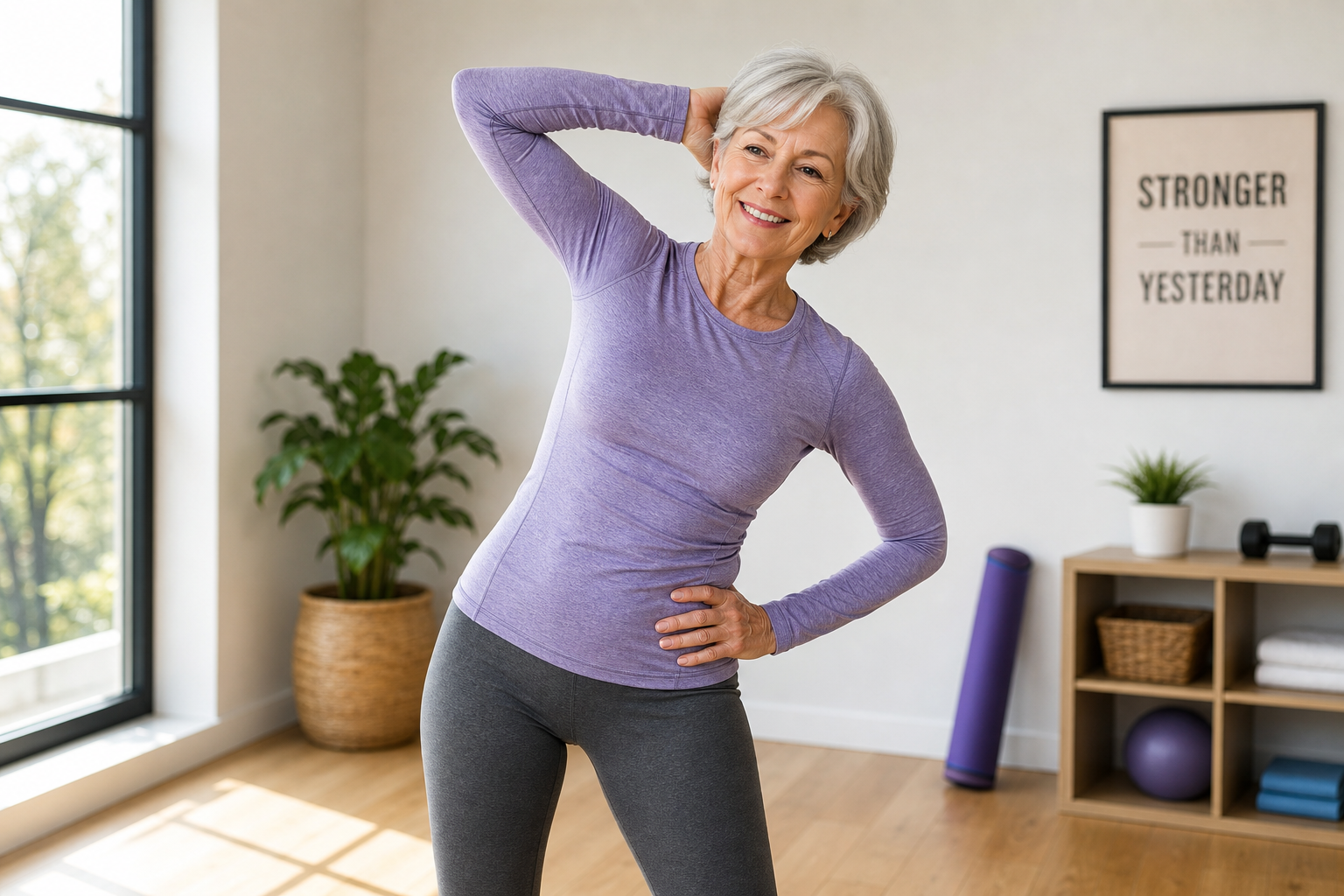
Hold a light dumbbell in one hand at your side. Slowly lean toward the weighted side, then return to upright. 3 sets of 10 per side.
This targets the obliques and quadratus lumborum (deep side-body muscles that stabilize the spine during lateral movements).
The movement is small. You’re not trying to touch your knee with the weight. A 6-8 inch lean is plenty. The eccentric (lowering) phase is where the work happens. Take 2-3 seconds to lean, then 2-3 seconds to return.
Keep your shoulders square. Don’t rotate forward or backward as you lean. Your body moves in a single plane, directly to the side.
Standing Bird Dog
Hold a counter with one hand. Simultaneously extend the opposite arm forward and the same-side leg backward, creating a straight line from hand to foot. Hold for 5 seconds, return. 3 sets of 8 per side.
This trains the anti-extension and diagonal stabilization patterns that the floor-based bird dog provides.
This is harder than it looks. Start with just the leg extension if the full movement challenges your balance. Add the arm reach once you’re stable.
Your standing leg should have a soft knee. Don’t hyperextend or lock it. The extended leg doesn’t need to be parallel to the floor. Lift it as high as you can while keeping your hips level and your torso upright.
Seated Core Exercises
Seated Knee Lifts
Sit tall on the edge of a sturdy chair. Lift one knee toward your chest while keeping your back straight (don’t lean backward). Hold for 3 seconds, lower with control. 3 sets of 10 per leg.
Your core contracts to keep your torso upright against the weight of your rising leg.
The chair needs to be stable and shouldn’t have wheels. Sit far enough forward that your back isn’t touching the backrest. Place your hands lightly on the seat beside your hips for support if needed, but try not to push with your hands.
The core should do the stabilizing work.
If this feels too easy, extend the hold time to 5-7 seconds. You can also add a small ankle weight (1-2 pounds) once you’ve mastered the basic movement. These exercises can be especially beneficial for those following chair-based workout programs that focus on building strength without standing movements.
Seated Trunk Rotation with Band
Sit in a chair positioned sideways to an anchored resistance band at chest height. Hold the handle with both hands and rotate your torso away from the anchor point. 3 sets of 12 per side.
Same anti-rotation benefit as the standing Pallof press, but from a seated position.
Keep your hips square on the chair. They shouldn’t rotate. Only your torso turns. This isolates the obliques and prevents compensating with hip movement.
Sit up tall throughout. Don’t slouch or round your spine. Think about rotating around a vertical axis running through the center of your body.
Seated Bicycle Motion
Sit tall with your hands lightly behind your head. Lift one knee while rotating the opposite elbow toward it. Alternate sides in a controlled pedaling motion. 3 sets of 10 per side.
This challenges the obliques and hip flexors simultaneously.
Don’t yank on your neck with your hands. Your hands are there for light support only. The rotation comes from your torso, not from pulling your head.
Each rep should take about 3 seconds total: 1 second to lift and rotate, 1 second to hold, 1 second to return. This isn’t a race.
Seated Lean-Backs
Sit at the front edge of a chair with your arms crossed over your chest. Slowly lean your torso backward about 20-30 degrees (not all the way back), pause for 3 seconds, and return to upright. 3 sets of 8.
Your abdominal muscles work hard to control the lean and pull you back up. The chair back acts as a safety stop.
This is an eccentric-focused exercise. The lowering phase (the lean back) is where the intensity comes from. Lower slowly, taking 3-4 seconds. Return to upright with control.
If you have trouble coming back up, reduce the lean angle. Even a 15-degree lean provides core work. As you get stronger, increase the angle.
Seated Torso Twist with Weight
Sit upright holding a light weight (2-5 pounds) at chest height with both arms extended. Rotate your torso to the left, bringing the weight across your body. Return to center, then rotate right. 3 sets of 10 per side.
Keep the weight at a consistent distance from your chest. Don’t let it drift closer or farther as you rotate. Your arms act like a fixed steering wheel attached to your torso.
Breathe steadily. Don’t hold your breath. Exhale during the rotation, inhale as you return to center.
Wall Core Exercises
Wall Plank
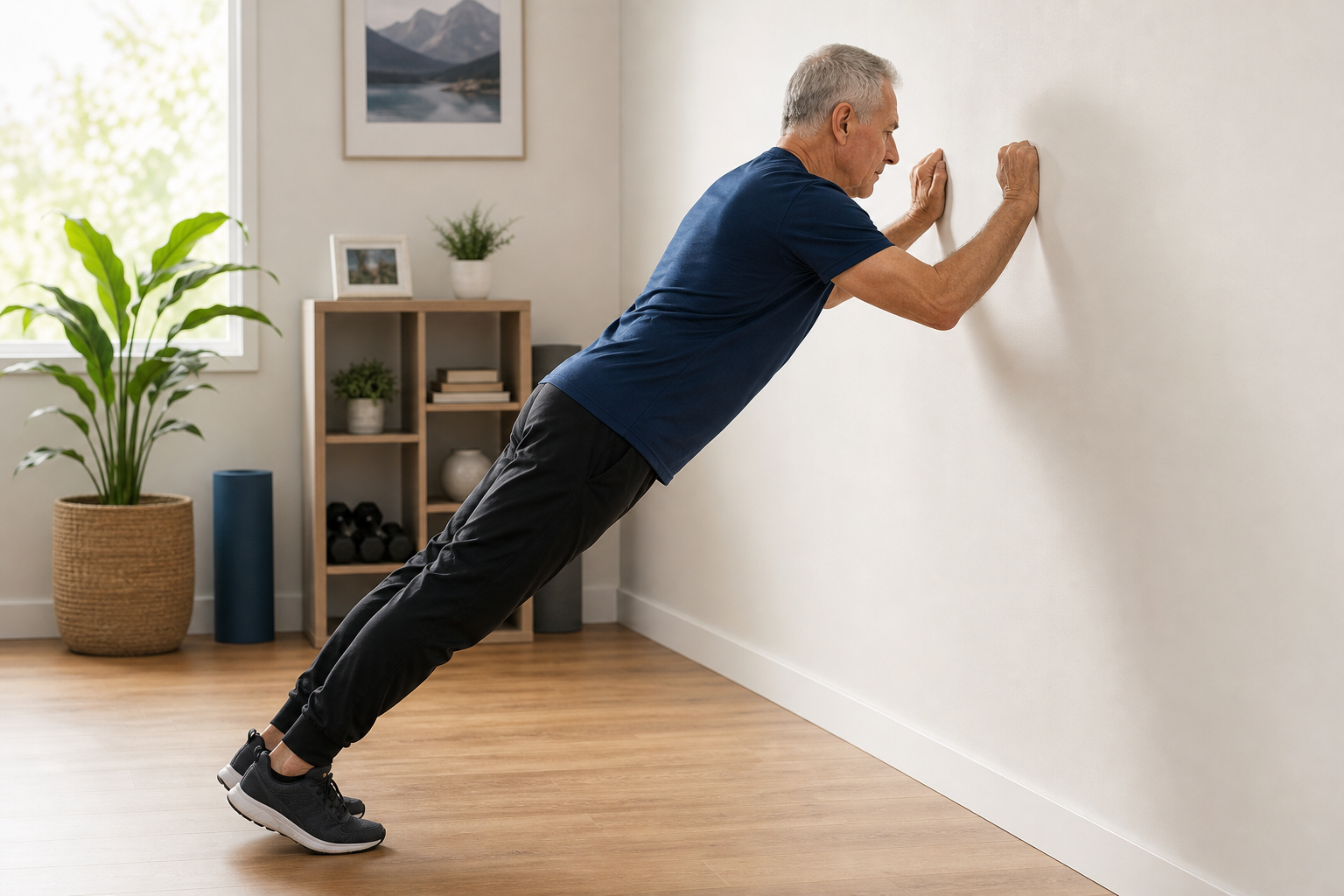
Face the wall and place your forearms against it at chest height. Walk your feet back until your body forms a straight line at an angle to the wall. Hold for 15-30 seconds. 3 holds.
This is the wall equivalent of a floor plank, engaging your entire core without wrist strain.
Your body should form a straight line from your heels to your head. Don’t let your hips sag or pike upward. Engage your glutes and pull your belly button toward your spine.
The farther your feet are from the wall, the harder this becomes. Start closer to the wall (2-3 feet) and walk backward as you build strength.
If your forearms feel uncomfortable against the wall, place your palms flat instead and hold with straight arms. This reduces the angle slightly but still works the core effectively.
Wall Push-Off with Rotation
Face the wall with both hands flat at shoulder height. Push away from the wall, and as you reach full arm extension, rotate your torso and reach one arm toward the ceiling. Return and repeat on the other side. 3 sets of 8 per side.
This combines pushing strength with rotational core control.
The rotation should happen at the peak of the push, not during it. Push off, hold at full extension, rotate, return to the wall, then push again.
Keep your feet planted. Don’t twist from your lower body. The rotation is isolated to your torso.
Wall Sit with Arm Reach
Stand with your back against a wall and slide down until your thighs are parallel to the ground (or as low as comfortable). Hold this position while reaching one arm straight up, then the other. Alternate arms for 30 seconds.
The wall sit loads your core, and the reaching arms challenge stability.
If parallel thighs are too intense, only slide partway down. Even a partial wall sit provides core activation. The reaching arms are what create the balance challenge that engages the obliques and transverse abdominis.
Press your lower back into the wall. Don’t let it arch away as you fatigue.
Building a No-Floor Core Routine