Rain, ice, extreme heat, and bitter cold don’t have to derail your exercise routine. Seniors who depend on outdoor walking for their primary fitness often lose weeks or months of consistency to weather, and every break makes restarting harder. Having a menu of indoor alternatives ready before the weather turns means you never face the “I can’t exercise today” decision. You just pivot to a different activity.
Indoor exercise isn’t second-best. It’s strategic. The ability to maintain movement regardless of conditions is what separates people who exercise year-round from those who lose months and have to rebuild their base every spring. The specific activities you choose matter less than having a plan that removes the friction between bad weather and staying active.
9 Indoor Activities That Keep You Moving
1. Indoor Walking Routes
Your house is a walking track. Map a loop through connected rooms and hallways. Most homes provide a 50-150 foot circuit. Walk the loop for 20-30 minutes with a podcast or music playing. Count laps if that motivates you, or just focus on time. The repetition that seems boring at first becomes meditative after a few sessions.
If your home is too small for a satisfying route, mall walking is the classic senior alternative: climate-controlled, flat, well-lit, with benches for resting and bathrooms nearby. Many malls open their doors early (before stores open) specifically for walkers. You’ll find the same group of regulars most mornings, which adds a social component outdoor walking often lacks. Some malls track distance with posted markers, so you can measure your progress lap by lap.
Apartment dwellers with hallways can walk circuits in their building. Interior hallways provide the same controlled environment as malls without the drive. If you live in a multi-story building and can safely use the stairs, incorporating one or two flights into each lap adds intensity.
The surface matters less indoors than out. You’re not dealing with uneven pavement, roots, or gravel. Your focus shifts entirely to maintaining pace and duration. That makes indoor walking especially appropriate for anyone working through balance concerns or recovering from an injury that outdoor terrain might aggravate. For a structured approach to getting started, our complete indoor walking program provides day-by-day guidance for building a safe routine at home.
2. Chair Exercise Routines
A sturdy chair and 20 minutes provide a full-body workout covering cardio, strength, and flexibility. Seated marches, arm punches, leg extensions, resistance band rows, and trunk rotations hit every major muscle group. YouTube has hundreds of free guided chair workouts for seniors, from gentle 10-minute sessions to vigorous 30-minute programs.
Chair exercises remove the balance challenge entirely, which makes them accessible for anyone who struggles with standing exercises or has significant fall risk. You can work at high intensity from a seated position. Rapid marches and punches elevate heart rate just as effectively as standing cardio, and the stability of the chair lets you focus on speed and range of motion rather than maintaining balance.
Start with a basic routine: seated marches for two minutes, arm circles in both directions for one minute, seated knee lifts (pulling one knee toward your chest, then the other) for two minutes, and seated twists (rotating your upper body side to side) for one minute. Repeat the circuit three times. That’s a 15-minute session covering cardio, flexibility, and core work.
Add resistance bands to the chair setup for strength training. Anchor a band under your feet for bicep curls and shoulder presses. Loop it behind the chair back for rows. The chair provides the stable base that makes resistance training safer and more controlled than free weights for many older adults.
If you have arthritis or joint pain that makes standing exercise uncomfortable, chair routines may become your primary workout format rather than an occasional substitute. That’s completely fine. Many seniors maintain excellent fitness levels doing nothing but chair-based training because the consistency is more important than the exercise mode.
3. Pedal Exerciser While Watching TV
A pedal exerciser in front of your couch converts screen time into active time. Pedal at a comfortable pace during shows and increase the resistance during commercials for natural intervals. A 60-minute movie becomes a 60-minute cardio session without feeling like exercise.

Quiet Magnetic Pedal Exerciser
The single best indoor cardio investment for seniors, converting any chair into exercise equipment with nearly silent operation
The mental engagement of watching something makes the time pass without the clock-watching that plagues solo cardio. You’re not exercising for 30 minutes; you’re watching a show and your legs happen to be moving. That psychological shift matters for adherence, especially on days when motivation is low.
Quiet magnetic resistance pedal exercisers generate almost no noise, so you won’t need to turn up the TV volume. The resistance dial lets you adjust intensity mid-session. Start easy during dialogue-heavy scenes and increase resistance during action sequences or commercials. The natural variation keeps your legs engaged without requiring you to think about interval structure.
Pedal exercisers work for arms too. Set the unit on a table and pedal with your hands for upper-body cardio and shoulder strengthening. Hand pedaling is particularly useful for anyone with lower-body limitations that make leg exercise difficult. You can get a complete cardio session from arm pedaling alone, though it typically requires slightly higher effort to reach the same heart rate as leg pedaling.
Track your sessions by time rather than distance. Most pedal exercisers have basic displays showing time, speed, and distance, but the distance readings are often inaccurate and irrelevant. What matters is that you pedaled for 40 minutes, not that the display says you covered 8 miles.
4. Resistance Band Training
A set of resistance bands with a door anchor turns any room into a home gym. Rows, presses, curls, squats, lateral walks, and core exercises cover every muscle group. A full-body resistance band session takes 20-30 minutes and requires no more floor space than you’re standing in.
Bands are easier on joints than free weights because the resistance increases gradually through the range of motion rather than hitting maximum load at the weakest point. They’re also safer for home use. Dropping a band doesn’t damage floors or feet. There’s no weight to lose control of during fatigue.
A basic full-body band routine: door-anchor the band at chest height for rows (pulling the handles toward your ribs), at head height for lat pulldowns (pulling down toward your shoulders), and at floor level for bicep curls and squats (standing on the band and pulling up). Do 10-15 repetitions of each exercise, rest for one minute, and repeat the circuit twice more. That’s three circuits covering back, shoulders, arms, and legs in about 25 minutes.
The door anchor is critical. Trying to anchor bands around doorknobs or furniture legs leads to slipping and inconsistent resistance. A proper door anchor clamps securely when the door is closed and provides a stable attachment point at any height. Close the door with the anchor on the hinge side (not the knob side) so the door frame takes the force rather than the latch.
Bands come in multiple resistance levels, typically marked by color. Most sets include three to five bands ranging from light to heavy. Start with the lightest band for every exercise until you’re confident with the movement pattern. Once you can complete 15 repetitions with good form, move to the next resistance level. Using bands that are too heavy from the start leads to compensatory movement patterns that reduce effectiveness and increase injury risk, which is one of the most common mistakes seniors make when starting a new exercise program.
5. Yoga or Tai Chi Videos
Follow-along yoga and tai chi videos provide guided exercise that builds flexibility, balance, and strength while keeping your mind engaged. Search YouTube for “gentle yoga for seniors” or “tai chi for beginners over 60.” The visual guidance from an instructor is especially helpful for people who struggle to exercise independently because they’re unsure what to do next.
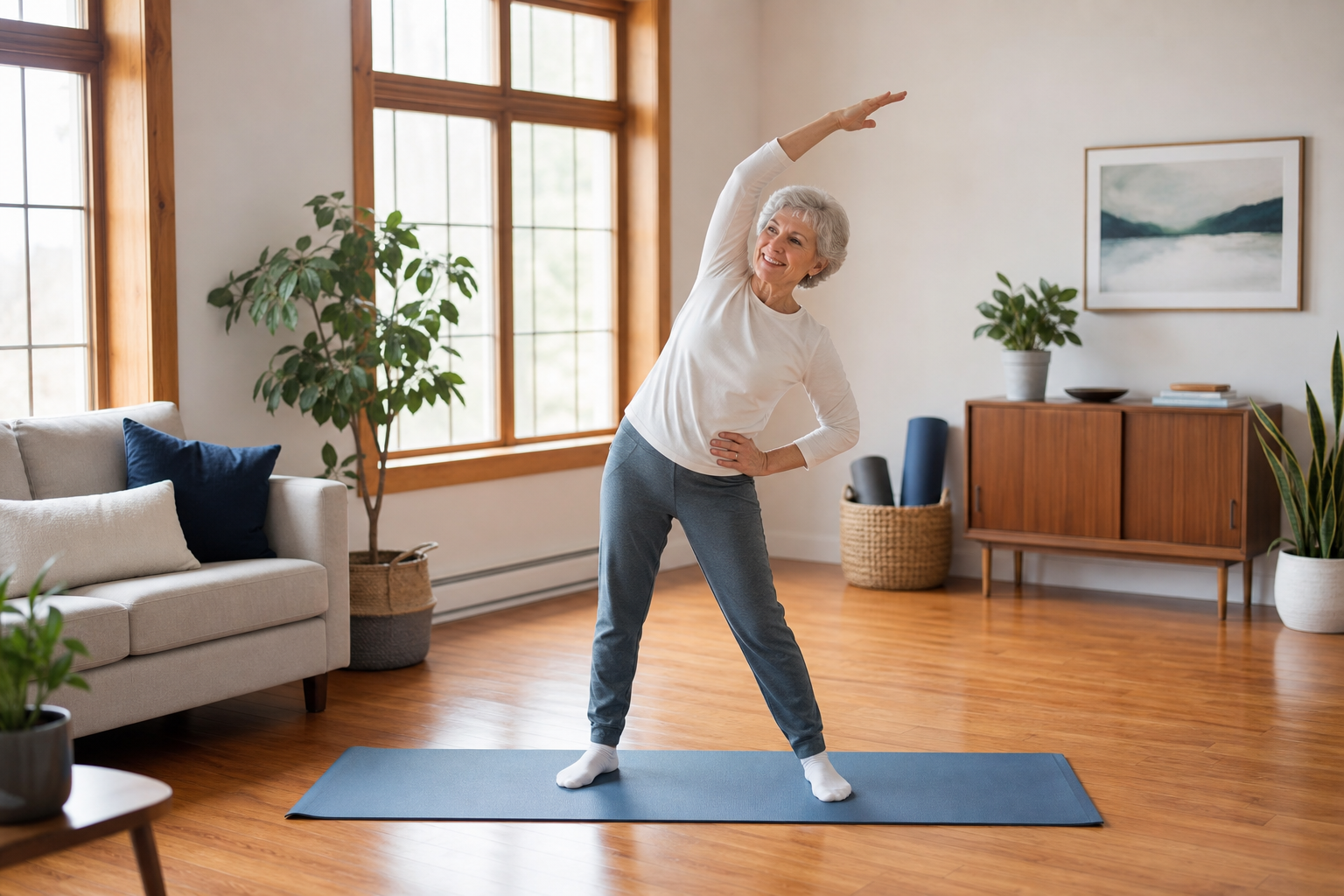
Yoga addresses flexibility and balance simultaneously. Many yoga poses challenge your balance while stretching muscles that tighten with age: hip flexors, hamstrings, shoulders, and chest. A 20-minute yoga session typically includes standing poses (for balance and leg strength), seated poses (for flexibility), and floor poses (for core and hip work). The continuous flow from one pose to the next provides mild cardiovascular benefit along with the primary flexibility and balance training.
Tai chi is moving meditation with measurable physical benefits. The slow, controlled movements require constant balance adjustments as you shift your weight from one leg to the other. Research shows tai chi reduces fall risk in older adults as effectively as traditional balance training, likely because the movements train both physical balance and the mental focus required to maintain stability.
Chair yoga is the modification that makes yoga accessible for anyone with significant balance concerns or mobility limitations. Every pose is performed sitting or using the chair for support. Chair yoga still delivers the flexibility and breathing benefits of traditional yoga while removing the fall risk that standing poses present for some practitioners.
Start with 10-15 minute videos rather than full 30-40 minute classes. Shorter sessions are less intimidating for beginners and easier to fit into a daily routine. Once you’re comfortable with the basic movements, longer sessions become appealing rather than overwhelming. For more on choosing between these practices, check out our detailed yoga vs tai chi comparison.
6. Stair Climbing
If you have stairs at home, climbing them is one of the most effective cardiovascular and leg-strengthening exercises available. Each step generates 2-3 times your body weight in force through your hips and legs. Start with 1-2 flights and build to 5-10 flights (with rest breaks between). Always use the handrail. Walking up and down your stairs 5-6 times takes about 10 minutes and provides a concentrated workout.
Stair climbing builds leg strength faster than level walking because the vertical component forces your quadriceps, glutes, and calves to work against gravity on every step. That intensity means shorter sessions produce equivalent benefits to much longer flat walks. A 10-minute stair session matches the training effect of a 30-minute outdoor walk.
The handrail is non-negotiable. Using it doesn’t reduce the exercise value. Your legs are still doing the work of lifting your body weight up each step. The handrail provides stability that reduces fall risk, especially on the descent when your muscles are fatigued and your knees absorb the most force.
Descending stairs is harder on joints than climbing. If you have knee pain, walk up the stairs and take the elevator or walk the long way around to avoid going back down. You get 70% of the benefit from the ascent alone. Or climb the stairs twice for every descent, which gives you more time to recover between downward trips.
Start conservatively. One flight up and down is enough for the first session if you haven’t been doing stairs regularly. Add one additional flight every few sessions until you reach a duration that feels like a workout but doesn’t leave you excessively sore the next day. For most people, that’s somewhere between 5 and 10 flights (counting each up-and-down as one flight).
7. Dancing
Put on your favorite music and move. Dancing is cardiovascular exercise, balance training, and mood enhancement rolled into one. You don’t need a partner or choreography. Simply moving to music for 15-20 minutes in your living room burns calories, improves coordination, and lifts your spirits. Seated dancing (moving your upper body, arms, and legs from a chair) is an option for anyone with balance concerns.
The music selection drives the intensity. Upbeat songs naturally increase your movement speed and energy expenditure. Slower songs allow for sustained movement with less cardiovascular demand. Mix both within a session for natural intervals. Three fast songs followed by one slow song creates a 4:1 work-to-rest ratio that’s ideal for interval training.
You don’t need to follow specific dance steps. March in place, step side to side, raise your arms overhead, turn in circles, tap your feet. Any continuous movement to music counts. The variety of movements dancing produces (unlike the repetitive motion of walking) challenges balance and coordination in ways that single-mode exercises don’t.
Seated dancing preserves the enjoyment and much of the physical benefit when standing balance is a concern. Move your arms, twist your torso, lift your knees, tap your feet. Upper-body dancing alone provides meaningful cardiovascular work. Adding leg lifts and marches from the seated position increases intensity without increasing fall risk.
Dancing with a partner adds social connection to the physical activity, which improves adherence. Couples who dance together tend to maintain the habit longer than individuals dancing alone. You’re not exercising; you’re spending time together. The exercise is a byproduct.
8. Household Chores as Exercise
Vacuuming, mopping, laundry, gardening (indoor plants), organizing closets, and cleaning bathrooms all count as light-to-moderate physical activity. A 30-minute cleaning session burns 100-200 calories and involves bending, reaching, carrying, and walking. Making chores more intentional (adding extra trips up the stairs, squatting to reach low shelves instead of bending) increases the exercise value.
The advantage of counting chores