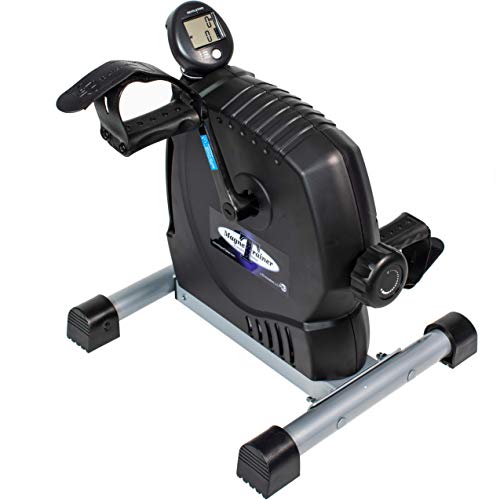
A pedal exerciser is the exercise equivalent of a Swiss Army knife for seniors who need accessible, low-impact cardio. It sits on the floor in front of your chair, weighs 5-15 pounds, costs a fraction of a full-size bike, and lets you pedal while watching TV, reading, or talking on the phone. For seniors with mobility limitations, balance concerns, or joint pain that prevents walking, a pedal exerciser may be the most practical piece of fitness equipment available.
Unlike a full-size stationary bike, a pedal exerciser requires no mounting or dismounting. You’re already seated. There’s no balance component, no risk of falling, and no need to clear floor space for a bulky frame. It’s exercise reduced to its simplest mechanical form: two pedals connected to a resistance mechanism. That simplicity makes it accessible to seniors who haven’t exercised in years or who are recovering from surgery, stroke, or injury.
The cardiovascular benefit is real. Studies on seated pedaling show measurable improvements in leg circulation, reduced ankle swelling, and increased heart rate variability in older adults. It won’t replace a brisk walk for those who can still walk comfortably, but for seniors with limited mobility, it’s often the difference between zero cardio and 30 minutes a day. For those who want to complement their pedaling routine with other low-impact movement, chair-based cardio exercises offer additional variety.
Before starting any new exercise program, talk to your doctor, especially if you have heart conditions, recent joint replacements, or chronic pain that affects your legs.
What to Look for in a Pedal Exerciser
Resistance System
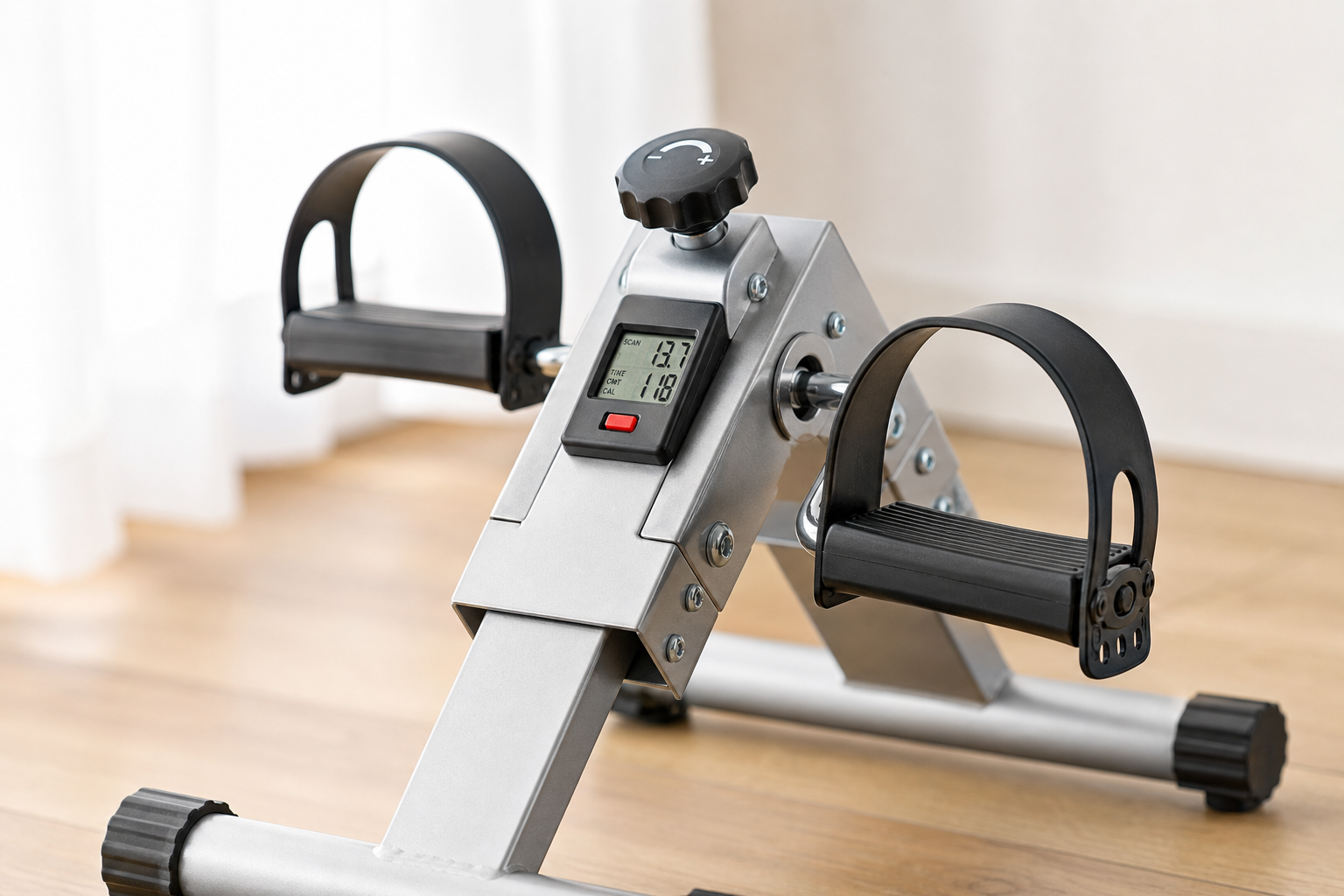
Magnetic resistance is the gold standard for home use. It’s whisper-quiet (critical for TV-time use), smooth through the entire pedal stroke, and typically adjustable across 4-8 levels. The resistance comes from magnets moving closer to or farther from a metal flywheel. No physical contact means no friction noise and no parts that wear out quickly.
Friction resistance (a tension knob pressing a pad against the flywheel) is cheaper but noisier and can develop a scraping sound at higher settings. The pad wears down over time and may need replacement after heavy use. Friction systems work fine at low resistance, but they’re audibly distracting when you’re trying to watch TV or have a conversation.
Some high-end models offer digitally controlled magnetic resistance with preset programs, but most seniors don’t need that complexity. A manual dial with 6-8 levels covers the full practical range from barely-there resistance to legitimately challenging pedaling.
Stability
The unit must stay planted during pedaling. Rubber feet prevent sliding on hard floors. Heavier units (8+ pounds) are naturally more stable than ultralight models. On very smooth floors, placing a rubber mat underneath adds extra grip. If the exerciser creeps across the floor while you pedal, it’s either too light or the feet aren’t grippy enough.
Weight matters more than base width. A 6-pound unit with a wide base will still scoot forward on smooth tile. A 12-pound unit with a compact footprint will stay put. The physics of pedaling create forward thrust with every downstroke, so the exerciser needs mass to resist that motion.
Test stability by sitting down and pedaling at your expected resistance level before committing to daily use. If the unit shifts even slightly during the first session, it’ll be worse after a month of use when the rubber feet have compressed.
Pedal Straps
Adjustable foot straps keep your feet on the pedals during the full rotation. Without straps, your feet can slip off at the top of the pedal stroke, especially at higher resistance levels. Straps should be wide enough to accommodate different shoe sizes and easy to tighten with one hand.
Some models use Velcro straps, others use buckle systems. Velcro is faster to adjust but loses grip over time as it collects lint and debris. Buckles stay secure longer but take more dexterity to fasten, which matters for seniors with arthritis in their hands.
The pedal surface itself should have some texture or tread. Smooth plastic pedals are slippery even with straps. Molded ridges or rubberized surfaces give your shoes something to grip against.
Pedal size varies. Larger pedals (4+ inches wide) support more of the foot and distribute pressure better, reducing hot spots during longer sessions. Smaller pedals work fine for short sessions but can cause forefoot discomfort after 30 minutes.
Display
A basic LCD showing time, speed, distance, and calories lets you track your sessions without a separate app or device. Large, easy-to-read numbers are essential. Many seniors skip models with tiny displays because squinting at the screen mid-session defeats the casual, multitasking appeal of pedal exercising.
Some models include cumulative distance tracking (total miles over time), which provides long-term motivation. Watching the total tick from 50 miles to 100 miles over a few months offers tangible proof of consistency that daily stats don’t capture.
Calorie counts are estimates at best. The sensors don’t know your weight, body composition, or actual effort level. Treat them as relative measures (today’s session versus yesterday’s), not precise metabolic data.
Battery-powered displays are standard. Most use AAA batteries that last several months. A few models draw power from the pedaling motion itself, which sounds clever but often results in the display blanking out when you stop pedaling to rest.
Low Profile
The pedal exerciser needs to fit under your chair without pushing your knees uncomfortably high. Lower-profile units (under 10 inches tall) work with standard dining chairs and most couches. Taller units may require a higher seat or a footrest to maintain comfortable knee angles.
Measure the clearance from your floor to the underside of your chair seat. Subtract the exerciser’s height. The remaining space determines your knee angle. Ideally, your knee should bend to roughly 90 degrees at the top of the pedal stroke. Much less and you’re cramping your leg. Much more and you’re losing mechanical efficiency.
Very low chairs (recliners, some sofas) may not provide enough clearance even for the slimmest pedal exercisers. In those cases, consider an ottoman or footstool to raise your starting position slightly.
Top Pedal Exercisers for Seniors
DeskCycle Under Desk Bike
DeskCycle Under Desk Bike
The quietest option with smooth magnetic resistance and low profile design, perfect for living room use
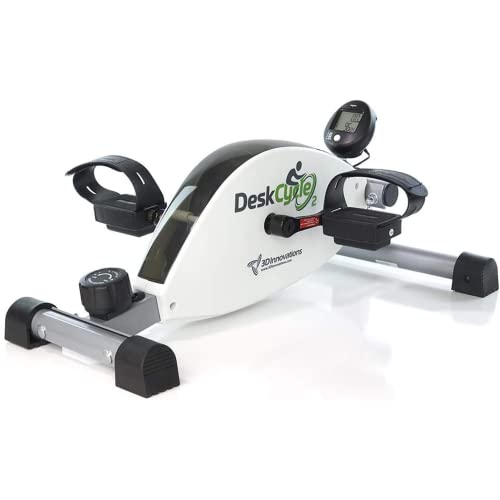
The DeskCycle is the quality benchmark for pedal exercisers. Its magnetic resistance system is essentially silent. The 8 resistance levels cover everything from gentle warm-up to a genuinely challenging workout. At just 9 inches tall, it fits under most chairs without knee clearance issues. The 5-function display tracks speed, distance, time, calories, and cumulative distance.
The flywheel weight and bearing quality create a smooth pedal stroke that feels closer to a real bike than cheaper models. There’s no dead spot at the top or bottom of the rotation. The resistance dial clicks into each level with clear detents, so you know exactly where you are without looking down.
The DeskCycle’s weight (around 14 pounds) makes it stable on all floor types without needing a mat. It doesn’t budge even during hard pedaling at high resistance. The rubber feet leave no marks on hardwood.
Pedal straps are extra wide and adjust with a single pull-tab system. They accommodate everything from bare feet to winter boots. The pedals themselves are oversized and slightly concave, cradling your foot rather than forcing it onto a flat surface.
Best for: Most seniors. The quiet operation and low profile make it the most practical option for living room or bedroom use.
Vive Pedal Exerciser
Vive Pedal Exerciser
Portable mid-range option with fold-down display, ideal for multi-room use
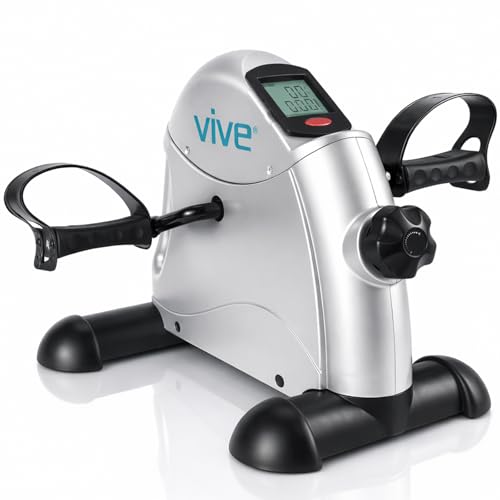
The Vive is a solid mid-range option with friction-based resistance, a fold-down LCD display, and non-skid rubber feet. It’s lighter and more portable than the DeskCycle. The adjustable tension knob provides smooth resistance at lower settings, though it’s slightly noisier at higher levels.
The fold-down display is a nice touch for storage. You can collapse it flat and slide the unit under a couch or into a closet. The display shows speed, time, distance, and calories on a rotating cycle, so you see one metric at a time rather than all four simultaneously.
At around 7 pounds, the Vive is light enough to carry room-to-room with one hand but still stable enough for moderate pedaling on carpet or tile. On very slick floors, it benefits from a rubber mat underneath.
The tension knob offers infinite adjustment rather than discrete levels. That’s liberating if you want precise control, but it also means you can’t reliably return to “level 4” the way you can on a model with clicked detents. You’re setting resistance by feel each time.
Best for: Seniors who want a portable option to move between rooms or who need to stow the exerciser out of sight when not in use.
Sunny Health Mini Exercise Bike
The Sunny Health mini bike features a digital monitor, adjustable resistance, and textured pedals with straps. The wider base provides good stability on hard floors. At a budget-friendly price point, it’s the best entry-level option for seniors trying out pedal exercising for the first time.
The resistance knob is friction-based and offers a decent range for light-to-moderate effort. It’s noisier than magnetic systems but not loud enough to drown out conversation. Think of it as a low hum rather than a grinding sound.
The monitor is basic but readable. It cycles through time, speed, distance, and calories automatically, updating every few seconds. There’s no cumulative tracking or memory function. Each session resets to zero when you power down.
Build quality is acceptable for the price. The frame is steel, the pedals are plastic with rubber straps, and the feet are rubber pads. Nothing feels premium, but nothing feels fragile either. Expect it to handle daily 20-30 minute sessions without issues. Heavy users pedaling 60+ minutes at high resistance might wear it out faster.
Best for: Budget-conscious seniors or those trying pedal exercising before investing in a premium model.
MagneTrainer ER Mini Exerciser