A knee brace for arthritis serves two purposes: it reduces pain during activity and it provides a sense of stability that gives you the confidence to keep moving. For seniors with osteoarthritis, the right brace can extend your comfortable walking distance, make stairs more manageable, and let you participate in exercises that would otherwise be too painful. The wrong brace, though, is bulky, uncomfortable, and ends up in a drawer after a week.
The market is crowded with options, and most product descriptions focus on athletes recovering from sports injuries rather than older adults managing chronic arthritis. What works for a 25-year-old recovering from an ACL tear isn’t necessarily what works for a 70-year-old with bone-on-bone medial compartment arthritis. This guide focuses on braces designed for the specific needs of arthritic knees: pain reduction during weight-bearing activities, manageable bulk, ease of application, and reasonable cost for something you’ll need to replace periodically.
Before selecting a brace, talk to your doctor or physical therapist, especially if you have significant instability (your knee gives way), severe arthritis, or if you’ve recently had surgery. They can identify whether your knee needs light compression, moderate support, or structural stabilization, which determines the type of brace that will actually help rather than just add bulk.
Types of Knee Braces for Arthritis
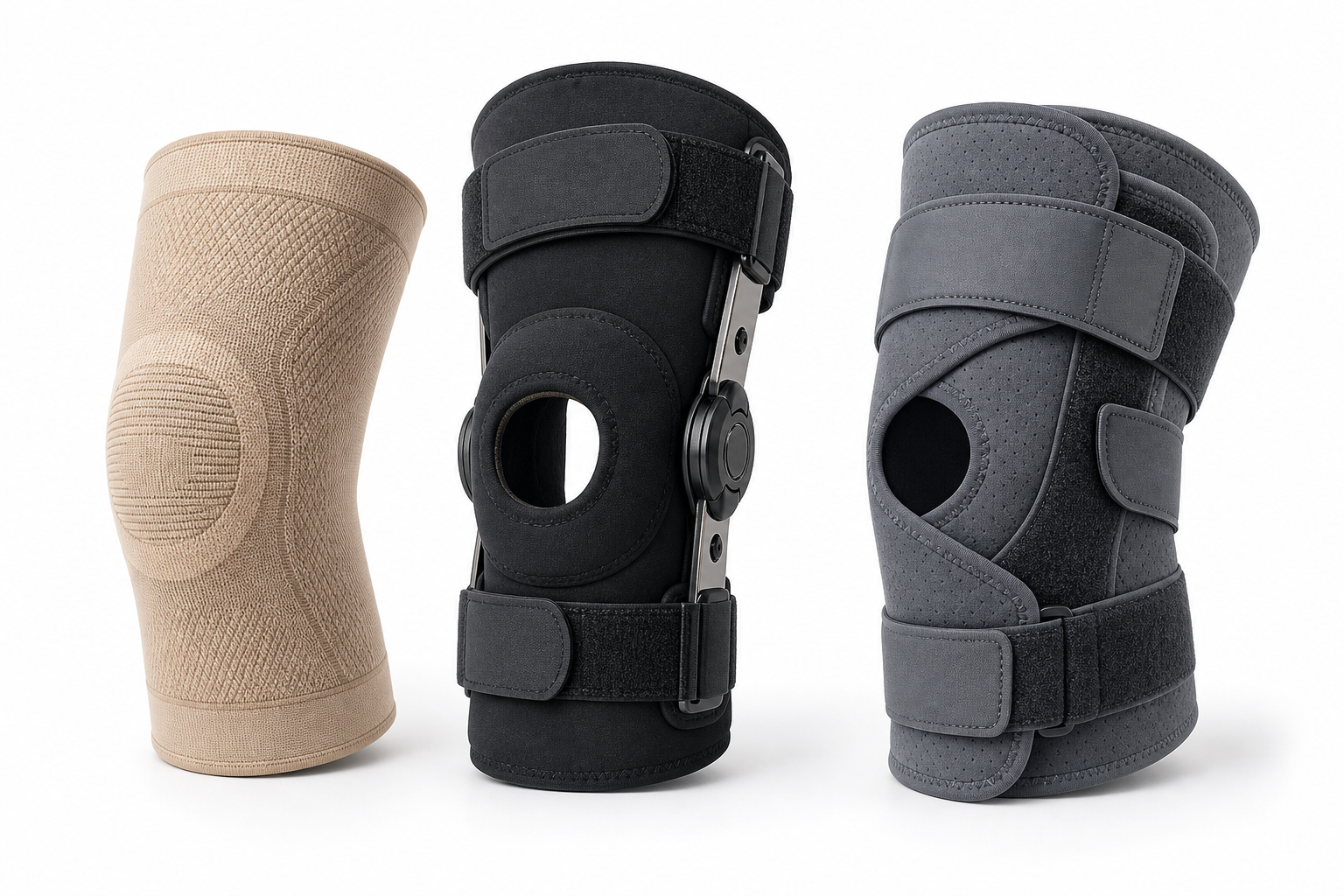
Compression Sleeves
Pull-on elastic sleeves that provide uniform compression around the entire knee joint. They’re the simplest, most comfortable option and are worn under clothing without anyone knowing. Compression improves proprioception (joint position awareness), reduces mild swelling, and provides warmth that loosens stiff arthritic joints. They don’t provide structural support for unstable knees.
The compression is typically graduated, meaning it’s tighter in the center and lighter at the top and bottom edges. This design prevents blood flow restriction while still providing the therapeutic pressure that reduces joint swelling. Most sleeves are made from a blend of nylon, spandex, and sometimes a small percentage of latex or silicone for grip.
Application is simple: roll the sleeve up, insert your foot, and pull it over your knee. If you have limited hand strength or arthritis in your fingers, the pull-on process can be challenging. Some people use a small amount of cornstarch on their skin to reduce friction during application. Once on, the sleeve should feel snug but not tight enough to cause numbness, tingling, or skin discoloration.
Best for: Mild to moderate arthritis with general achiness, stiffness, and minor swelling. Good for daily wear during walking and light exercise.
Open-Patella Braces
Similar to compression sleeves but with a hole or opening over the kneecap. The opening reduces pressure on the kneecap (which is beneficial for patellofemoral arthritis) while the surrounding compression supports the rest of the joint. Many have side stabilizers (rigid or semi-rigid strips along the inner and outer edges) for additional lateral support.
The patella opening serves a specific purpose beyond just comfort. It allows the kneecap to track naturally without external pressure, which is important if your arthritis involves the joint surface behind the kneecap. That area is prone to pain during stair climbing, squatting, or getting up from a seated position. Relieving pressure there can make those movements noticeably more comfortable.
Side stabilizers add a degree of lateral control without the full commitment of hinged braces. They’re typically made from flexible plastic or spring steel encased in fabric channels. They prevent side-to-side wobbling (varus/valgus instability) while still allowing full flexion and extension. For seniors whose knees feel slightly unsteady but don’t fully give way, this is often the right level of support.
Best for: Kneecap pain (front-of-knee arthritis), patellofemoral syndrome, and mild lateral instability.
Hinged Braces
These have metal or polymer hinges on both sides of the knee that control and limit the range of motion. They provide the most structural support and are recommended for moderate instability (knee giving way) or after ligament injuries. The trade-off is bulk, weight, and visibility under clothing.
Hinges mimic the natural movement of the knee joint while preventing hyperextension (knee bending backward) and controlling rotation. The hinges are typically polycentric, meaning they have multiple pivot points that allow the brace to flex and extend along the same path as your actual knee joint. This reduces rubbing and pressure points during movement.
Most hinged braces include adjustable ROM (range of motion) stops. If your physical therapist wants to limit how far you bend or straighten your knee during recovery from surgery or an injury, these stops can be set to specific angles. For arthritis management, the stops are usually left fully open to allow unrestricted movement.
The downside is noticeable. Hinged braces are heavier than sleeves, they make noise (metal-on-metal clicks during walking), and they’re visible under most clothing. They also take longer to put on because you need to align the hinges properly with your knee joint and secure multiple straps. For someone with limited dexterity, application can be difficult without assistance.
Best for: Moderate to severe arthritis with instability, post-surgical support, or ligament laxity.
Unloader Braces
Specialized braces designed to shift weight from the damaged compartment of the knee to the healthier side. If your arthritis is predominantly on the inner (medial) or outer (lateral) side of the knee, an unloader brace takes pressure off the worn area during walking. These are typically prescribed by an orthopedist and custom-fitted.
The mechanism is a three-point pressure system. The brace applies force above and below the knee on one side while pushing in the opposite direction at the knee joint itself. This creates a bending moment that opens up the compressed compartment slightly, reducing bone-on-bone contact during weight-bearing.
Unloader braces are significantly more expensive than other options. Insurance sometimes covers them if prescribed as a conservative treatment before knee replacement surgery. The fitting process matters. A poorly aligned unloader brace can increase pain rather than reduce it, which is why professional fitting is recommended.
Best for: Single-compartment knee arthritis (medial or lateral, not both). Often recommended as an alternative to surgery.
Top Knee Braces for Seniors
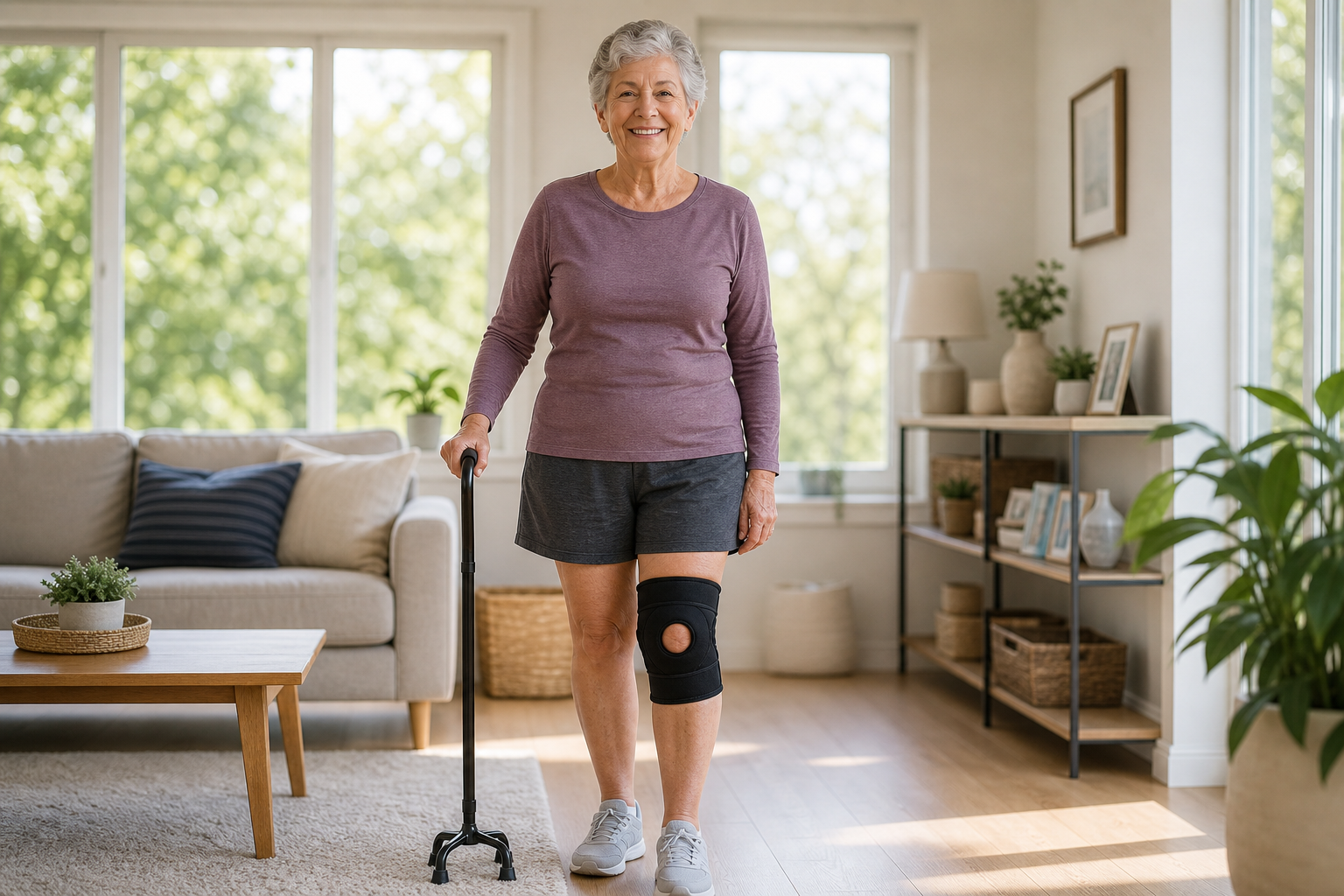
PowerLix Knee Compression Sleeve
The PowerLix sleeve is the bestselling compression sleeve for arthritis. The 3D knitting provides graduated compression (tightest at the center, lighter at the edges) with a non-slip silicone band at the top that prevents the sleeve from rolling down during walking. It’s thin enough to wear under pants and comfortable enough for all-day use.

PowerLix Knee Compression Sleeve
Best-selling compression sleeve with graduated support and anti-slip silicone band, thin enough for daily wear
The sleeve is available in multiple compression levels, though most seniors with arthritis find the standard compression adequate. The fabric wicks moisture reasonably well, which matters if you’re wearing it during exercise or in warm weather. The silicone grip band is effective but can irritate sensitive skin. If you have thin or fragile skin, check the area after the first few uses for any redness or irritation.
One practical advantage: the PowerLix is thin enough to fit inside most shoes without requiring a larger size. Some bulkier braces force you to go up a half size in footwear, which affects stability and comfort.
The sleeve is machine washable on a gentle cycle, though hand washing extends its life. Expect to replace it every four to six months with regular use. The elastic fibers break down over time, and once the sleeve starts feeling loose or slides down your leg during walking, it’s no longer providing meaningful compression.
Shock Doctor Knee Brace with Stabilizers
The Shock Doctor features bilateral stabilizers (flexible stays on both sides) with an open-patella design. It provides more support than a simple sleeve without the bulk of a hinged brace. The Velcro straps above and below the knee allow adjustable compression, and the padded interior is comfortable against skin.
The stabilizers are semi-rigid plastic inserts in fabric channels running along the medial and lateral sides of the knee. They’re flexible enough to allow full range of motion but stiff enough to resist side-to-side wobbling. This is useful if your knee occasionally feels like it might buckle but doesn’t fully give way.
The Velcro straps are both an advantage and a potential problem. They allow precise adjustment of compression throughout the day as swelling changes, but they also require decent hand strength to secure tightly. If you have arthritis in your hands, ask someone to help you get the tension right the first few times so you know how tight is appropriate. Too loose and the brace slides. Too tight and you restrict circulation.
The open-patella design is generous, with enough clearance that it doesn’t create pressure points around the kneecap. Some cheaper open-patella braces have small openings that still press on the edges of the patella, which defeats the purpose.
Best for: Moderate arthritis with some instability, or knees that need more support than a compression sleeve provides.
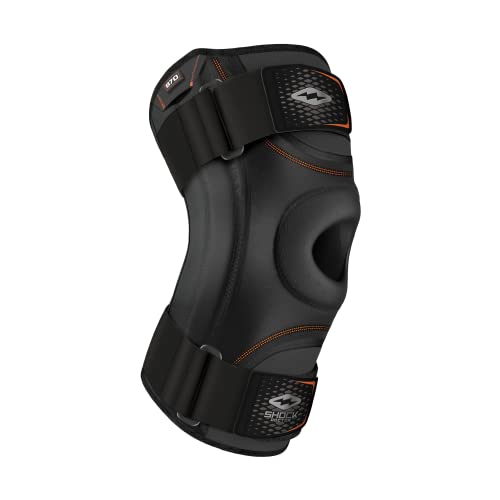
Shock Doctor Knee Brace with Stabilizers
Open-patella design with bilateral stabilizers for moderate arthritis and mild instability
DonJoy Deluxe Hinged Knee Brace
The DonJoy hinged brace provides the most structural support in this list. The polycentric hinges allow natural knee flexion while preventing the lateral instability that causes giving-way episodes. Adjustable ROM (range of motion) stops can limit flexion if your doctor or therapist recommends it. The neoprene material retains heat, which arthritic knees appreciate.
The DonJoy is built for durability. The hinges are metal, the strap anchors are reinforced, and the neoprene is thicker than bargain-brand alternatives. This also makes it heavier and warmer. In hot weather, the neoprene traps heat and sweat. Some people wear a thin compression sleeve underneath to absorb moisture and reduce skin irritation.
Application requires aligning the hinge centers with the center of your knee joint (an imaginary line running through the middle of your kneecap when your leg is straight). If the hinges sit too high or too low, they create pressure points and restrict natural movement. The straps secure in a specific order: center strap first, then top and bottom. This ensures the brace stays centered during activity.
The ROM stops are adjustable dials on each hinge. Most people leave them fully open for everyday arthritis use. They’re more relevant for post-surgical recovery when a surgeon wants to limit flexion during healing.
Best for: Significant instability (frequent giving-way), post-surgical support, or knees that don’t respond to lighter bracing.
Additional Options Worth Considering
Bauerfeind GenuTrain