Unrealistic goals are the number one reason seniors quit exercise programs. You set a target based on what you used to do (or what someone your age “should” do), fall short within weeks, and conclude that exercise isn’t working. The problem was never your effort. It was the goal itself.
Realistic fitness goals for adults over 60 look different from goals at 30 or 40, and they should. The measures of success shift from aesthetics and performance to function, independence, and quality of life.
Before starting any new exercise program or making significant changes to your activity level, talk to your doctor. This is especially important if you have existing health conditions, take medications, or haven’t been active in a while.
Why Standard Fitness Goals Don’t Work After 60
Comparison to Your Younger Self
“I want to get back to my college weight” or “I used to run 5 miles; I should be able to again.” These goals ignore decades of physiological change. Your metabolism is slower, your recovery takes longer, your joints have accumulated wear, and your muscle mass has decreased naturally through a process called sarcopenia.
After age 30, adults lose 3-8% of muscle mass per decade, with acceleration after 60.
Setting goals based on a version of yourself from 30+ years ago guarantees frustration. Your body has changed. That’s not weakness or failure. It’s biology. You can build strength, endurance, and flexibility at any age. You just can’t expect to perform identically to your 25-year-old self.
Arbitrary Numbers
“Lose 30 pounds.” “Walk 10,000 steps.” “Do 50 push-ups.” These numbers sound concrete and motivating, but they’re often arbitrary, disconnected from your current fitness level, and may not even matter for your health. The 10,000-step target, for instance, originated from a Japanese marketing campaign for a pedometer in the 1960s, not from research on optimal health outcomes.
A senior who goes from 2,000 steps to 5,000 has improved their health dramatically. Research suggests that health benefits begin at around 4,000 steps per day for older adults, with continued gains up to about 7,500 steps. More isn’t necessarily better if it means pain, injury risk, or unsustainable effort.
Weight loss goals face similar problems. A 70-year-old who loses 10 pounds and gains functional strength has achieved more meaningful health improvement than losing 30 pounds through severe restriction that leaves them weak and nutrient-deficient.
All-or-Nothing Thinking
“I’ll exercise every day for an hour.” This works for about 10 days before life intervenes (illness, appointment, bad weather, fatigue). Missing a day feels like failure. The goal crumbles, and exercise stops entirely rather than continuing at a reduced level.
This thinking pattern treats exercise as something you’re either doing perfectly or failing at completely. But fitness isn’t pass/fail. Exercising three days instead of seven is still three days of benefit. Twenty minutes instead of sixty is still twenty minutes your body moved, your heart pumped, and your muscles worked. The mental health benefits of regular exercise accumulate even when your routine isn’t perfect.
Ignoring Recovery Needs
Younger exercisers can work out intensely six days a week and recover overnight. After 60, your body needs more time to repair and rebuild. Goals that don’t account for this (like daily high-intensity training) lead to overuse injuries, chronic fatigue, and burnout.
Recovery isn’t laziness. It’s when adaptation happens. Your muscles don’t get stronger during the workout. They get stronger during the rest period afterward when your body repairs the microscopic damage from exercise.
How to Set Goals That Stick
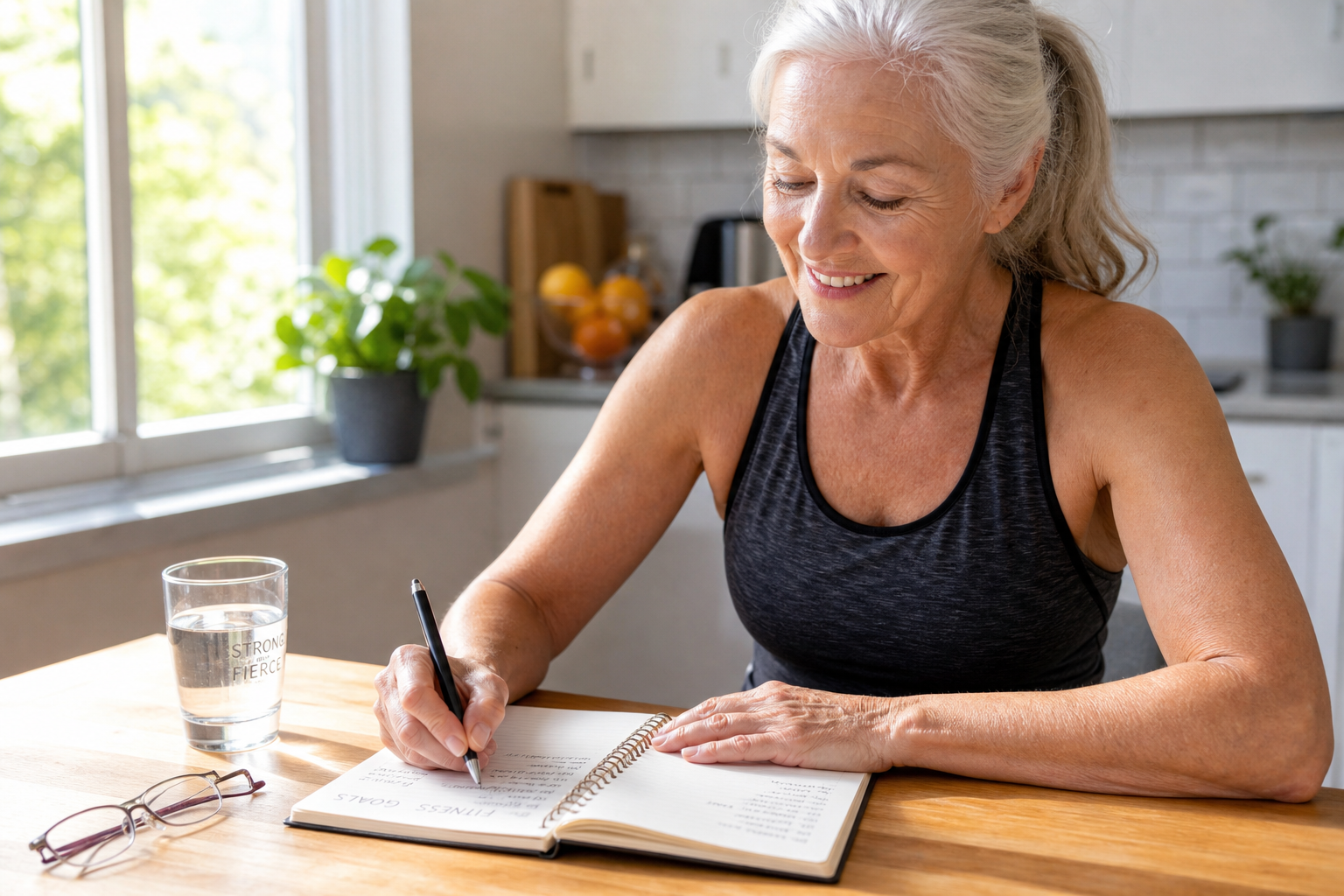
Start with Function, Not Numbers
Ask yourself: what do I want to be able to do that I currently can’t? Functional goals connect exercise to your real life, which provides far stronger motivation than arbitrary metrics.
Functional goal examples:
- “I want to walk to the mailbox and back without needing to rest.”
- “I want to get up from the floor if I fall.”
- “I want to carry my own groceries from the car.”
- “I want to climb a flight of stairs without getting winded.”
- “I want to play on the floor with my grandchildren.”
- “I want to travel without worrying about keeping up.”
- “I want to garden for an hour without back pain.”
- “I want to lift my suitcase into an overhead bin.”
- “I want to stand from a low chair without using my hands.”
These goals are specific, meaningful, and measurable (you can clearly tell when you’ve achieved them). They also naturally dictate the type of exercise you need: walking endurance, floor-to-standing strength, carrying capacity, cardiovascular fitness, mobility, or overall stamina.
When you know why you’re exercising (to keep up with grandkids on vacation, not to hit some abstract step count), motivation sustains itself through the inevitable rough days.
Use the “Baseline Plus 10%” Rule
Whatever you can do right now is your baseline. Your first goal is 10% more than that. If you currently walk 10 minutes before needing to rest, your goal is 11 minutes. If you can do 5 chair squats, your goal is 6. This approach guarantees achievable progress because it’s calibrated to your actual ability, not someone else’s standard.
Once you hit 10% above baseline, reset your baseline to the new level and aim for another 10%. This creates a staircase of small wins that accumulates into significant progress over weeks and months. After six months of consistent 10% improvements, you’re not 60% better than baseline. You’re 77% better (1.10 multiplied six times equals 1.77).
To find your baseline, test yourself on a day when you feel reasonably good. Walk until you need to rest, time it, and that’s your baseline. Do squats, push-ups, or standing exercises until your form breaks down, count them, and that’s your baseline. Don’t test yourself on your best day or worst day. Average is fine.
Set Process Goals, Not Just Outcome Goals
Outcome goal: “I want to walk 30 minutes without stopping.” (You can’t fully control whether you reach this because pain, weather, or illness might intervene.)
Process goal: “I will walk for at least 15 minutes, 4 days this week.” (This is entirely within your control.)
Process goals build the habits that produce outcomes. If you consistently complete your process goals, the outcomes follow. If you focus only on outcomes, a bad week feels like failure even if you exercised more than you have in years.
Process goals also allow for variation in how you feel day to day. Some days 15 minutes is easy and you walk 25. Other days 15 minutes takes real effort. Both count as success because you met your process goal.
Build in Flexibility
Life after 60 includes doctor appointments, flare-ups, visiting grandchildren, caregiving, and unpredictable energy levels. Rigid goals (“exercise Monday, Wednesday, Friday at 9 AM for exactly 30 minutes”) collapse when life doesn’t cooperate.
Flexible versions: “Exercise 3-4 days this week, any day that works, for 20-30 minutes.” Same total activity, zero guilt when Tuesday’s appointment runs long and Thursday’s knee flares. The minimum that counts as “success” should be easy enough to achieve on your worst week.
Build in explicit permission to modify. If the plan is 30 minutes but you’re feeling worn out, 15 minutes counts. If the plan is resistance training but your shoulder is cranky, substituting a walk is fine. Flexibility prevents the all-or-nothing collapse. For those managing specific conditions, consider specialized exercise protocols that accommodate your unique needs.
Use the Two-Week Test
Set a goal for two weeks, not forever. At the end of two weeks, assess honestly: Did I complete most of my planned sessions? Did I feel better or worse? Was it sustainable given my life right now?
If the answer is yes, continue for another two weeks and reassess. If the answer is no, adjust the goal (fewer days, shorter duration, different activity) and try that version for two weeks.
This prevents the trap of committing to an unrealistic goal for months, failing, and giving up entirely. Two weeks is long enough to establish a pattern but short enough that any goal feels doable.
Stack New Habits on Existing Routines
Attach your new exercise habit to something you already do consistently. “After I finish my morning coffee, I’ll do 10 minutes of stretching.” “When I take the dog out in the evening, I’ll walk an extra block.” This technique (called habit stacking) uses established routines as triggers for new behavior, making the new habit easier to remember and execute.
Sample Realistic Goals by Starting Level
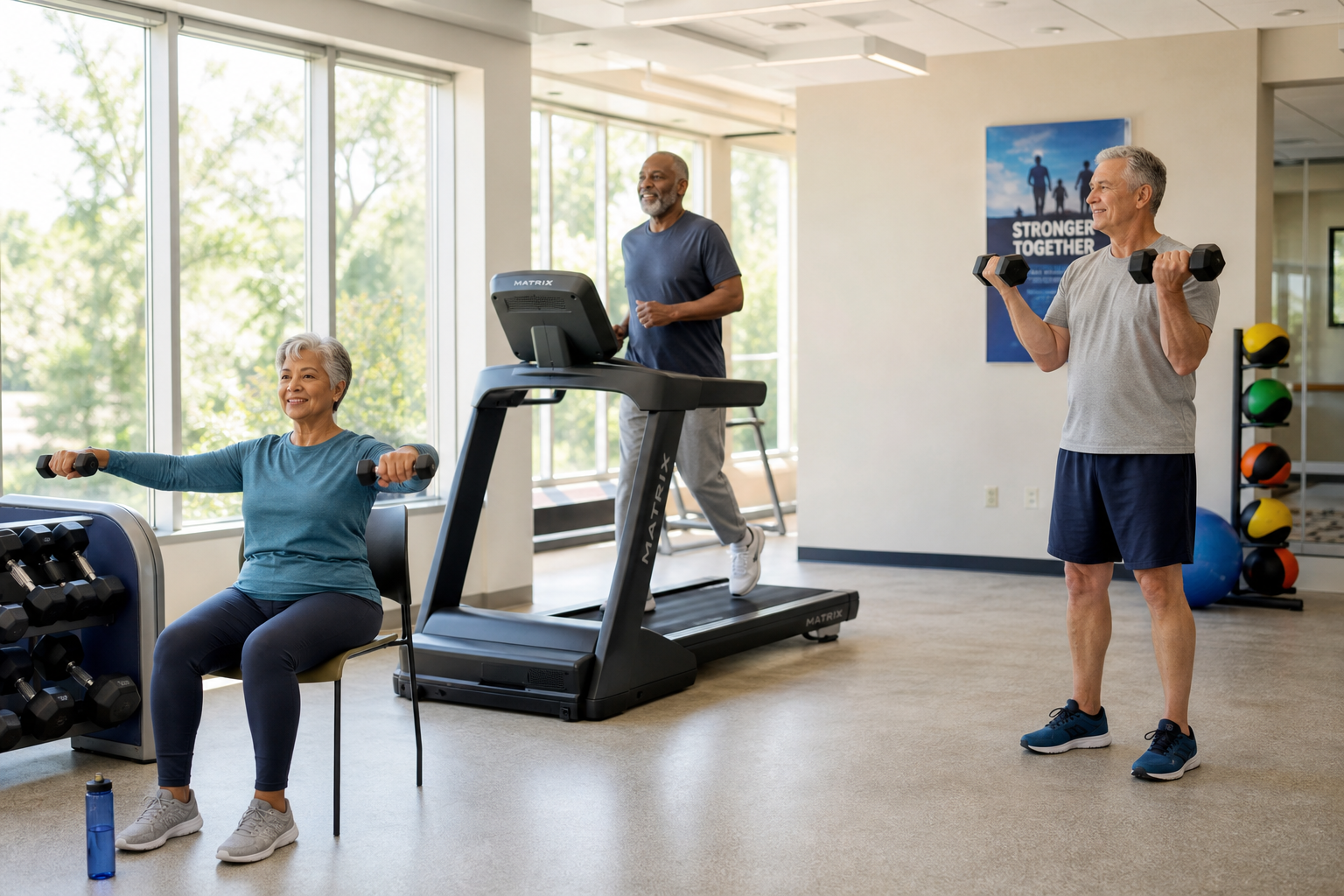
Currently Sedentary
If you haven’t exercised regularly in years or have been recovering from illness or injury, start here.
- Month 1: Walk 10 minutes, 3 days per week. Do 5 chair squats and 5 wall push-ups on 2 days per week. Focus: establishing the habit, not intensity.
- Month 2: Walk 15 minutes, 4 days per week. Chair squats and wall push-ups increase to 2 sets of 8. Add seated marching or leg raises 2 days per week.
- Month 3: Walk 20 minutes, 4-5 days per week. Add balance exercises (single-leg stands near a counter) 2 days per week. Continue strength work.
Modifications: If 10 minutes feels too long, start with 5 and add 1-2 minutes per week. If chair squats are difficult, practice sit-to-stand from your regular chair without going all the way down. Meet yourself where you are.
Currently Lightly Active
You move regularly but not in a structured way. You can walk 20 minutes comfortably and do basic strength movements.
- Month 1: Walk 25 minutes, 5 days per week. Resistance training (resistance bands or light dumbbells) 2 days per week, focusing on major muscle groups (legs, back, chest, shoulders).
- Month 2: Walk 30 minutes with intervals (brisk 1 minute, easy 3 minutes). Resistance training 3 days per week, same exercises but slightly heavier resistance or more reps.
- Month 3: Add a balance or flexibility session 2 days per week (yoga, tai chi, or targeted stretching). Increase resistance training loads by one increment (next band level, 2-pound heavier dumbbells).

Resistance Bands for Seniors
Adjustable tension levels make these perfect for progressive strength training at home
Currently Moderately Active
You already exercise regularly and want to progress toward specific functional goals or maintain capacity.
- Month 1: Increase one existing workout’s duration by 10%. Add a new movement pattern you don’t currently do (if you walk, add some upper body work; if you lift, add mobility).
- Month 2: Introduce progressive overload in strength work (more weight, more reps, or more challenging variations like standing instead of seated). Add intentional rest days if you’ve been going daily.
- Month 3: Work on a specific weakness (balance if you’re strong but unsteady;