Osteoarthritis of the knee is one of the most common reasons seniors avoid strength training, and it’s one of the best reasons to do it. The muscles surrounding your knee (quadriceps, hamstrings, calves, and hip muscles) act as shock absorbers that protect worn cartilage from further damage. When those muscles weaken from inactivity, the joint surfaces take the full impact of every step, and pain accelerates. Research consistently shows that resistance training reduces knee osteoarthritis pain by 30-40% while improving function and slowing disease progression.
The trick is training smart: loading the right muscles, avoiding the wrong movements, and respecting the joint’s limits without babying it. Before starting any new exercise program, especially if you have diagnosed osteoarthritis or other medical conditions, talk to your doctor or physical therapist. They can identify specific limitations or precautions that apply to your situation.
Exercises That Help Arthritic Knees
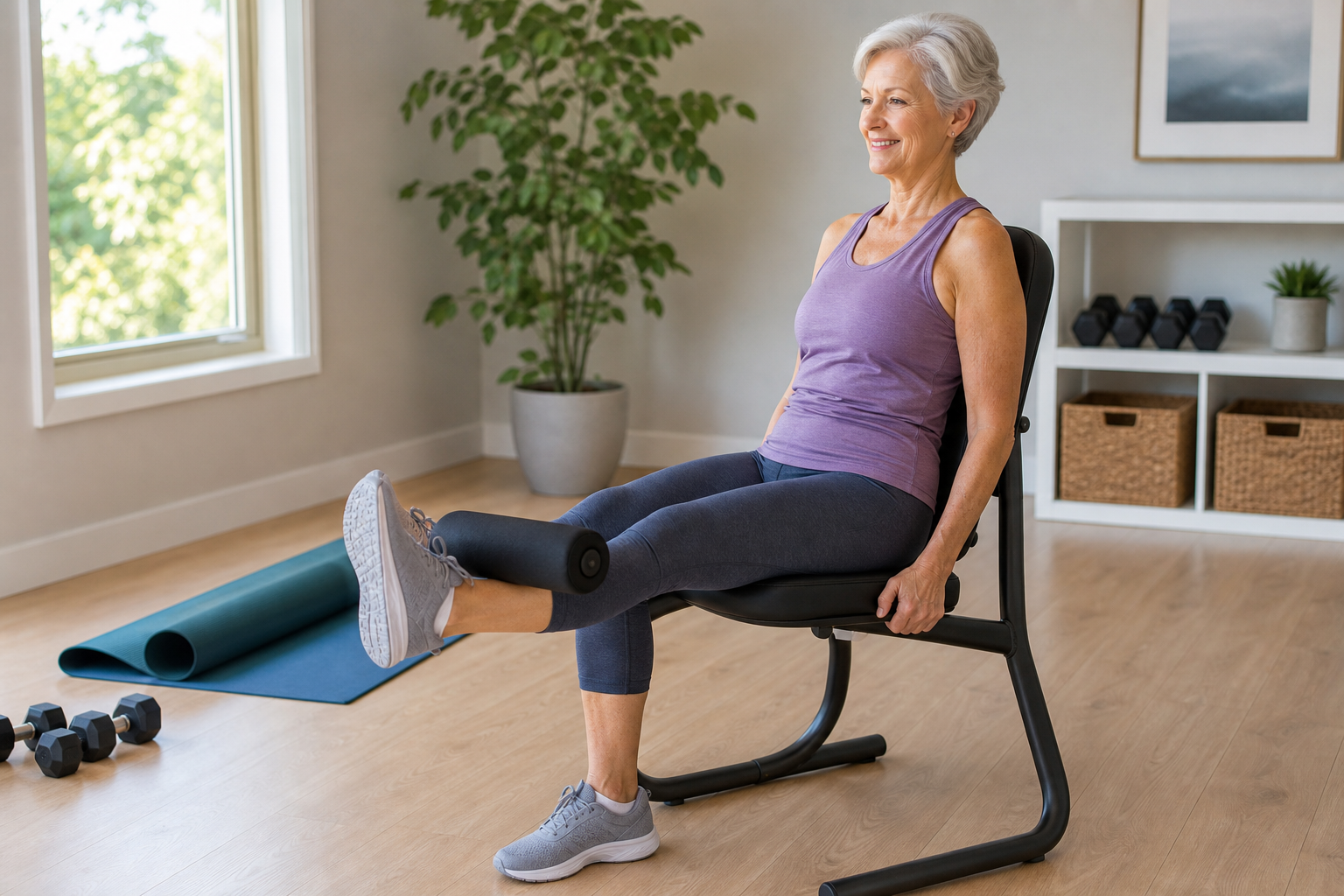
Partial Range Leg Extensions
Full-range leg extensions (straightening the knee completely from a fully bent position) place maximum stress on the kneecap at the start of the movement when the knee is deeply flexed. Partial range extensions eliminate this problem. Sit in a chair and start with your knee bent at about 60 degrees (not fully bent). Extend to straight, hold for 2 seconds, and lower back to 60 degrees. 3 sets of 12 per leg. Add light ankle weights when bodyweight becomes easy.
If even 60 degrees of bend causes discomfort, start with your leg at a shallower angle, around 45 degrees. The goal is controlled strengthening without flaring symptoms. Some people find this exercise easier with a rolled towel under the knee for support. For more guidance on proper ankle weight usage and safe weight guidelines, start with 1-2 pounds per ankle and progress gradually as your strength improves.

Adjustable Ankle Weights
Look for adjustable weights that start at 1-2 pounds per ankle so you can progress gradually without buying multiple sets
Wall Sits
Stand with your back against a wall and slide down until your knees are bent to about 45-60 degrees (not a full 90-degree squat). Hold for 15-30 seconds. 3 holds. The wall supports your back while isometric quad contraction builds strength without the repetitive joint motion that irritates arthritic surfaces. Gradually increase hold time to 45-60 seconds.
The beauty of wall sits is you control the depth. If 60 degrees feels like too much compression, slide down only to 40 degrees. You’ll still build strength, just with less joint load. Keep your feet flat and your weight distributed evenly across both legs. If one knee is significantly worse than the other, it’s fine to shift slightly more weight to the better leg at first.
Glute Bridges
Lie on your back with knees bent, feet flat on the floor. Push through your heels to lift your hips until your body forms a straight line from shoulders to knees. Hold 3 seconds, lower slowly. 3 sets of 12. Bridges strengthen the glutes and hamstrings without significant knee stress. Strong glutes absorb landing forces during walking and stair climbing that would otherwise hammer the knee joint.
Your feet should be positioned so your shins are roughly vertical at the top of the movement. Too close or too far changes the knee angle and can cause discomfort. If you have trouble getting up and down from the floor, do bridges on your bed instead. The softer surface reduces the range of motion slightly but still provides good muscle activation.
As you get stronger, add a resistance band around your thighs just above the knees. Push your knees slightly outward against the band during the bridge. This activates the hip abductors and further offloads the inner knee compartment where arthritis wear is often worst.
Clamshells with Band
Lie on your side with knees bent at 45 degrees. Place a mini loop band around both thighs just above the knees. Open your top knee against the band resistance while keeping your feet together. 3 sets of 15 per side. This strengthens the gluteus medius, which stabilizes your pelvis during walking and prevents the inward knee collapse that accelerates arthritis wear on the inner compartment.
If getting down to the floor is difficult, clamshells work sitting in a chair too. Sit toward the front edge with the band around your thighs. Press your knees apart against the band, hold, and release. Same muscle, different position. You won’t get quite the same range of motion, but you’ll still build the stabilizers that protect your knee during daily activities.

Mini Loop Resistance Bands
Get a set with multiple resistance levels so you can progress from light to medium resistance as your hip stabilizers strengthen
Step-Ups (Low Height)
Using a 4-inch step (the lowest stair step or a thick book), step up with the affected leg and bring the other foot up. Step back down, leading with the unaffected leg. 2 sets of 8 per leading leg. This trains the functional pattern of stair climbing while controlling the load. Increase step height to 6 inches only when 4-inch step-ups feel easy and pain-free.
Many people rush step-ups and lose control on the descent. The lowering phase is where you build the most strength and where poor control causes the most knee stress. Take a full 3 seconds to step down. If you need to hold a railing or counter for balance, do it. Stability matters more than looking like you don’t need support.
Step-ups reveal strength imbalances fast. If one leg struggles noticeably more than the other, that’s the leg that needs extra work. Add an extra set on the weaker side, or do step-ups with that leg more frequently during the week.
Standing Calf Raises
Hold a counter for balance. Rise onto your toes, hold 3 seconds, lower slowly. 3 sets of 15. Your calves contribute to knee stability during walking and absorb some of the impact that would otherwise reach the knee joint. Strong calves also improve push-off during walking, making your gait more efficient and less knee-dependent.
The lowering portion of the calf raise matters. Don’t just drop back to flat feet. Control the descent for 2-3 seconds. That eccentric contraction builds more strength than the lift itself.
If standing calf raises cause calf cramping, you’re probably dehydrated or low on electrolytes. Drink water throughout the day and consider adding a magnesium supplement (after checking with your doctor). Cramping during exercise is common in older adults and usually fixable with better hydration.
Seated Hamstring Curls with Band
Sit in a chair with a resistance band looped around one ankle and anchored under the chair leg. Bend your knee to pull your foot under the chair against the band’s resistance. 3 sets of 12 per leg. The hamstrings are the “other” knee stabilizer that most people neglect in favor of quad work. Balanced quad-hamstring strength is essential for smooth, pain-free knee function.
If you don’t have a resistance band, this exercise works with just gravity. Sit and lift your foot off the floor, then pull your heel back under the chair as far as comfortable. Hold 3 seconds, release. You won’t get the same resistance as a band, but you’ll still activate the muscle and improve the movement pattern. Resistance bands are among the most affordable and versatile home exercise equipment options for building strength without heavy weights.
Straight Leg Raises
Lie on your back with one knee bent, foot flat on the floor. Keep the other leg straight and lift it to the height of the bent knee. Hold 3 seconds, lower slowly without letting the heel touch the floor. 3 sets of 10 per leg. Straight leg raises strengthen the quadriceps without bending the knee, making them one of the safest exercises for people with moderate to severe osteoarthritis.
This exercise looks easy. It isn’t. If you can’t keep your leg straight or your lower back arches off the floor, bend the working knee slightly (about 10-15 degrees). A very slight bend still protects the kneecap while reducing strain on the hip flexors and lower back.
Add ankle weights in 1-pound increments once bodyweight feels too easy. Don’t jump to 5-pound weights. The hip flexors fatigue faster than the quads, and too much weight too soon causes hip or back discomfort that has nothing to do with your knee.
Exercises to Avoid or Modify
Deep squats (below 90 degrees): Maximum compression on the kneecap occurs at deep flexion. Keep squats above 60-70 degrees of knee bend. If you’re not sure what 60 degrees looks like, sit in a chair. That’s roughly 90 degrees. Stand up halfway. That’s closer to 60. For detailed guidance on safe squatting techniques when you have knee pain, focus on proper form and limited range of motion rather than depth.
Lunges (without modification): Standard forward lunges place high stress on the front knee. If you do lunges, keep them shallow (knee never past ankle) and use a counter for balance support. Reverse lunges (stepping backward) reduce front-knee stress compared to forward lunges, but they require better balance. Most people with knee arthritis get better results from step-ups or split squats with the back foot elevated on a low step.
Leg press machine (at full range): If using a leg press, don’t bring your knees closer than 90 degrees. Set the seat position so the starting angle is comfortable. Leg presses load the knee heavily under compression, and many people go too deep because the machine makes it easy. Stick to partial range or skip the leg press entirely in favor of bodyweight or band exercises.
Jumping and plyometrics: Impact forces multiply joint loading. Stick to controlled, ground-based movements. Box jumps, jump squats, and burpees are not appropriate for people with knee osteoarthritis. You don’t need explosive movements to build strength or improve function.
Heavy loaded squats: Barbell squats with significant weight compress the knee joint under high loads. Use bodyweight, bands, or light dumbbells for goblet squats instead. If you did heavy squats years ago and miss them, understand that your body has changed. Loading an arthritic joint like you loaded a healthy one will cause problems. There are plenty of ways to challenge your legs without risking a flare-up that sidelines you for a week.
Kneeling exercises: Planks from the knees, kneeling leg lifts, and similar moves place direct pressure on the kneecap. If kneeling hurts, don’t do it. Use a bench or elevated surface to modify planks, or do standing exercises instead.
Programming Guidelines
Frequency: 2-3 sessions per week with at least 48 hours between sessions for the same muscle groups. Muscles grow during recovery, not during the workout. If you train legs on Monday, don’t train them again until Wednesday at the earliest. Older joints and tissues need that recovery time.