Under-desk pedalers take the pedal exerciser concept and optimize it specifically for use beneath a desk, table, or workstation. They’re lower profile, quieter, and more stable than general-purpose pedal exercisers, making them ideal for seniors who spend time at a computer, craft table, or home office and want to keep their legs moving throughout the day. The difference between an under-desk pedaler and a standard pedal exerciser is like the difference between a sports car and an SUV: same basic function, different design priorities.
Why Under-Desk Pedalers Work for Seniors
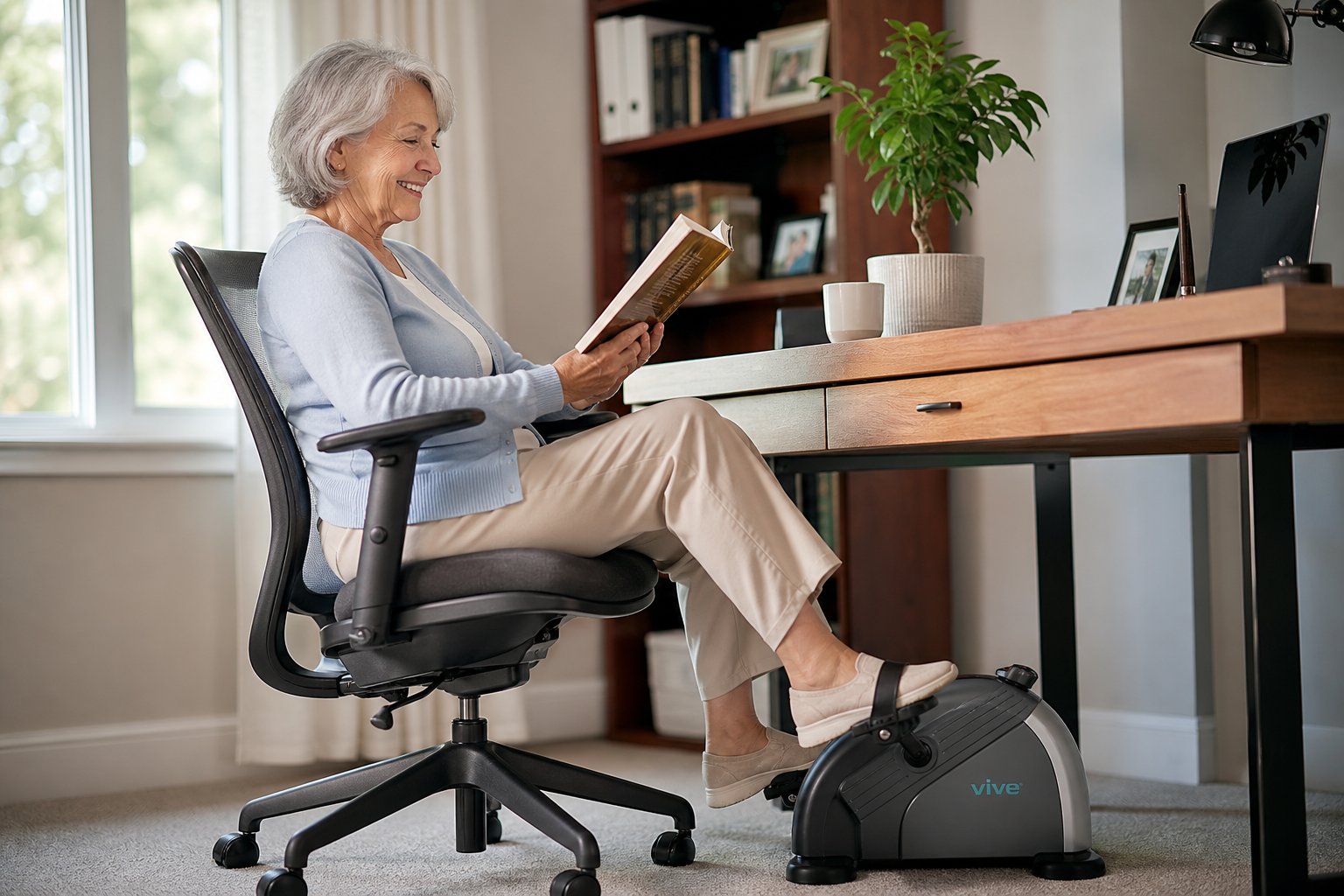
Extended sitting is one of the biggest health risks for adults over 60. Even if you exercise for 30 minutes daily, the remaining 10-15 hours of sitting still takes a toll on circulation, blood sugar, joint stiffness, and cardiovascular health.
An under-desk pedaler lets you accumulate 2-4 hours of light leg movement throughout the day without dedicating separate exercise time. This “exercise snacking” approach improves circulation to the legs (reducing swelling and blood clot risk), keeps joints lubricated, burns an additional 100-200 calories per hour of pedaling, and stabilizes blood sugar (pedaling during or after meals blunts glucose spikes).
Research suggests that breaking up sitting time with light movement every 30-60 minutes can counteract many of the metabolic effects of prolonged sitting. You don’t need intense effort. The simple act of moving your legs at a comfortable pace while you work, read, or watch TV adds up over hours and days.
Under-desk pedaling also helps maintain range of motion in the hips and knees without putting weight or impact stress on these joints. For seniors recovering from knee or hip surgery, very gentle pedaling (with medical clearance) can be part of the rehab process to restore normal movement patterns. If you’re working through recovery, our post-knee replacement exercises guide and post-hip replacement exercise guide offer additional support for safe movement progression.
The repetitive, circular motion promotes synovial fluid circulation in the knee joint, which reduces stiffness. Some users find that gentle pedaling helps with restless legs, particularly in the evening. The rhythmic movement seems to satisfy the urge to move without requiring you to get up and walk around.
What Sets Under-Desk Models Apart

Ultra-Low Profile
Standard pedal exercisers stand 10-14 inches tall. Under-desk models are typically 9-10 inches, designed to fit beneath standard 28-30 inch desk surfaces without your knees hitting the underside.
If your desk or table is on the lower end, measure the clearance between your knees and the desk surface before buying. You need at least 2-3 inches of clearance above your knees at the top of the pedal stroke.
Adjustable desks solve this problem entirely. If you can raise your desk surface by 3-4 inches, almost any pedaler will fit comfortably. Some users set up a dedicated pedaling station at a higher table rather than trying to fit a pedaler under their main desk.
Silent Operation
Under-desk pedalers are designed for use during focused work, phone calls, or video conferences. Magnetic resistance systems are the quietest (under 40 decibels, quieter than a whisper). Friction-based systems are acceptable for TV-time use but may be audible during quiet work.
The difference matters if you share an office or make frequent calls. A magnetic system produces only a faint whir that won’t carry through a phone or video mic. Friction systems create a soft scraping sound that’s noticeable in a quiet room.
Chain-drive systems, common in cheap pedalers, are the loudest and shouldn’t be used under a desk during work hours. They clank and rattle with every pedal stroke.
Enhanced Stability
Under-desk models typically have wider bases and heavier frames than portable pedal exercisers because movement during desk work is both annoying and distracting. Rubber feet, weighted bases, and textured bottom surfaces all prevent the unit from creeping across the floor during use.
A pedaler that slides forward with each stroke forces you to constantly reposition it, which breaks your focus and creates frustration. Stability matters more for under-desk use than for dedicated exercise sessions where you can brace the unit against a wall.
Weight is a trade-off. Heavier units (15-20 pounds) stay put better but are harder to move between rooms. Lighter models (8-12 pounds) are portable but may slide on hard floors unless you use a mat.
Compact Footprint
Under-desk pedalers have smaller front-to-back dimensions than full-size pedal exercisers. A compact footprint means the unit doesn’t extend far in front of or behind your feet, which matters when you’re working in a confined space under a desk. The pedals stay close to the central axis rather than swinging out in wide arcs.
Some models have adjustable or removable pedal straps. Straps help keep your feet in position during faster pedaling, but many seniors find them unnecessary at the low speeds typical of desk work. If your feet tend to slip off the pedals, straps help. If not, you can leave them off for easier on-and-off access.
Top Under-Desk Pedalers for Seniors
DeskCycle 2
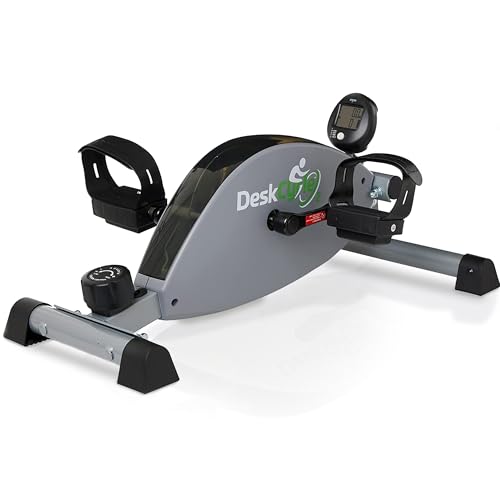
DeskCycle 2
Market leader with patented magnetic resistance, ultra-quiet operation, and excellent build quality for daily use
The DeskCycle 2 is the market leader for under-desk pedaling. At 10 inches tall, it fits under most desks. The patented magnetic resistance is virtually silent even at higher levels.
Eight resistance settings cover gentle rehabilitation to moderate cardio. The display shows speed, distance, time, and calories. A Bluetooth version syncs with a free app for long-term tracking.
The DeskCycle’s pedal positioning is slightly forward of center compared to traditional pedal exercisers. This puts less strain on the hip flexors during extended pedaling sessions. The pedal arms are also longer than most compact models, which creates a smoother, more natural circular motion.
Build quality is excellent. The frame is steel, the resistance mechanism is sealed and maintenance-free, and the unit weighs 23 pounds (heavy enough to stay put without anchoring). The display is large and easy to read without leaning forward. It tracks total cumulative distance and time, so you can see your activity add up over weeks and months.
The main limitation is price. It costs significantly more than budget models. But for seniors who plan to use an under-desk pedaler daily for years, the reliability and quiet operation justify the investment.
Best for: Seniors who spend time at a desk or table and want the quietest, most reliable under-desk pedaler available.
Cubii JR2

Cubii JR2
Elliptical motion reduces knee flexion, ideal for arthritis sufferers who find circular pedaling uncomfortable
The Cubii JR2 uses an elliptical motion rather than a circular pedal stroke, which some users find more comfortable for arthritic knees because the motion is smoother and doesn’t require as much knee flexion at the top of the stroke. It’s quiet (magnetic resistance), compact, and has a built-in display. The elliptical motion also engages the hip flexors and glutes slightly more than pure pedaling.
The Cubii sits 10 inches tall and has a modern, furniture-like design. It looks less medical and more like an intentional piece of home office equipment. The resistance adjustment is a dial on the front, easy to reach without bending down.
Eight resistance levels provide a similar range to the DeskCycle. The lowest settings are gentle enough for post-surgery rehab (with medical clearance), and the highest settings create a noticeable cardiovascular challenge.
The elliptical motion is the key differentiator. Instead of your foot moving in a circle, it traces a shallow oval. This reduces the amount your knee has to bend at the top of each stroke, which many people with knee osteoarthritis find more comfortable. The motion also feels more like walking than pedaling, which some users prefer. For more joint-friendly exercise comparisons, see our exercise bike vs elliptical guide.
The trade-off is that the elliptical mechanism is slightly bulkier than a simple pedal crank. The front-to-back footprint is larger than the DeskCycle. Measure your under-desk space carefully.
Best for: Seniors with knee arthritis who find circular pedaling uncomfortable, or those who prefer the feel of an elliptical motion.
Sunny Health SF-B0418
The Sunny Health SF-B0418 is the best budget option with magnetic resistance. It’s slightly taller than the DeskCycle (about 11 inches), which may be an issue under lower desks. The resistance is smooth and quiet, the display is basic but readable, and the stability is adequate for moderate-pace pedaling.
This model proves you don’t need to spend a lot to get magnetic resistance. The frame is lighter than premium models (around 14 pounds), which makes it easier to move but also means it may slide on hard floors without a mat. The resistance dial is accessible from the top.
The display is simpler than the DeskCycle or Cubii. It shows speed, time, distance, and calories, but doesn’t store cumulative totals. Each session resets when you turn it off. For many users, this is fine. You’re just looking for real-time feedback, not long-term data tracking.
Build quality is decent but not exceptional. The pedals are plastic rather than metal, and the crank arms are thinner. This is a budget product, and it feels like one. But it works quietly and smoothly, which are the two most important requirements for under-desk use.
Best for: Budget-conscious seniors who want magnetic resistance without the premium price.
Stamina InMotion Compact Strider
The Stamina InMotion Compact Strider uses a friction resistance system, making it louder than magnetic models but also more affordable. It’s very low profile (about 9 inches) and lightweight (around 12 pounds). The compact size makes it easy to slide under even low desks or store in a closet when not in use.
The resistance knob adjusts tension on a felt pad that presses against the flywheel. This creates a soft scraping sound during use, not loud enough to disrupt TV watching but noticeable in a quiet office. If you work from home alone and don’t take many calls, the noise may not matter.
The strider motion is somewhere between pedaling and elliptical. Your feet move in shallow arcs rather than full circles. Some users find this more natural than circular pedaling, while others prefer the traditional bike-like motion.
The display is basic and runs on a watch battery. It shows time, count (total strides), and calories. No distance or speed metrics.
Best for: Seniors who need an ultra-compact, lightweight pedaler for TV time or casual use and don’t require silent operation.
Vaunn Medical Folding Pedal Exerciser
The Vaunn Medical is marketed as a medical device rather than fitness equipment, which means it’s designed with stability and safety as top priorities. It has a wide, heavy base with large rubber feet that grip hard floors and carpet equally well. The unit folds in half for storage, unlike most under-desk models.
Resistance is friction-based, so it’s not silent. But the mechanism is smooth and doesn’t create the clunky feel of cheap friction systems. The tension knob offers enough range to accommodate very weak legs (post-stroke rehab) up to moderate cardio effort.
The pedals have adjustable straps and textured surfaces. The straps are wide and secure, designed for users who may have foot drop or difficulty keeping feet in position.
This model is 10 inches tall when unfolded and stable enough for arm pedaling (flip it upside down on a table and pedal with your hands for upper body movement). Many seniors use one pedaler for both leg and arm exercise.
Best for: Seniors who need maximum stability and safety features, or those who want a single unit for both leg and arm exercise.
Setup Tips
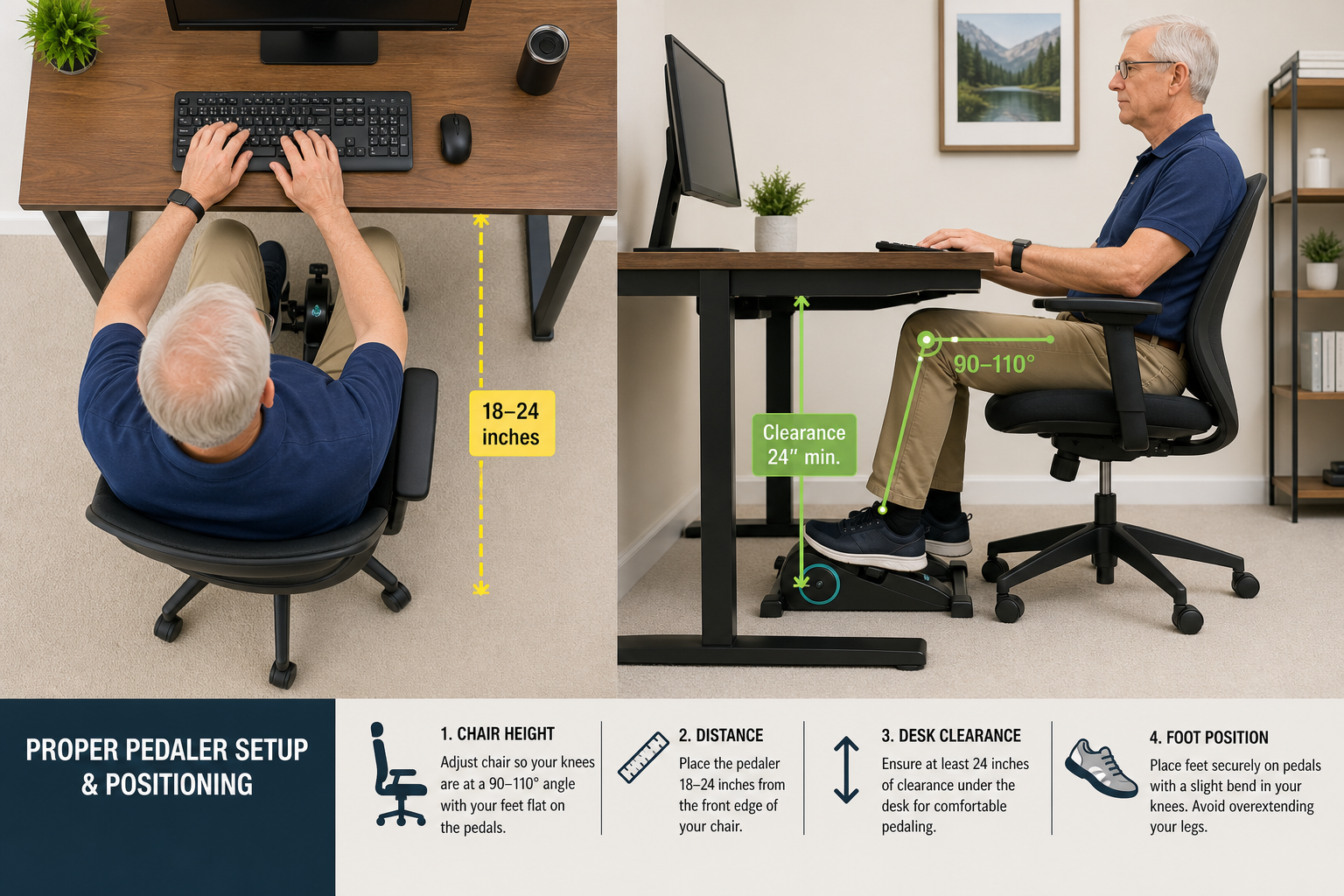
Desk height check: Sit at your desk or table in your normal chair. Measure the gap between the top of your thighs and the underside of the desk. The pedaler should be at least 2-3 inches shorter than this gap to allow smooth pedaling without your knees bumping.
If your desk is too low, you have three options: raise the desk (add bed risers or desk leg extenders), lower your chair (which may make typing uncomfortable), or use the pedaler at a different location like a dining table or coffee table while watching TV.
Chair height: You may need to raise your chair slightly to accommodate the pedaler. A firm cushion on the seat adds 2-3 inches. Ensure your feet still reach the pedals comfortably.
Your legs should extend almost fully at the bottom of the pedal stroke, with a slight bend remaining in the knee. If your knee is still bent significantly at the bottom, your chair is too high. If your leg locks out completely, you risk hyperextending the knee joint.
Floor surface: Place a rubber mat under the pedaler on hard floors to prevent sliding. On carpet, most models stay in place naturally.
Exercise equipment mats work well and protect the floor from scuffs. A thick yoga mat also works but may compress over time under a heavy pedaler.
Positioning: Center the pedaler under your desk so your legs move straight forward and back, not at an angle. Off-center positioning causes knee tracking issues over time.
Your knees should track directly over your toes during the pedal stroke. If your knees angle inward or outward, the pedaler is too far left or right. Adjust until the motion feels natural and symmetrical. For more information on proper knee mechanics during movement, check out our guide on preventing knee pain while walking.
How Much to Pedal
Starting recommendation: 10-15 minutes of pedaling per hour of sitting. This breaks up the sitting time without fatiguing your legs.
Set a timer or use the pedaler’s display to track intervals. Pedal for 10-15 minutes, then take a 45-50 minute break. The goal is consistency throughout the day, not continuous pedaling.
Building up: Increase to 20-30 minutes per hour as your endurance improves over 2-4 weeks.
Many users find they can pedal almost continuously during certain activities (reading, watching TV, phone calls) but need to stop during tasks requiring fine motor control (typing, mousing). That’s