Resistance gloves add gentle, wearable resistance to every hand movement you make. Unlike hand grippers or therapy putty that require a dedicated exercise session, resistance gloves work passively while you go about your day: opening and closing your hands, typing, cooking, gardening, and doing household tasks all become micro-exercises. For seniors with weak grip strength, arthritic hands, or recovering from hand surgery, resistance gloves provide continuous low-level strengthening that’s nearly effortless to incorporate into daily life.
The beauty of resistance gloves is cumulative training. You’re not setting aside blocks of time for hand therapy. You’re adding gentle load to movements you already make. Over weeks, those hundreds of low-resistance repetitions build functional strength that translates directly to the tasks you care about: opening pill bottles, lifting coffee cups, handling utensils, and buttoning shirts.
How Resistance Gloves Work
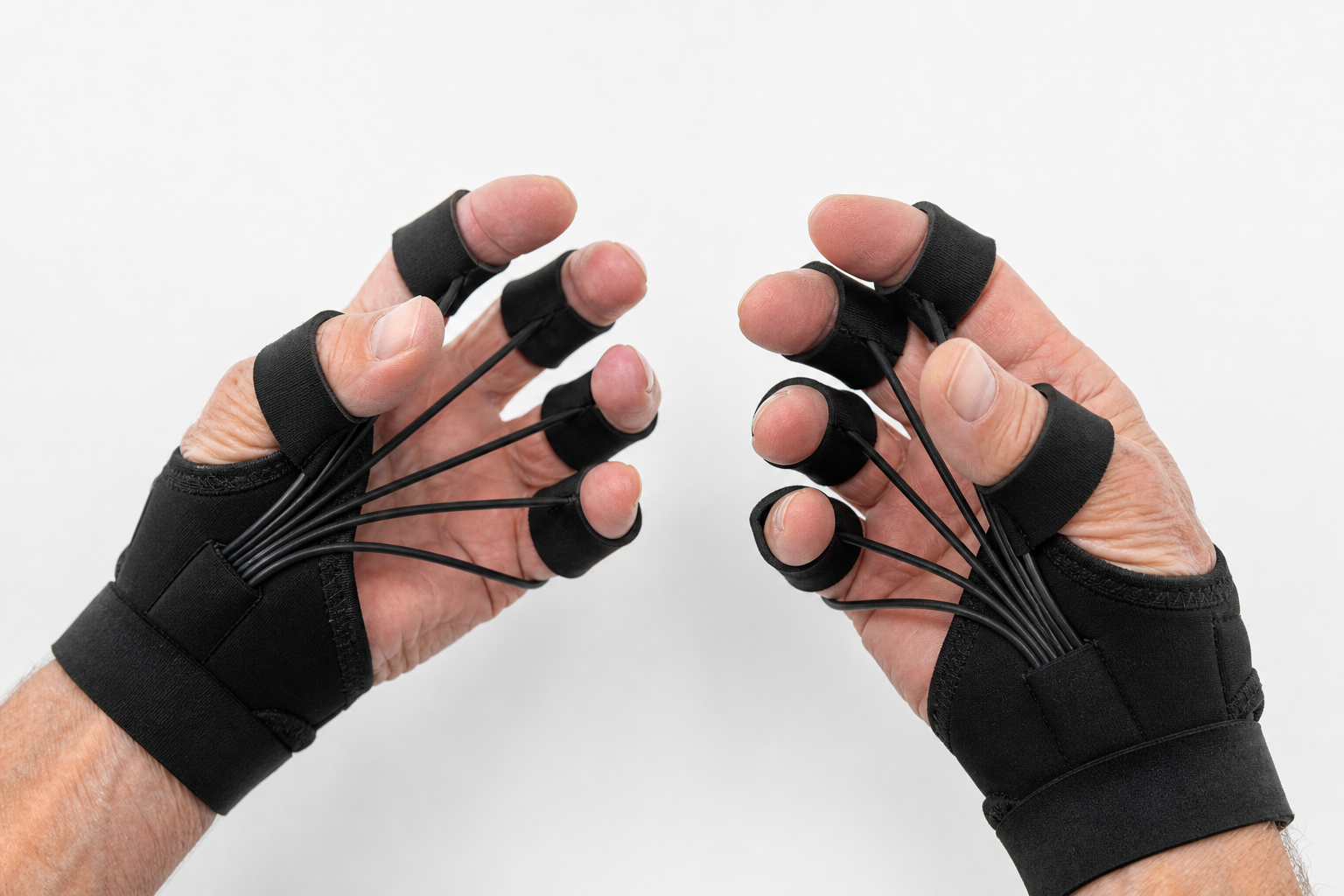
Resistance gloves use tension bands, springs, or elastic material sewn into the finger and thumb sections. When you open your hand (extend your fingers), the glove resists the opening motion, strengthening the extensor muscles. When you close your hand (make a fist), some models also resist the closing motion, strengthening the flexors. The resistance is light (typically 1-3 pounds per finger), which makes them safe for arthritic hands while still providing enough stimulus for strengthening when worn over extended periods.
The extensor muscles deserve special attention. Most daily tasks involve gripping (flexion), which means the muscles that open your hand (extensors) often get neglected. Over time, this imbalance contributes to stiffness, reduced range of motion, and weakened grip. Resistance gloves address that imbalance by loading the extensors during every hand opening, restoring muscular balance and joint function.
Some gloves use individual bands for each finger, allowing independent resistance per digit. Others use a unified elastic system across all fingers. Individual-band models let you isolate weak fingers (ring and pinky are commonly weaker), while unified systems provide more consistent resistance across the full hand. Neither design is inherently better; your choice depends on whether you need targeted finger strengthening or general hand conditioning.
What to Look for in Resistance Gloves
Adjustable Resistance
Gloves with removable or adjustable resistance elements let you start at the lightest level and increase as your hands strengthen. Fixed-resistance gloves work if the resistance matches your current ability, but you may outgrow them within weeks.
Progressive resistance matters for long-term gains. Your hands adapt to the current load within 3-4 weeks. If you can’t increase resistance at that point, your strengthening plateaus. Adjustable gloves typically offer 3-5 resistance levels, giving you months of progression before you need new equipment.
Comfortable Fit
You’ll wear these for 30-60 minutes at a time (or longer). The material should be breathable, the fingers should be the right length (too long creates bunching, too short creates pressure on the fingertips), and the wrist closure should be secure but not tight. Look for gloves with open fingertips so you can still feel and manipulate objects while wearing them.
Open-fingertip designs are non-negotiable if you plan to wear gloves during daily tasks. You need tactile feedback to handle dishes, turn pages, and type. Full-finger gloves limit dexterity and often create heat buildup that becomes uncomfortable within minutes.
Wrist closures vary from Velcro straps to elastic cuffs. Velcro allows micro-adjustments for comfort and stays secure during movement. Elastic cuffs are faster on and off but may loosen slightly during extended wear. If you have arthritis in your wrists or find Velcro straps fiddly, elastic cuffs are the better choice.
Sizing matters more than with regular gloves. Too tight restricts circulation and creates pressure points. Too loose allows the glove to shift during movement, which changes the resistance angle and reduces effectiveness. Measure your hand circumference at the widest point across your knuckles and compare it to the manufacturer’s sizing chart before ordering.
Quality Construction
The resistance elements (bands, springs) must withstand thousands of hand movements without breaking or losing their tension. Reinforced stitching at stress points and durable elastic materials are worth the slightly higher price because they’ll last 6-12 months of regular use.
Check where the resistance bands attach to the glove body. This junction takes the most stress. Double stitching with reinforced patches at attachment points indicates better durability. Gloves without reinforcement often see band pull-through after 2-3 months.
Material quality affects both comfort and longevity. Breathable mesh or moisture-wicking fabrics prevent sweat buildup during wear. Cheap synthetic materials trap heat and develop odors quickly. If the glove material feels stiff or plasticky in your hand, it won’t soften with use and will remain uncomfortable.
Washability
You’ll sweat in these gloves. Hand-wash capability is essential. Machine-washable models are rare because the agitation can damage resistance elements, but if you find one, it’s a convenience win. Most quality gloves handle hand washing with mild soap and air drying without losing their shape or resistance properties.
Top Resistance Gloves for Seniors
Xtensor Hand Exerciser

Xtensor Hand Exerciser
Individual finger bands allow targeted strengthening with replaceable, adjustable resistance for each digit
The Xtensor focuses specifically on finger extension (opening the hand against resistance). Individual rubber bands loop around each fingertips, providing independent resistance for each finger. The bands are replaceable and come in different tensions (light, medium, heavy) for progressive strengthening. The open-palm design is comfortable for extended wear.
The Xtensor’s strength is targeted training. If your ring finger is noticeably weaker than your index finger (common after stroke or nerve injury), you can use a lighter band on the ring finger while maintaining higher resistance on stronger digits. This individualization isn’t possible with unified-resistance gloves.
Replacement bands are inexpensive and widely available, which extends the product’s lifespan indefinitely. When a band breaks or loses tension, you replace just that band rather than buying new gloves. Over years of use, this saves money compared to fixed-resistance models.
The trade-off is setup time. Each finger band must be positioned correctly before use, which takes 30-45 seconds. If you’re wearing gloves multiple times per day, that setup adds up. The open-palm design also means no resistance during grip closure, only during hand opening.
Clinically Fit Hand Resistance Gloves
These gloves use a full-hand design with built-in elastic resistance throughout the finger and thumb sections. Both opening and closing your hand are resisted, providing strengthening for flexors and extensors simultaneously. The breathable fabric allows extended wear during daily activities.
Dual-resistance training addresses both muscle groups in every movement. When you grip a coffee cup, the flexors contract against resistance. When you release the cup, the extensors contract against resistance. This balanced loading prevents the flexor-extensor imbalance that contributes to hand stiffness and weakened grip.
The fixed-resistance design means no setup and no adjustability. You get a specific resistance level based on the model you buy. This simplifies use but limits progression. Most users will need to replace these gloves with a higher-resistance pair after 2-3 months of consistent use.
Clinically Fit gloves run slightly small. If your hand measurement falls between sizes, order up. A glove that’s too tight restricts movement range and becomes painful during extended wear.
Finger Resistance Bands (Budget Alternative)

Silicone Finger Resistance Bands
Affordable entry point for dedicated exercise sessions with multiple resistance levels included
Silicone finger resistance bands are stretchy loops that fit around all five fingertips. Spreading your fingers against the band’s resistance strengthens the extensors. Available in multiple resistance levels and budget-friendly, they’re an accessible entry point for hand resistance training. The trade-off is that you can only use them during dedicated exercise (they don’t stay on during daily tasks).
Resistance bands excel for focused exercise sessions. You can perform high-rep finger spreads, individual finger isolations, and thumb opposition exercises with precise control. The immediate tactile feedback (you feel exactly how much each finger contributes) helps identify weak digits that need extra attention.
Bands work well for seniors who prefer structured exercise over passive daily-wear strengthening. If you’re already doing a morning exercise routine, adding 5 minutes of band work slots into that existing habit. If you struggle with habit formation and need the passive approach, bands won’t work because they require deliberate use.
Silicone bands last 4-6 months with daily use before the material loses elasticity. At their low price point, replacing them regularly isn’t a financial burden. Buy a multipack with 3-4 resistance levels so you have progression built in from day one.
Exercises to Do with Resistance Gloves
While Wearing Gloves During Daily Tasks
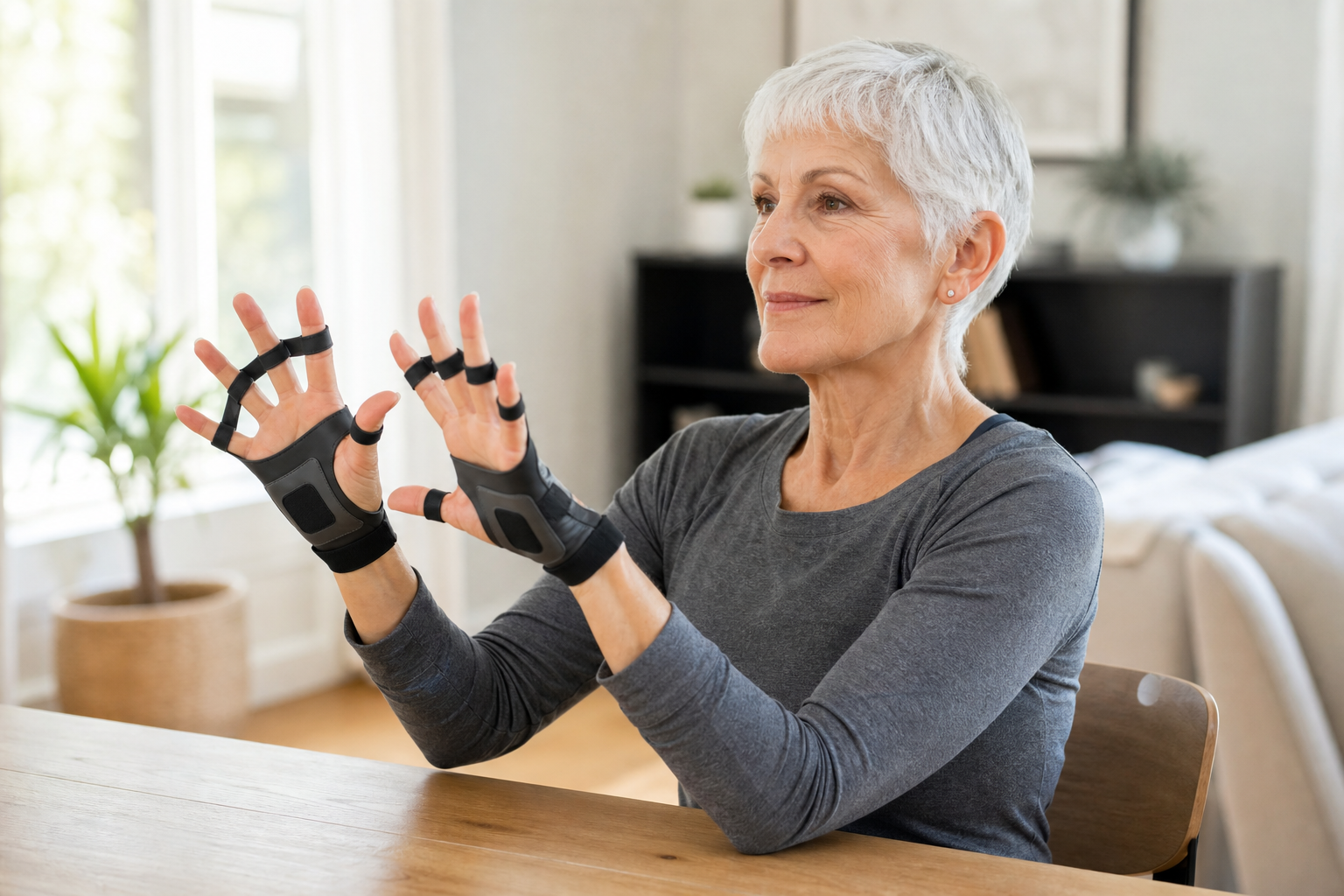
Simply going about your morning routine with resistance gloves on provides accumulated strengthening: making the bed (gripping, pulling, smoothing), preparing breakfast (opening containers, stirring, lifting), washing dishes (gripping, squeezing sponge), and reading (turning pages, holding a book). Thirty minutes of daily-task glove wearing provides hundreds of low-resistance hand movements.
Focus on tasks that involve varied hand positions. Folding laundry requires full-hand grasping, pinching small items like socks, and spreading fabrics flat. Cooking uses grip (holding utensils), precision pinch (measuring spices), and wrist rotation (stirring). Gardening incorporates digging (grip strength), pruning (finger dexterity), and pulling (forearm engagement). The variety ensures all hand muscles receive training stimulus.
Avoid wearing gloves during tasks requiring maximum grip force. You shouldn’t wear resistance gloves while lifting heavy pots, opening stubborn jars, or using power tools. The added resistance reduces your available grip strength by 15-20%, which creates a safety risk. Reserve glove wearing for light to moderate activities where reduced grip capacity isn’t a concern.
Dedicated Exercise Sets
These grip strength exercises complement resistance glove training:
- Finger spreads: With glove on, spread all five fingers wide against the resistance. Hold 3 seconds. Close. 3 sets of 15.
- Individual finger lifts: Place your hand flat on a table. With glove on, lift each finger individually against the resistance. Hold 2 seconds. 2 sets of 10 per finger.
- Thumb opposition: Touch your thumb to each fingertip in sequence against the glove’s resistance. 3 rounds per hand.
- Fist pumps: Open fully, close into a tight fist, open fully. 3 sets of 20. The glove resists both the opening and closing (if dual-resistance) or the opening only (if extension-only).
Add wrist curls to your routine for complete forearm strengthening. Hold a light dumbbell (1-3 pounds) with your palm up, forearm resting on your thigh. Curl your wrist upward against the weight. 2 sets of 15. This strengthens the wrist flexors that support grip during jar opening and lifting.
Reverse wrist curls target the extensors. Same setup, but palm faces down. Lift the back of your hand upward against the weight. 2 sets of 15. Combined with resistance glove training, reverse wrist curls provide extensor strengthening from fingertips to elbow.
Finger taps improve dexterity alongside strength. With gloves on, tap each finger to your thumb as quickly as you can while maintaining control. Go forward (index to pinky) and backward (pinky to index). 3 rounds. This exercise trains the neural coordination that translates to improved fine motor control during buttoning, typing, and handling small objects.
Who Benefits Most from Resistance Gloves
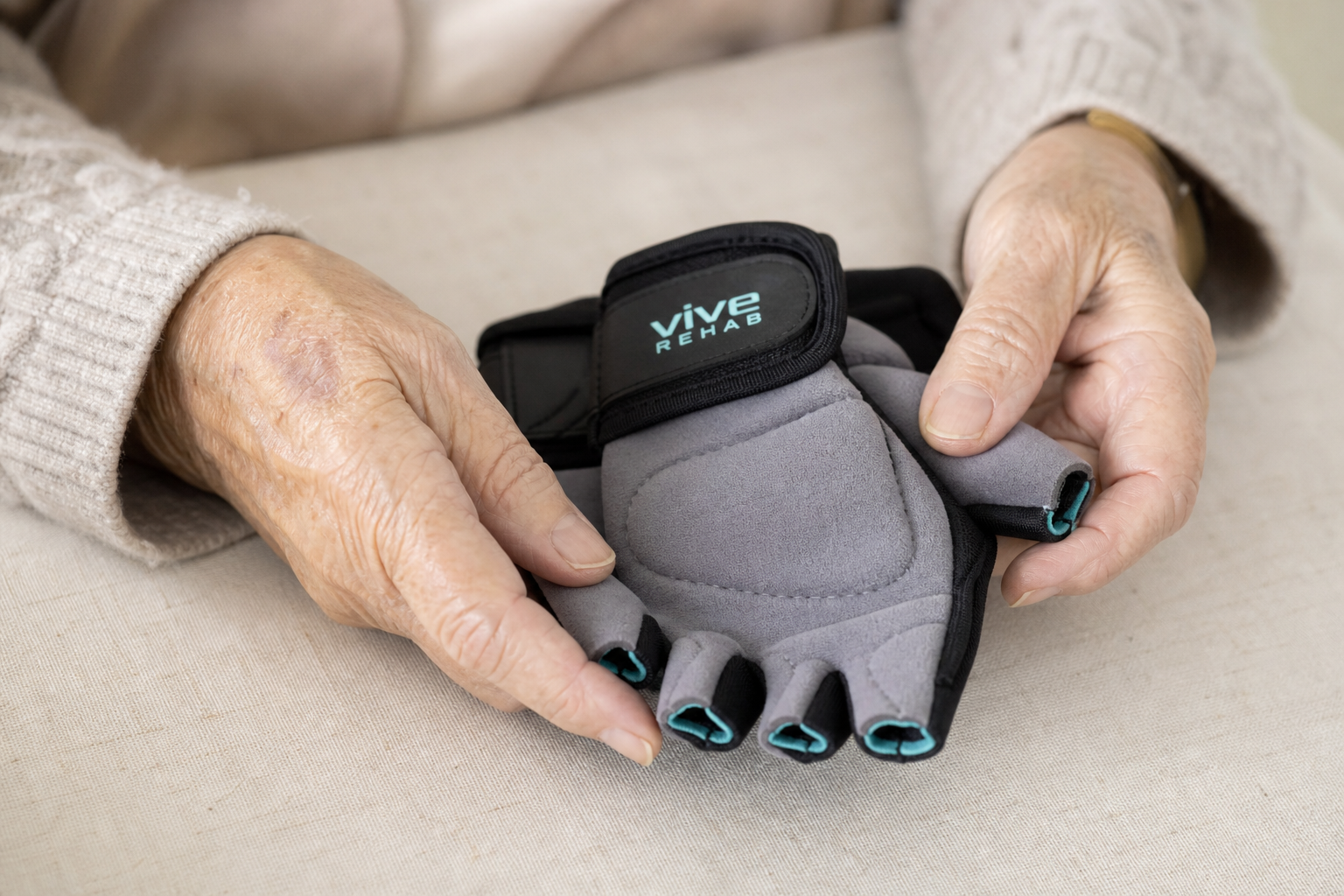
Seniors with arthritic hands: The gentle, continuous resistance maintains joint range of motion and builds the muscular support around arthritic joints without the impact of gripping heavy objects. Stronger muscles stabilize joints, reducing pain during daily activities. The low load doesn’t trigger inflammation the way high-force gripping does. For more ways to stay active with arthritis, check out our guide to arthritis-friendly exercises.
Post-stroke recovery: Resistance gloves provide repetitive, low-intensity hand movement practice that supports neural retraining after stroke-related hand weakness. The repetition is what drives neuroplasticity. Every finger opening and closing reinforces the neural pathways controlling that movement. Over months, this accumulated practice can restore function that seemed permanently lost.
Grip weakness from disuse: Seniors who’ve become sedentary and notice declining grip strength benefit from the passive strengthening that occurs during daily wear. Disuse atrophy is reversible. Within 6-8 weeks of consistent resistance glove use, most people regain 30-40% of lost grip strength. Consistency is key; wearing gloves twice weekly won’t reverse years of decline.
Carpal tunnel recovery: After carpal tunnel surgery, resistance gloves help rebuild hand strength during the rehabilitation period. Surgery relieves nerve compression but doesn’t restore the muscle strength lost during months of pre-surgery weakness. Resistance gloves provide the progressive loading needed to rebuild that strength without overloading the healing surgical site. Similar to post-surgery exercise for joint replacements, gradual progression is essential.
Guitar players, crafters, and hobbyists: Seniors who play instruments, knit, crochet, or do woodworking benefit from the hand endurance resistance gloves build. These activities require sustained finger dexterity and strength. Regular glove training reduces hand fatigue during long practice or project sessions.
Anyone with hand tremors: Essential tremor and Parkinson’s-related tremors may improve with hand strengthening. Stronger muscles provide better control over fine movements, which can reduce tremor amplitude during functional tasks. Research suggests resistance training reduces tremor severity in some individuals, though results vary. Those with Parkinson’s should also explore our Parkinson’s exercise program.
When Resistance Gloves Aren’t the Right Tool
If you have significant arthritis flare-ups, resistance gloves during active inflammation will worsen pain and swelling. Wait until inflammation subsides before resuming glove use. During flares, gentle range-of-motion exercises without resistance are more appropriate.
Severe nerve damage (advanced diabetic neuropathy, complete nerve transection) may prevent you from feeling whether the glove is too tight or causing tissue damage. Without sensory feedback, you can’t adjust fit or recognize early warning signs of overuse. In these cases, resistance training needs supervision from a hand therapist who can monitor your tissue response.
Trigger finger (stenosing tenosynovitis) involves inflamed tendon sheaths that catch during finger movement. Resistance gloves may aggravate this condition because they load the tendons during every movement. Trigger finger typically requires rest, splinting, and sometimes cort