A consistent walking routine starts with a route you trust. If your path has cracked sidewalks, aggressive dogs, no shade, or stretches without crosswalks, you’ll find excuses to skip your walk. Planning a safe, enjoyable route removes those barriers and turns daily walking into something you look forward to rather than dread.
This isn’t about finding the perfect path. It’s about eliminating obstacles that make walking harder than it needs to be. A good route protects your joints, keeps you visible to drivers, offers places to rest, and lets you focus on the walk itself instead of navigating hazards.
What to Look for When Scouting Routes
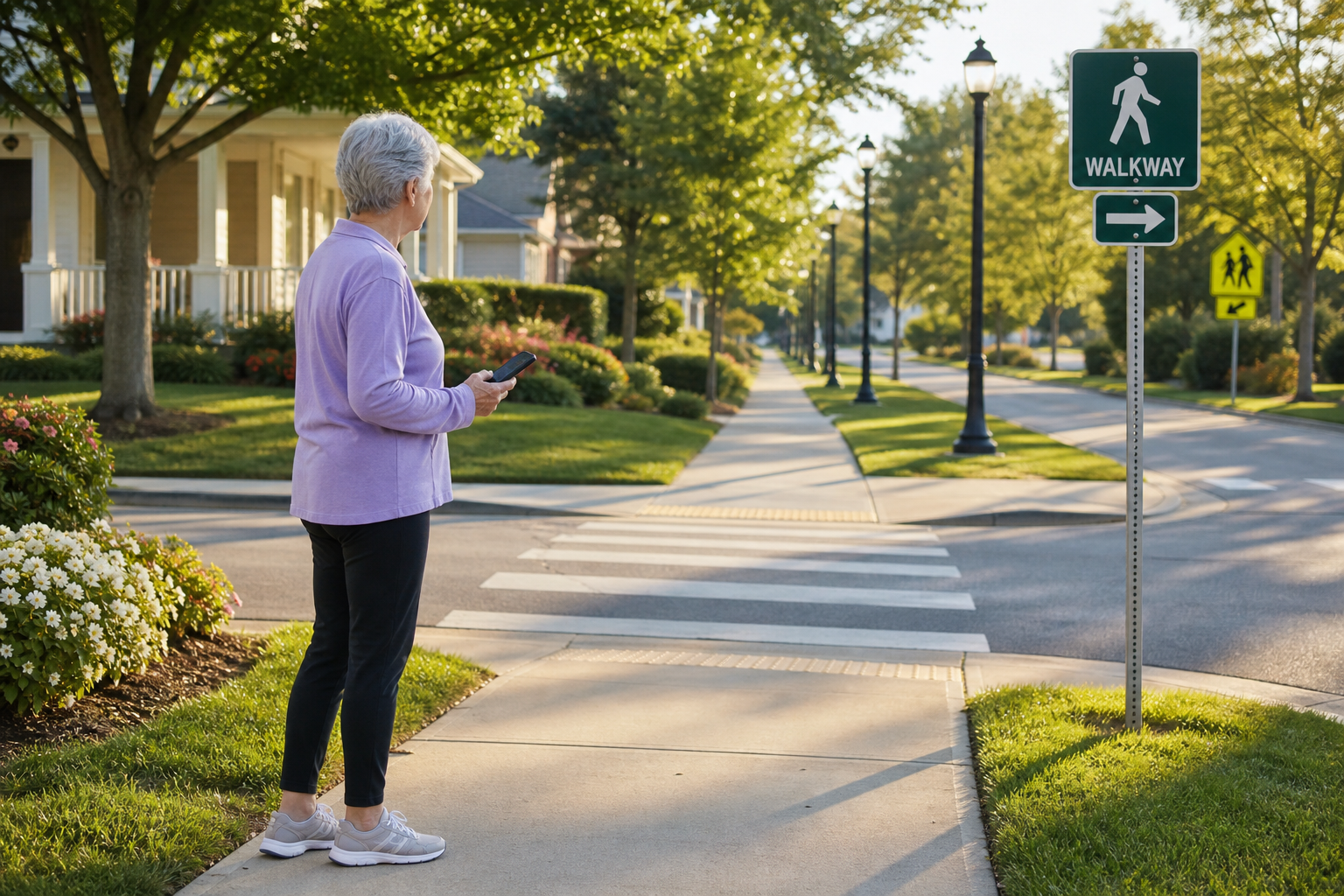
Surface Quality
Uneven pavement, cracked sidewalks, and tree root upheavals are the most common tripping hazards for senior walkers. Scout your route during daylight and note any sections where the surface is broken, raised, or uneven. Gravel paths are acceptable if the gravel is packed and level, but loose gravel increases fall risk. Paved paths and well-maintained sidewalks are the safest options.
Pay attention to transitions: where driveways meet sidewalks, where concrete slabs meet, where curb cuts angle down to the street. These are the spots where small height differences catch shoes and cause falls. Walk the route slowly the first time. Look down.
If you see a raised edge you’d need to step over or a crack wide enough to catch a toe, mark that section on a map or mental note and decide whether to avoid it or just memorize it as a spot that needs extra attention.
If your neighborhood sidewalks are poorly maintained, consider walking in a local park with paved trails, a school track (many are open to the public outside school hours), or a mall (climate-controlled and flat). Some community college campuses have paved paths open to the public and are less crowded than parks during weekday mornings. For those concerned about outdoor conditions, you might also consider an indoor walking program that offers climate-controlled options year-round.
Grass paths work if the ground is firm and level, but avoid them after rain when the surface gets slippery or uneven. Dirt paths are fine for experienced walkers with good balance, but they’re less predictable than pavement.
Traffic and Crossings
Routes that require crossing busy streets add risk and stress to your walk. Map a path that minimizes crossings. Where crossings are unavoidable, choose intersections with traffic signals and pedestrian countdown timers.
Avoid relying on unmarked crosswalks or intersections where drivers make fast turns. Wear bright or reflective clothing if you walk during dawn, dusk, or overcast conditions.
Watch for right-turn-on-red intersections. Drivers scanning left for oncoming traffic often miss pedestrians crossing from the right. Make eye contact with drivers before stepping into the crosswalk. If a driver is looking at their phone or turning their head away, wait.
Roundabouts and traffic circles are harder to navigate on foot than standard intersections. Drivers focus on merging traffic, not crosswalks. If your route includes one, walk around the outside rather than trying to cross through the middle, or find an alternate route that avoids it entirely.
Four-way stops feel safer than signaled intersections because traffic moves slower, but don’t assume drivers will stop. Some roll through without looking for pedestrians. Treat every crossing as if the driver doesn’t see you until you’ve confirmed they’ve stopped.
Lighting
If you walk in the early morning or evening, your route needs adequate lighting. Well-lit streets, park paths with lamp posts, and commercial areas provide better visibility than residential side streets. A clip-on LED safety light attached to your clothing or hat makes you visible to drivers and cyclists even on dimly lit paths.
Test your route after dark before committing to it for morning or evening walks. Streetlights that seem sufficient at dusk might leave large dark patches between pools of light. Paths through parks that feel safe during the day can become isolated and poorly lit at night.
Motion-sensor lights on homes and businesses help, but they’re not reliable. They don’t always trigger when you need them, and some have delays. Plan your route around consistent, fixed lighting rather than assuming motion sensors will fill the gaps.
Rest Points
Plan your route to include at least one bench, low wall, or other sitting surface at the halfway point or wherever you might need a rest. Knowing you can sit if needed gives you the confidence to walk further. Many parks have benches every quarter mile.
If your route lacks seating, consider carrying a lightweight foldable cane seat that converts from a walking cane to a small stool.
Bus stops often have benches. Low walls around building landscaping work. Some neighborhoods have decorative boulders or low retaining walls along sidewalks. Look for anything stable and at a height that lets you sit without straining your knees.
If you need to rest but there’s no seating, standing still for a minute or two works. Find a tree, fence, or wall to lean against. There’s no rule that says you have to keep moving continuously. A 30-second pause to catch your breath or let your heart rate settle is perfectly fine and doesn’t diminish the value of your walk.
Shade and Weather Protection
Sun exposure matters, especially during summer months. Tree-lined streets and covered walkways provide shade that makes hot-weather walking tolerable. If your route is fully exposed, plan walks before 9 AM or after 5 PM during summer. Carry water regardless of temperature, and wear a wide-brimmed hat and sunscreen.
South-facing streets get more sun throughout the day. East-facing streets are cooler in the afternoon. West-facing streets stay shaded in the morning. If you walk at the same time daily, you can choose a route that puts shade where you need it most.
Wind matters as much as sun. Open stretches with no buildings or trees expose you to wind that increases cold on winter days and makes hot days feel hotter. Routes with natural windbreaks (buildings, hedges, berms) are more comfortable year-round.
Bathroom Access
Accessible restrooms along your route matter, especially for longer walks. Public parks, libraries, coffee shops, and community centers often have restrooms available. Knowing where they are removes a significant anxiety barrier that prevents many seniors from walking longer distances.
Gas stations with single-occupancy restrooms that don’t require asking for a key are the most reliable option in neighborhoods without parks. Fast-food restaurants typically allow restroom use without purchase. Libraries are ideal: clean, climate-controlled, and welcoming to the public.
Check restroom hours. Park facilities often close at dusk. Coffee shop hours vary. If you walk early mornings, you might need a different backup plan than if you walk mid-morning when most businesses are open.
Hills and Elevation Changes
Flat routes are easier on your heart and joints than routes with hills. If you’re building endurance or managing joint pain, prioritize flat paths. If you’re reasonably fit and want more challenge, moderate hills add intensity without requiring you to walk faster or longer.
Avoid steep descents. They’re harder on your knees than climbs and increase fall risk. If a route includes a hill, walk up it and return the way you came rather than creating a loop that sends you down a steep slope on the back half when you’re already tired.
Short, gradual inclines spread across a route are better than one long sustained hill. Your heart rate and breathing stay more consistent. If the only route available includes a steep section, plan to pause at the top before continuing.
Building Your Route
Start small: Begin with a 10-15 minute loop from your front door. Familiarity reduces anxiety and ensures you’re never far from home if you need to stop.
Map your immediate block first. Walk it once at a slow pace, noting every curb, crack, and crossing. Once you’re comfortable with that loop, extend it by one block in any direction that looks safe. Build outward incrementally rather than trying to plan a long route from scratch.
Create options: Map three routes of different lengths (short: 15 minutes, medium: 25 minutes, long: 40 minutes). This gives you flexibility based on how you feel, the weather, and your time. On tired days, take the short loop. On energized days, go for the long one.
Having options removes the pressure to complete a full route when you don’t feel up to it. You’re more likely to walk on marginal days if you know you can take the short version without feeling like you failed.
Walk the route first by car: Drive the path to check surface conditions, traffic patterns, and rest points before walking it on foot. This preview eliminates surprises.
Bring someone else to drive while you observe, or drive slowly and note landmarks, hazards, and features. Use your phone to take photos of spots you want to remember: benches, tricky intersections, sections with good shade. Review those photos before your first walk so you know what to expect.
Share your route with a family member or friend. Let someone know which path you’re taking and when you expect to return. Carry your phone for emergencies.
If you live alone, a daily check-in text when you finish your walk gives someone confirmation you’re safe. Some families use location-sharing apps so a relative can see where you are without requiring constant updates. That setup works well for walkers who don’t want to feel monitored but want someone to notice if they’re delayed.
Test the route on a weekend: If you plan to walk on weekday mornings, walk the same route on a weekend morning first. Traffic patterns, parking behaviors, and pedestrian volumes change between weekdays and weekends. A route that’s calm on Saturday at 8 AM might be congested on Tuesday at 8 AM if it passes a school drop-off zone.
Common Route Problems and How to Fix Them
Problem: Your ideal route has one bad crossing that feels unsafe.
Solution: Walk to that crossing, turn around, and go back the way you came. Out-and-back routes are perfectly valid. You don’t lose anything by retracing your steps, and you gain safety.
Problem: The only nearby sidewalk ends after half a mile, forcing you onto a road shoulder.
Solution: Walk the sidewalk section twice. A quarter-mile out and back four times equals a mile. Repetitive routes get boring, but boredom is better than walking on a dangerous road.
Problem: Your neighborhood has no sidewalks at all.
Solution: Drive to a park, trail, or mall with safe walking paths. Some recreation centers and YMCAs have indoor tracks that are free or low-cost for community members. Senior centers often organize walking groups that carpool to safe locations.
Problem: You want variety but don’t know how to find new routes without getting lost.
Solution: Use a mapping app to preview routes before walking them. Satellite view shows you surface types, shade coverage, and landmarks. Street view lets you virtually walk the route and spot hazards before committing to it in person.
Safety Gear for Daily Walks
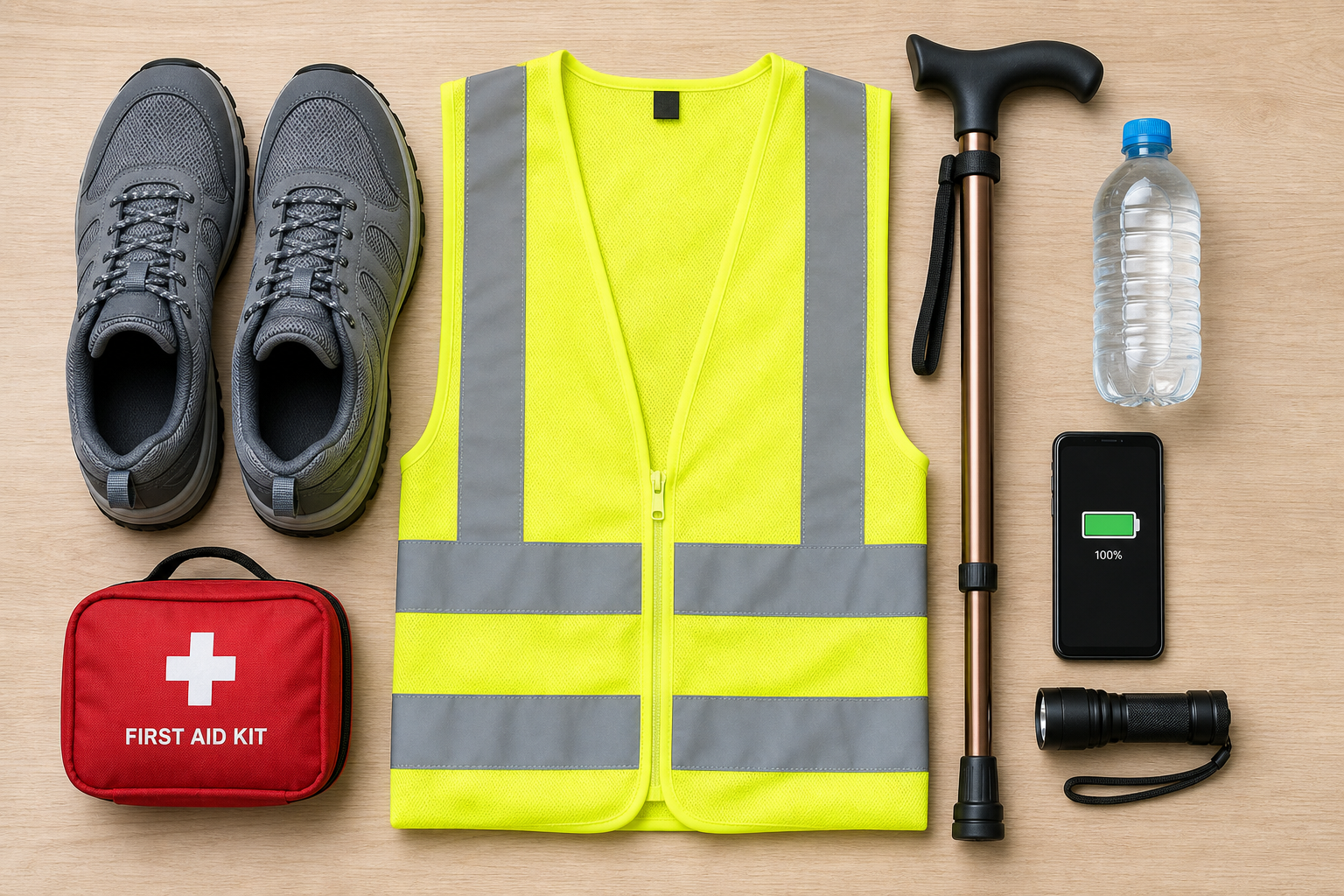
- Supportive walking shoes with non-slip soles and good ankle support
- Phone with emergency contacts saved and location sharing enabled
- ID (a medical ID bracelet or card in your pocket with emergency contact and medical information)
- Water bottle (even for short walks)
- Reflective vest or LED light for low-visibility conditions

Reflective Walking Vest
Essential for early morning or evening walks to increase visibility to drivers
Add a small pouch or belt pack if you don’t have pockets. Carrying everything in your hands gets tiring and throws off your balance. A phone armband works, but many people find belt packs more comfortable because they distribute weight evenly.
If you take medication that could cause dizziness or low blood sugar, carry a small snack (a few crackers or a granola bar) in case you need it mid-walk. Low blood sugar hits faster when you’re active, and being prepared prevents a minor issue from becoming a serious one. If you experience dizziness during or after physical activity, understanding what triggers it can help you stay safe on your walks.
Walking Alone Safely
Walk during hours when other people are out. Early morning and late afternoon see more foot traffic than mid-morning or mid-afternoon. Routes through residential areas are busier when people are walking dogs, commuting, or doing yard work.
Stay alert. Earbuds are fine if you