Tracking your exercise doesn’t require an app, a fitness tracker, or a spreadsheet. A simple notebook, wall calendar, or printed log sheet provides the accountability and progress visibility that keeps you exercising consistently. The best tracking method for seniors is the one that takes less than 60 seconds per day to update and provides a visual record that motivates you to maintain your streak.
Many older adults find digital tracking systems either too complicated or too easy to ignore. A phone notification is easy to swipe away. A notebook sitting on your kitchen counter is harder to avoid. Physical tracking creates a ritual: you finish your walk, you mark your calendar, you feel the satisfaction of recording another completed session. That simple act reinforces the habit.
The methods below require no tech skills, no charging cables, and no subscription fees. They work during power outages and don’t become obsolete when a company shuts down its servers. For those who prefer digital solutions, you might want to check out our guide on fitness tracking apps for seniors, but this article focuses exclusively on non-digital methods.
Best Low-Tech Tracking Methods
Wall Calendar X Method
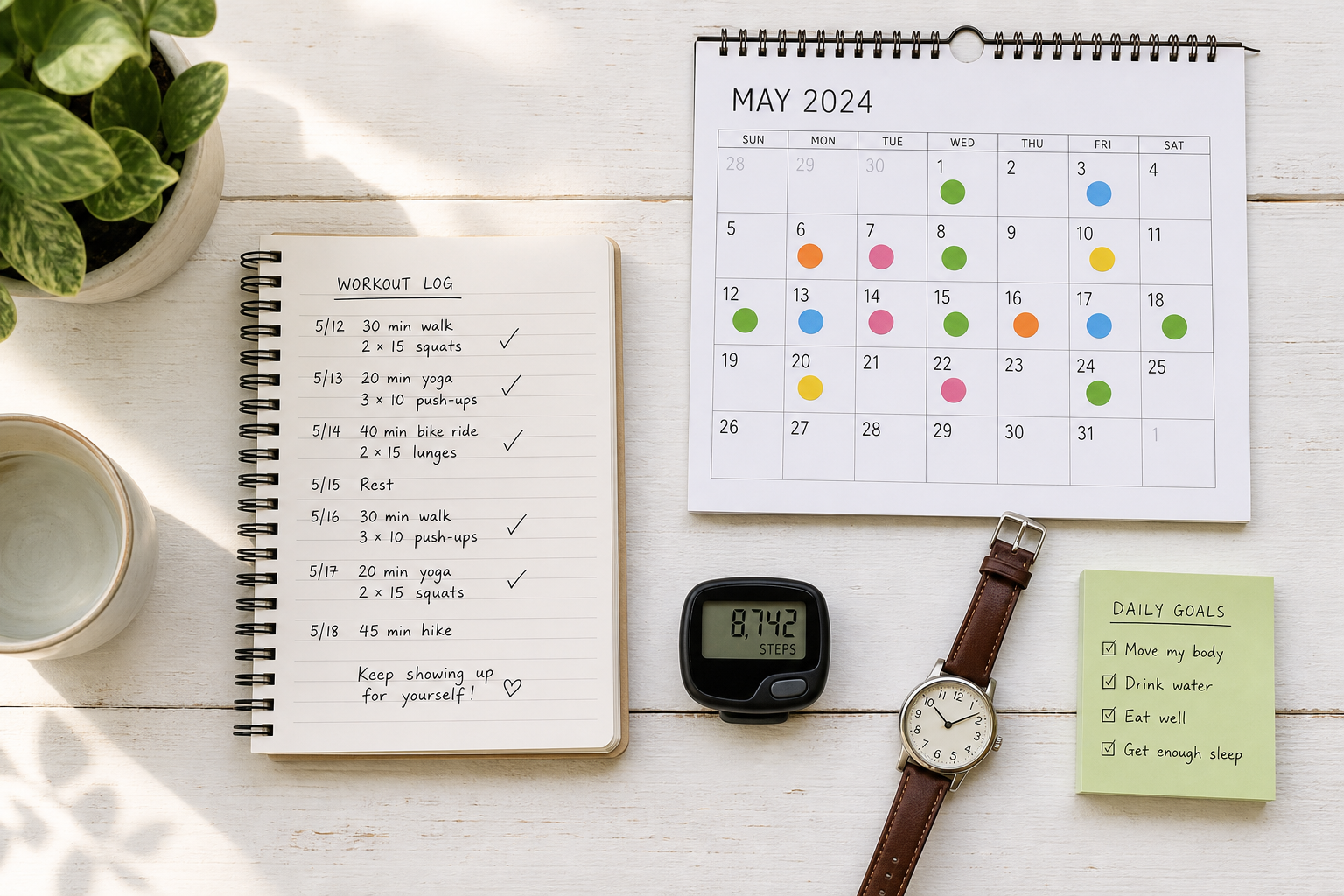
Hang a wall calendar in your exercise area. Mark a large X on every day you exercise. The visual chain of X’s becomes its own motivation (you don’t want to break the chain). At the end of each month, count your X’s. This is the simplest, most effective tracking method and costs nothing beyond a calendar you may already own.
The wall placement matters. Put the calendar where you see it multiple times per day: the bathroom mirror, the kitchen wall near the coffee maker, the hallway you walk through constantly. Visual reminders work. A calendar buried in a drawer doesn’t.
Use a marker or pen that makes a bold, satisfying mark. Thin pencil lines don’t provide the same visual punch. Some people use different colored markers for different exercise types (blue for walking, green for strength work, red for stretching). This adds zero complexity but makes the calendar easier to scan at a glance.
If you miss a day, the blank square stands out. The gap in your chain creates mild social pressure with yourself. Most people find they’ll do a shorter workout rather than see another blank square. Ten minutes of chair exercises still earns an X.

Large Print Wall Calendar
Oversized date squares make marking and viewing your progress easier, especially if you have vision concerns
Dedicated Exercise Notebook
A small fitness journal kept beside your exercise area. After each session, write: the date, what you did (walked 20 min, chair exercises 15 min), and how you felt (1 word: great, tired, sore, energized). This 30-second daily entry creates a permanent record that reveals patterns over weeks and months. Looking back at 3 months of entries and seeing your walking time grow from 10 to 30 minutes is powerfully motivating.
The notebook method works best for people who like writing by hand and want more detail than a calendar X provides. You’re not writing paragraphs. Three lines per entry is plenty. The act of writing helps some people process how the workout went and mentally commit to the next session.
Keep the notebook in the same place every time. Not sometimes on the kitchen counter and sometimes on the bedroom dresser. Same spot, same pen next to it, same post-workout ritual. Consistency in the tracking ritual supports consistency in the exercise habit.
Consider a notebook small enough to fit in a pocket or purse if you exercise in different locations. A 4×6 inch notebook travels easily to the pool, the park, or your daughter’s house. You can log immediately after the workout instead of trying to remember details hours later. This is especially helpful if you’re following travel workout routines.
Reviewing old entries provides perspective that memory alone can’t match. You might feel like you’re not making progress, then flip back six months and realize you couldn’t walk half the distance you cover now. Written records don’t lie or forget.

Simple Exercise Log Notebook
Look for options with large print and plenty of writing space that won’t cramp your hand
Printed Weekly Log Sheet
A one-page weekly log with rows for each day and columns for exercise type, duration, and notes. Print 52 copies for a year’s worth of tracking. Pin the current week on the refrigerator or exercise area wall. File completed weeks in a folder. The filled-in sheets provide a tangible record of your consistency.
Free printable exercise log templates are available online. Search for “simple weekly exercise log printable” and choose one with large print and plenty of white space. Cramped, tiny boxes are frustrating to fill in, especially if you have any vision limitations or arthritis affecting your handwriting.
You can also create your own in a word processor. Make it as simple or detailed as you want. Some people add a column for morning resting heart rate, others for mood before and after exercise, others for pain levels. The template is yours to customize.
The physical act of filing completed sheets creates a sense of accomplishment. A folder getting thicker with filled-in logs is a visual representation of months of work. That folder is proof you did the thing, week after week.
If you exercise with a spouse or friend, consider printing two logs and posting them side by side. A little friendly accountability helps. You’re less likely to skip when someone else will notice the blank spaces on your sheet.
Sticker Chart
Purchase a pack of star stickers and a poster calendar. Place a sticker on each exercise day. The childlike simplicity is the point: the visual reward of placing a sticker activates the same positive reinforcement loop that makes sticker charts effective for children. Adults respond to visual rewards more than they admit.
Gold stars work. So do smiley faces, checkmarks, or seasonal stickers (autumn leaves in fall, snowflakes in winter). The specific sticker doesn’t matter. The satisfaction of peeling it off the sheet and placing it on the calendar does.
This method combines the visual chain effect of the X calendar with a small tactile reward. The act of finding the sticker, peeling it, and pressing it down takes maybe 10 seconds, but those 10 seconds register psychologically as a mini-celebration.
Some people use different sticker colors or types for different exercise intensities. A small dot sticker for a light stretching day, a star for a full workout, two stars for an especially challenging session. This creates a richer visual record without requiring any writing.
Poster calendars (the large wall-mount type with generous date squares) give you room for multiple stickers per day if you do more than one exercise session. Morning walk gets one sticker, evening chair exercises get another. The filled-up calendar becomes genuinely impressive looking.
What to Track
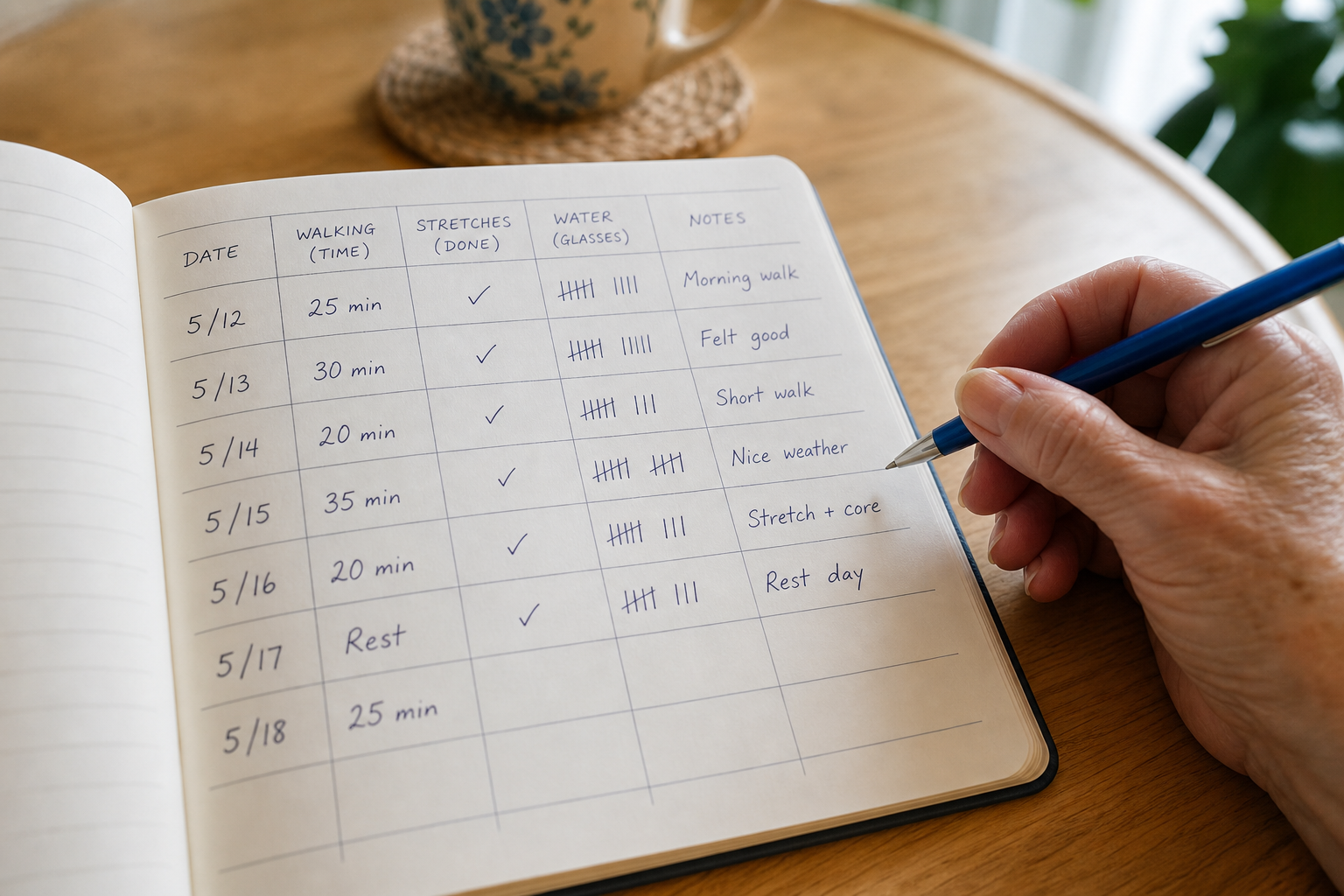
Minimum tracking: Date and whether you exercised (the X method). This is sufficient for maintaining consistency. You’re not training for competition. You’re building a habit that keeps you mobile and independent. Knowing you moved your body and marking the day creates accountability.
Moderate tracking: Date, exercise type, and duration. This reveals trends in what you do and how much. You might notice you walk consistently but rarely do strength work, which signals an imbalance to address. Or you might see that 20-minute sessions feel sustainable while 40-minute sessions lead to skipped days, which tells you your current sweet spot.
Detailed tracking: Date, exercises performed, sets/reps/resistance, walking distance/time, and how you felt. This enables progressive overload (knowing exactly what to beat next session). If you did 10 reps of seated leg raises last time, you can aim for 11 this time. Detailed logs make progression concrete instead of vague. This approach works particularly well if you’re following a structured program like progressive resistance training.
Start with the minimum. Add detail only if you find the extra information useful. Over-tracking leads to tracking fatigue, which leads to abandoning the log entirely.
The goal is to track just enough to keep you honest and motivated, not to create a second job. If filling in your log starts taking longer than the warm-up portion of your workout, you’re tracking too much.
Practical Tracking Tips
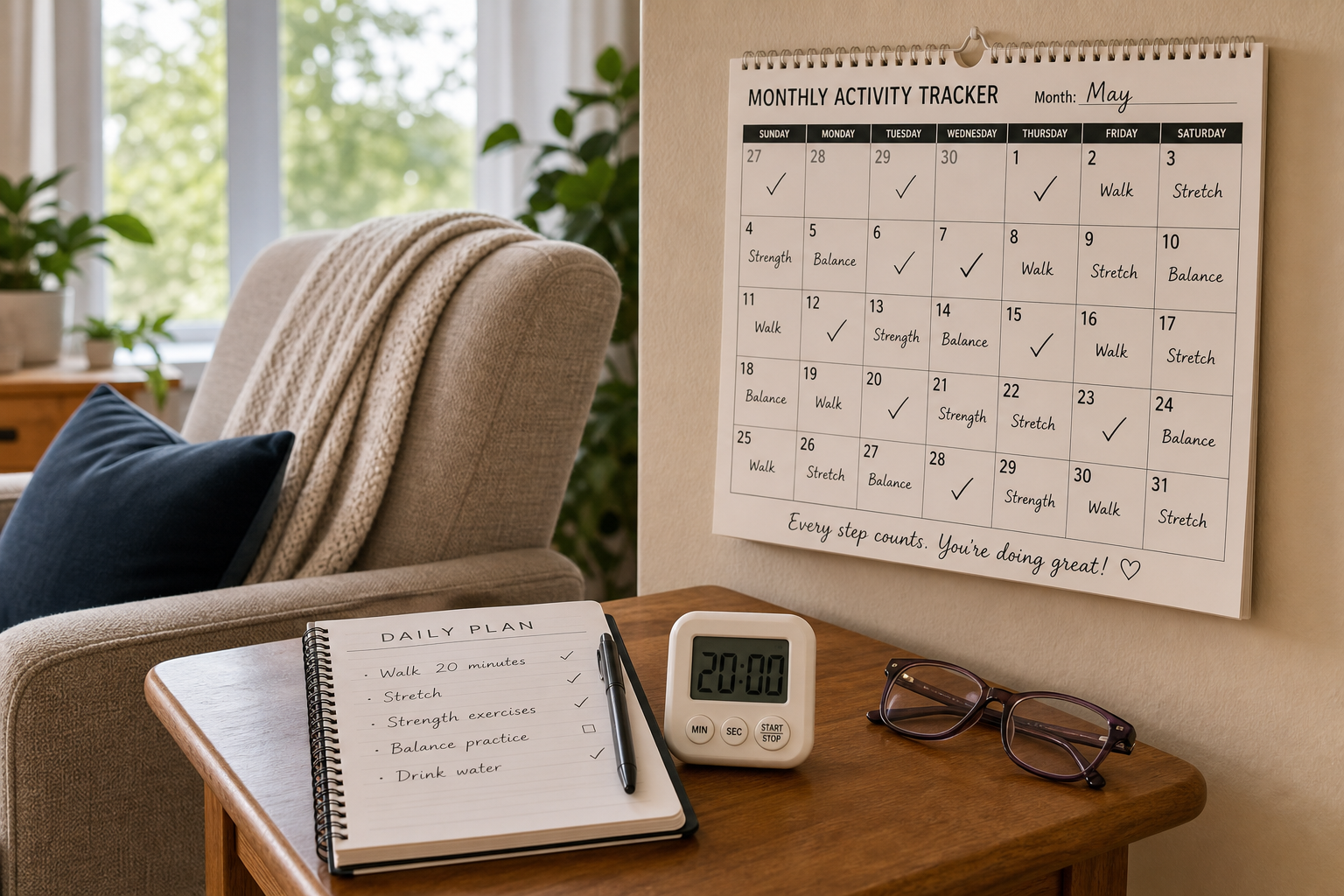
Keep your tracking tool visible. A notebook buried in a drawer will be forgotten. A calendar on the back of a closet door won’t create the same visual accountability as one on a high-traffic wall.
Set a trigger for logging. “After I finish exercising and before I shower, I mark my calendar” creates a stronger habit than “I’ll remember to log sometime today.” Pair the tracking action with another consistent daily action.
Don’t overcomplicate the first month. Pick one method and stick with it for 30 days before deciding it doesn’t work. Most tracking failures happen because people switch methods every few days, never giving any single system time to become routine.
If you travel frequently, choose a portable method. A small notebook or a phone photo of your calendar before you leave lets you keep the streak going while away from home. Some people text themselves their daily exercise summary, then transfer it to their log when they return.
Consider tracking alongside a friend or family member, even if you don’t exercise together. Weekly check-ins where you share your totals create mutual accountability. Friendly competition (who got more days this week?) makes tracking more engaging for some people.
When Tracking Becomes Counterproductive
Some personalities turn tracking into an unhealthy obsession. If you feel genuine anxiety about missing a day, if you push through pain to avoid a blank square, if you exercise when genuinely ill just to maintain a streak, the tracking system is creating harm instead of help.
Tracking should support your health and consistency. It shouldn’t become a source of stress or a reason to ignore your body’s signals. If you wake up with a fever or severe joint pain, the correct choice is rest, not forcing a workout to satisfy a log. This is especially important if you’re managing conditions that require careful monitoring, such as recovering from hip replacement surgery or knee replacement.
Perfectionism ruins tracking for many people. They miss two days, decide the whole month is ruined, and abandon the log. A log with 23 out of 30 days filled in represents significant consistency. It doesn’t need to be 30 out of 30 to be valuable.
If your tracking method starts feeling like a burden, simplify. Switch from detailed logging to simple X’s. Or take a week off from tracking entirely while continuing to exercise, then restart with fresh perspective.
Using Your Log to Adjust Your Program
Monthly reviews reveal patterns you won’t notice day to day. If your log shows you consistently exercise 5 days one week, 2 days the next, 5 days again, then 1 day, that erratic pattern suggests your program might be too intense for sustainable consistency. Pulling back to a schedule you can maintain every week often produces better long-term results.
A log that shows steady 15-minute sessions for three months with no missed days suggests you could safely increase duration or intensity. Progressive overload doesn’t mean doubling your work overnight. Adding 2 minutes to your walk or 2 reps to your exercises creates measurable progress without risking injury or burnout.
Energy and mood notes help identify which types of exercise leave you feeling better versus drained. If every strength training session gets a “tired” note and every walk gets an “energized” note, useful information emerges. Maybe you need to reduce strength training volume or move it to a different time of day when you have more energy. Our article on morning vs evening exercise can help you optimize your workout timing.
Pain notes matter. If your log shows knee discomfort three days running, a signal appears to modify your routine, not push through. The log gives you concrete evidence to share with your doctor or physical therapist instead of vague “my knee bothers me sometimes” reports. This is particularly important for those managing chronic conditions like arthritis or sciatica.
Seasonal patterns show up in long-term logs. Many older adults exercise more consistently in spring and fall, less in extreme summer heat or winter cold. Knowing your personal pattern lets you plan for the low-motivation seasons: joining an indoor exercise class, finding a mall-walking program, or accepting that December might be a maintenance month rather than a progression month. Check our guides on hot weather workout safety and cold weather exercise tips for seasonal strategies.
Frequently Asked Questions
Is paper tracking as effective as app tracking?
For accountability and consistency (the most important outcomes of tracking), paper is equally effective. Apps add automatic data analysis, trend charts, and reminders, which some people find valuable and others find overwhelming. The best system is the one you’ll actually use daily. If an app feels like a chore, paper is better. If paper gets lost in a drawer, an app is better.
Digital tracking offers advantages for people who want detailed statistics or automatic syncing with other health data. Paper tracking offers advantages for people who find physical actions more satisfying or who don’t want to deal with technology immediately after sweating through a workout.
Many people successfully combine methods: a simple wall calendar for daily tracking and a phone app for logging the occasional longer hike with route maps and elevation. Use whatever tools serve you. There’s no rule against hybrid approaches.
How often should I review my log?
Weekly: count your exercise days and compare to your goal. Monthly: review trends (are you doing more or less than last month? Are you progressing in distance, reps, or duration?). Quarterly: assess whether your program is producing the results you want and adjust if it’s stalling.
Weekly reviews take 2 minutes. Flip through your log or count the X’s on your calendar. If your goal is 4 exercise days per week and you hit it, acknowledge that. If you only got 2 days, think about what got in the way and how to address it next week.
Monthly reviews might reveal you’re crushing your goals and ready to increase difficulty, or you’re barely keeping up and need to scale back to something sustainable. Both insights are valuable.
Quarterly reviews let you assess bigger questions: Is this program helping me feel stronger and more capable? Am I enjoying it enough to keep doing it? What would I change if I could start over? Logs give you the data to answer those questions instead of relying on fuzzy impressions.
What if I miss logging a day?
Leave it blank and log the next day. A missed log entry is not a failure; it’s a gap. Don’t try to reconstruct missed days from memory (inaccurate) or stop logging because the record is “ruined” (perfectionism kills tracking). Consistent 80% logging provides more than enough data for accountability and progress assessment.
If you realize at bedtime that you forgot to log your morning workout, fill it in. If you realize three days later, let it go. The point of tracking is to support your current exercise habit, not to maintain a perfect historical archive.
Some people note missed logs with a different mark: a circle instead of an X, a question mark, or just the letter M. This distinguishes “I didn’t exercise” from “I don’t remember if I exercised” when reviewing old records.