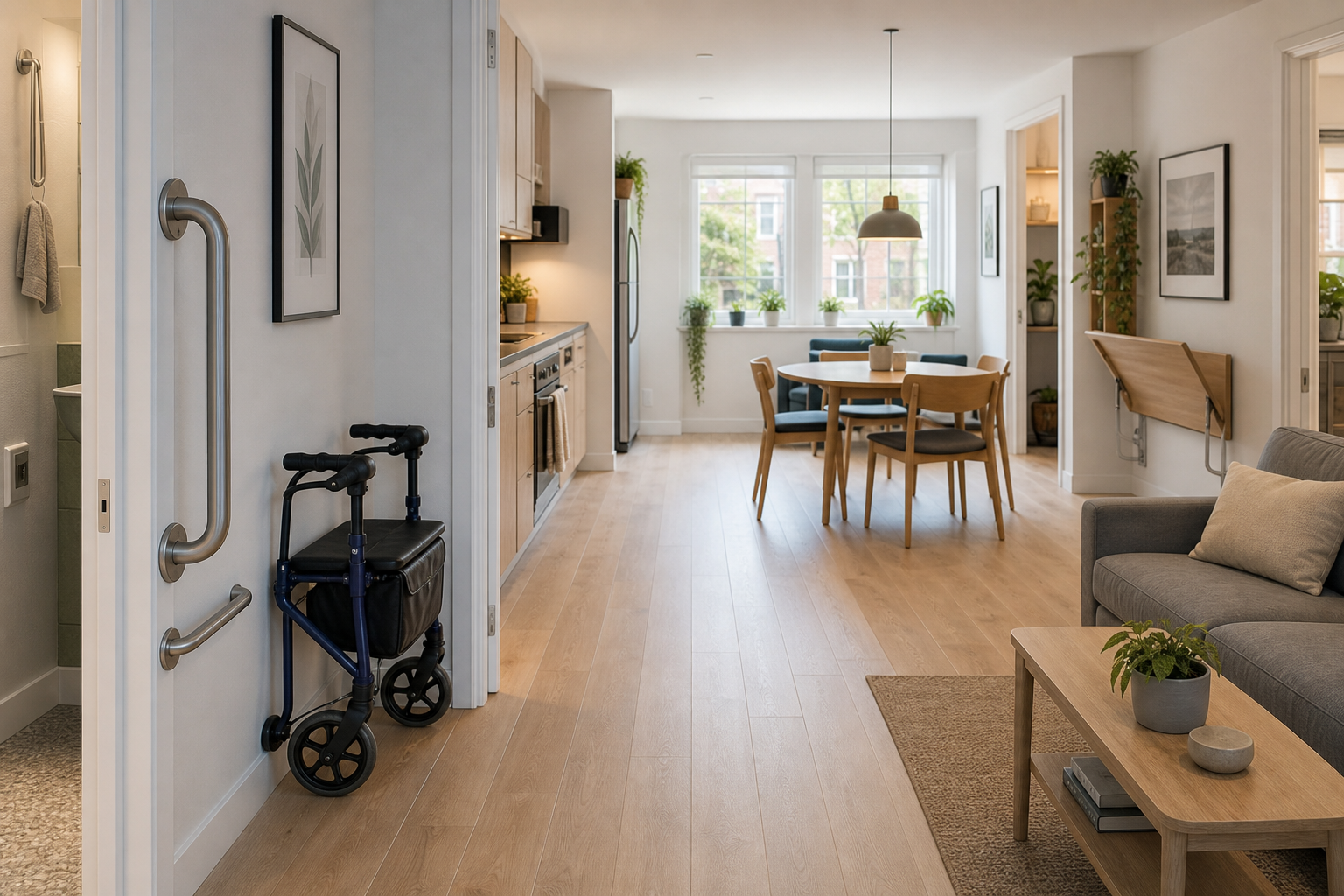
Standard walkers and rollators are designed for hospital corridors and wide suburban hallways. In a small apartment with narrow doorways, tight bathroom spaces, and limited storage, these full-sized aids become obstacles rather than helpers. They block hallways, can’t navigate 90-degree turns into small bathrooms, and have nowhere to park when not in use. Compact mobility aids designed for tight spaces let you move safely through a small home without the frustration of a device that doesn’t fit your living environment.
Challenges of Mobility Aids in Small Spaces
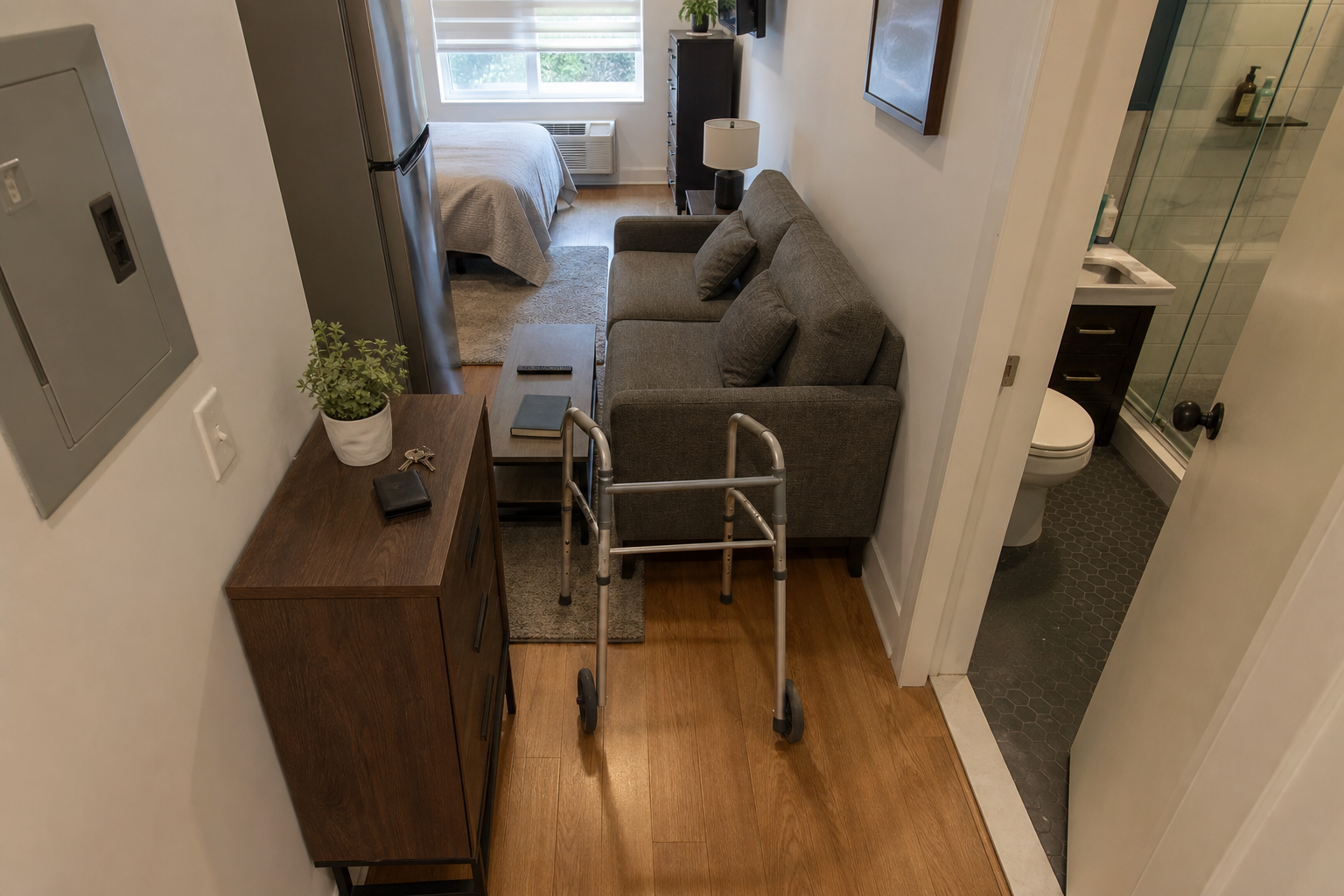
- Narrow doorways: Many older apartments have 28-30 inch door frames. Standard walkers are 22-24 inches wide, leaving only 3-4 inches of clearance per side. Standard rollators are 22-26 inches wide, which may not fit at all.
- Tight turns: Small bathrooms, galley kitchens, and L-shaped hallways require 90-degree turns that wide-based walkers can’t execute without lifting and repositioning.
- Storage: A rollator that sits in the middle of a small living room is a tripping hazard. Folding and compact storage is essential when floor space is limited.
- Clutter: Small homes have furniture closer together, creating narrow pathways that wide mobility aids can’t navigate.
The math matters. A 24-inch-wide walker in a 30-inch doorway leaves 3 inches on each side. That sounds workable until you factor in the door frame trim (another inch), slight angles when you’re not perfectly centered, and the natural sway that happens when you’re moving through. What looks like adequate clearance on paper becomes a frustrating squeeze in practice, especially if you have arthritis in your hands and need to grip the walker firmly without worrying about scraping knuckles on the door frame.
Small bathrooms present the worst-case scenario. The typical apartment bathroom is 5 feet by 8 feet with the toilet, sink, and shower all competing for space. A standard rollator can’t turn around once inside. You back out, which is awkward and unsafe, or you leave it outside the door, which defeats the purpose of having mobility support when you need it most.
Best Compact Mobility Aids
Narrow-Frame Walker
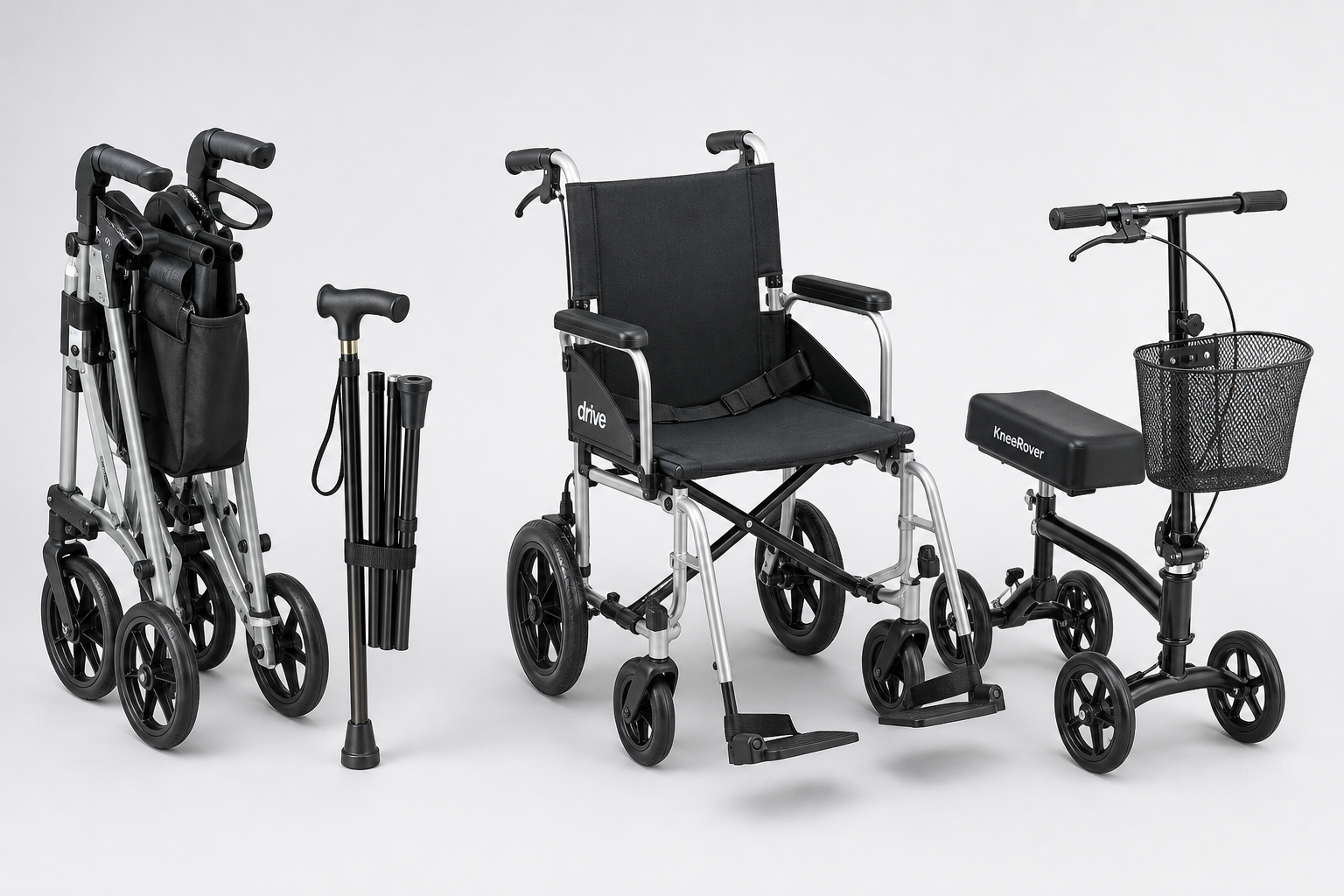
A narrow walker (18-20 inches wide) fits through standard doorways with comfortable clearance and navigates tight turns more easily than standard 22-24 inch models. Look for models that fold flat for storage behind a door or in a closet. Two-wheeled narrow walkers provide the best combination of compact width and walking fluidity.

Narrow Walker for Small Spaces
Essential for apartments with doorways under 30 inches, folds to just 4 inches for storage
The two-wheeled configuration (wheels on the front legs, rubber tips on the back) is easier to maneuver than four-legged pick-up walkers. You don’t have to lift the entire frame with each step. You push forward on the wheels and the back legs glide along. This matters when you’re navigating a tight turn into a bedroom or trying to position the walker close to a kitchen counter.
Weight matters in small spaces. A narrow walker that weighs 8 pounds instead of 12 pounds is easier to lift over a bathroom threshold, easier to fold and unfold, and less likely to cause problems if you bump it into furniture. Aluminum frames keep the weight down without sacrificing stability.
When not in use, the walker folds to about 4 inches deep. That’s thin enough to slide between a dresser and a wall, stand upright in a narrow closet, or tuck beside a refrigerator in a galley kitchen. Proper height adjustment and grip positioning prevents shoulder and wrist strain that many users experience with poorly configured mobility aids.
Compact Rollator
Compact rollators (like the Medline Ultralight or similar models) feature a narrow frame (under 22 inches), tight turning radius, and vertical folding (folds to 10-12 inches wide for closet storage). Indoor-specific rollators have smaller wheels (6 inches instead of 8) for better maneuverability in tight spaces. The trade-off is less stability on outdoor surfaces, so these are best for indoor use.
The seat is the main reason to choose a rollator over a walker. In a small apartment, you may have a longer distance between the bedroom and kitchen than you can comfortably walk without a rest. The rollator seat lets you stop, sit, and catch your breath without needing a chair nearby. If you’re still deciding between these two options, understanding the key differences between rollators and walkers can help you make the right choice for your specific needs.
Smaller wheels turn tighter. A 6-inch wheel pivots in a radius that an 8-inch wheel can’t match. You can execute a 90-degree turn into a bathroom with one smooth motion instead of a three-point turn. The downside is that small wheels catch on uneven pavement, gravel, and grass. If you plan to use the rollator outdoors, you need 8-inch wheels. If it’s strictly for indoor use, 6-inch wheels make navigation easier.
The brake system matters. Loop brakes (hand-operated like bicycle brakes) are easier to use than push-down brakes if you have arthritis or weak grip strength. Check that the brakes lock securely when you sit on the seat. Some lower-quality rollators have brakes that slip under body weight, which is dangerous.

Compact Indoor Rollator
Features 6-inch wheels for tight turns and vertical folding for closet storage
Hemi Walker (Side Walker)
A hemi walker (also called a side walker) is a one-sided frame that’s held with one hand, similar to a quad cane but with a wider, more stable base. It’s 12-14 inches wide, fits through any doorway, and navigates tight spaces easily. The hemi walker is ideal for seniors with one-sided weakness (stroke recovery) or those who need more stability than a cane provides but less than a full walker.
The base has four contact points with the floor, arranged in a rectangular pattern that’s wider and longer than a quad cane. This gives you more stability when you lean on it. You can put significant weight on a hemi walker without it tipping, which you can’t do with a standard cane.
Height adjustment is critical. The handle should align with your wrist when your arm hangs naturally at your side. If it’s too high, you’ll lean sideways and strain your shoulder. If it’s too low, you’ll hunch forward and lose the stability benefit.
Hemi walkers work best when you have good strength and balance on one side of your body and need support on the other side. This makes them particularly useful for those recovering from stroke or following hip replacement surgery. If both sides are weak or your balance is significantly impaired, a two-handed walker provides better stability. Talk to a physical therapist before committing to a one-sided aid if you’re not sure which configuration is right for you.
The narrow footprint is the major advantage in small spaces. A 12-inch-wide hemi walker goes anywhere a person can walk. It fits beside the toilet, in a shower stall, between closely spaced furniture, and in a narrow galley kitchen where nothing wider will fit.
Folding Cane with Seat
A folding cane with a flip-down seat provides walking support in the narrowest spaces (a cane is 1 inch wide) and a rest seat that deploys in seconds when you need to sit. These are ideal for small homes where a walker or rollator physically can’t fit in the bathroom or between closely spaced furniture, and for short-distance walking where the primary need is a walking aid with occasional sitting capability.
The seat portion folds flat against the cane shaft when not in use. When you need to sit, you flip it down and lock it into position. The cane becomes a small stool. Most models support 250-300 pounds when used as a seat.
The limitation is stability. A cane with a seat is still a cane. It provides less support than a walker or rollator. If you need significant stability support when walking, this isn’t the right primary aid. But if you mainly need something to steady yourself occasionally and a place to rest during longer walks, it’s a practical choice that takes up almost no space.
Check the seat height. Some models have fixed seat heights around 30 inches, which may be too high if you’re under 5 feet 4 inches tall. Adjustable-height models let you set both the handle height (for walking) and seat height (for sitting) to match your body. Making these proper adjustments to your cane prevents the hand, wrist, and shoulder discomfort that comes from using an incorrectly sized mobility aid.
Bed Rail / Grab Bar Combination
In a bedroom too small for a walker to park beside the bed, a bed assist rail provides the stability needed for getting in and out of bed without a walker. The rail slides between the mattress and box spring, extends upward and outward, and provides a handhold for sitting, standing, and repositioning in bed. Takes zero floor space.
The rail typically extends 16-18 inches above the mattress and has a padded or cushioned grip surface. You grab it when you’re lying down and use it to pull yourself to a sitting position. From sitting, you use it to push yourself up to standing. The reverse process (standing to sitting to lying down) works the same way.
Installation takes about 5 minutes. You lift the mattress, slide the rail’s base plate between the mattress and box spring, lower the mattress, and adjust the vertical post to the right height. No tools needed. The weight of the mattress locks the base plate in place.
Check the clearance between your bed and the wall. Some bed rails extend 6-8 inches out from the mattress edge. If your bed is pushed against the wall, the rail might not fit unless you move the bed a few inches away from the wall.
Adapting Your Small Home for Mobility Aids