Depression affects 15-20% of adults over 65, and it’s both underdiagnosed and undertreated in this age group. The symptoms, including fatigue, loss of interest, difficulty concentrating, sleep disruption, and feelings of worthlessness, overlap with what many people dismiss as “normal aging.” They’re not.
Strength training provides antidepressant effects that are measurable, reliable, and free of the side effects that medication carries. A meta-analysis of 33 randomized controlled trials found that resistance exercise significantly reduced depressive symptoms in adults regardless of health status, and the effects were strongest in people with mild-to-moderate depression.
Before starting any new exercise program, talk to your doctor, especially if you have existing health conditions or are currently taking medication for depression. Strength training can complement your treatment plan, but changes to medication should only happen under medical supervision.
How Strength Training Combats Depression
Neurochemical Changes
Resistance exercise increases the production and release of several mood-regulating neurotransmitters. Endorphins (the body’s natural painkillers and mood elevators) rise during and after each session. Serotonin levels improve with consistent training, addressing the same neurotransmitter deficit that SSRI medications target. BDNF (brain-derived neurotrophic factor) increases, protecting and growing neural connections that depression degrades.
These changes happen at different timescales. Endorphin elevation is immediate, peaking during your workout and lasting 30-60 minutes after. Serotonin and BDNF changes accumulate over weeks of consistent training. You get the short-term mood boost right away, and the deeper neurochemical shifts build underneath.
The neurochemical response doesn’t require high-intensity training. Moderate resistance that challenges you through the last few repetitions triggers the same mechanisms. You don’t need to exhaust yourself or train to failure. Progress and consistency matter more than intensity.
Self-Efficacy and Mastery
Depression erodes your sense of competence and agency. Strength training provides a direct counter-narrative: you set a goal (lift this weight, do these repetitions), you accomplish it, and the evidence of your capability is objective and undeniable. Over weeks, you lift heavier weights, complete more repetitions, and perform tasks (carrying groceries, climbing stairs) that were difficult before. This accumulating evidence of physical capability rebuilds the sense of personal effectiveness that depression destroys.
The mastery component is particularly valuable because it bypasses the cognitive distortions depression creates. Depression tells you you’re weak and incapable. A logbook showing that you squatted 15 pounds last month and 25 pounds this month contradicts that narrative with concrete data. Your brain can dismiss compliments or rationalize away achievements, but it can’t argue with weight lifted.
This also works in reverse: setbacks in training (an off day, a week you had to skip) provide manageable practice in resilience. You miss a week, you come back, your strength hasn’t vanished. That experience translates to other setbacks. Depression catastrophizes interruptions (“I missed three days, I’ve ruined everything”). Regular training teaches your brain that pauses aren’t failures and that you can restart.
Sleep Improvement
Poor sleep is both a symptom and a cause of depression. Resistance training improves sleep quality by increasing slow-wave (deep) sleep, the most restorative sleep stage. Better sleep improves mood, cognitive function, and energy, which makes the next day’s exercise more likely, creating an upward spiral that counters depression’s downward one.
The sleep improvement shows up most reliably when you train earlier in the day. Strength training within 2-3 hours of bedtime can be stimulating for some people and delay sleep onset. For more guidance on optimal workout timing, see our article on morning vs evening exercise for seniors. Morning or early afternoon sessions produce the sleep benefit without the potential interference. If your schedule only allows evening workouts, that’s still better than no workout, just monitor how it affects your sleep and adjust timing if needed.
Sleep architecture changes become noticeable after 2-4 weeks of regular training. You may fall asleep faster, wake less during the night, or feel more rested in the morning. Track these changes. When you notice you slept better after a workout day, that feedback reinforces the habit.
Social Connection
Depression thrives in isolation. Attending a gym, joining a class, or working out with a partner provides social contact that breaks the isolation cycle. Even brief positive interactions during exercise (a nod from a fellow gym-goer, encouragement from an instructor) provide the human connection that depression-driven withdrawal eliminates.
The social component doesn’t require deep friendships or extensive conversation. Low-stakes, routine contact with familiar faces offers benefit. Seeing the same people at the same class creates a sense of belonging without demanding emotional energy. You don’t have to explain yourself or perform social competence beyond showing up.
If in-person settings feel overwhelming, starting at home with resistance bands or bodyweight exercises is completely valid. You can add social contact later when you feel ready. Many people follow along with recorded classes or live-streamed sessions, which provides a sense of exercising “with” others without the pressure of face-to-face interaction.
Body Image and Physical Function
Depression often includes negative body perception and a sense of physical helplessness. Strength training directly improves physical function (stronger, more capable body) and body composition (more muscle, less fat), which gradually shifts self-perception from “broken and useless” toward “strong and capable.” This shift doesn’t happen overnight, but it accumulates with consistent training.
Functional improvements usually appear before visible body composition changes. You’ll notice you can carry a heavier bag or stand up from a low chair more easily before you see muscle definition in the mirror. Those functional wins matter more for mental health than aesthetic changes. Depression cares less about how you look and more about whether you feel capable.
Physical function directly impacts independence, which has psychological weight. When you can do things yourself that you previously needed help with, that reclaims a piece of autonomy that depression takes away. Each recovered capability is evidence against the helplessness narrative.
A Depression-Fighting Strength Routine

The research supports 2-3 sessions per week of moderate-intensity resistance training for antidepressant effects. Each session should include 6-8 exercises covering major muscle groups, performed for 2-3 sets of 8-12 repetitions.
Moderate intensity means the weight or resistance makes the last 2-3 repetitions of each set difficult but achievable with good form. If you finish a set feeling like you could easily do five more repetitions, increase resistance next time. If you can’t complete the set without form breakdown, reduce resistance. The challenge itself is therapeutic. Coasting through easy repetitions doesn’t trigger the mastery response.
For a longer, structured approach to building strength systematically, check out our 12-week progressive resistance training program.
Sample Full-Body Session (25 Minutes)
- Chair squats: 3×10
- Wall push-ups: 3×10
- Resistance band rows: 3×12
- Standing shoulder press with band: 2×10
- Band bicep curls: 2×12
- Calf raises: 3×15
- Standing hip abduction: 2×10 per leg

Resistance Band Set for Seniors
Look for sets with multiple resistance levels and door anchors for versatile home workouts
Rest 30-60 seconds between sets. Use a resistance level that makes the last 2-3 repetitions of each set challenging but achievable. If every repetition feels easy, increase resistance. The challenge is part of the antidepressant mechanism: overcoming difficulty builds the mastery response that counters learned helplessness.
You can modify this routine based on your current ability. Chair squats too easy? Progress to squats without touching the chair, or hold light dumbbells. Wall push-ups too hard? Start with hands on a kitchen counter (higher surface, easier angle). The structure matters more than the specific difficulty level. Consistent challenge, progressive improvement, full-body coverage.
Modifications for Limited Mobility
If balance is a concern, perform exercises near a wall or sturdy counter you can touch for support. Chair squats are already a supported movement. For standing exercises like shoulder press or hip abduction, position yourself so you can steady yourself with one hand if needed.
If you’re working around joint pain or arthritis, adjust range of motion to what’s comfortable. Partial-range squats and push-ups still provide training stimulus. Resistance bands allow you to control resistance precisely and often feel gentler on joints than free weights. For more arthritis-specific exercise guidance, see our article on arthritis-friendly exercises.
If you use a walker or wheelchair, seated versions of most exercises exist. Seated band rows, seated shoulder press, seated bicep curls, and seated leg extensions cover the major muscle groups. A physical therapist can help design a seated routine specific to your mobility level. You can also explore our seated resistance training guide for a complete sitting workout.
Getting Started When Depression Makes Everything Hard

The cruelest aspect of depression is that it robs you of the motivation and energy to do the things that would help. Starting an exercise program while depressed requires strategies that account for this barrier:
- Start absurdly small. Tell yourself you’ll do one set of one exercise. Five minutes. If you do more, great. If you don’t, you still exercised. The “just one set” commitment bypasses the overwhelming feeling of a full workout.
- Anchor exercise to an existing habit. After morning coffee, do 10 chair squats. After brushing teeth, do 10 wall push-ups. Attaching exercise to something you already do automatically removes the need for a separate motivation decision.
- Exercise at the same time every day. Routine eliminates decision-making, which depression makes exhausting. When exercise is scheduled like a medication (same time, same days), it requires less willpower to initiate.
- Tell someone. Tell a friend, family member, or your doctor that you’re starting an exercise program. The external accountability (someone asking “did you exercise today?”) provides motivation when internal motivation is absent.
- Don’t wait for motivation. Action precedes motivation, not the other way around. You won’t feel like exercising. Do it anyway. The mood improvement during and after the session is the motivation that builds over time.
The 10-Minute Rule
Make a deal with yourself: start the workout, and if you still feel terrible after 10 minutes, you can stop. Most of the time, the act of moving improves your mood enough that you’ll finish. When it doesn’t, you still moved for 10 minutes, which is better than nothing. This removes the pressure of committing to the full session upfront.
Use Minimal Preparation
The more steps between you and starting exercise, the more opportunities depression has to derail you. Keep your resistance bands in plain sight. Wear clothes you can exercise in. Don’t require yourself to change into special workout gear or travel anywhere. Reduce friction to near zero.
Track Completion, Not Performance
Log that you did the workout. Don’t get wrapped up in whether you lifted as much as last time or whether your form was perfect. Showing up is the metric that matters. Depression will use any dip in performance as evidence that you’re failing. Consistency beats performance for mental health outcomes.
Consider using one of the fitness tracking apps designed for seniors to make logging simple and visual.
What to Expect Week by Week
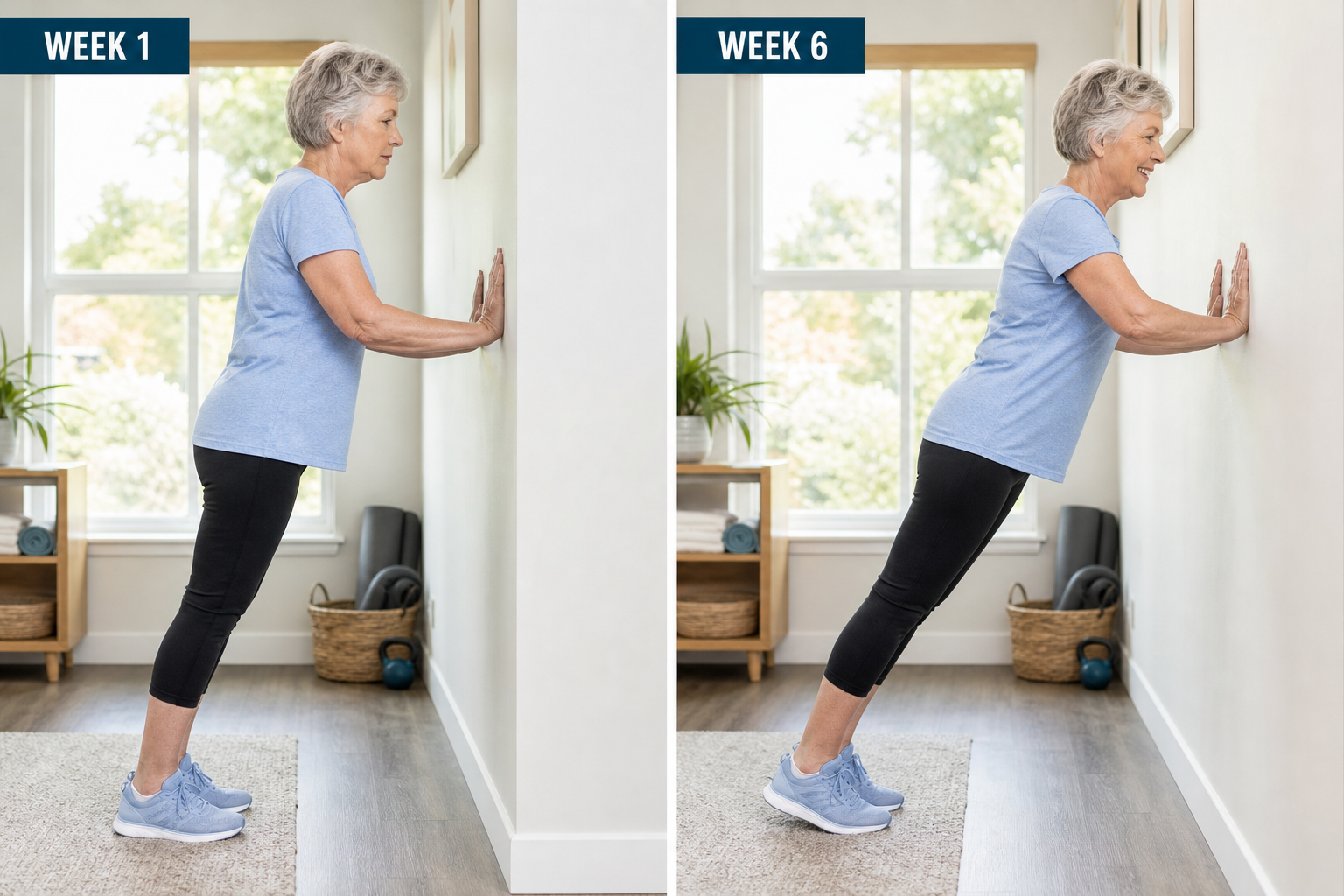
Week 1-2: You’ll likely feel some mood lift during and immediately after workouts. You’ll also feel sore. Delayed-onset muscle soreness (DOMS) peaks 24-48 hours after the first few sessions. This is normal. It fades as your body adapts.
Week 3-4: Soreness decreases. You may notice you’re sleeping slightly better. The exercises start feeling more familiar and less effortful to initiate. You might not feel dramatically different yet. Keep going.
Week 5-8: Mood improvements become more stable and less tied to the immediate post-workout window. You may notice you have slightly more energy during the day or that getting out of bed feels less oppressive. Small functional gains appear (easier to get up from a chair, carry bags).
Week 9-12: More noticeable strength gains. You’re using heavier resistance or doing harder variations of exercises. The routine feels established. You may notice the days you skip exercise feel worse, which is your brain recognizing the benefit.
Month 4-6: Sustained improvements in mood, sleep, and functional capacity. The training has become part of your baseline routine. Depression symptoms may still be present, but they’re likely less severe than when you started.
This timeline is typical, but individual responses vary. Some people feel significant improvement in the first month. Others take longer. Lack of immediate dramatic results doesn’t mean it’s not working.
Combining Strength Training with Other Depression Treatments
Strength training works well alongside therapy and medication. It’s not an either-or choice. Many people find that exercise makes therapy more effective (easier to engage, better mood during sessions, more energy to work on behavioral changes) and reduces medication side effects (exercise counters weight gain and sexual dysfunction from some antidepressants).
If you’re in therapy, tell your therapist you’re starting strength training. They can help you work through the motivation barriers and use the exercise as a behavioral activation tool. If you’re working with a psychiatrist on medication, report how exercise affects your symptoms. Some people can reduce medication dosage over time as exercise effects build, but that should happen under medical supervision with gradual tapering.
For more information on how exercise can support medication reduction, read our guide on reducing medication through exercise.
Group therapy or depression support groups can provide the social connection component if you’re training at home alone. You get the neurochemical benefits from exercise and the social benefits from the group.
Common Mistakes That Undermine Results
Starting too hard: Jumping into an intense program that leaves you exhausted and unable to sustain the routine. You need a program you can maintain 2-3 times per week for months. Sustainable beats impressive.
Skipping rest days: Training every day doesn’t produce better results. Muscles need recovery time to adapt and grow stronger. Training hard without rest leads to fatigue, injury risk, and burnout. Stick to 2-3 sessions per week.
Stopping when you feel better: Depression often lifts before it’s fully treated. If you stop exercising as soon as you feel okay, symptoms frequently return. Strength training works as ongoing maintenance, not a short-term fix.
Comparing yourself to others: Depression loves to tell you everyone else is stronger, faster, better. Your only relevant comparison is yourself last week or last month. Are you stronger than you were? That’s the measure that matters.
Perfectionism about form: Good form matters for safety and effectiveness, but obsessing over perfect technique becomes procrastination. Learn the basics (back straight, controlled movement, full range of motion