You’ve been practicing basic balance exercises. You can stand on one foot without wobbling. Maybe you’ve even mastered heel-to-toe walking. But if you’re ready to challenge your stability further and really improve your proprioception, balance board training might be your next step.
Balance boards create an unstable surface that forces your body to make constant micro-adjustments. This advanced training can significantly enhance your stability, coordination, and confidence in everyday activities. But they’re not for everyone, and starting safely is critical.
When You’re Ready for Balance Board Training
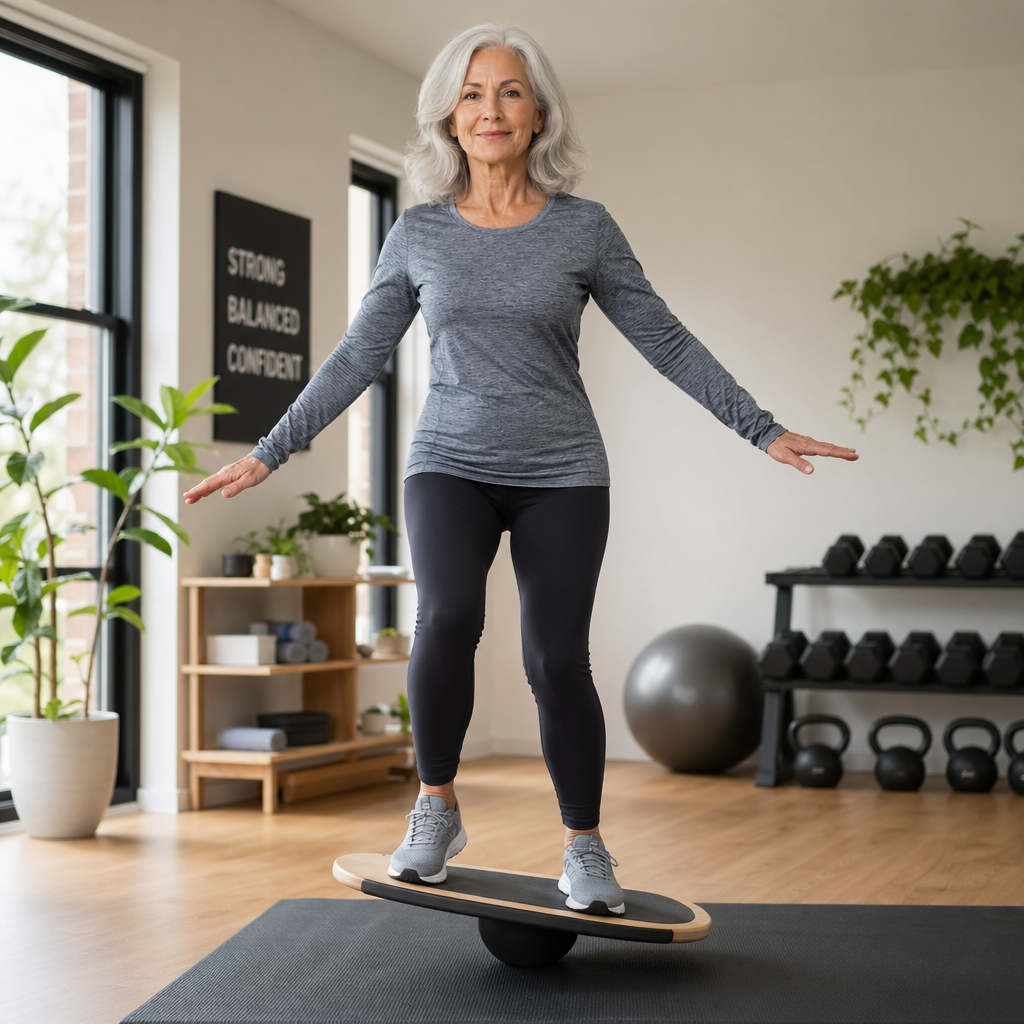
Don’t rush into balance board exercises. You need a solid foundation first. You should be able to stand on one foot for at least 30 seconds without support. You should also feel comfortable doing basic balance exercises like tandem stance and single-leg reaches.
Talk to your doctor or physical therapist before starting balance board training, especially if you have a history of falls, severe osteoporosis, or inner ear problems. These tools create genuine instability, which means there’s real fall risk if you’re not prepared.
The best candidates for balance board training are seniors who’ve plateaued with standard balance exercises and want to push their abilities further. You might be someone who walks regularly, gardens, or plays with grandchildren and wants to maintain those activities well into your later years. If you find your balance exercises aren’t producing results, progression to an unstable surface might provide the stimulus your body needs.
Setting Up Your Safety System
Never use a balance board without proper safety measures in place. This isn’t about being overly cautious. It’s about training smart so you can keep training.
Position your board in a corner or doorway where you can reach sturdy surfaces on both sides. A kitchen counter corner works perfectly. You want immediate access to stable support without having to reach or lunge.

Yes4All Wooden Wobble Balance Board
Solid construction with a gentle learning curve makes this ideal for seniors starting balance board training.
Place a yoga mat or exercise mat underneath your balance board. This protects your floors and adds a small cushion if you need to step off quickly. Some people even practice over carpet initially for extra forgiveness.
Keep the area completely clear of obstacles. You don’t want to worry about tripping over shoes, furniture, or pets if you need to step off. A three-foot radius of clear space around your board gives you room to recover.
Wear supportive athletic shoes when you’re starting out. Once you’ve built confidence and skill, you can progress to socks or bare feet, which actually increases the difficulty and sensory feedback.
Starting Exercises for Balance Board Beginners
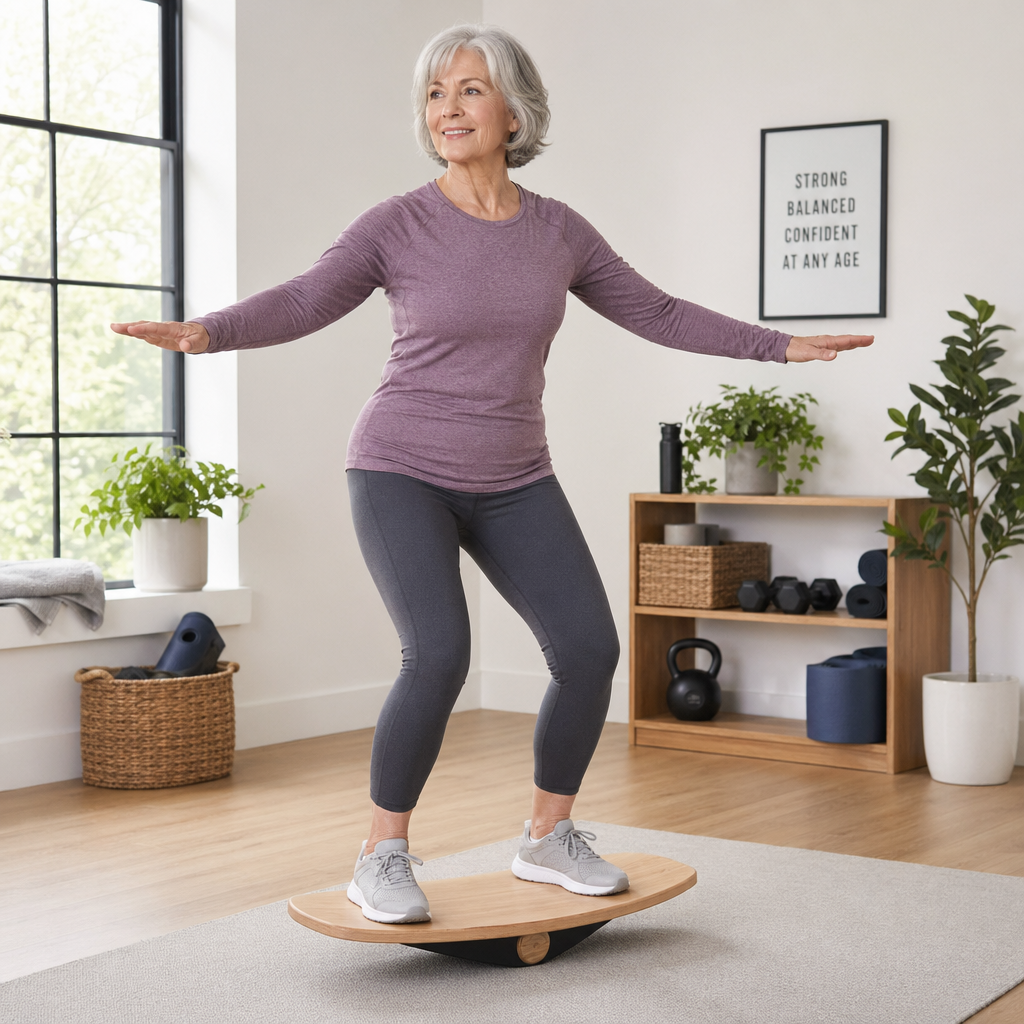
Your first goal is simply to stand on the board with both feet while holding support. This sounds basic, but you’ll immediately feel how different it is from standing on solid ground. The board responds to every tiny weight shift, and your ankles, knees, and hips all have to work together to maintain stability.
Start with 30-second holds while gripping your support surfaces firmly. Focus on keeping the edges of the board off the ground. You’ll feel your feet and lower legs working constantly to make adjustments. Practice this twice daily for several days before progressing.
Next, lighten your grip on the support. Use just your fingertips for balance rather than full hand contact. This increases the challenge significantly. Your core muscles will start engaging more as your hands provide less assistance.
The third progression is touching support only when needed. See how long you can balance without holding on, but keep your hands close to the wall or counter. You might manage five seconds at first. That’s fine. Your balance will improve quickly with consistent practice.
Progressive Challenge Levels
Once you can stand independently on the board for 30 seconds, you’re ready for movement-based progressions. These exercises dramatically improve your functional balance for real-world activities.
Weight shifts come first. While standing on the board, slowly shift your weight forward, backward, left, and right. The goal is controlled movement, not speed. You’re teaching your body to make intentional adjustments rather than reactive ones.
Add arm movements next. Reach your arms forward, to the sides, and overhead while maintaining your balance. This mimics reaching for items on shelves or catching yourself during a stumble. You can also try passing a small ball from hand to hand or tossing and catching it.

StrongTek Professional Wooden Balance Board
The slightly larger platform gives you more room to adjust your stance as you build confidence.
Single-leg stands on the balance board represent an advanced progression. Only attempt this after several weeks of successful two-footed practice. Start with just lifting your heel slightly off the board while keeping your toe in contact. Eventually, you can progress to full single-leg stands, but many seniors never need this level of difficulty.
Clock taps add a coordination element. Imagine your balance board is the center of a clock. While standing on the board, tap your toe at the 12, 3, 6, and 9 o’clock positions around the board. This challenges your balance in multiple directions and improves your spatial awareness. These patterns are similar to stability drills you can practice at home on solid ground before advancing to the board.
Benefits Beyond Basic Balance
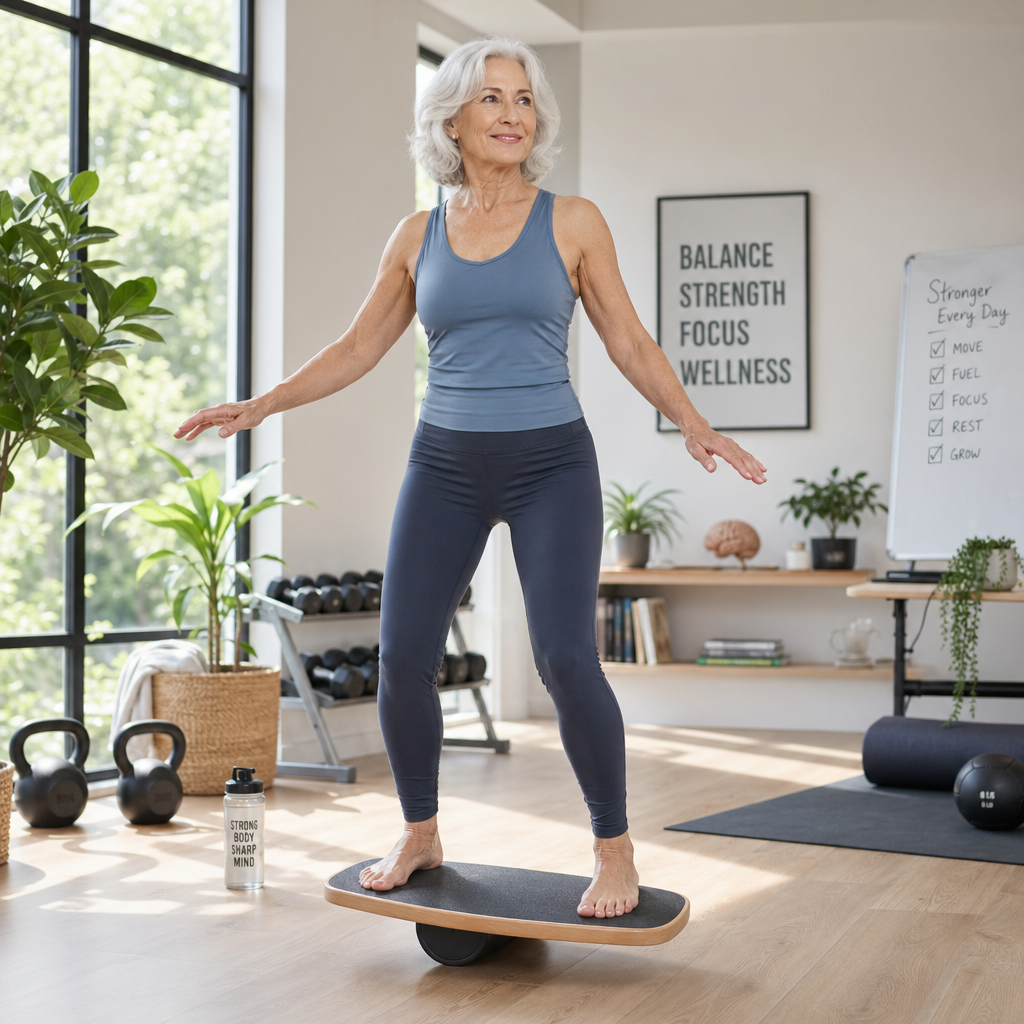
Balance board training improves proprioception, which is your body’s awareness of where it is in space. This sensory system deteriorates with age, but targeted training can slow or even reverse that decline. Better proprioception means you react faster when you start to lose your balance in everyday situations.
Your ankle strength and mobility will improve noticeably. The constant adjustments required on a balance board work the small stabilizing muscles around your ankles that often get neglected in regular exercise. Stronger ankles mean better stability on uneven surfaces like gravel driveways or hiking trails.
Many seniors report improved confidence in their daily activities after consistent balance board training. You’ll feel more stable climbing stairs, walking on sidewalks, and moving around in dim lighting. This confidence often leads to staying more active overall.
The wobble cushion offers a gentler alternative if a full balance board feels too challenging. These inflatable discs create instability but with less range of motion, making them perfect for transitional training.
Training Schedule and Frequency
Practice balance board exercises three to four times per week. Daily training isn’t necessary and may lead to overuse soreness in your feet and ankles. Your stabilizing muscles need recovery time just like any other muscle group.
Keep sessions short initially. Ten minutes of quality practice beats 30 minutes of fatigued, sloppy form. As you build endurance, you can extend your sessions to 15 or 20 minutes.
Morning practice often works best because you’re fresh and alert. Avoid training when you’re tired, have just eaten a large meal, or are feeling dizzy or unwell. Your balance system doesn’t perform optimally under those conditions.
Track your progress in a simple notebook. Note how long you can stand independently, which progressions you’re working on, and how you feel during training. You’ll be amazed how quickly you improve in the first few weeks. For a more structured approach, consider following a progressive 30-day balance plan that incorporates board work alongside floor exercises.
Contraindications and Warning Signs
Skip balance board training if you have severe peripheral neuropathy. Without adequate sensation in your feet, you can’t get the feedback needed to make safe adjustments on an unstable surface. Stick with floor-based balance exercises instead.
Recent joint replacements, particularly in the ankle, knee, or hip, require clearance from your surgeon before starting balance board work. The dynamic forces can stress healing tissues if you start too soon.
Active vertigo or dizziness makes balance board training dangerous. Wait until these symptoms resolve completely. The visual and vestibular confusion caused by the moving surface can worsen your symptoms.
Stop immediately if you experience sharp pain anywhere, especially in your ankles, knees, or back. Muscle fatigue and soreness are normal, but pain signals a problem. Don’t train through it.
Frequently Asked Questions
How long does it take to see improvement in balance from board training?
Most seniors notice improved stability within two to three weeks of consistent practice. Your proprioception adapts quickly to the new challenge. Functional improvements, like feeling steadier on stairs or uneven ground, typically become apparent within four to six weeks. Remember that everyone progresses at their own pace, and prior fitness level significantly affects how quickly you’ll advance.
Can I use a balance board if I have arthritis in my ankles or feet?
Mild to moderate arthritis isn’t necessarily a contraindication, but you need to approach carefully. Start with very short sessions and pay attention to pain levels during and after training. Some people find that the gentle movement actually reduces stiffness. However, if you have severe arthritis with significant joint damage, consult your rheumatologist or physical therapist before starting. They may recommend a foam balance pad as a gentler alternative.
What’s the difference between a wobble board and a rocker board for seniors?
Wobble boards have a dome underneath that allows 360-degree tilting in all directions. Rocker boards have a curved base that only tilts forward and backward or side to side. For seniors, rocker boards are generally easier to start with because they limit the directions of instability. You can master front-to-back movement, then switch to side-to-side before progressing to a full wobble board. Many physical therapists recommend rocker boards for older adults who are newer to balance training.
Related Articles
- Why Balance Exercises Aren’t Working: 2 Critical Fixes
- Vertigo And Balance Exercises For Seniors
- 30-Day Balance Improvement Plan for Older Adults
- 5 Balance Drills for Seniors Over 60 (Improve Stability at Home)
This article contains affiliate links. We may earn a small commission at no extra cost to you.