If treadmill walking aggravates your knees or hips, an elliptical trainer might be the cardio machine you’ve been looking for. The gliding motion eliminates the repetitive impact of walking and running while still providing a full-body cardiovascular workout. Your feet never leave the pedals, so there’s no jarring heel strike, and the smooth arc of motion keeps your joints in a comfortable range.
For seniors with arthritis, recovering from joint surgery, or dealing with chronic joint pain, the right elliptical can extend your ability to do meaningful cardio for years beyond what walking allows. Before starting any new exercise program, especially if you have existing joint conditions, talk to your doctor about what intensity and duration are appropriate for your situation.
Why Ellipticals Work for Joint Pain
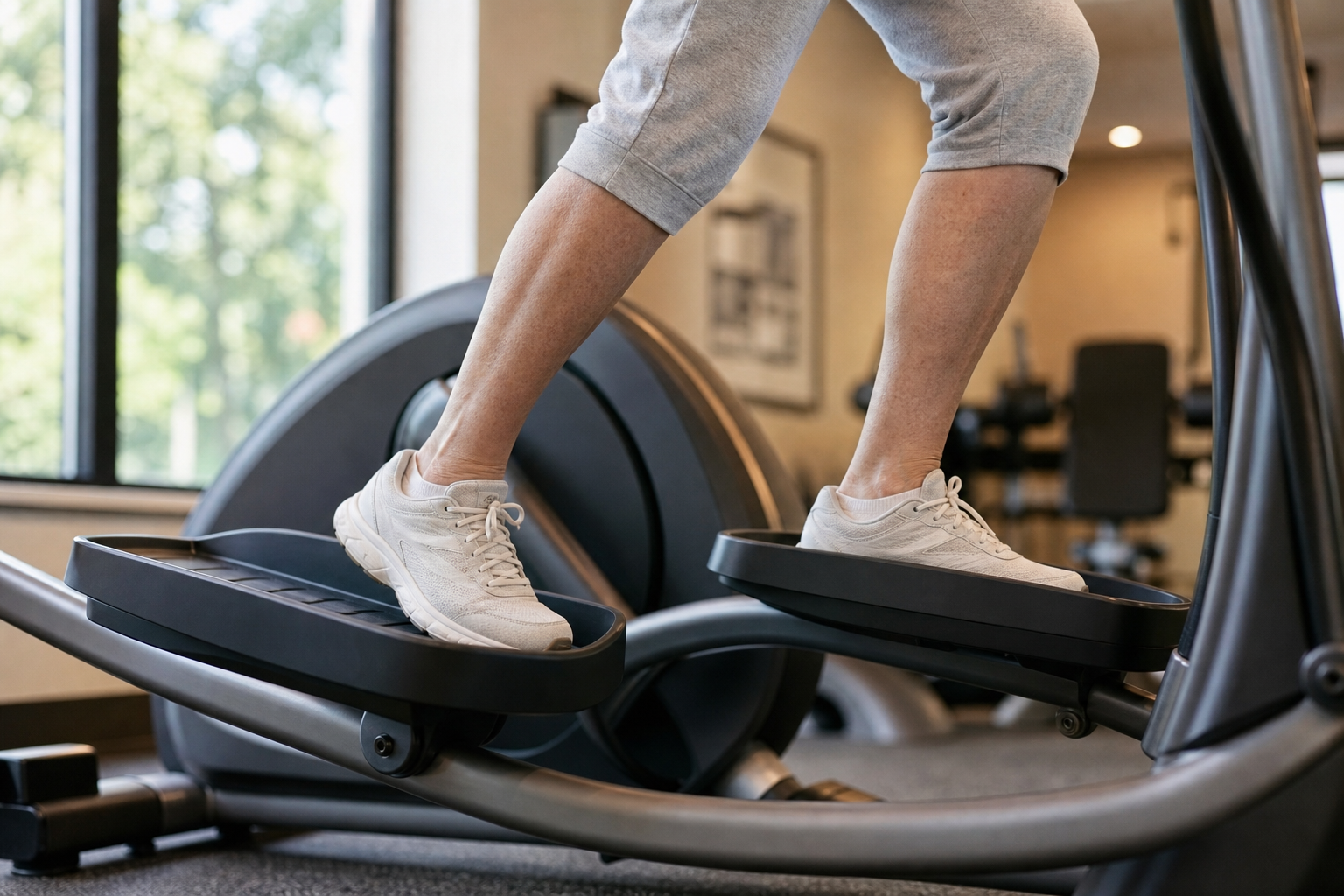
Every step you take while walking generates impact force equal to 1.5 times your body weight. Running increases that to 3-4 times. Elliptical trainers reduce that impact to near zero because your feet ride on pedals that move in a continuous loop. The joint still moves through flexion and extension (which is important for cartilage health), but without the repetitive compression that triggers arthritis pain.
The continuous motion pattern matters more than many people realize. Traditional walking creates a moment of peak force at heel strike when your knee and hip absorb the shock of landing. That shock travels up the kinetic chain, stressing not just the knee but also the hip and lower back. The elliptical replaces that jarring motion with a smooth, controlled arc. Your knee flexes and extends through a natural range, but the load stays constant rather than spiking with each step.
Additionally, the arm handles engage your upper body, distributing the workload across more muscle groups. This means you burn more calories at a lower perceived effort than walking alone. The upper body engagement also helps maintain balance, which becomes increasingly important as we age. You’re not just getting cardio; you’re training coordination and stability at the same time.
If you’re comparing cardio options for low-impact exercise, check out our detailed Exercise Bike vs Elliptical for Seniors comparison to see which machine fits your needs best.
Key Features for Seniors
Stride Length Adjustability
Your ideal stride length depends on your height and hip flexibility. A stride that’s too long overextends your hips and knees; too short feels choppy and stresses your knees at an awkward angle. Adjustable stride length (16-22 inches) lets you find the sweet spot. Fixed-stride machines work if the length matches your body, but there’s no way to adapt if it doesn’t.
Most people between 5’4″ and 5’10” do well with an 18-20 inch stride. Taller individuals (over 6 feet) often need 20-22 inches to avoid that choppy feeling. Shorter individuals (under 5’4″) may prefer 16-18 inches. If you have limited hip flexibility from arthritis or past injury, a shorter stride within your comfortable range of motion works better than forcing a longer one.
Step-On Height
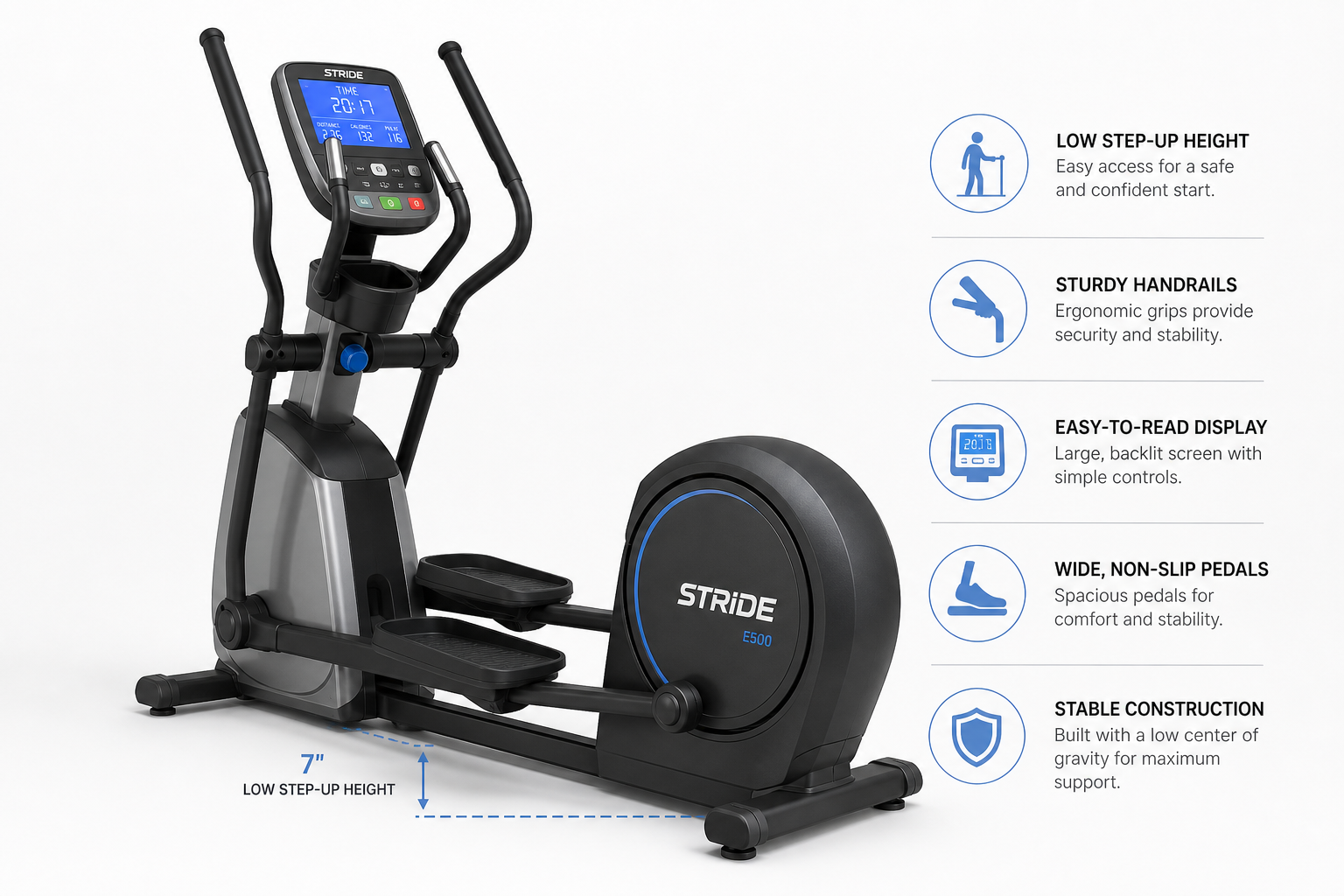
This is how high you need to lift your foot to get onto the pedals. Some ellipticals have pedal heights of 14+ inches at their lowest point, which requires climbing a step just to mount the machine. Look for models with a step-on height under 10 inches, or machines that include a step platform.
Getting on and off the machine safely matters as much as the workout itself. If you have knee replacements, hip problems, or balance concerns, mounting a high-platform elliptical can be risky. A low step-on height reduces fall risk and makes the machine more accessible on days when your joints are stiff or sore. Some manufacturers design machines with one pedal that drops lower than the other specifically to ease entry.
Handle Stability
The moving arm handles should feel solid, not wobbly. Look for thick, padded grips that are easy to hold. Fixed handles (that don’t move) should also be available for times when you want to focus on lower body only or need extra stability. Heart rate sensors on the fixed handles are a useful addition.
Test the handles if possible before buying. Grab them and push forward hard, then pull back. Any flex or wobble in the connection points is a red flag. Cheap handles can rattle or shake during use, which breaks your rhythm and makes you grip harder than necessary. That extra gripping tension can cause hand fatigue and shoulder tightness over time.
Cushioning System
Higher-end ellipticals include cushioned pedal platforms that further reduce joint stress. Models with articulating pedals (pedals that adjust angle during the stride) keep your ankles in a neutral position and reduce Achilles tendon strain.
Articulating pedals are particularly valuable if you have foot or ankle arthritis. Standard flat pedals force your foot to remain at a fixed angle throughout the stride, which can stress the ankle joint. Articulating pedals pivot slightly with each rotation, letting your foot move more naturally. The difference is subtle but noticeable over a 20-minute workout.
Weight Capacity and Frame Stability
Ellipticals designed for lighter users can feel unstable under heavier seniors. Check the manufacturer’s weight capacity and look for machines rated at least 50 pounds above your current weight. A solid, heavy frame (200+ pounds for the machine itself) reduces wobble and noise. Lighter, cheaper frames tend to rock or shift during use, especially when you’re moving at a moderate pace.
Console Readability
Tiny digital displays with faint gray text are frustrating. Look for consoles with large, backlit LCD screens that show time, distance, calories, and heart rate simultaneously. Some machines offer high-contrast modes specifically for users with vision impairment. Avoid consoles that require navigating through multiple menus just to start a basic workout.
Top Ellipticals for Seniors with Joint Pain
Sole E25
The Sole E25 offers a 20-inch stride, cushioned foot pedals with a 2-degree inward slope (which aligns your knees more naturally), and 20 resistance levels. The step-on height is lower than many competitors, and the frame is stable enough for users up to 350 pounds. The console is simple with large, readable numbers.
The inward pedal slope is a standout feature. It mimics the slight internal rotation your legs naturally perform during walking, reducing lateral stress on the knee joint. Users with patellofemoral pain syndrome (runner’s knee) often find this slope reduces discomfort compared to flat pedals. The machine runs quietly thanks to a heavy flywheel and belt drive system.
Best for: Most seniors looking for a reliable, joint-friendly elliptical at a mid-range price point.

Sole E25 Elliptical
Best overall choice for seniors with joint pain, featuring cushioned pedals with natural knee alignment and low step-on height
Schwinn 470
The Schwinn 470 features a 20-inch stride, 25 resistance levels, and Bluetooth connectivity. The motorized incline adds variety without requiring manual adjustment. Dual LCD screens display workout metrics clearly. The padded, oversized pedals are comfortable for long sessions.
The motorized incline is a genuine benefit for progression. As you get stronger, adding incline provides more challenge without requiring faster speed or dramatically higher resistance. The incline also shifts emphasis slightly from quads to glutes and hamstrings, which can be helpful if you have anterior knee pain that worsens with too much quad-dominant work. The built-in fan and water bottle holder are practical touches that cheaper machines skip.
Best for: Seniors who want more workout variety through incline adjustments and built-in programs.
NordicTrack FS14i FreeStride Trainer
The NordicTrack FreeStride is a premium option with an adjustable stride length from 0 to 32 inches. This adjustability lets you mimic walking, jogging, or climbing without changing machines. The 14-inch touchscreen provides guided iFIT workouts (subscription required). The auto-adjusting stride means you never have to stop to change settings.
The stride variability is the selling point here. You can start a workout at a 10-inch stride (essentially a low-impact stepper motion), work up to a 20-inch elliptical stride for cardio, then shift to a 32-inch stride that mimics a stair climber. That range lets you target different muscle groups and joint angles in one session. The iFIT integration provides coached workouts where the trainer adjusts your resistance and stride length automatically. The subscription costs extra, but the machine functions fine without it if you just want manual control.
Best for: Tech-savvy seniors who want guided workouts and maximum stride adjustability. Premium price point.

NordicTrack FreeStride Trainer
Premium option with 0-32 inch adjustable stride for ultimate versatility and personalized joint-friendly workouts
Budget-Friendly Options Worth Considering
ProForm Carbon E7
The ProForm Carbon E7 delivers solid performance at a lower price point than the Schwinn or Sole models. It features an 18-inch stride, 18 resistance levels, and a weight capacity of 300 pounds. The console is basic but readable, and the machine folds for storage if space is tight. The shorter stride works well for users under 5’8″. It lacks the cushioning and pedal articulation of pricier models, but the frame is stable and the motion is smooth. Expect more noise from the drive system compared to belt-driven models.
Teeter FreeStep Recumbent Cross Trainer
The Teeter FreeStep is a different animal entirely. It’s a recumbent elliptical, meaning you sit rather than stand. The pedals move in a stepping motion similar to a traditional elliptical, but your back is supported by a seat. This design works exceptionally well for seniors with severe back pain, balance issues, or extreme hip arthritis who can’t safely stand for 20 minutes. The trade-off is reduced calorie burn compared to standing ellipticals since your core isn’t engaged. The step-on height is minimal, essentially level with the ground.
The Elliptical Learning Curve
If you’ve never used an elliptical before, expect 3-5 sessions before the motion feels natural. Common beginner mistakes include:
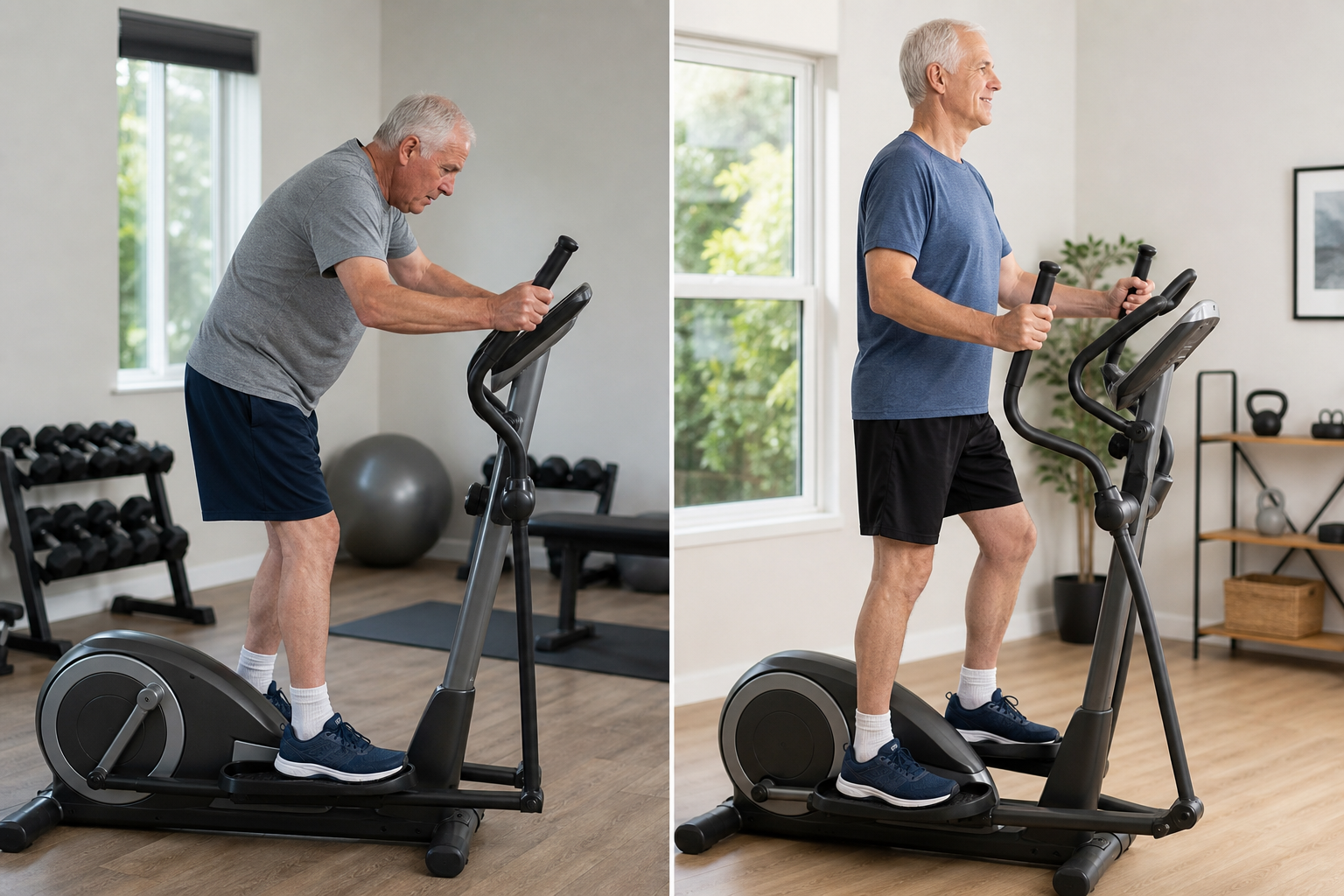
- Leaning too far forward: Stand upright and let your legs do the work. Leaning on the handles reduces the workout and strains your back.
- Setting resistance too low: Very low resistance actually makes the machine harder to control because the pedals spin freely. Start at resistance level 3-5 for better stability.
- Ignoring the arms: Use the moving handles for a full-body workout, but don’t pull on them aggressively. Let them move with your natural arm swing.
- Going too fast: Speed is less important than resistance. A slower pace with moderate resistance is more effective and safer than a fast pace with no resistance.
Additional technique notes: Keep your weight centered over your heels rather than your toes. Toe-heavy posture forces your calves to work harder and can cause foot cramping. Your knees should track over your toes, not collapsing inward or bowing outward. If you notice your knees drifting toward each other, lower the resistance and focus on form. Sloppy form at high resistance builds bad movement patterns and increases injury risk.
Don’t grip the handles like you’re hanging on for dear life. A light touch is enough. White-knuckling the handles tenses your shoulders and neck, leading to upper body fatigue that has nothing to do with the actual workout. If you find yourself gripping hard, you’re either going too fast or the resistance is too high.
Common Mistakes That Cause Discomfort
Pedaling Backward
Many ellipticals allow reverse pedaling to engage different muscle groups. That’s fine occasionally, but spending too much time in reverse can irritate the back of the knee (popliteal region). Reverse motion shifts more load to the hamstrings and away from the quads, which sounds good in theory but can create imbalance if overdone. Stick to 80% forward, 20% reverse as a general rule.
Bouncing or Jerky Motion
Smooth is the goal. If you’re bouncing up and down, you’re likely pushing too hard on the downstroke and not engaging during the upstroke. The elliptical should feel like one continuous motion, not a series of individual pushes. Lower the resistance and focus on even pressure throughout the entire rotation.
Ignoring Pain Signals
Joint discomfort is different from muscle fatigue. Muscle fatigue is a burning sensation in the thighs or glutes that fades when you stop. Joint discomfort is sharper, more localized, and lingers after the workout. If you feel sharp pain in a knee or hip during a session, stop. Pushing through joint pain on an elliptical doesn’t build toughness; it aggravates inflammation. Rest a day or two, then retry at lower resistance or shorter duration.
Modifications for Specific Joint Issues
Hip Arthritis
Shorten your stride if a longer stride triggers hip pain. Use higher resistance at a slower cadence rather than low resistance at high speed. The slower pace with more resistance keeps the hip joint stable while still providing a workout. Hold the fixed handles rather than the moving arms if arm motion causes hip rotation that hurts.
If you’re recovering from hip surgery, our Post-Hip Replacement Exercise Guide provides detailed information about safely returning to exercise, including when to start using an elliptical after surgery.
Knee Arthritis
Focus on keeping your kneecap tracking straight over your toes. If your knees tend to collapse inward (valgus collapse), you may need to strengthen your hip abductors off the machine before the elliptical feels comfortable. Start with very short sessions (5-7 minutes) and gradually build up. The repetitive flexion-extension motion can help maintain knee mobility, but only if you stay within a pain-free range.
For more strategies on managing knee pain during exercise, read our guide on Preventing Knee Pain While Walking, which covers proper form techniques that also apply to elliptical training.
Ankle or Foot Pain
Articulating pedals help significantly here.