Elbow pain during weight training is one of the most stubborn exercise injuries after 60. It tends to linger for weeks, flaring up with bicep curls, tricep extensions, rows, and even gripping heavy objects around the house. The elbow joint is a workhorse that gets stressed from both the pushing and pulling movements in any upper body routine.
Fortunately, most exercise-related elbow pain responds to a combination of technique changes, targeted strengthening, and strategic rest.
Before starting any new treatment or modifying your exercise routine, check with your doctor. This is especially important if you have existing joint conditions, take blood thinners, or have had previous elbow injuries.
The Two Main Types of Elbow Pain
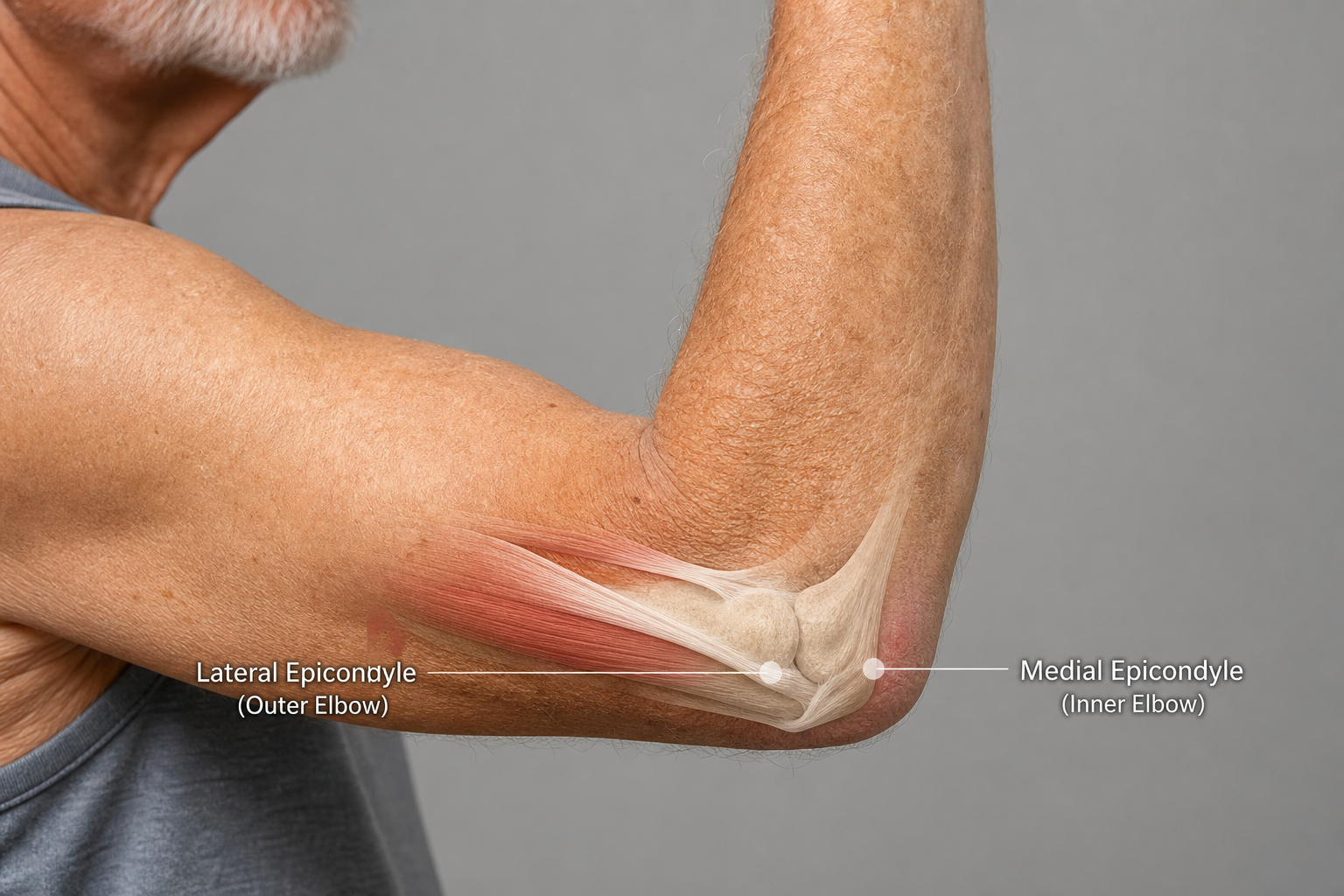
Lateral Epicondylitis (Tennis Elbow)
Pain on the outside of the elbow, where the forearm extensor tendons attach. Despite the name, you don’t need to play tennis to get it. Any repetitive gripping and wrist extension (lifting weights, using tools, even turning doorknobs) can trigger it. The pain worsens when you grip a dumbbell, twist a jar lid, or shake hands.
The outer elbow pain typically develops gradually rather than from a single incident. You might notice it first as a dull ache after your workout that fades within hours. Over time, it becomes sharper and sticks around longer.
Eventually, even light gripping activities like carrying groceries or pouring from a full kettle can trigger it.
Test: Extend your arm straight and try to lift a coffee cup by the handle. If this produces pain on the outer elbow, tennis elbow is likely. Another test: resist someone trying to push your hand down while your wrist is extended. Pain during this resistance confirms the diagnosis.
Medial Epicondylitis (Golfer’s Elbow)
Pain on the inside of the elbow, where the forearm flexor tendons attach. This is triggered by gripping, pulling, and wrist flexion movements: bicep curls, rows, and any exercise where you squeeze a handle tightly. The pain radiates along the inner forearm and may cause a weak grip.
Golfer’s elbow is less common than tennis elbow but often more disruptive to weight training because so many pulling exercises stress the inner elbow. The pain can make it difficult to carry a briefcase, open doors, or even type on a keyboard for extended periods. If you’re also experiencing numbness in your arm, particularly at night, this may indicate nerve involvement from overuse.
Test: Make a fist and flex your wrist (curl it toward you) against resistance. If this produces pain on the inner elbow, golfer’s elbow is likely. You can also press on the bony bump on the inner elbow. Tenderness here combined with forearm pain during gripping confirms the condition.
Both conditions are forms of tendinosis, not tendinitis. The “itis” suffix implies inflammation, but research shows these are degenerative tendon conditions with minimal inflammation. The tendon fibers have developed microtears and disorganized collagen structure from repetitive stress.
This matters because anti-inflammatory drugs and ice provide temporary pain relief but don’t address the underlying tendon damage.
4 Fixes That Work

1. Modify Your Grip
A death grip on the dumbbell is the number one contributor to elbow pain during lifting. Your forearm muscles connect to the elbow through tendons, and squeezing hard puts maximum stress on those attachment points.
- Loosen your grip. Hold the weight firmly enough to control it, but don’t white-knuckle it. Think “firm handshake” rather than “crush.” This reduces peak force on the tendon by 30-40%. You should be able to maintain the grip for the entire set without your forearm burning out halfway through.
- Use a neutral grip (palms facing each other) instead of palms-up (supinated) for curls and presses. Neutral grip reduces the rotational stress on the forearm tendons. Hammer curls and neutral-grip dumbbell presses are better tolerated than standard supinated curls and bench presses during the healing phase.
- Try thicker handles. Wrapping a towel around the dumbbell handle or using grip adapters spreads the load across more hand surface and reduces peak stress at the elbow. The thicker diameter forces your hand into a less clenched position. Start with one layer of towel and add more if it helps.
- Use wrist straps for pulling exercises (rows, deadlifts) so your forearm doesn’t have to work as hard to hold the weight. This shifts the limiting factor from grip to the larger back and leg muscles. Straps let you train the target muscles without overloading compromised tendons.

Thick Grip Adapters
Spreads load across more hand surface, reducing peak stress on elbow tendons during lifts
Grip modification alone can reduce elbow pain by 50% within two weeks for many people. You have to be consistent, though. One workout with a relaxed grip followed by another where you squeeze hard will set back progress. If you find yourself needing additional wrist support during training, this can further reduce strain on your forearm tendons.
2. Eccentric Strengthening
Eccentric exercises (slowly lowering a load) are the gold standard treatment for tendon pain. They stimulate tendon healing and remodeling better than rest alone. The slow lowering phase creates controlled microdamage that triggers the tendon to rebuild itself with stronger, better-organized collagen fibers.
For tennis elbow: Hold a light dumbbell (1-2 pounds) with your palm facing down, forearm resting on a table with your hand over the edge. Slowly lower the weight by extending your wrist downward over 5 seconds. Use your other hand to lift the weight back to the starting position (don’t use the injured arm to lift). Perform 3 sets of 15, once daily.
Start with a weight light enough that you feel mild discomfort (3 out of 10 on a pain scale) during the lowering phase but not sharp pain. The exercise should feel manageable. As the tendon adapts over weeks, you’ll need to increase the weight to maintain that 3/10 discomfort level. By week 8, many people are using 5-8 pounds.
For golfer’s elbow: Same setup, but with your palm facing up. Slowly lower the weight by letting your wrist drop downward over 5 seconds. Use the other hand to lift back. 3 sets of 15, once daily.
Expect 6-12 weeks of consistent eccentric work before the tendon fully remodels. Early improvement in pain often occurs within 3-4 weeks. Don’t skip days. The tendon needs regular stimulus to reorganize. Missing three days in a row can stall progress for a week or more.
Some discomfort during the eccentric exercise is normal and even necessary. But sharp, severe pain (7+ out of 10) means you’re using too much weight or progressing too fast. Scale back and rebuild gradually.
Reverse Tyler Twist (for tennis elbow): This variation uses a FlexBar or rolled towel. Hold one end with the painful arm (palm down), the other end with the good arm (palm up). Twist the bar or towel so the good arm brings its end toward you and the painful arm pushes its end away. Then slowly untwist using only the painful arm to control the motion. This combines eccentric loading with functional twisting and has shown excellent results in clinical studies.
3. Reduce Training Volume (Don’t Stop Entirely)
Complete rest allows the tendon to decondition, making it weaker when you return. Instead, reduce the weight by 30-40% and cut sets from 3 to 2 for any exercise that aggravates the elbow. Continue training with this reduced load; it’s enough to maintain strength without overloading the healing tendon.
This is hard for many lifters to accept. Dropping from 25-pound dumbbells to 15 pounds feels like giving up progress. But the alternative (stopping entirely or pushing through worsening pain) leads to months of forced rest later. Reduced volume now prevents a complete shutdown later.
Avoid the specific exercises that cause the most pain. Common culprits for tennis elbow: reverse curls, wrist extensions, overhead tricep extensions. For golfer’s elbow: heavy bicep curls, underhand rows, pull-ups. Substitute with pain-free alternatives using resistance bands or different grip angles.
Resistance bands are particularly useful during the healing phase. They provide less peak load at the start of the movement when tendons are most vulnerable and more resistance at the end when muscles are strongest. A band bicep curl may be tolerable when a 20-pound dumbbell curl is not.
Exercise substitutions for tennis elbow:
- Replace overhead tricep extensions with close-grip push-ups or neutral-grip dumbbell presses
- Replace reverse curls with hammer curls
- Replace wrist extensions with isometric wrist holds (hold a light weight in extended position for 30 seconds without moving)
Exercise substitutions for golfer’s elbow:
- Replace barbell curls with band curls or preacher curls with a neutral grip
- Replace underhand-grip rows with neutral-grip or overhand-grip rows
- Replace pull-ups with lat pulldowns using a wide, overhand grip
Track your pain levels in a simple log. Rate elbow pain during and after each exercise on a 0-10 scale. If an exercise consistently scores 5 or higher, remove it from your program for at least two weeks. Reintroduce it only after pain from other exercises has dropped below 3.
4. Counterforce Bracing
A counterforce strap worn just below the elbow (about 1-2 inches below the bony point) changes the force distribution through the tendon during gripping. This reduces pain during exercise and daily activities. It’s not a cure, but it provides enough relief to keep you training while the eccentric exercises heal the tendon.

Counterforce Elbow Strap
Changes force distribution through the tendon, reducing pain during exercise and daily activities
The strap works by compressing the muscle belly just below where it attaches to the elbow. This dampens the force transmitted up to the tendon attachment point during gripping and lifting. Think of it as a shock absorber for the tendon.
Wear the strap during exercise and any daily activities that aggravate the elbow. Remove it during rest and sleep. Position it snugly but not tight enough to restrict blood flow. You should be able to slide one finger under the strap when it’s fastened. If your forearm goes numb, tingles, or turns pale, it’s too tight.
Position matters. The strap should sit over the muscle bulk of the forearm, not directly on the bony elbow prominence. For tennis elbow, center it over the outer forearm muscles about 2 inches below the outer elbow bump. For golfer’s elbow, center it over the inner forearm muscles about 2 inches below the inner elbow bump.
Some people find the strap annoying or distracting during workouts. If you can’t tolerate it, focus on the other three fixes. The strap is helpful but not essential if you’