A travel scooter gives you back the world that limited mobility took away. Airports, museums, zoos, shopping centers, and tourist destinations become accessible again instead of exhausting or impossible. The latest generation of travel scooters are lighter, fold smaller, and have better battery range than ever before. The right one fits in a car trunk, passes through airline gate check, and folds in seconds so you don’t need a strong companion to manage it.
Before starting any new mobility routine or making decisions about mobility equipment, talk with your doctor. They can help you choose equipment that matches your specific physical needs and health conditions.
What Makes a Travel Scooter Different
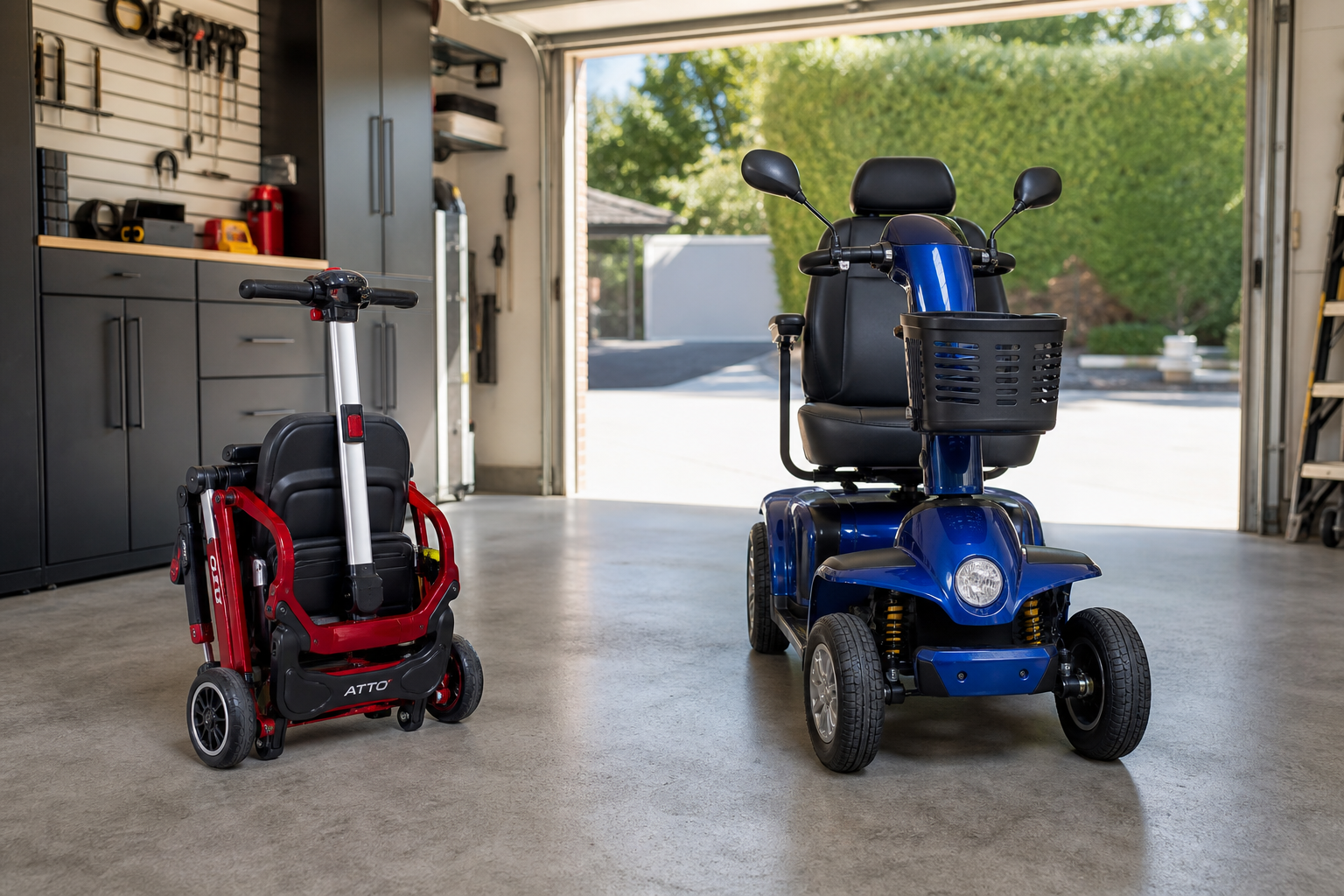
Travel scooters prioritize portability over performance. They weigh 30-60 pounds (compared to 100-200 pounds for full-size scooters), fold or disassemble into pieces light enough for one person to lift, and have smaller footprints for navigating tight spaces. The trade-offs are shorter battery range (8-15 miles versus 15-25 for full-size), lower top speed (4-5 mph versus 6-8 mph), and less suspension for rough terrain.
Full-size scooters handle sidewalk cracks, gravel paths, and uneven pavement better than travel models. If your primary use involves outdoor terrain or long distances around your neighborhood, a full-size scooter may be the better choice. Travel scooters excel at smooth indoor surfaces, airport terminals, shopping malls, and paved pathways. They’re built for the person who drives to a destination and then needs mobility support once there, not for someone who uses a scooter as their daily outdoor transportation.
The smaller wheels on travel scooters (typically 7-8 inches versus 10-12 inches on full-size models) mean bumps and transitions feel more jarring. Curb cuts and threshold ramps are manageable. Six-inch sidewalk drop-offs are not. Plan routes accordingly.
Key Features to Evaluate
Weight and Folding
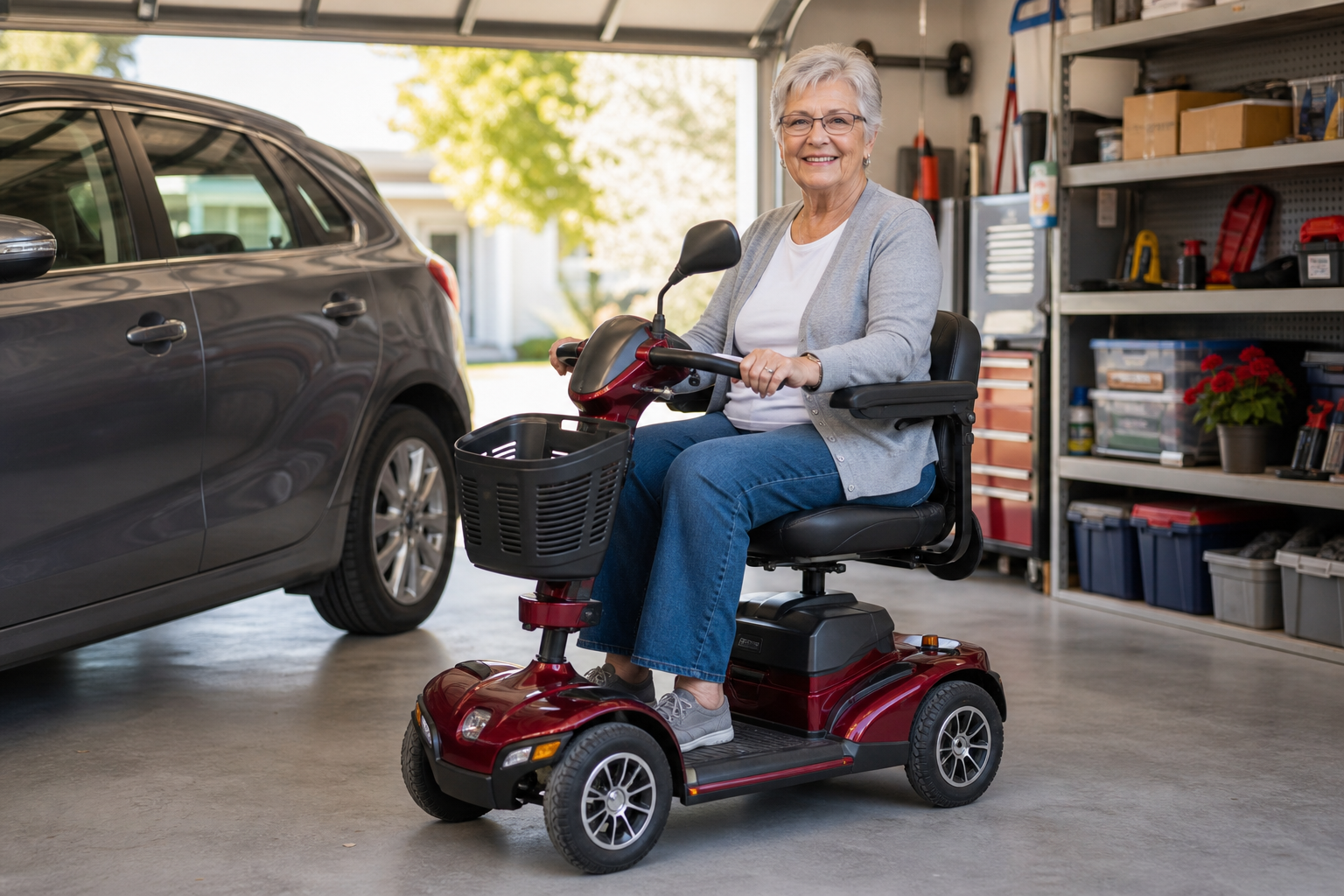
The heaviest single piece you’ll need to lift determines whether you can manage the scooter independently. Some scooters fold into a single unit (convenient but heavier as one piece). Others disassemble into 3-5 pieces (lighter individual pieces but more assembly time). Your heaviest liftable weight determines which type works for you. If you can lift 30 pounds, look for scooters where no single piece exceeds that threshold.
Folding mechanisms vary in complexity. The simplest designs use a single lever or latch. More complex systems require multiple steps: remove the seat, disconnect the tiller, separate the base. Try the folding process in person before buying if possible. What seems simple in a product video can be frustrating when you’re managing it alone in a parking lot.
Disassembly models require you to handle and store multiple pieces. You need trunk space organized so pieces don’t shift during transport. Folding models stay as a single unit, which simplifies handling but concentrates all the weight in one lift. If you have arthritis in your hands or reduced grip strength, folding latches may be difficult to operate. Disassembly models with simple bolt connections might be easier to manage.
Airline Compatibility
Airlines accept scooters with lithium batteries under 300 watt-hours as gate-checked or cargo-checked items. Most travel scooters meet this limit. Verify with your airline before flying. Removable batteries simplify the process because the battery can be carried in the cabin while the scooter is checked.
Each airline has its own procedures for handling mobility devices. Call the airline’s accessibility desk at least 48 hours before your flight. Have your scooter’s battery specifications ready: watt-hours, battery type (lithium-ion is standard), and whether it’s removable. Some airlines require you to disconnect the battery and tape the terminals. Others want the battery removed entirely and carried in your carry-on bag in a protective case.
Gate-checking is easier than cargo-checking. You use the scooter through the terminal, fold it at the gate, and receive it immediately when you deplane. Cargo-checking means checking it with regular luggage and retrieving it at baggage claim, which adds wait time and potential for damage or loss. Request gate-checking when you book your ticket and confirm it when you check in.
Scooters sometimes arrive at your destination with cosmetic damage: scratched plastic, bent tiller, loose parts. Take photos before you fold and hand over your scooter. Inspect it carefully when you receive it at your destination. Report damage to the airline immediately while you’re still at the airport.
Battery Range
Stated ranges are measured with a lightweight rider on flat, smooth ground. Real-world range with a heavier rider on varied surfaces is typically 60-70% of the stated range. If the manufacturer claims 15 miles, plan for 9-10 miles of real-world use. For full-day outings, consider a scooter with a swappable battery so you can carry a spare.
Range decreases faster when you’re going uphill, carrying packages in the front basket, or riding on soft surfaces like thick carpet or gravel. Cold weather also reduces battery capacity. A scooter that gives you 12 miles in summer might give you 8-9 miles on a cold winter day. Cold weather affects mobility equipment performance, just as it impacts outdoor exercise.
Battery indicators on most scooters are basic: full, half, low. They don’t give you precise remaining mileage. When the indicator shows half, you’re somewhere between 30% and 70% capacity. Start heading back toward your car or hotel when you hit the half mark. Running out of power means you’re stuck with a 50-pound object that doesn’t roll easily when unpowered.
Spare batteries add weight to your trip, but they’re worth it for full-day outings where charging isn’t possible. A spare also serves as insurance if your primary battery fails or doesn’t hold charge as well as it used to. Batteries degrade over time. Expect to replace your scooter’s battery every 2-3 years with regular use.
Weight Capacity
Travel scooters typically support 250-300 pounds. Heavier riders need to check the weight capacity carefully, as lightweight frames sacrifice load capacity for portability.
Weight capacity includes your body weight plus anything you’re carrying: backpack, shopping bags, purse, oxygen tank if applicable. If you’re near the weight limit, the scooter will function but won’t handle as smoothly. Acceleration is slower. Hills are harder. Range decreases because the motor works harder. Battery life shortens over time because of the constant heavy load.
Exceeding the weight limit isn’t just a performance issue. It’s a safety issue. The frame can crack. The motor can overheat. Brakes may not stop you as quickly as designed. If you’re over 300 pounds, look at bariatric scooters instead. They’re heavier and bulkier but built for higher weight capacities (up to 500 pounds for some models).
Seat Comfort and Adjustability
You’ll be sitting for extended periods. The seat matters more than you might think. Travel scooter seats are smaller and less padded than full-size scooter seats because they’re designed to be lightweight and compact. Most are 16-17 inches wide. If you need more width or cushioning, you can add an aftermarket seat cushion, but this adds height and may make it harder to reach the ground with your feet.
Seat height should allow you to plant both feet flat on the ground when stopped. This gives you stability and makes it easier to get on and off. Seats adjust up and down on most models. Test the lowest setting. If your feet dangle, the scooter may not be right for you.
Swivel seats rotate to make getting on and off easier. You sit down on the seat while it’s turned to the side, then rotate forward to ride. This reduces the twisting and maneuvering required to mount the scooter. Swivel seats add cost but may be worth it if you have limited hip or knee mobility, particularly if you’re recovering from hip replacement surgery.
Tiller and Controls
The tiller is the steering column with the handlebars and controls. Tillers adjust forward and back to accommodate different arm lengths and sitting positions. Controls should be within easy reach when your hands are resting comfortably on the handlebars. If you have to stretch or hunch forward to reach the throttle or brake, the tiller isn’t adjusted correctly.
Most travel scooters use thumb throttles (press down with your thumb to go) or finger throttles (squeeze like a bicycle brake to go). If you have arthritis or limited hand strength, test both types. Some people find thumb throttles easier. Others prefer finger throttles. There’s no universal better option. Those dealing with arthritis in their hands should test controls carefully before purchasing.
Speed settings on travel scooters typically max out around 4-5 mph. That’s a brisk walking pace. It feels faster when you’re sitting down. Most scooters have a dial to limit top speed, which is useful in crowded spaces or when you’re learning to operate the scooter. Start at low speed until you’re comfortable with steering and braking.
Top Travel Scooters for Seniors
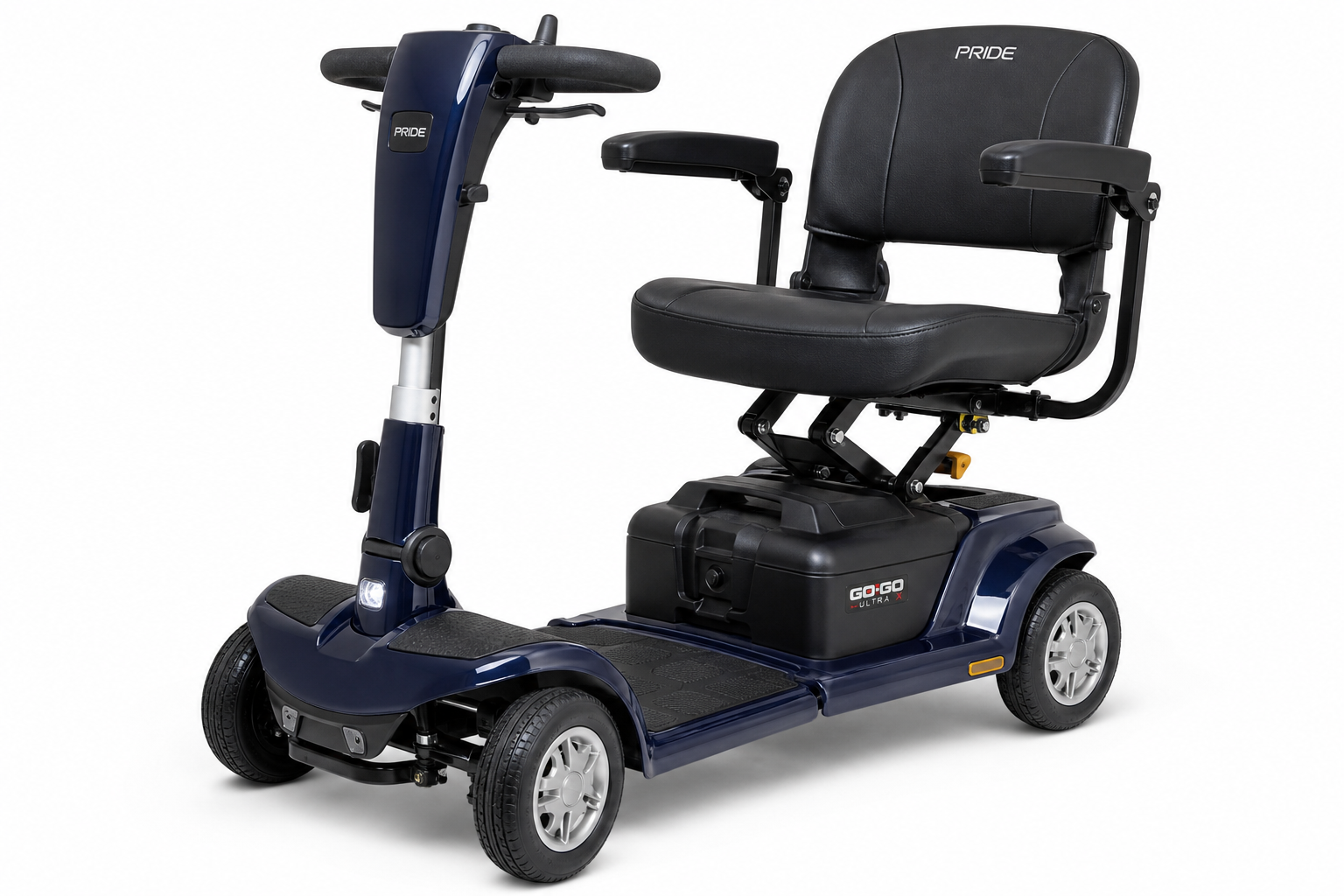
Pride Go-Go Folding Scooter
The Pride Go-Go folds with a single lever action into a compact package that fits in most car trunks. Weight capacity: 250 pounds. Range: approximately 8-12 miles. The folding mechanism is simple enough for most seniors to operate independently. The lithium battery is airline-approved and removable.
Pride is one of the most established names in mobility equipment. Their service network is extensive, which matters when you need repairs or replacement parts. The Go-Go has been in production for years with incremental improvements to battery life and folding mechanics. This isn’t cutting-edge technology, but it’s proven and reliable.
The folded dimensions (approximately 32 inches long, 16 inches wide, 22 inches tall) fit in the trunk of a mid-size sedan. Measure your trunk before buying. Some compact cars and sports cars won’t accommodate it even when folded. The scooter weighs about 60 pounds when folded as a complete unit. Lifting it into a trunk requires strength or a helper. Ramps and lift systems are available if you can’t manage the lift.

Pride Go-Go Folding Scooter
Best for simple one-lever folding and reliable brand support
Drive Medical Scout Compact Travel Scooter
The Drive Scout disassembles into 5 pieces (heaviest piece approximately 24 pounds). Weight capacity: 300 pounds. Range: approximately 9 miles. The disassembly design means lighter individual pieces for lifting, though the multi-piece handling takes more time than folding models. One of the most affordable travel scooter options.
Budget matters. The Scout offers excellent value compared to comparable folding models. The trade-off is time and effort in disassembly. You’ll spend 3-5 minutes taking it apart and putting it back together each time you load and unload it. If you’re traveling frequently, that time adds up. If you use the scooter occasionally, the savings may be worth the extra effort.
The 300-pound weight capacity makes this a better choice for heavier riders who still want portability. The frame is reinforced compared to lighter models, which adds durability but also adds weight to each piece. The five-piece design includes the tiller, front section, battery pack, rear section, and seat. Store them in a specific order in your trunk so you’re not digging through pieces to find the right one.

Drive Medical Scout
Best value option with 300-pound weight capacity and lighter individual pieces
EV Rider Transport AF+
The EV Rider Transport AF+ folds automatically with the press of a remote button (no manual folding required). This power-fold feature is a significant advantage for seniors with limited hand strength or dexterity. Weight capacity: 250 pounds. Range: approximately 12 miles. The premium pricing reflects the automatic folding convenience.
The remote control works from about 15 feet away. You can fold or unfold the scooter while standing next to your car trunk, which eliminates bending and reaching. The folding process takes about 10 seconds. The unfolding process takes about the same. This is the easiest scooter to manage if you travel frequently and value convenience.
The automatic folding mechanism is electronic. It can fail. If the remote battery dies or the folding motor malfunctions, you can still manually fold the scooter, but it requires more force than models designed for manual folding. Carry a spare remote battery. EV Rider’s customer service can walk you through manual folding procedures if the automatic system fails while you’re traveling.
The 12-mile range (real-world: 8-9 miles) is enough for most full-day outings with conservative use. You won’t drain the battery riding around a museum or shopping center. You might drain it at a large zoo or amusement park. Plan charging opportunities if you’re going to be out for more than 6-8 hours of intermittent use.

EV Rider Transport AF+
Best for those with limited hand strength who need automatic folding via remote control
Using a Travel Scooter for Exercise
A travel scooter doesn’t replace exercise. It extends the distance and duration of outings so you can combine scooter use with walking. This approach aligns with maintaining fitness while traveling.
Scooter-walk intervals: Ride the scooter to a destination, park it, and walk for 10-15 minutes. Ride to the next point of interest, walk again. This allows you to cover a museum, zoo, or shopping area that’s too large for walking alone.
Independent outings: The scooter enables solo trips to stores, parks, and community events that would otherwise require a companion or a car drop-off.
Energy conservation: Using the scooter for long distances preserves your energy for the walking, standing, and activities that matter most to you.
The scooter should support your mobility, not replace movement entirely. Walking remains important for maintaining leg strength, balance, and cardiovascular health. Use the scooter strategically. Walk when distances are manageable. Ride when walking would exhaust you or prevent you from participating in the activity you came for.
Some users worry that relying on a scooter will weaken their legs or reduce their walking ability. Research suggests that’s not typically the case. People who use mobility devices for appropriate situations often increase their overall activity level because they’re able to go more places and do more things. The scooter removes barriers. What you do with that expanded access determines whether your fitness improves or declines.
Consider working with a physical therapist to