Your hands are the tools you use for nearly everything. Opening jars, carrying groceries, gardening, playing with grandchildren, or simply buttoning a shirt all require adequate grip strength. As we age, hand strength naturally declines, making these everyday tasks increasingly difficult. But here’s what most people don’t realize: grip strength is more than just a convenience factor. Research has shown a direct correlation between grip strength and longevity, with weaker grips associated with higher mortality rates and increased risk of disability.
The encouraging news is that grip strength responds incredibly well to targeted exercises. You don’t need expensive equipment or a gym membership to see real improvements. With simple tools like grip strengtheners, therapy putty, and items you already have around the house, you can rebuild hand function and maintain your independence for years to come.
Why Grip Strength Matters More Than You Think
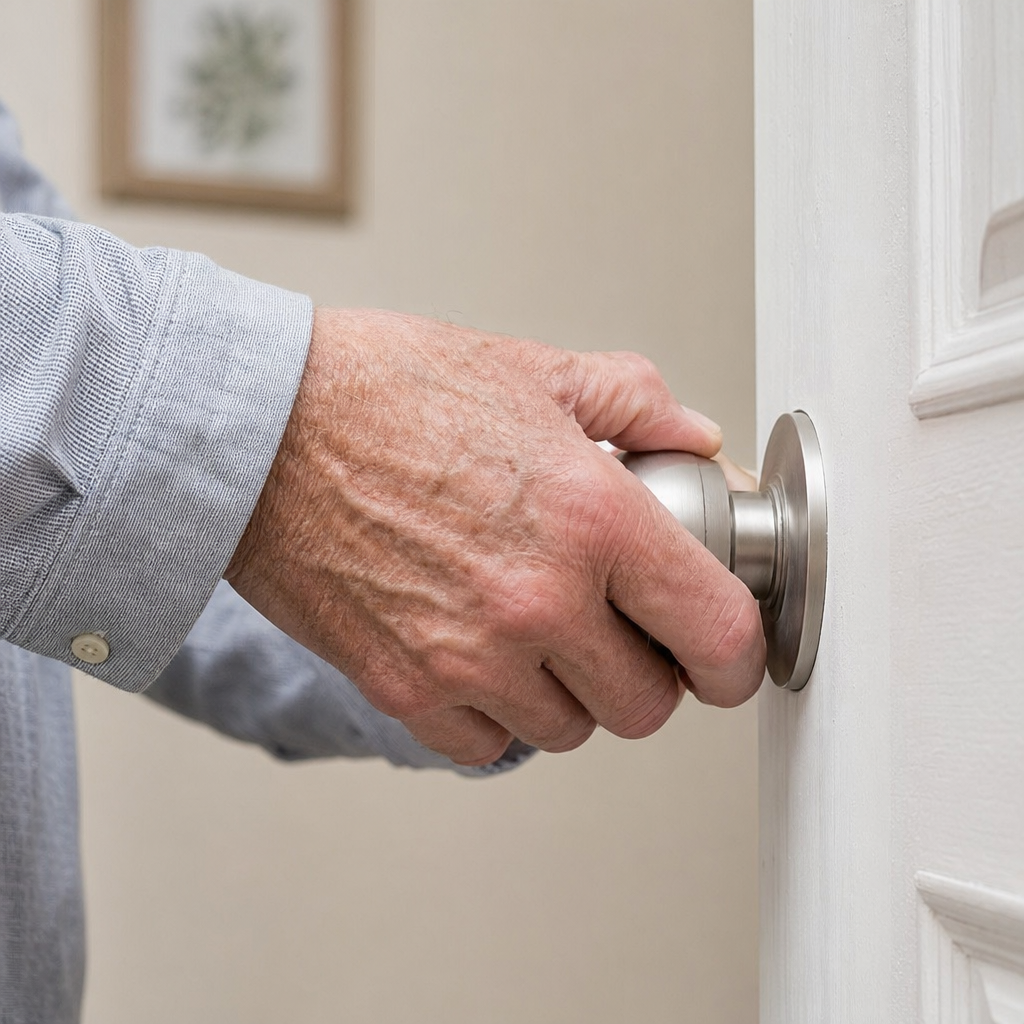
Multiple studies have established grip strength as a biomarker for overall health and vitality. A 2015 Lancet study following over 140,000 adults found that reduced grip strength was associated with increased risk of cardiovascular disease, respiratory disease, and all-cause mortality. Each 5-kilogram decrease in grip strength corresponded to a 16% increase in mortality risk.
Beyond the research, think about what weak grip strength actually means for your daily life. You might struggle to open medication bottles, lose your grip on a coffee mug, or find it difficult to use tools for home repairs. Gardening becomes more challenging. Carrying shopping bags feels exhausting. These limitations compound over time, often leading to reduced activity levels and further decline.
Building grip strength isn’t just about maintaining independence. It’s about quality of life. Stronger hands mean you can keep doing the things you enjoy without asking for help or avoiding activities altogether.
Essential Grip Strengthening Equipment
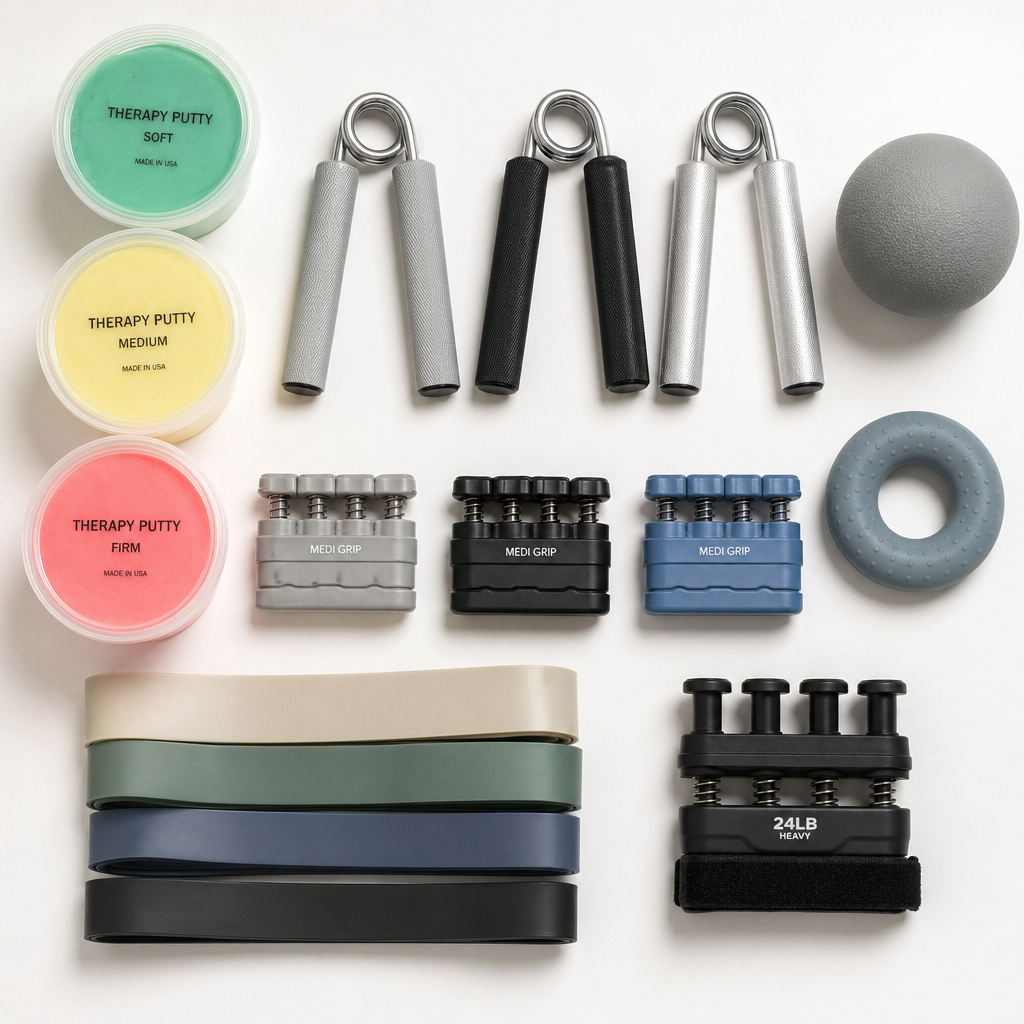
You have several excellent options for grip training equipment, each offering unique benefits. Starting with the right tools makes your exercises more effective and engaging.
Grip Strengtheners
Traditional spring-loaded grip strengtheners remain one of the most practical tools for hand training. Look for models with adjustable resistance levels so you can progress as you get stronger. The ability to train each finger individually is particularly valuable for addressing specific weaknesses.

Vive Grip Strengthener
Features adjustable resistance from 22 to 88 pounds, perfect for gradual progression as your strength improves
Some grip strengtheners feature individual finger buttons rather than a single squeeze mechanism. These allow you to work on finger independence and address imbalances between stronger and weaker digits.
Therapy Putty
Therapy putty offers a different type of resistance training. It comes in various resistance levels, typically color-coded from extra soft to extra firm. The malleable nature of putty allows for creative exercises that target different hand movements beyond simple squeezing.
Putty exercises improve not just strength but also dexterity and finger coordination. You can pinch it, roll it, spread it between your fingers, or press objects into it. This variety keeps your training interesting and works your hands from multiple angles.

Theraflex Therapy Putty Set
Includes multiple resistance levels in one set, allowing you to progress gradually and work different exercises at appropriate difficulty
Hand Exercise Balls
Stress balls and hand therapy balls provide another versatile training option. Different densities allow for progressive resistance, and their portability makes them perfect for exercising while watching TV or during idle moments throughout the day.
Effective Exercises Using Grip Strengtheners
Getting the most from your grip strengthener requires proper technique and structured progression. Start with exercises that match your current strength level, then gradually advance.
Basic Full-Hand Squeeze
Begin with the fundamental squeeze exercise. Hold the grip strengthener in one hand with your forearm supported on your thigh or a table. Squeeze slowly and steadily until the handles meet (or as far as you can comfortably manage), hold for 2-3 seconds, then release slowly. Complete 10-15 repetitions, rest for 60 seconds, then repeat for 2-3 sets.
Focus on controlled movement rather than speed. The eccentric (releasing) phase is just as important as the squeezing phase for building strength.
Individual Finger Training
For strengtheners with individual finger buttons, work each finger separately. This addresses common imbalances where your ring and pinky fingers are significantly weaker than your index and middle fingers. Press each button 8-10 times, moving from your index finger to your pinky, then repeat the sequence 2-3 times.
Your ring and pinky fingers will likely fatigue faster. This is normal. Consistent training will gradually reduce this disparity.
Isometric Holds
Once you’ve built basic strength, add isometric holds. Squeeze the grip strengthener to about 75% of your maximum effort and hold for 15-30 seconds. Rest for 30 seconds, then repeat 3-5 times. These sustained contractions build endurance alongside strength.
Therapy Putty Exercises for Complete Hand Training
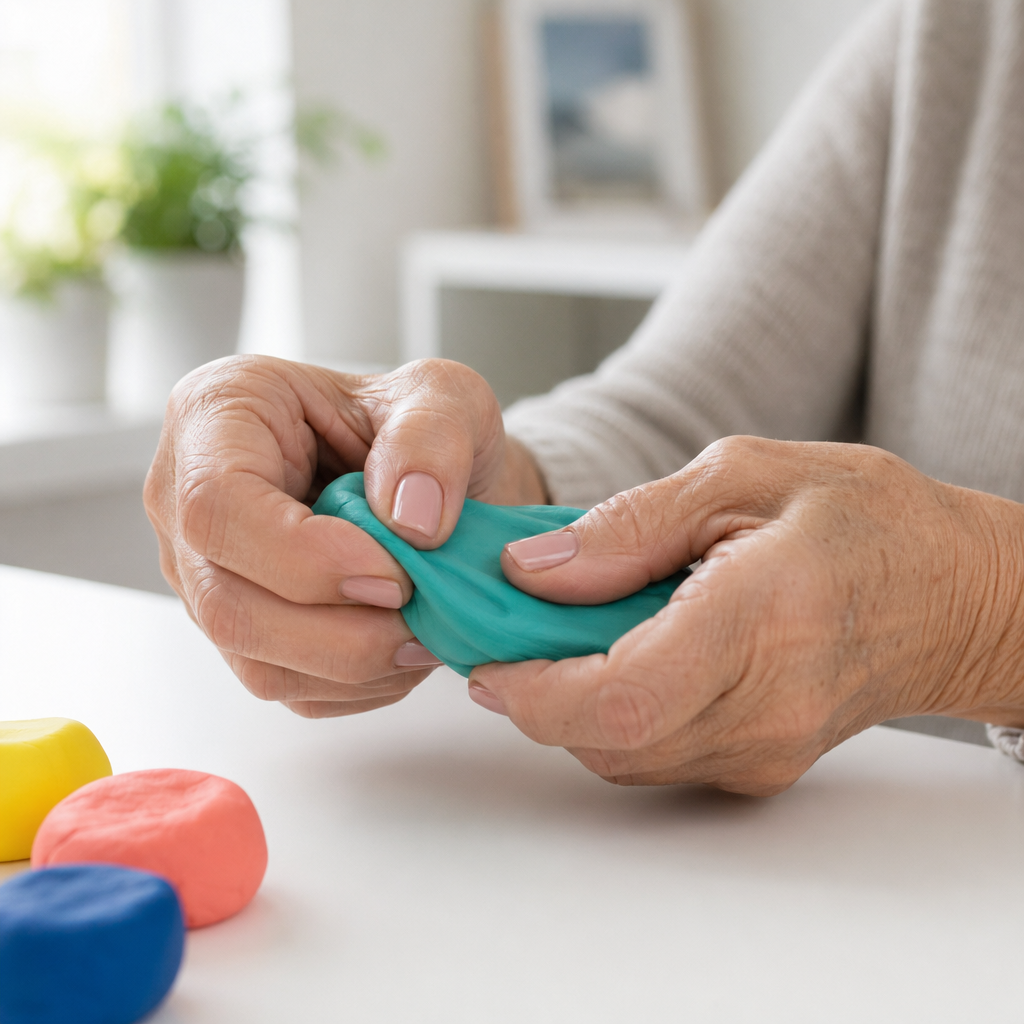
Therapy putty allows for more creative exercises that develop dexterity and coordination while building strength.
Full-Hand Squeeze and Spread
Form the putty into a ball and squeeze it firmly in your palm, working to compress it as much as possible. Then spread your fingers wide, stretching the putty between them. Repeat 15-20 times. This combination works both gripping and finger extension muscles.
Finger Pinches
Pinch small pieces of putty between your thumb and each finger individually. Start with your index finger and work to your pinky. Squeeze firmly for 3-5 seconds, then release. Complete 10 repetitions with each finger pairing. This exercise strengthens the precise grip you use for buttoning clothes or picking up small objects.
Putty Rolls
Roll the putty into a long snake shape using your palms on a table surface. Then use just your fingers to roll it back and forth. This works your finger flexors and improves coordination. Try making the putty snake longer and thinner as you get more skilled.
Finger Spreads
Wrap a flattened piece of putty around two adjacent fingers. Spread those fingers apart against the resistance. Hold for 5 seconds, then relax. Do 10 repetitions for each finger pair. This strengthens the often-neglected muscles that spread your fingers apart, which helps with tasks like spanning objects or playing musical instruments.
Household Item Exercises That Actually Work
You don’t always need specialized equipment. Common household items provide effective resistance training for your hands.
Towel Wringing
Wet a hand towel and wring it out as thoroughly as possible using both hands. Twist in both directions. Repeat 10-15 times. This exercise mimics real-world tasks and works your grip, wrist strength, and forearm muscles simultaneously.
Newspaper or Magazine Crumpling
Take a full sheet of newspaper and crumple it into the tightest ball possible using just one hand. Start with the paper flat on a table, then work it into your palm and compress it. This takes more grip strength than you’d expect. Complete 5-10 repetitions per hand.
Rice Bucket Training
Fill a bucket or large container with uncooked rice. Plunge your hand deep into the rice and practice opening and closing your fist, spreading your fingers wide, or making circular motions with your wrist. The rice provides variable resistance that changes based on how deeply your hand is buried. Train for 3-5 minutes per hand.
Clothespin Exercises
Clip wooden (not plastic) clothespins around the edge of a container. Remove them one at a time, working each finger against your thumb. Start with 10 clothespins and increase as this becomes easier. You can increase difficulty by using stiffer clothespins or by attaching small weights to them.
Daily Activities That Become Easier
Improved grip strength translates directly into easier daily living. You’ll notice changes in activities you probably take for granted right now.
Opening jar lids and bottle caps becomes effortless again. Carrying grocery bags, suitcases, or laundry baskets requires less struggle. Gardening tasks like pulling weeds, using pruning shears, or wielding a trowel won’t leave your hands aching. Kitchen work from chopping vegetables to whisking ingredients becomes less tiring.
Personal care activities improve too. Buttoning shirts, fastening jewelry clasps, and styling your hair all require adequate finger strength and dexterity. Hobbies like knitting, woodworking, painting, or playing musical instruments remain accessible when your hands stay strong.
Perhaps most importantly, you reduce your fall risk. Strong hands help you catch yourself if you stumble and maintain your grip on handrails or walking aids.
Progressive Training: From Beginner to Advanced
Structure your grip training with clear progression to ensure continuous improvement.
Beginner Phase (Weeks 1-4)
Start with the softest resistance putty or a light-tension grip strengthener. Focus on learning proper form and building the habit of daily practice. Train 3-4 times per week, performing 2 sets of each exercise. Don’t push to failure. Stop when you feel moderate fatigue.
At this stage, your goal is consistency, not intensity. Your hands need time to adapt to new demands.
Intermediate Phase (Weeks 5-12)
Increase to 3-4 sets per exercise and train 4-5 times per week. Move to medium-resistance putty or increase your grip strengthener tension by one level. Add isometric holds and more challenging household item exercises like the rice bucket training.
You should feel genuinely challenged during your sets but still maintain good form throughout. Recovery becomes more important at this stage. Don’t train the same exercises on consecutive days.
Advanced Phase (Week 13+)
Use firm or extra-firm putty and higher grip strengthener settings. Incorporate more complex exercises that combine grip strength with wrist and forearm work. Add weight to household item exercises. For example, crumple dampened newspaper for extra resistance or use larger, stiffer clothespins.
Advanced training might include tools like heavy-duty grip trainers designed for serious strength development. Focus on quality over quantity. Fewer sets with maximum effort often produce better results than high-volume, moderate-effort training.
Frequently Asked Questions
How long does it take to see improvement in grip strength?
Most people notice measurable improvements within 3-4 weeks of consistent training. You might feel increased endurance sooner, perhaps within 10-14 days. However, significant strength gains typically become apparent after 6-8 weeks of regular exercise. Remember that everyone progresses at different rates based on starting strength, age, and training consistency.
How often should I do grip strengthening exercises?
For optimal results, train your grip 4-5 times per week with at least one rest day between intense sessions. Your hands contain small muscles that recover relatively quickly, but they still need recovery time to rebuild stronger. You can do light exercises like stress ball squeezes daily, but save high-intensity training for every other day.
Can I do too much grip training and hurt my hands?
Yes, overtraining your grip can lead to tendonitis, joint pain, or repetitive strain injuries. Warning signs include persistent soreness lasting more than 48 hours, sharp pain during exercises, or numbness and tingling in your fingers. If you experience these symptoms, reduce training intensity and frequency. Consider consulting a physical therapist if pain persists beyond a week of rest.
Will grip exercises help with arthritis pain?
Grip strengthening can help manage arthritis symptoms by improving joint stability and maintaining range of motion. However, you need to approach training carefully. Use lower resistance and higher repetitions rather than maximum-effort squeezes. Therapy putty works particularly well for arthritic hands because it provides gentle, variable resistance. Always warm up your hands with gentle movements or warm water before exercising, and stop if you experience sharp pain. Consult your doctor before starting any new exercise program if you have severe arthritis.
Can I combine grip training with other exercises?
Absolutely. Grip strengthening complements other strength building programs and can enhance your overall functional fitness. Many people incorporate chair exercises or bone-building exercises alongside their grip work. You can even integrate forearm strengthening exercises to develop complete upper body functional strength.
This article contains affiliate links. We may earn a small commission at no extra cost to you.